My The Potteries Post has updated. ‘News you can use’ from the Potteries and nearby, with a focus on the creative industries, history and wildlife.

My The Potteries Post has updated. ‘News you can use’ from the Potteries and nearby, with a focus on the creative industries, history and wildlife.
“New app to bring Legend of Alderley Edge to life”…
Launched on 21st December 2022, the Invisible Worlds app will enhance the visitor experience at Alderley Edge. Through their smartphones or tablets, visitors and users will be able to explore Alderley Edge with Augmented Reality wizards, knights, and white horses appearing throughout the landscape, as well as specially commissioned soundscapes providing an atmospheric background.
I think I’d just rather hear the slosh of wellies and the howling of warg-winds. But for kids and those who can’t go anywhere without a mobile phone, it may be just what the wizard ordered.
This looks fun. A seemingly-new Stafford Cat Extravagaza at the County Showground on the edge of Stafford, 18th & 19th March 2023.

If you prefer an at-home kittee experience, Stoke and Newcastle Cats Protection will be only too glad to introduce you to your very own permanent Tibbles or Tabitha.
Currently on eBay, and possibly of interest to some locally. The magnetic tape soundtrack for a local comedy movie called “Jael’s Nail” (1950). Evidently it was a locally-made 16mm comedy of some quality…
The Daily Mail Challenge Trophy, for the most outstanding film entered, went to Jael’s Nail, a black and white comedy by the Stoke-on-Trent Amateur Cine Society.
It also won The Wallace Heaton Cup for Best Photography, 1950. Of unknown ‘local colour’ and length. I’m not sure if the visual part of the movie survives, and can’t immediately find details for it online.
Update: Movie Maker reel listing from 1977: “A comedy about a man who claims to have the original nail with which Jael killed Sisera as told in the Old Testament”. So possibly Biblical and not of much local Stoke interest, re: local scenes and settings. Although I guess it might just have a contemporary 1950 Stoke setting? I’m imagining a sort of strange Stokie hybrid of Railway Cuttings, East Cheam, and Waiting for Godot, with a dash of The Life of Brian.
It’s good to hear that Uttoxeter’s three-day Acoustic Festival of Britain will return in early June 2023 after a long hiatus, and it still seems to be set for Uttoxeter Racecourse in the Staffordshire Moorlands. Booking now. Probably also a good time to pitch them your music workshops, storytelling sessions, and the like.

A small update for my The Potteries Post. That’s it for 2022. I’ll be back with more local ‘news you can use’ in early 2023.

A sampling of recent posts at the Post, which has replaced my Facebook groups ‘Creative Stoke’ and ‘Wild Stoke’…
Opportunity: Staffs University has a day and evening Apprenticeship Fair on 4th Feb 2023.
Opportunity: Deutsche Bank Awards for Creative Entrepreneurs are now open for 2023.
Work: Staffs University (Stoke campus) requires a Senior Lecturer in Immersive Technology.
Good news: Staffs Wildlife Trust is taking on eleven open-space sites in the Moorlands.
Work: Newcastle-under-Lyme’s Appetite requires a part-time Community Co-ordinator.
Funding: Small businesses can bag £5,000 government vouchers for new software.
Work: The new ‘Great Northern Bog’ seeks part-time artists, £20-£25k commissions.
Good News: Peak District National Park bags £1 million for restoration of ‘bare peat’ bog areas.
New book: Staffs Uni Pro Vice-Chancellor co-authors an important new book on Visual Pollution.
Funding: Community Project Funding is now available from Music for All.
Opportunity: Connects Network event – hear from Alton’s Rural Brewing Co.
Opportunity / good news: Staffordshire will support new entrants into farming.
Opportunity: Could your business use a Keele graduate, to work on a digital project?
Training: Cheshire Wildlife Trust – Beaver Ecology and Reintroduction Training Day.
Work: The Forest of Mercia requires a Community Woodlands Officer.
Report: The UK Local Government Association’s new ‘Cornerstones of Culture’.
Work: Keele University requires a video producer, to boost student recruitment.
Work: Newcastle-under-Lyme’s CEDARS Short Stay School requires a Teacher of Art.
Good News: Newcastle-under-Lyme to plant a new “Lyme Forest” of 850 lime trees.
Work: Stoke Town High Street Heritage Action Zone seeks an artist – £8k commission.
Work: A full-time Art Teacher is required at Stoke’s Peak Education.
Work: Buxton Museum & Art Gallery seeks day-rate workshop artists for 2023.
Work: Stoke City Council is now advertising its new Tree Officer vacancy externally.
Report: Can a R&D tax policy help support the creative industries? Staffs Uni has the answers.
Work: The Buxton Opera House requires a full-time Head of Marketing & Comms.
Work: Artists invited to submit proposals for “What Does Staffordshire Mean to You?” workshops.
Work: A part-time arts Project Officer is required for ‘Outside’ in the Moorlands.
Work: Staffs Uni’s Media & Communications Hub requires a Technical Assistant.
Event: Stoke and North Staffordshire CEP Partnership Networking Meeting.
Opportunity: Staffs Uni has a Staffs Startup Community Launch evening event.
Opportunity: The Stoke Creates Exchange Forum has the December event date.
Work: Stoke’s 6th Form College needs a Teacher of Creative Arts – also has news of new T-level Ceramics.
Funding: Universal Music UK Sound Foundation grants, for teachers and instruments.
Talk: North Staffordshire RSPB, “in-depth talk” on Peak raptors in January 2023.
Good news: Stoke-on-Trent has a new Grade II Listed Building.
Work: Nottingham Uni has a paid PhD in Creative Arts Youth Work.
Work: Newcastle-under-Lyme’s Brampton requires a part-time Education Officer.
Opportunities: Dance with Frontline.
Work: Full-time Assistant Curator at World of Wedgwood in Barlaston.
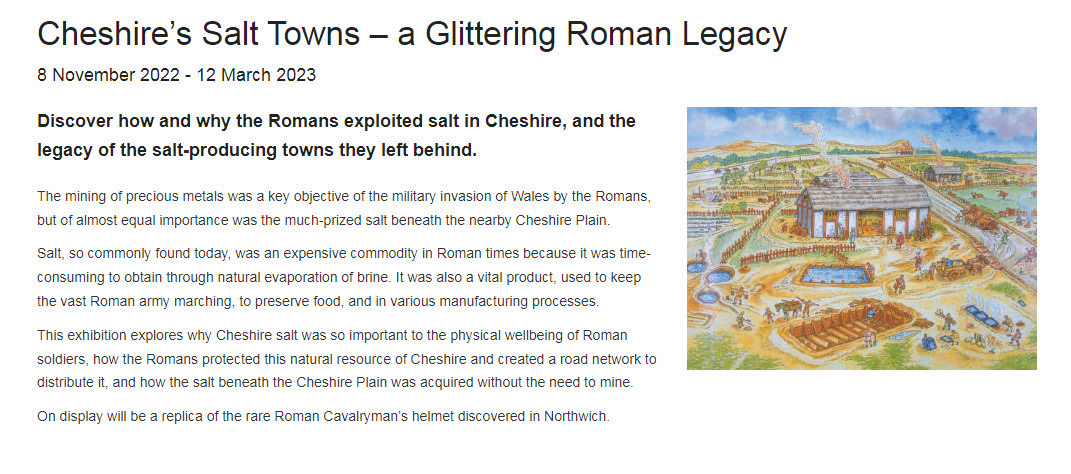
At nearby Northwich until March 2023, “Cheshire’s Salt Towns – a Glittering Roman Legacy”. A museum exhibition that tells the story of the salt-pits of the Cheshire Plain in the time of the Roman Empire.
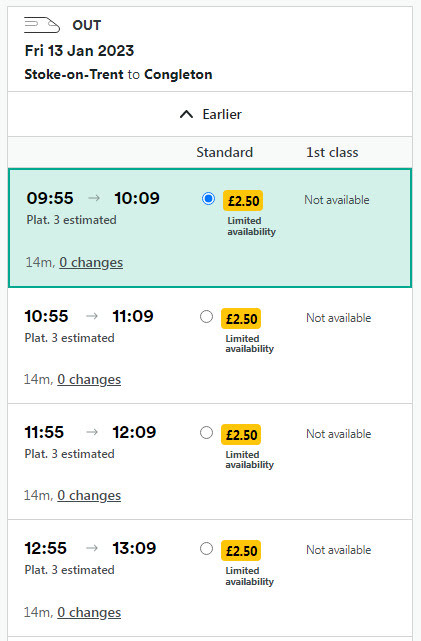
Platform 2c has a handy new 8-mile circular tour of Congleton and Mow Cop on foot, recently undertaken and photographed (summer 2022). The walk starts at Congleton Station, which is reachable from Stoke-on-Trent by train. I think I looked at it some years ago, and had thought that it wasn’t accessible via a direct service. Or perhaps it was then costly to cross the border from the West Midlands into the North West. But there’s a quick direct hourly service now, and you can apparently get up there and back for a fiver if you book ahead. Brilliant.
If you want to also visit Congleton itself, note that the station is a good mile and a half from the start of the core of the town centre’s main shopping areas. I can’t immediately see any fabulous off-road direct walking-route from the station into the town centre. The Local Cycling and Walking Infrastructure Plan: Congleton (2021) suggests that those arriving by rail trudge alongside a main road, albeit on a mostly segregated path, while dodging cyclists…
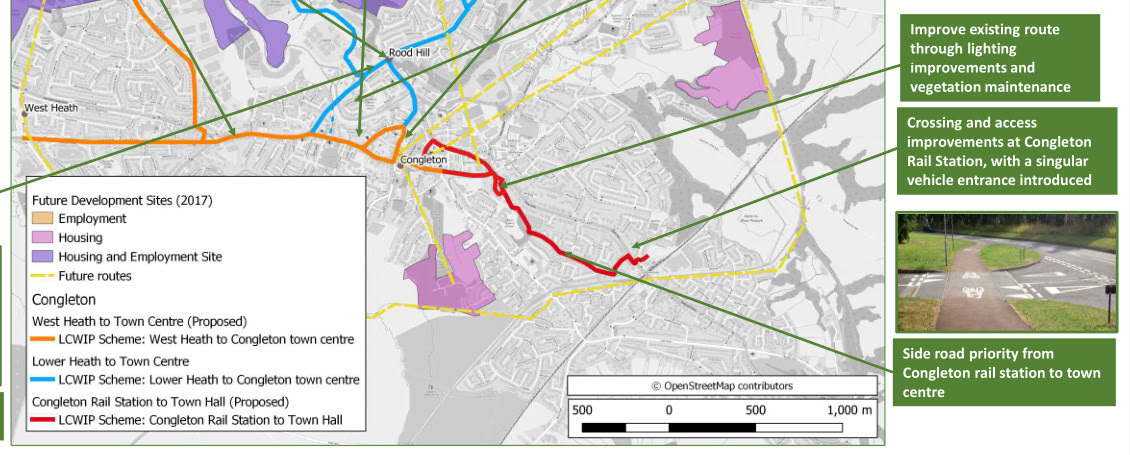
The red line is the current station-centre walk.
Not ideal. Though it looks like you might instead be able to go west along the canal towpath, and then on rural footpaths to reach Howey Lane and Moody Street and thus into the town centre. That would be a longer two-and-a-half mile dog’s-leg, though, and with an uncertain level of muddiness. This is just a theoretical suggestion to explore, so don’t blame me if it lands you in a quagmire lane heavily trafficked by tractors and scrambler-bikes from the local council estate.
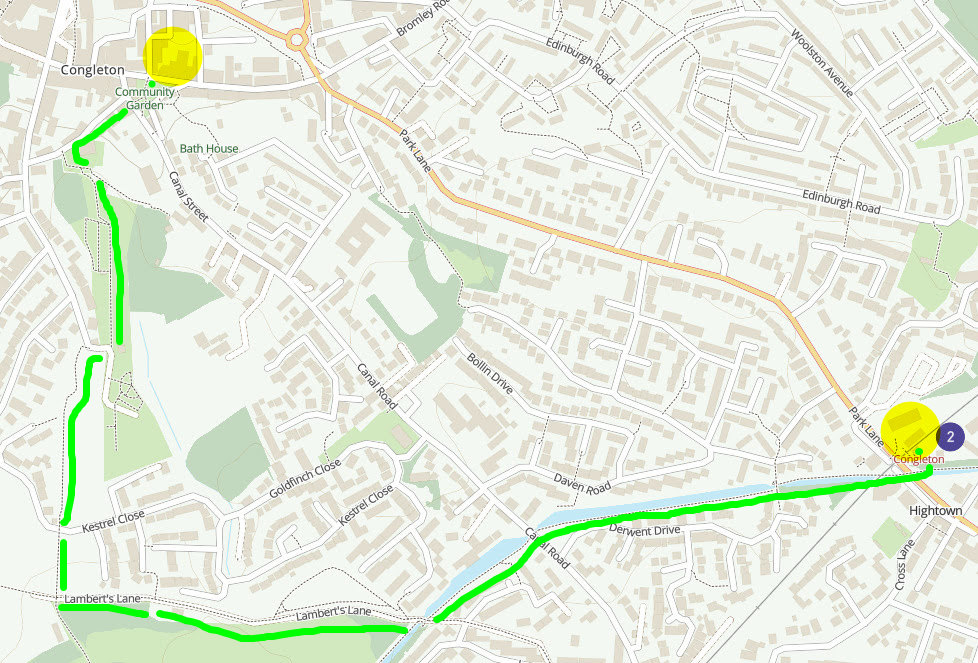
You might also be able to thread your way through to the top of the town centre, as a walker, via the Station – then a short stretch of Canal – then the road seen above Bollin Drive? Here seen as another hypothetical route marked in blue.
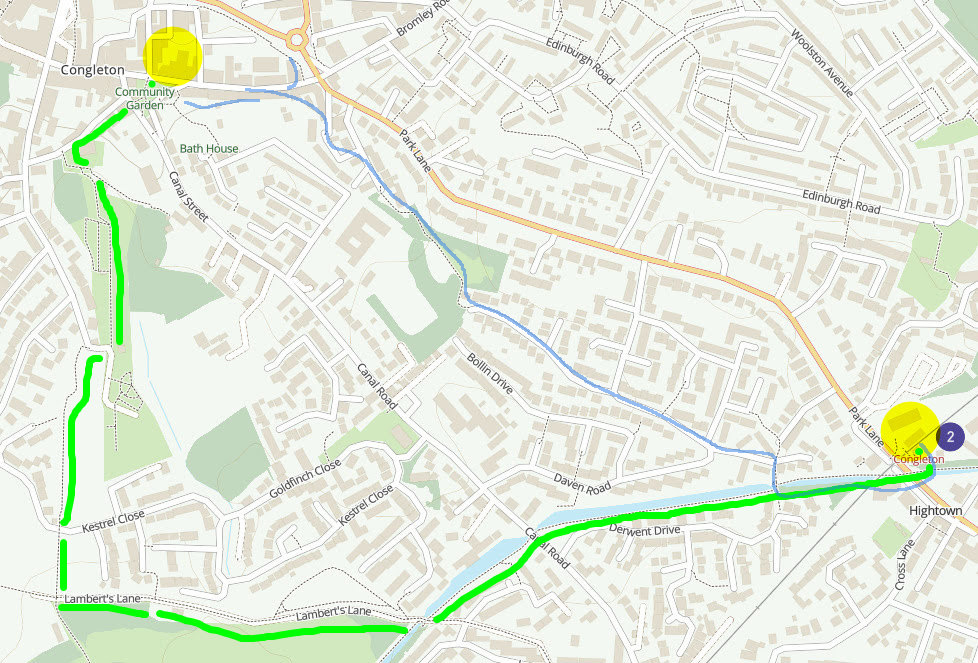
Canal Street / Canal Road looks like a nice short-cut here, but isn’t — it is noted on the Local Cycling and Walking Infrastructure Plan as a busy road with ‘heavy traffic’.
The unspecified “future routes” marked on the council map suggest things may improve in future.
The Potteries Post has updated.
Local lad Arnold Bennett’s movie Piccadilly (1929), now on YouTube. I missed hearing about a recent big-screen screening in Stoke-on-Trent. If you did too, you can still catch it on YouTube. At least, you can until the copyright cops come for it. Only ‘1927 and before’ material is technically in the public domain in the U.S., as of 1st January 2023.

Good news locally. Newcastle-under-Lyme council is set to plant 850 lime trees by 2023, on their now-derelict council golf course at Keele. The planting is being pitched as a key part of a ‘new Lyme’ forest, named after the ancient forest now long-gone, and other sites are also being planted (but not with limes). Similar large planting schemes are underway in Stoke-on-Trent, and there is also a large private planting of native woodland in Eccleshall, and along the HS2 route.
The Lyme is one of a half-dozen local ancient forests discussed in detail in the new “The Forests and Elite Residences of the Earls of Chester in Cheshire, c. 1070–1237” (The Des Seal Memorial Lecture), in Anglo-Norman Studies XLIII: Proceedings of the Battle Conference 2020. Sadly this is paywalled at JSTOR but it is of obvious importance for any tracing of the Gawain journey from North Wales to the Staffordshire Moorlands, in Sir Gawain and the Green Knight.
I can get enough of the Anglo-Norman Studies article to summarise a bit, re: the Lyme. It suggests Lyme does not actually mean “lime trees”, but most likely comes from the Latin limen, meaning ‘threshold (of a house)’ or ‘boundary line’. The Lyme was a dense belt of protective forest running along the Cheshire / north Staffordshire / Shropshire border, some 50 miles long and augmented by impassable Cheshire mere-bogs and high escarpments that rise as the Cheshire Plain meets Staffordshire. Difficult to trace today, but the monk Lucian of Chester (monk of St. Werburgh) mentioned it (possibly c. 1195) as “(Cestra provincia) Lime nemoris (limite lateraliter clausa)”. Later others talk of it, including a Shrewsbury charter which knew it as “nemus quod Lima dicitur”. Through the dark wood of the Lyme passed all the passable routes from Cheshire into north Staffordshire. The forest probably linked strategically with other protective forests that lay between the Dee and the Peak, which the article also discusses.
I now speculate a little. If it dates from pre-Norman times must be unknown, unless pollen archaeology might one day shed some light on that. Lucian’s text is available in a 1912 scholarly reprint and he is said by the Latin-reading editor to be keen to give credit to his lord for creating the Lyme. Yet such a landscape-work is one of many generations, and his Lord may only have put things in order and filled in gaps of some earlier Mercian version of the Lyme. That would be my guess, but just a guess.
What we can be sure of is that from the Lyme the local places of Audlem and Burslem partly take their names. Though this does not mean that the Lyme once flowed directly around the foot of the hill and churchyard of Burslem. It would be more likely that it was way over toward Red Street and Bignall Hill, thick and thorny on the slopes and banks running down to the Cheshire Plain. Though thinning woodland may have stretched back from there, perhaps as far as the western lip of the Fowlea Valley opposite Burslem, which would make Bradwell Woods a relic. Thus Burslem would have lain some way SE of the Lyme, but near enough to take its placename (‘Burgweard’s Lyme’) from it. What Lyme might have meant to Burgweard, if it ever had a tree-ish meaning, we can’t know. But one placename study suggests ‘Elm’ as a possible meaning for ‘Lyme’. In which case the Lyme forest would have been rather tall, since elms are very big trees.
The obvious enemy that the Lyme might be defending the English heartlands against were raiding incursions from North Wales and Ireland. In total it probably formed a wide 55-mile arc from Market Drayton in Shropshire through north Staffordshire and south-east Cheshire to near Ashton-under-Lyme in Lancashire. So far as I know no-one has ever tried to map its likely spread, with reference to relic woodland and suitable terrain. An interesting ‘retirement project’ for someone, perhaps.
I’m pleased to learn of another writer on the topography and people of the Potteries, via stumbling on a new book with poems about Stoke-on-Trent. The poet Jeffrey Wainwright had a 2020 collection from noted poetry publisher Carcanet, As Best We Can. Wainwright was born and schooled in Stoke (specifically Sandford Hill, Longton) in the 1950s. Then went to university in Leeds and took his first job on the Welsh coast. Local poems, of Etruria and Longton, in his new book include…
* “”Crockery”, a sequence of six poems […] on the products of Josiah Wedgwood’s factories draws in history, politics, class, art and aspiration.” The lustrous products of the factory are contrasted with the imagined lives of Etruria’s workers.
* “”Who Was St. Chad?” evokes the Anglican church my mother attended as a girl. She was part of a strong religious culture, mainly Anglican and Methodist, that existed in Stoke-on-Trent in the first half of the 20th century and has all but disappeared in the course of my generation and since.”
* “”Dreams of Lennox Road” [memories of] the street where I spent the first 18 years of my life.” The top end of Longton, shading into Florence / Normacot.
* ““The Prims” [on] the austere and charitable Primitive Methodists, who emerged in the early 19th century, often drawn from the poorest workers.” This originated on Mow Cop and… “had strong popular appeal in the Potteries up to the mid-twentieth century when Wainwright was a boy”.
The last quote is from the Times Literary Supplement review, which wrongly guesses “The Prims” is set the “Victorian Black Country”. The poem’s use of the word “potbanks” in describing the topography places it rather in North Staffordshire. There are big bottle-ovens (for glass, rather the clay) in Wordsley, in south Staffordshire at the far semi-rural south of the Black Country. But they are not there called “potbanks”.
Possibly there are other Stoke poems in his earlier collections. Would there be enough for a dedicated book of the Stoke poems, one wonders? Perhaps illustrated with new pen drawings?