Tolkien Gleanings #122

Tolkien Gleanings #122.

* A new thirty minute Brandon Vogt and Holly Ordway Interview for Word on Fire. Not the same as the previous Word on Fire podcast interview about Ordway’s new Tolkien’s Faith: A Spiritual Biography book, which was a long pre-publication interview with Michael Ward.

* Wheaton College has two events celebrating the launch of Tolkien’s Faith: A Spiritual Biography, on 25th-26th September 2023.

* A Spanish translation of the book Tolkien’s Faith will be published by Loyola in spring 2024.

* Holly Ordway has posted a new report on the recent Tolkien’s Words and Worlds event at Oxford University…

Simon Horobin’s excellent paper “‘Never Trust a Philologist’: C.S. Lewis, J.R.R. Tolkien and the Place of Philology in English Studies” was illuminating of the academic context that Tolkien found himself in when he arrived at Pembroke as the Rawlinson and Bosworth Professor of Anglo-Saxon.

* In northern England, the Barnsley Museum now has an official page for The Magic of Middle Earth touring exhibition. On this stop the exhibition will be free, and will run from… “30th September 2023 – 6th April 2024”.

* And finally, new in the classical antiquity journal Antigone, “Middle-earth Songs: 50 Years After Tolkien”.

Tolkien Gleanings #121

Tolkien Gleanings #121.

* A new talk in London this weekend, Holly Ordway on “Beauty and Sorrow: Tolkien’s journey of faith”. At St. Mary’s Church, Sunday 10th September 2023. Her publisher Word on Fire has also just released a new and highly-polished official one minute trailer for Ordway’s acclaimed new book, Tolkien’s Faith: A Spiritual Biography.

* In October, Ordway is in Houston with a talk on “Tolkien’s Faith and the Foundations of Middle Earth”, 2nd October 2023. Free and booking now.

* The first review I’ve seen of the recent book Tolkien in the Twenty-First Century: What Middle-earth means to us today (2023). The reviewer finds it “a long wearying slog” and “a read that is about as compelling as a phone book”. Not to be confused with the academic collection Tolkien in the 21st Century: Reading, Reception, and Reinterpretation (2022).

* A new long and very informed article on “J.R.R. Tolkien on Philosophical Anarchism”.

* News of a new book, Tolkien on Chaucer, 1913-1959. From Oxford University Press and apparently containing everything Tolkien ever published or said about Chaucer. Including his translation of the Reeve’s Tale, which is said to be as yet unpublished. The OUP issued a contract for the book in 2021, and the French Tolkendil forum suggests publication toward the end of April 2024. Amazon UK is pre-ordering, but currently has no shipping date.

* And finally… this week’s TLS comments, on the week’s literary news and very much in passing, that…

“[it is] fifty years since Anthony Burgess declared in the TLS [in 1973] that “The Hesse cult continues, though the Tolkien one seems to be at an end”, getting it exactly the wrong way round.”

Thus back-handedly implying that the TLS even now thinks that the attention paid to Tolkien is due to a ‘cult’. Judging by their lack of coverage, Tolkien is not high on their book-reviewer Wish List. Also, pushing the idea of a “cult” aligns with a small group of TV-oriented fans who try to label and dismiss the majority of Tolkien fans as “an intolerant cult”.

The Hesse referred to above was the now little-read German writer Herman Hesse, not to be confused with Hess the captured Nazi leader.

Tolkien Gleanings #120

Tolkien Gleanings #120.

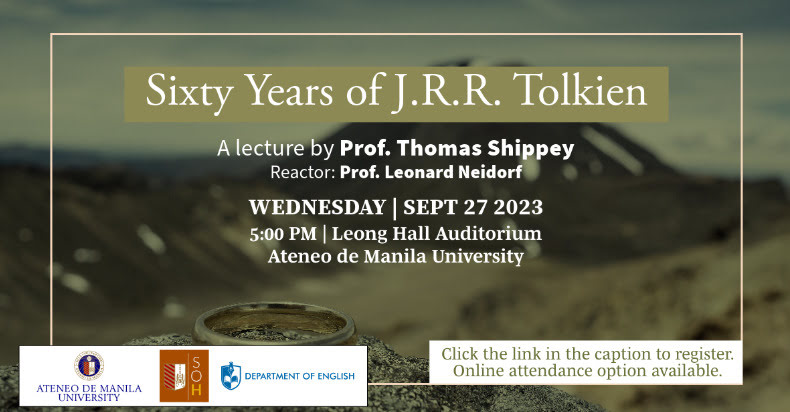
* Ateneo de Manila University’s Events at the School of Humanities this September Web page includes news of a free lecture by the venerable Tom Shippey, titled “Sixty Years of J.R.R. Tolkien”. Set for 27th September 2023. “Online attendance option available”, and booking now. At the Department of English, so I assume it will be given in English.

* There’s to be a major Tolkien exhibition at the Galleria Nazionale d’Arte Moderna e Contemporanea di Roma (GNAM), Italy’s national contemporary arts museum. This was announced verbally at a festival in early July 2023, by the GNAM director. Update: Thanks to Sebastiano Tassinari for getting the exhibition’s title, “J.R.R. Tolkien 1973-2023, Man – Professor – Author” and the dates. It will run from 14th November 2023 to January 2024. It will be a mid-sized show of 150 items.

* CCS Universe notes “Astronomer Keynotes at International Conference Celebrating Middle-earth”

“CCSU astronomer Dr. Kristine Larsen was one of two keynote speakers at the 50th Oxonmoot conference in Oxford last weekend […]. Her talk, focusing on letters Tolkien wrote to his children for over 20 years in the guise of Father Christmas, included references to eclipses, comets, constellations, and most especially auroras. In particular, she demonstrated how Tolkien’s artistic renditions of aurora in specific years echoed displays witnessed by astronomers in his native England.”

I didn’t see this on the official list of presentations, which I looked at in an earlier Tolkien Gleanings. Perhaps because it was a keynote talk, listed apart from the regular presentations?

* In Mexico, the event Tolkien: La fantasia del libro al mundo digital in September 2023.

* From Bangor University, via The Conversation, How J.R.R. Tolkien was inspired by medieval poems of northern bravery. A short article under Creative Commons Attribution.

“Fifty years on from Tokien’s death, that spirit of northern bravery endures as an alluring concept. What makes Tolkien’s fantastical world so appealing is the recurrent suggestion that the courage manifested to defeat the big monsters in The Hobbit and The Lord of the Rings is the very same courage that can be found in hopeless situations of a more ordinary sort.”

* Charles Williams expert Sorina Higgins this week reports several projects underway

  – An article on Tolkien’s only play, The Homecoming of Beorhtnoth Beorhthelm’s Son.
  – A book [on Williams], An Introduction to The Oddest Inkling.
  – My life’s work! The long-anticipated Annotated Arthuriad of Charles Williams.

* And finally, France.info visits the Lamb & Flag pub in Oxford, recently re-opened as a community-run venture and reportedly doing a roaring trade.

Tolkien Gleanings #119

Tolkien Gleanings #119.

* The Knowing and Understanding C.S. Lewis podcast interviews Holly Ordway on her new book Tolkien’s Faith. It’s a two-part interview, and only the first 25 minutes is currently available.

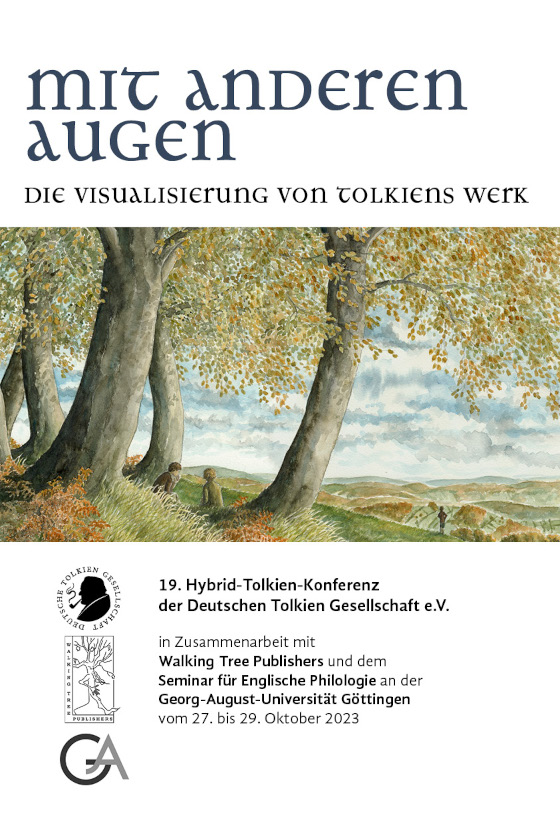
* A pleasing poster for the forthcoming German conference on visualising Tolkien’s work, to be held in Gottingen in Germany, 27th to 29th October 2023. No programme listing, as yet.

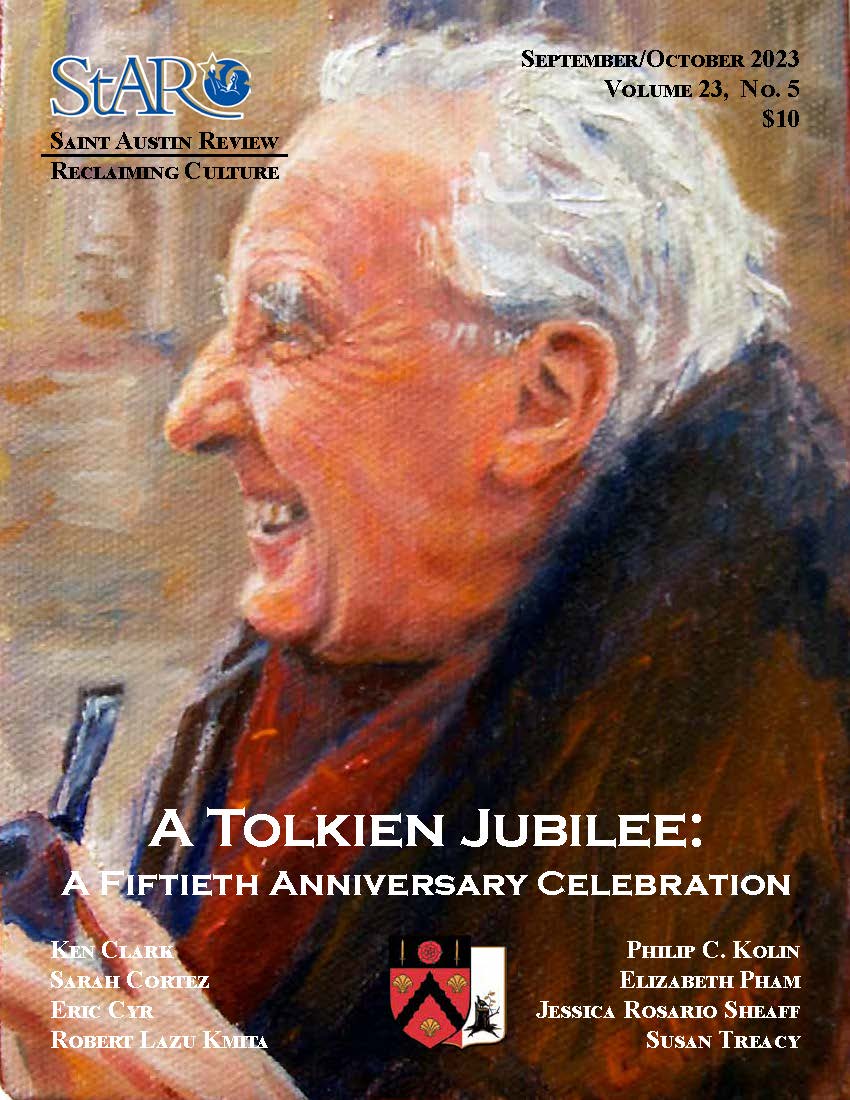
* A less pleasing cover for the September/October issue of the St. Austin Review, themed as ‘A Tolkien Jubilee’. Looks vaguely like an orange and elderly Ken Dodd, to me. It’s the teeth, I guess.

  – “On Fairy-Stories and Fantasy: 50 Years After the Father’s Farewell”.

  – “The Liturgy of the Mass Seen Through Tolkien’s Lens of Fairy-Story”.

  – “Good Love, Bad Love: From Tolkien to Denis de Rougemont and Back Again”.

  – A review of The Nature of Middle-Earth.

* Bitter Winter details a recently auctioned and (apparently) previously unknown 1969 letter from Tolkien.

* In The Critic this week, “Tolkien, 50 Years On: the true scale of his legacy is gradually becoming apparent”. One of the better and more thoughtful articles in the current wave of ‘Tolkien for the clueless’ articles appearing in newspapers and magazines.

* And finally, the long-running British Fairies blog this weekend surveys “Popular Views of Faeries in Victorian and Edwardian Times”, as seen on popular cards of the period. This post’s focus necessarily gives a one-sided view. But recall that a fairy-play, The Blue Bird, could win Maetlinck the 1911 Nobel Prize for Literature. And that Kipling, author of Puck of Pook’s Hill (1906), had won the Nobel Prize in 1907. Such was the context in which Tolkien began writing.

Tolkien Gleanings #118

Tolkien Gleanings #118.

* “A Tale of Two Essays: The Inklings on the Alliterative Meter” in Notes and Queries (August 2023). No download, but a useful long abstract…

“… why did Tolkien claim precedence [for the metrical appendix in ‘On Translating Beowulf’] despite knowing, strictly speaking, that such precedence was false? My solution to this minor mystery is that Tolkien simply got ‘scooped’ by his friend [C.S. Lewis]. That is, Lewis unintentionally pre-empted Tolkien’s essay, yet his own essay seems to have directly spurred Tolkien, a perennial procrastinator, into completing a metrical work fifteen years in the planning.

* A Spanish cultural journal has a new Tolkien special, complete with slightly scary cover-art. Seems to be a fairly standard mix, but the article on a “biographical link” may interest some…

a profile of the author; a discussion of LoTR; a look at “twelve clues that illuminate some enigmas” in his work; discussion of the film adaptations; and “Andreu Navarra explains his biographical link with Tolkien”.

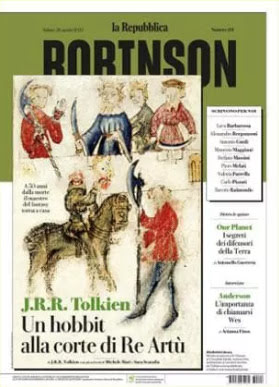
* In Italy, the La Repubblica newspaper’s cultural magazine also celebrates Tolkien. Specifically the new Italian Sir Gawain & The Green Knight

* Oxonmoot 2023 is now underway in Oxford. The final schedule includes, among others…

  – “A Tolkien Onomasticon: the need, and a possible approach”. [The need for a full and scholarly name-list]

  – “Making The Invisible Visible: presences of evil and disappearing characters in illustrations for J.R.R. Tolkien”. [How do we illustrate the “hidden things” in Tolkien or his descriptions such as “Not a nasty, dirty, wet hole”?]

  – “Dyeing in Middle-earth”. [“Explores the links between Tolkien’s use of distinctive colours to define the races of Middle-earth, and the flora he names” in LoTR].

  – “A Different Gaze: hidden features in Tolkien’s drawings” [We can now see “some minute features which might otherwise have remained unnoticed” [and the talk will itemise] “the hidden features in Tolkien’s drawings which have been identified so far.”]

  – “Reading Tolkien in the 1950s” [This was “a very different experience from the context of present-day publications and adaptations. It is worthwhile examining the development of our knowledge of the Legendarium in this light.”]

  – “Creative ‘Borrowings’: an overview of Heimskringla’s influence on J.R.R. Tolkien and C.S. Lewis” [On “the two authors’ different responses to the classic Norse text Heimskringla, written by the twelfth-century scholar Snorri Snurluson.”]

  – “Water-Lillies Bringing: a horrific monster hidden in plain sight” [Bombadil as a reflection of “a terrible monster posing as a kind and innocent figure”? Sounds like it’s about the real-world River-man folk-lore, and perhaps and/or inland pool nixies. Both of which I’ve detailed in my recent book.]

  – “The Animals That Are Not There (and the trees that are)” [Why “among all of Tolkien’s descriptions of nature, are there almost no descriptions of animals?”]

The latter talk also asks… “How come Bilbo doesn’t have a dog that goes on walks with him, and why aren’t there any cats in the Prancing Pony Inn”? Because dogs appear to be big nasty smelly hairy farmyard things with fangs, not the modern cute breeds. Having a dog would also likely alarm dwarves and elves, scare off all local birds and wildlife (as they do), and would further mean the ring could not be used — the presence of the dog would give Bilbo away. Also because he probably has nasty memories of the white wolves invading the Shire in the Fell Winter of 2911 (he was there, though a young hobbit at age 21). As for cats, with all the ruckus going on inside the Prancing Pony, the stables packed with smelly (and then escaped en masse) horses, and a Black Rider prowling about outside, any cats would have been sensibly keeping well away from the frontage and stables of the Prancing Pony while the hobbits were there. Perhaps the next morning they were all round the back, sniffing for the kitchen scraps? Actually, we know Bob and thus the Pony has at least one cat, since the text tells us so: “Bob ought to learn his cat the fiddle, and then we’d have a dance”.

* A new undergradate dissertation from Ohio, “Into the Mythopoeia of J.R.R. Tolkien and C.S. Lewis: Memories of War through Fantasy Literature” (2023). The author has done primary source work in the Bodleian. The download is embargoed, but the page has a long abstract.

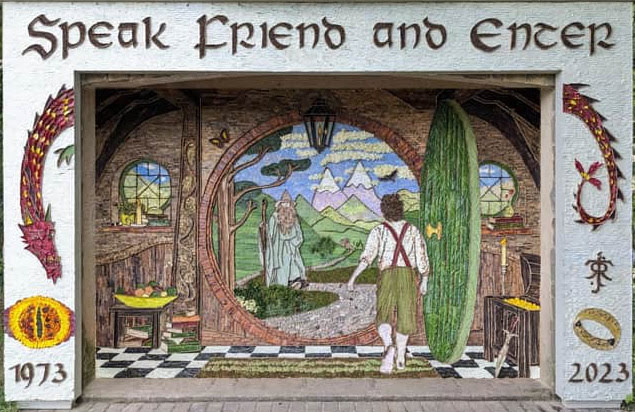
* And finally, the Derbyshire well-dressing tradition has been extended to Tolkien. Holymoorside has three new well-dressing panels featuring Tolkien scenes, each made with around 40 varieties of flowers, plus leaves and seeds collected from the locality. Well-dressing is a folk custom practiced in the Derbyshire Peak district and parts of North Staffordshire, involving the painstaking creation of large decorated panel-pictures made with flower-petals and seeds, which are then placed around local springs and water-wells.

Tolkien Gleanings #117

Tolkien Gleanings #117.

* Currently up for auction, with good pictures, a 1955 J.R.R. Tolkien autograph letter. On completing LoTR, Tolkien perhaps rather jokingly reveals he was being “bullied” by a fellow academic into not having a happy ending, but then asks with seeming anxiousness… “Would you call it a happy ending? Auden on the whole approves of Vol. III (seen in galley)”. Bidding ends 24th September 2023.

* The Franciscan University of Steubenville now has a partial speaker-list for their Tolkien conference “A Long Expected Party: A Semicentennial Celebration Of Tolkien’s Life, Works, And Afterlife”, set for 22nd-23rd September 2023. Holly Ordway and Carl F. Hostetter are the keynote speakers. Back in March 2023 the call-for-papers asked for new work on the “less studied elements of Tolkien’s legendarium and recently published works”. One hopes that the recordings will find their way online for free, after the event.

* I’ve only just spotted the long podcast “Lewis and Tolkien: Imagination and Sexuality” (March 2023), which paired Holly Ordway with the C.S. Lewis scholar Michael Ward. For the .mp3 download, click on ‘… More’, then right-click ‘Download Audio’ and then ‘Save Linked Content…’.

* New in Welsh, “Cymraeg egsotig J.R.R. Tolkien”, as an embargoed pre-print in a repository. The embargo locks pop on 22nd September 2023. The title translates as ‘The Exotic Welsh of J.R.R Tolkien’, and the article is otherwise in print in Bangor University’s stylish Welsh-language magazine O’r Pedwar Gwynt ($ paywall).

* New on Archive.org for the first time, Tolkien’s The Old English Exodus (1982). A poor and grainy scan, with no OCR… but free.

* And finally, the French newspaper La Vie interviews Vincent Ferre in French. Professor of Comparative Literature at the Sorbonne, and also overseer of the Tolkien Editions at the French publisher Christian Bourgeois. The interview has no news and is very much ‘potted Tolkien for the average newspaper reader who’s never encountered Tolkien’. But it looks like one of the better examples of the breed.

Tolkien Gleanings #116

Tolkien Gleanings #116.

* New this week on the Mythmakers podcast, an interview with Holly Ordway about her important new book Tolkien’s Faith (due for release on 2nd September 2023). For the .mp3 download, click on ‘… More’, then right-click ‘Download Audio’ and then ‘Save Linked Content…’. I hadn’t realised that the Birmingham Oratory that Tolkien knew as a boy is not not the one we have now. The new building was begun when Tolkien was about age 15 and completed three years later in 1910. He left Birmingham for Oxford in 1911, so as a schoolboy he would only have known the new and current building in daily use for perhaps 18 months.

* Newly and freely online, a short scholarly introduction to “Trees in J.R.R. Tolkien’s World”. Originally in “Birks, A. (2010), Etudes Tolkiennes, Universite Catholique de l’Ouest.” This journal Etudes Tolkiennes appears to have produced two issues and was a departmental collection of “the best articles written by Masters research students studying ‘Interculturality: Languages ​​and Cultures’ at UCO”. The journal appears to have otherwise utterly vanished into the mists of time. Note that this “Trees” article can also be had as a PDF download, by those not signed up to Researchgate, by searching for the title on Google Scholar.

* The Tolkien et al. Gawain is to get an Italian edition next week. Sir Gawain e il cavaliere verde: Con Perla e Sir Orfeo is due to ship on 30th August 2023 from Bompiani. “Beautifully rendered in a new translation” together with Pearl, and with a translation of Christopher Tolkien’s introduction. Also coming at the end of October 2023 is an Italian hardback edition of Hammond & Scull’s J.R.R. Tolkien: artista e illustratore, which may interest non-Italian readers simply for the pictures. Italian artbooks having a certain reputation for quality printing.

* A new edition of SELIM: Journal of the Spanish Society for Medieval English Language and Literature (Vol. 28 No. 1, July 2023). Note that many of the DOI links are broken (no surprise there, as around 50% of all DOIs are broken), but the PDF links are fine. This issue of SELIM has an addendum to “The Missing Letters J.R.R. Tolkien Received from Derek J. Price and R.M. Wilson”, together with a review of Winters in the World: A Journey through the Anglo-Saxon Year (2022) and of Tolkien in the 21st Century (2022). From the sound of it the latter is surprisingly historical, given the book’s title and sub-title “Reading, Reception, and Reinterpretation”. The book having within it “Fairy Women in J.R.R. Tolkien’s The Lord of the Rings and their Arthurian Counterparts” and “Tolkien’s Runes and their Legacy” in which the reviewer notes…

“Birkett establishes that the runes devised by Tolkien, contrary to his claims, did derive from older sources, at least appearance-wise”

* “Plans to revive pub where Tolkien and C.S. Lewis met”. It’s said that the firm applying for local council planning permission remains “committed to the Eagle and Child as a public house”. If the building of a restaurant extension can be approved, the firm will also “lightly” restore and refurbish. Though it sounds like the place has been left to go to rack-and-ruin, and probably needs a lot more work. Yet there’s obviously a market in Oxford, since the newly community-owned Lamb & Flag pub was reported in mid June to be thriving more than six months after re-opening.

* And finally, 20,000 words are newly included in a new dictionary of Shakespeare’s English. These are found in the new Arden Encyclopedia of Shakespeare’s Language (August 2023). The first two volumes (of five) should be available quite soon, and together these two hold the complete new A-Z. The new words are also drawn from a huge corpus written by Shakespeare’s contemporaries, as well as from the works. They have a £400 retail list-price, but currently no price on Amazon UK. The press-release was issued before Amazon could price the books for pre-order.

Tolkien Gleanings #115

Tolkien Gleanings #115.

* A large Tolkien Music Festival in Italy… “the Tolkien Music Festival aims to become a cultural center-of-gravity, capable of hosting and sustaining the ongoing artistic production” inspired by Tolkien. The 2023 event also includes a contest for visual artists. 30th September to 1st October 2023, in a town about 25 miles north of the city of Bologna in northern Italy. Booking now.

* New to me, the book Words of Westernesse: Tolkien’s languages of Men and Hobbits (November 2021). A 120-page introduction to “the tongues spoken by the men of Numenor”, and by extension the Westron. Google Books has an extended free preview, which inspires more confidence than the cover. Includes…

(tentative) etymologies of Adunaic and Westron as far as the corpus of vocabulary has been established. This volumes includes updated versions of the essays ‘Lalaith’s Guide to Adunaic grammar” and “Etymologies of the Atani Languages”.

This find led me to discover the author’s Middle-earth Science Pages website / blog. Again, new to me and now indexed by my new Tolkien scholarship search-engine. From the site I found there’s a 500-page omnibus edition (March 2022), combined with several other books…

“… a new hardcover offer. And I am most impressed! The omnibus edition of my four volumes “Middle-earth seen by the barbarians”, “Words of Westernesse”, “Dynasties of Middle-earth” and “The Moon in The Hobbit” looks most professional, the colour images are crisp, the paper feels noble – “like from the bookshop” my daughter said, admiringly!

Middle-earth Seen By The Barbarians considers what can be known about the barbarians and pirates of the far east and south. The Moon in The Hobbit looks at the astronomical / calenderical aspects. Dynasties has various annotated genealogical tables. This March 2022 omnibus can also be had as a budget £5.60 Kindle ebook (about $8).

* 100 Staffordshire churches will be open to visitors in September. These will include Our Lady of the Angels and St. Peter in Chains, on the edge of Hartshill in Stoke-on-Trent. This church is of some tangential Tolkien interest, since the older Tolkien spent many holidays in Stoke-on-Trent in his retirement. His son was the priest there and thus I assume the elder Tolkien attended this next-door church, though I don’t know of any hard evidence for that. I guess it’s just possible that he found a more traditional Catholic church somewhere else in the Potteries, and went there. Possibly the forthcoming Holly Ordway book will clarify such questions of attendance. Anyway the church will be open to the public on the weekend of 16th-17th September 2023, noon to 5pm. Free, with no booking required.

* And finally, new on Archive.org is a run of White Dwarf Magazine from #1 to #100 (1977-1988). Raw and fannish early RPG gaming, before the slick corporate takeovers and makeovers. Such games and scenarios drew heavily on ideas from Middle-earth, though with a strong infusion of pre-Tolkien sword & sorcery.

Can Venus twinkle and sparkle?

It’s sometimes said that the bright planets don’t twinkle in the night sky, and especially Venus. This appears to be an oft-repeated truism among modern astronomers. Yet it’s also equally true that for naked eye observations Venus can sometimes appear to twinkle. Especially when very low in the sky and/or seen through the cold moist air of the British Isles…

“Look at Mercury always, Mars and Venus when small or thin, or any planet when low, to see how strongly they twinkle.” Fred Schaaf, Seeing the Sky: 100 Projects, Dover Children’s Science Books, 2013.

Recall that Venus was very low on the horizon when Tolkien made the evening observation which spurred his first successful journeyman poem.

I’ve seen Venus twinkling remarkably in the pre-dawn dark of the early nearly-frosty spring, in terms of sharply sparkling surrounding ‘shafts’. Tolkien appears to have seen something similar, since in LoTR he describes the light of a “frosty star” as “flickering”…

“… Nenya, the ring wrought of mithril, that bore a single white stone flickering like a frosty star.” (LoTR: Return of the King)

And I also found these examples from Tolkien’s Edwardian era, from places with less light pollution than today…

“… a sparking jewel in the sky. I thought I saw a firework when I first saw the planet glittering through a tree at night” (The Private Diaries of Alison Uttley: Author of Little Grey Rabbit) (talking of rural England).

“The majesty of the night brought me so much consolation [in wartime]. Venus, sparkling, is a friend to me” (Letters of a Soldier, 1914-1915) (talking of rural France during wartime blackout)

I see there are also instances in poetic convention…

“Let English dames shewe foorth their shyne, lyke Venus’ twinkling starre” (from The Harleian Miscellany, Vol. 9. page 364).

“And Venus twinkling bland her tremulous lids” (Hesiod, trans. C.A. Elton). (bland = flutter [her eye-] lids, in a flattering manner)

Brill’s Translations of Babylonian Planetary Omens, from the original texts in clay tablets, interestingly has it that ‘if Venus twinkles in the West, and her light (i.e. shafts) appears to touch the earth, she is deemed to have become male’ and this is an ill-omen. Such notions suggest the wider possibility that aspects of Venus (as deity) were mutable for ancient peoples depending on the observed appearance. What seems straightforward to us was perhaps more nuanced for them, by things such as elevation above the horizon, twinkling, compass direction, ‘house’ of the sky, visibility of a crescent, proximity to the Moon and to the tops of sacred trees/groves and suchlike. Possibly also colour, since one African desert observer suggests a low twinkling Venus can appear to have several colours.

A quick look at the literature further suggests that Venus may have appeared in the ancient British Isles when showing a ‘crescent’ visible to the naked eye…

“Venus and Mercury, which at times are observed as fairly narrow crescents, do occasionally twinkle quite appreciably”. Marcel Minnaert, Light and Color in the Outdoors, Springer, 1992, page 92.

… which may be significant when one considers that pre-Roman British coinage strongly suggests that a crescent in the night sky was an emblem of special significance.

Tolkien Gleanings #114

Tolkien Gleanings #114.

* Now available, my free PDF Tolkien Gleanings, issue 6 (2023). At just 56 pages this is not as large and magazine-like as the previous issue 5. It just collects the blog’s Gleanings posts and also has a gallery which surveys ‘walking trees’ in Edwardian arts and literature. I’m not putting it on Gumroad this time, since issue 5 showed that no-one is interested in donating a few $’s — even when there’s a big substantial issue on offer. Thus issue 6 is only on the Archive.org site.

To get clickable Web links, you need to download the PDF rather than using the Archive.org flipbook preview.

* News of a new academic book, Critics of Enlightenment Rationalism Revisited, due to ship on 11th September 2022. It… “provides an overview of some of the most important critics of Enlightenment rationalism [including] Scruton and Tolkien”. £40 in ebook or paperback.

* A recreation of Tolkien’s “On Dragons and Dinosaurs” lecture for children, is “back by popular demand” as an event at the Oxford University Museum of Natural History. Free and booking now for 5th September 2023. More details at the British Society for Literature and Science page.

* Those interested in fantasy maps may want to look at a new research-summary open-access article by Japanese researchers, “A Study of ‘Map Sense’ that Supports the Accuracy of Maps, Through Interviews with Imaginary Map Creators” (2023).

* Tolkien Gateway now has the table-of-contents for Amon Hen 301 (June 2023). An especially hobbity issue by the look of it, with reviews of the new edition of The History of the Hobbit, and The Wisdom of Hobbits. Articles include “The House where The Hobbit was Born” and “Pippin, the Persistent Rebel”.

* Interesting musings this week on “Of Home and Hearth: Tolkien and The Wind in the Willows”

Oh, we have all the pleasantries, and even similar homecoming plot points [of The Wind in the Willows (1908)], but simply acting respectable and avoiding the outside world will not cut it with Tolkien. His hobbit interest is [in] what happens when you take the smug bourgeoisie and put them in an altogether new and alien setting. That which Grahame’s narrative discourages, in terms of character curiosity and breaks from social conformity, Tolkien’s narratives encourage.

* New in an Italian newspaper’s culture section, “Roy Campbell, il poeta in esilio che ispiro l’Aragorn di Tolkien” (‘Roy Campbell, the exiled poet who inspired Tolkien’s Aragorn’). I can’t say I’ve heard this claim before, or if the evidence for it is valid, but it may interest some.

* And finally, The Times ($ paywall) reports the “Swiss village of Lauterbrunnen is under siege from tourists” this summer. The newspaper blames the especially potent combination of a Tolkien claim (‘the inspiration for Rivendell’) and the nearby mountain-top setting for a classic 1969 James Bond movie.

Tolkien Gleanings #113

Tolkien Gleanings #113.

* My Tolkien book Tree & Star (2022) can now be had in paperback from Lulu.com. It’s produced and sold via the U.S. Lulu.com store, as a standard 6″ x 9″ American ‘trade’ paperback.

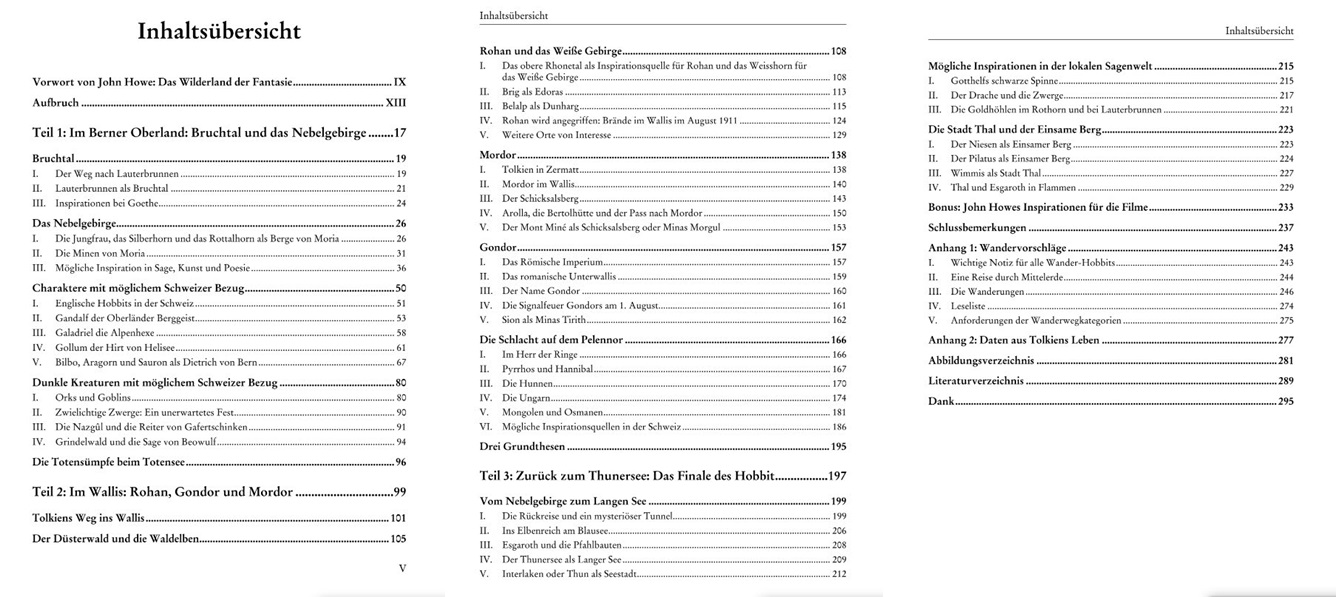
* The new book J.R.R. Tolkien in Central Europe: Context, Directions and the Legacy is on Amazon UK with a shipping date of 26th September 2023. But I see it’s already available for preview on Google Books, and the final table-of-contents is thus available…

* The much-trailed ‘Fantasy Goes to Hell’ Mythopoeic Society seminar event now has downloads online. There are many to choose from, but Tolkien items of interest to me are…

   – “Hellish Landscapes in J.R.R. Tolkien’s Legendarium”
   – “Tolkien goes to Hell: From the Deepest Underground to the Utmost Void”
   – “Managing Hell: C.S. Lewis and J.R.R. Tolkien on the Infernality of Managerialism”
   – Panel discussion: “Deep Places of the World: Journeys in the Underworlds of Middle-earth”

* A new YouTube video on “The Lost Words of Tolkien”. It’s a bit of a ‘quickie’ video, and please don’t imagine I’m suggesting it as a scholarly heavyweight. But it’s a nice idea to try to do explication videos for the spiflicated. I must say that even I was stumped by the word hame, as in “Gandalf Greyhame”, originally “Gray-hame” before the final text. I find that today hame is still in use, but only as a word for the stiff part of a fitted horse-collar. The pair of hames are used to fit the skein of leather control-reins to a working heavy-horse. The maker of the YouTube video suggests this horse meaning in passing, but Tolkien’s source is more likely to be found in the latest Bosworth-Toller. This venerable dictionary suggests the Old English hama (a natural covering or tough thin skin, as in a ‘shed snake-skin’) and for “Gandalf Greyhame” this implies a long cloak of natural material, possibly somewhat tattered and skein-like through much wear (“the most beggar-like…”). Hammond & Scull note the similar “Old English graeghama ‘grey-coated'”. No source is mentioned for this, but it is in The Fight at Finnsburg as graeg-hama, perhaps there applied to hearing the sound of grey mail-ring battle-corslets in motion beyond the hall’s doors, via a poetic comparison to the slavering of grey-coated wolves. The word is also apparently in Gothic as hama ‘covering, of a man’, and in Middle English meaning “coat”. I’d add that the word’s core meaning thus appears to link through to the continental Earendel cognates re: the tale of Orendel and his strange Gray Coat.

* A thoughtful new blog post on “Music and Its Effects in The Hobbit”.

* And finally, dates for the German Tolkien Days 2024 when… “more than 8,000 fantasy fans gather to bring Middle-earth to life”. 24th to 26th May 2024, on the Rhine in Germany.

Tolkien Gleanings #112

Tolkien Gleanings #112.

* New on Archive.org, Tolkien’s “English and Welsh” seen in its original context, along with other lectures. As the volume Angles and Britons: O’Donnell Lectures.

* A new second edition of The Historical Dictionary of Fantasy Literature (June 2023), though sadly aimed at university libraries and thus a whopping £150 for some 590 pages. Surely there would be more profit in making it a mass-market £30 title, given the thousands of fans who would buy it VS. a few hundred university libraries? Now the fans will just pirate it instead, whereas they might have ordered a paper edition. Anyway, it has…

“a chronology, an introduction, an extensive bibliography, and cross-referenced entries on more than 800 authors, ranging across the entire historical spectrum. More than 200 other entries describe the fantasy sub-genres, key images in fantasy literature, technical terms used in fantasy criticism”

No reference is made in the blurb to the venerable Brian Stableford’s Historical Dictionary of Fantasy Literature (2005), but it seems possible the new book is a second expanded edition of his work under a new editor. Since I can find no first edition credited to the second edition’s author.

* The Oxford Tolkien 50 event’s website has some details of the forthcoming small exhibitions at the University of Oxford Tolkien at Exeter College and Tolkien at Merton: Fellowship and Friendship.

* In France, the Tolkiendil society has a scholarly event to… “celebrate the 50 years of the first French translation of the Lord of the Rings”. In French, but one talk appears to be in English as “Rings of Smoke: Pipe-weed, Pipes, and Smoking Imaginary in J.R.R. Tolkien’s Narrative”. I’d hope to see this on YouTube later in the year. The event is set for 6th-8th October 2023. I see there’s also a re-issue of the French edition of the Carpenter biography, Tolkien: une biographie, due in September 2023.

* The proceedings of the Tolkien Society Autumn Seminar are on YouTube as video, uploaded in July 2023. Due in book form in October 2023, with the title Translating and Illustrating Tolkien (Peter Roe Series XXIII). Not yet on Amazon UK.

* Signum University’s Australian OzMoot, set for 26th-28th January 2024. ‘Above All Shadows: Tolkien and Uncertain Futures’ will be on the theme of Tolkien’s depictions of hope in the face of future uncertainty.

* Coming soon to the former mill-town of Barnsley in northern England, the touring Middle-earth exhibition. This time it will be free. Barnsley is about ten miles south of Leeds, and thus a visit to the show might be combined with a Tolkien-oriented visit to Leeds. Local walker Chris Tye has a Tolkien’s ‘walk to work’ route at Leeds.

* And finally, the Catholic Irish writer Rosa Mulholland’s vivid children’s fantasy The Walking Trees, now freely available in PDF. This is not the later handsome illustrated edition, which is utterly available except physically in a few Irish libraries. This version has been assembled from the original magazine serial. It has some Tolkien-like moments. Walking, talking trees. Flying on the back of an eagle. It ends rather abruptly, but perhaps the book editions gave it a better ending? Anyway, enjoy.