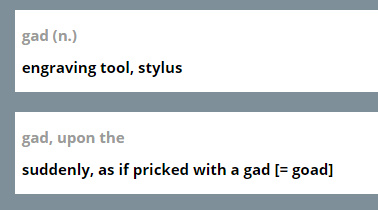
ShakespearesWords.com is now in version 3.0 (Summer 2018). A complete easy-to-use glossary of the words used and their original meanings.
No ‘original pronunciation’ audio yet, for each word, but apparently that’s coming in due course.
ShakespearesWords.com is now in version 3.0 (Summer 2018). A complete easy-to-use glossary of the words used and their original meanings.
No ‘original pronunciation’ audio yet, for each word, but apparently that’s coming in due course.
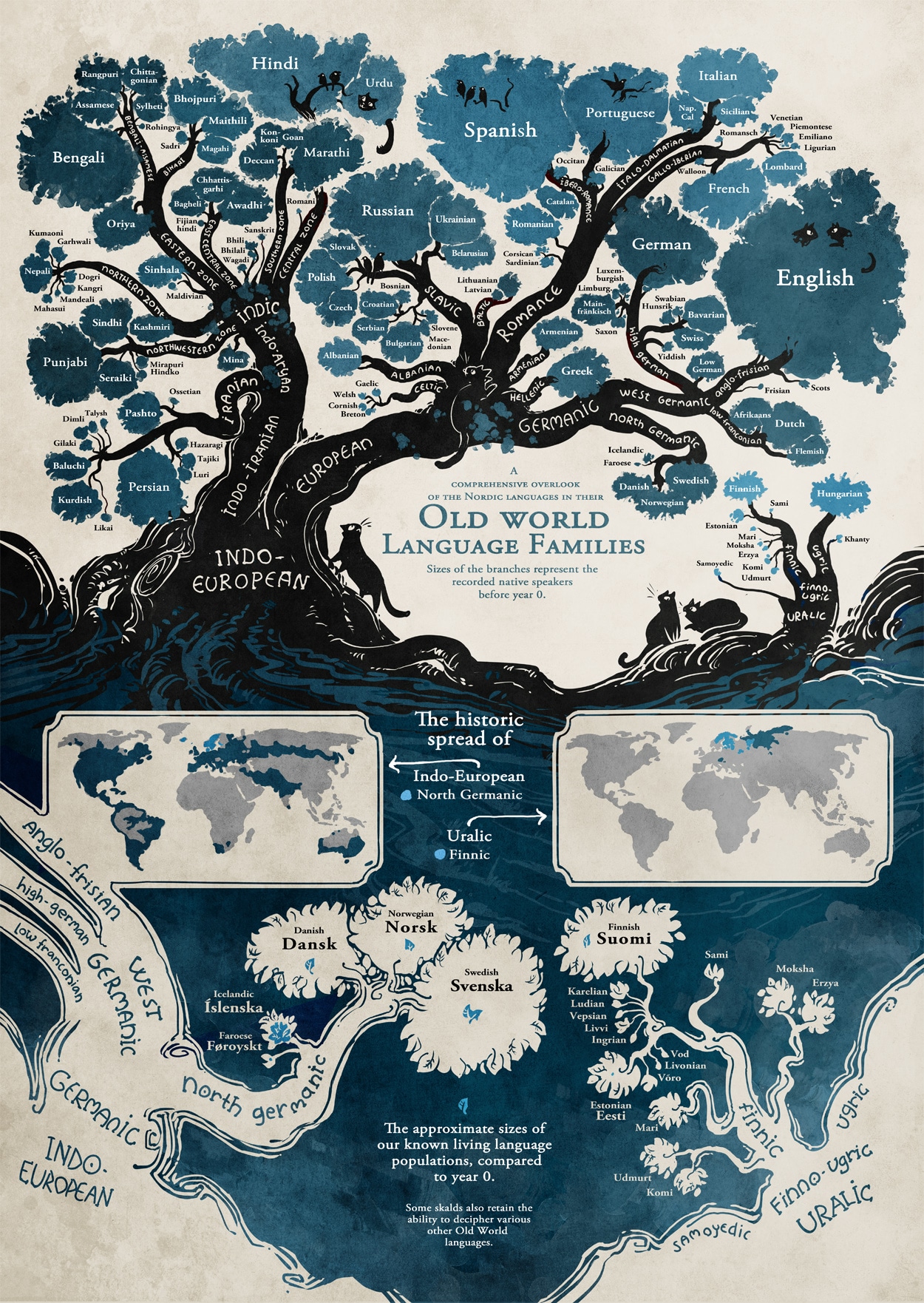
Finland’s Minna Sundberg has a super new illustrative chart of the “Nordic Languages in the Old World Language Families”. The amount of leaves indicate the size of the current-day population speaking that language.
Useful for getting your head around what came from where. A small additional translator inset would be been useful for converting the sort of terms one encounters in deeply researching pre-LOTR Tolkien, such as “Old Norse”. It would have been nice to have just a couple of orienting dates. The Indo-European (Aryan) family had its origins in the Near East just over 8,000 years ago from today, for instance, with a big diffusion into Europe around 5,000 years ago.
Minna is the fine comic artist and storyteller making the ‘young adult’ graphic novels Stand Still. Stay Silent (ongoing – a future Scandanavia has returned to a state of Nordic mythology complete with monsters and magic), and A Redtail’s Dream (completed – a young boy of the North strays into the land of dreams).
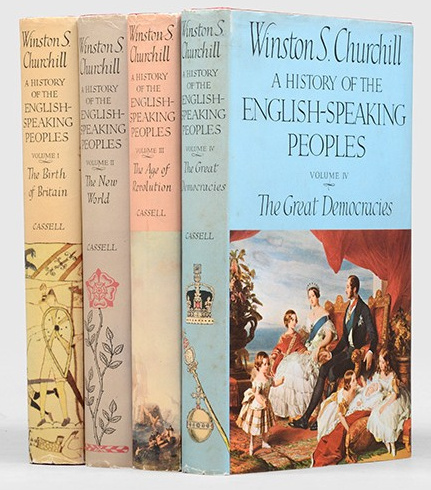
It’s always interesting to see what books looked like when they first appeared. Here’s Churchill’s masterpiece of popular history, the History of the English-Speaking Peoples…
There are two abridged versions, the handsome The Island Race (1964) with copious illustrations, and History of the English-Speaking Peoples (abridged). They’re said to be just a bit dry, with a lot of Churchill’s personality and wit removed. Those who balk at the length might do better to try the four-volumes unabridged, in a good audiobook version.
Churchill’s set of books came to a halt as the year 1900 dawned. But a later masterly updating was accomplished with the further book A History of the English-Speaking Peoples since 1900 by Andrew Roberts. Roberts is coming to speak in Stoke-on-Trent this summer, at the city’s literary festival.
Incidentally there’s now a book which calmly and systematically rebuts all the myths and sly slurs about Churchill, Winston Churchill: Winston Churchill, Myth and Reality: What He Actually Did and Said.
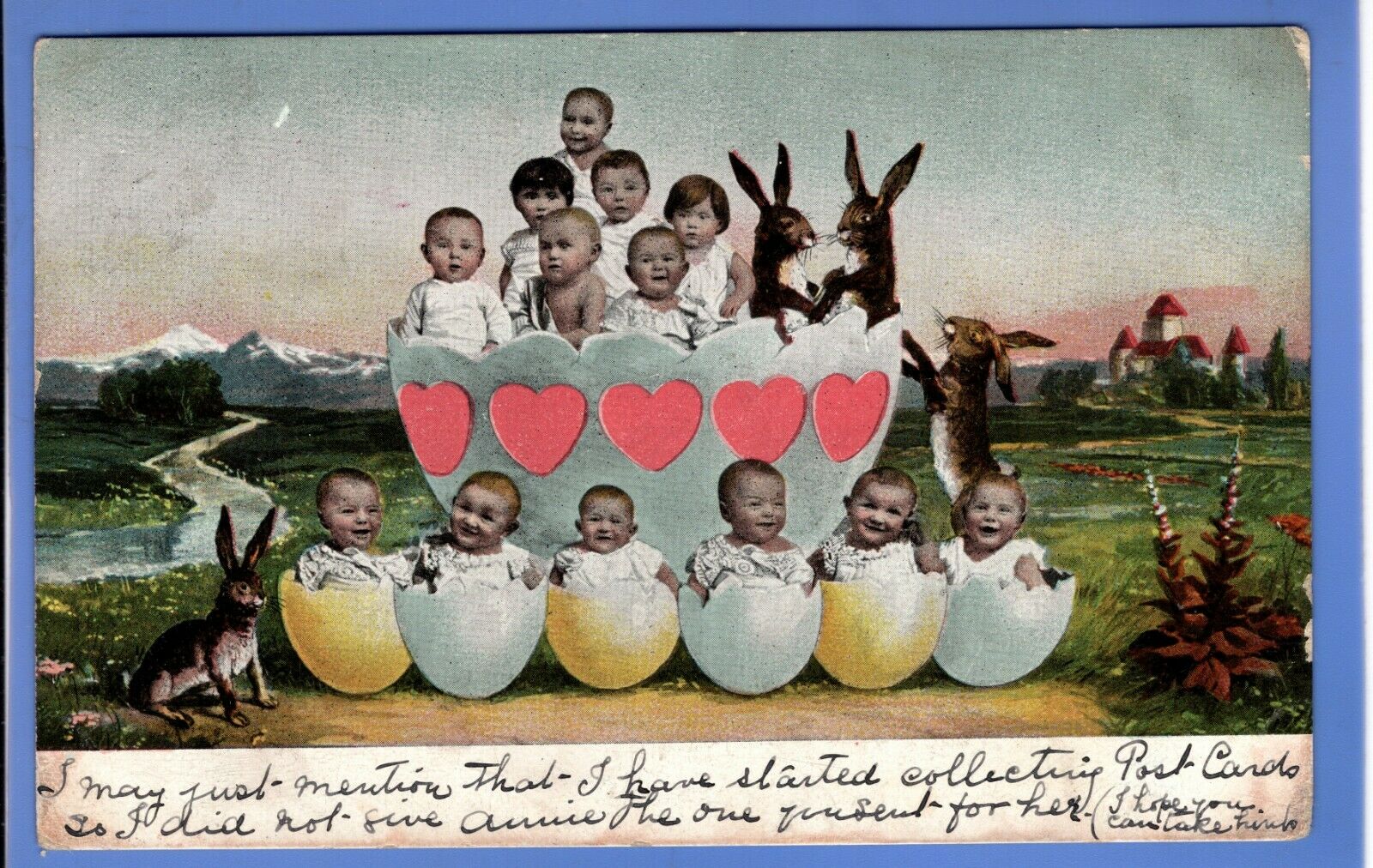
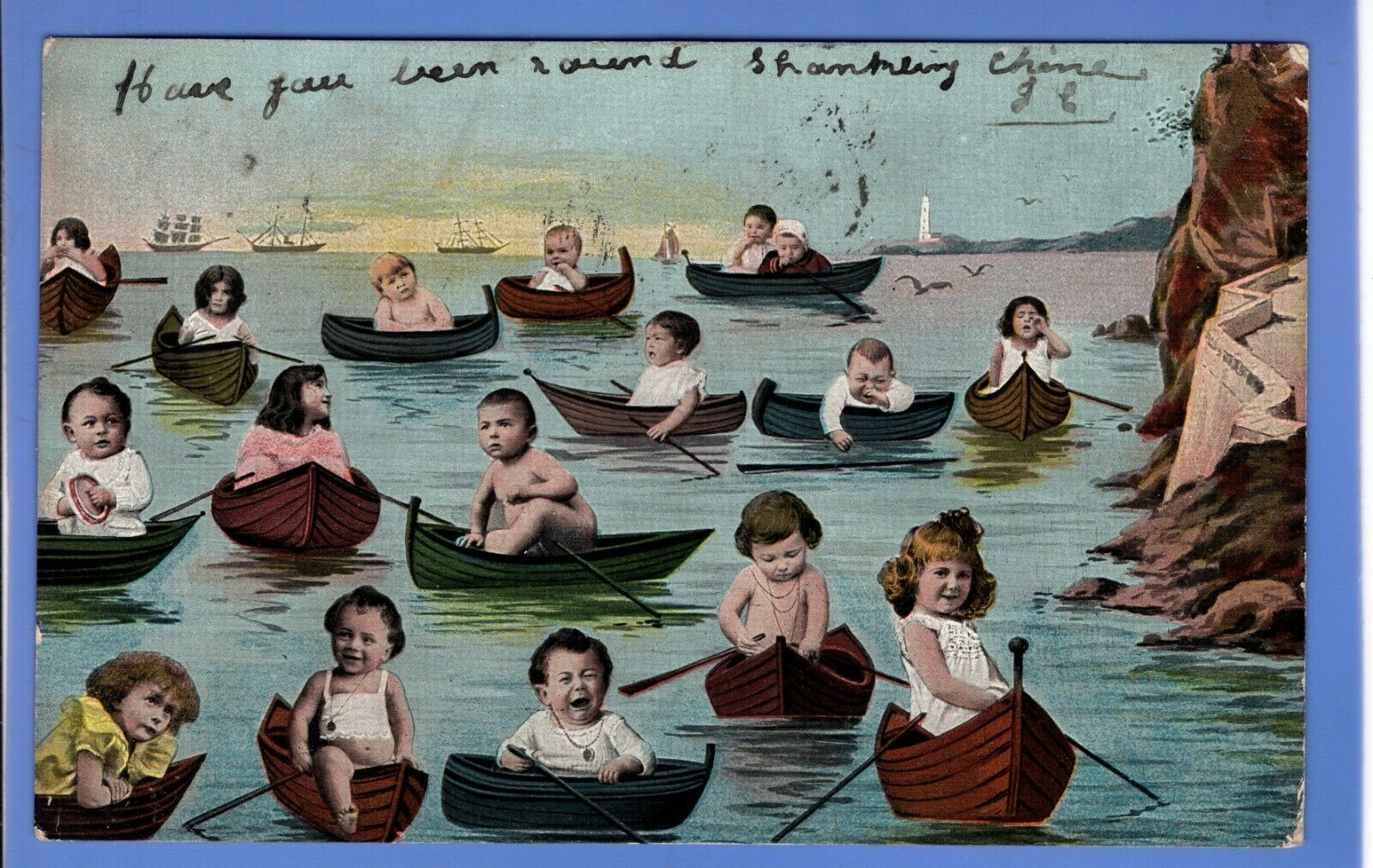
Early examples of photomontage from “Doff Brothers, Manchester”, both postmarked 1905. They show that early commercial photomontage for printed postcards wasn’t just something confined to the agricultural grassroots in America. The Americans were also making folksy cards like this at about the same time, but showing things like giant corn cobs, giant chickens and fish.
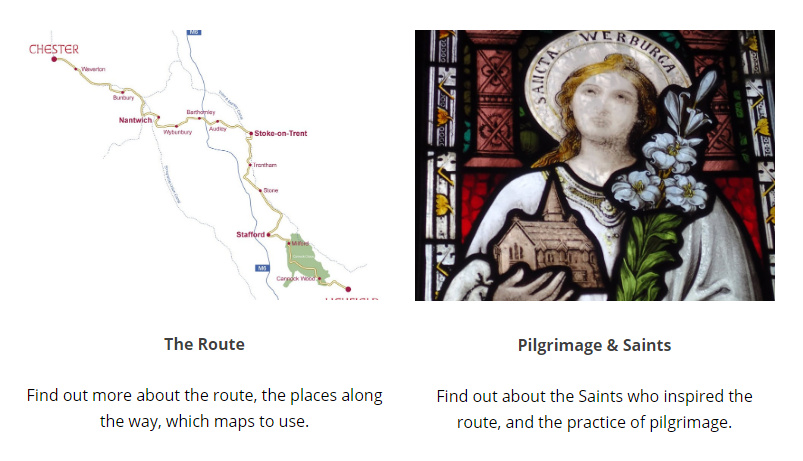
There’s a new website for the Two Saints Way, a long-distance footpath to and through Stoke-on-Trent. In the early stages I had a hand in advising on and photographing parts of the planned route through the city, though all the hard work on it has been done by others.
I’m pleased to hear that the Wolverhampton photographer Oscar Rejlander has a major exhibition at the J. Paul Getty Museum in Los Angeles, of all places. It appears to have travelled from its 2018 debut in Canada, so let’s hope it eventually crosses the Atlantic and reaches Birmingham. His work is far more human and warm than the cold and aloof psychotica made by Julia Margaret Cameron, with whom he’s commonly compared, and it should be a popular show.
“Oscar Rejlander: Artist Photographer, on view 12th March – 9th June 2019 at the J. Paul Getty Museum, Getty Center, Los Angeles. … The exhibition features 150 photographs”
“Mary Constable and Her Brother”, 1866.
“The Scholar’s Mate”, c. 1855 exhibited 1856. The governess-tutor appears pleased and amused that her clever girl scholar is about two moves from checkmating her brother at a game of chess, and she seems to be quietly warning the girl to remain ladylike about it and not to gloat and snook when she wins. (Boys were commonly dressed as girls until they were abruptly “breeched” into trousers, in those days, thus one assumes she’s playing her brother even though he wears skirts).
One wonders if his pictures titled “Wolverhampton Fair” and “The Fortune Teller”, of the same 1855 date, survived. Also how many other Wolverhampton pictures have survived. He spent about 15 years in Wolverhampton before fame hit. He’s said to have employed the fairground sideshow girls of Wolverhampton as models (“Madame Wharton’s Pose Plastique Troupe”), which probably added to the scandal around his famous breakthrough pictures known as Two Ways of Life.
The new show is billed as “the first major retrospective on Rejlander”, and there’s a sumptuous Yale University Press book to accompany it. Which might make the West Midlands curators pause for thought, about why we couldn’t have got there first and are instead being beaten to a major show on ‘the father of art photography’ by distant Canada and Los Angeles.
Now we know something about the locations for one of the Tolkien bio-pics. Not quite my own Staffordshire, but somewhat near-ish in what’s technically Cheshire. A south Manchester suburb stood in for the battlefield scenes….
“Tatton Studios was one of their key locations, with war scenes being filmed on one of its 24-acre backlots … played host to a cast of 150 First World War soldiers, 30 cavalry horses and a 300-strong crew, which included a dedicated SFX team to manage activity such as night shooting and also construction experts, who spent three months building the battlefield.”
This is a useful behind-the-scenes movie-making article, though there also seems to be a great deal of mindless legacy media blather in advance of this first movie. Such as dismal headlines like: “The Untold Truth of JRR Tolkien” and “Will ‘Tolkien’ bring the Lord of the Rings trilogy back to life?”.
Er, when did it die…?
But there are also currently some good thoughtful articles arising from the New York exhibition, such as the new “You’ve Read Tolkien’s Books — But Have You Seen His Paintings?” and “Tolkien’s drawings reveal a wizard at work”.
Cultural Heritage Spring Lecture Series, “brought to you by the South West Peak Landscape Partnership”…
12th March – There’s More to Walls by Master Craftsman Trevor Wragg;
19th March – Fire, Foxholes, Bullets and Barrows by SWP cultural heritage officer Dr Catherine Parker Heath;
26th March – Anglo Saxons in The Staffordshire Moorlands and the South West Peak by Harry Ball;
2nd April – Highways and Waymarkers by Jan Scrine of The Milestone Society;
9th April – Historic Mining in the South West Peak by Dr John Barnatt.
My new book The Cracks of Doom: Untold Tales in Middle-earth is now available as an ebook. In 22,000 words it carefully identifies 135 points or ‘cracks’ in The Lord of the Rings and related material, ‘cracks’ in which one might write new fan-fiction stories. The book is a side-project arising from my forthcoming scholarly book on Tolkien.
“Birmingham Then and Now” at Never Yet Melted.
And, sadly, the vandals usually slip away un-named and un-remembered.
New in The Sentinel, ‘The coal man and the bread man have gone for good’ – how things have changed in Stoke-on-Trent since the 1960s. Memories of Goldenhill, an isolated hilltop part of Stoke-on-Trent.
Mind you, such things lasted a long time in parts of Stoke-on-Trent. In the early 2000s when I lived in Middleport, you could still see coal-deliveries being made to pensioners, with coal-sacks trucked by hand up back-alleys and into coal-sheds. The distinctive ‘annnyyy-oll-irroon!’ call of the rag-and-bone man could still be heard, maybe once every six weeks, although his horse had long gone. And the milk-float man still made milk-bottle deliveries, and you could get a pre-ordered loaf of bread delivered with the milk. Of course, it’s all gone now — flattened into brick-dust by Commissar Nevin and henchmen.
There’s a fascinating new paper on ancient sea-travel routes in northern Europe, and a resulting coherent diffusion of stone-circle building… “Radiocarbon dates and Bayesian modeling support maritime diffusion model for megaliths in Europe”.
Now we have to be a little sceptical here, because… i) it seems increasingly easy to get questionable headline-grabber papers past peer-review and into the PNAS journal, judging by other recent examples; ii) the study is partly based on computer-modelling and statistical re-shaping, a method which has its own inherent problems; and iii) stone circles in remote coastal areas are far more likely to have survived into the historical record.
That said, the new paper does present an intriguing prehistoric proposition and has good evidence to support it…
“We argue for the transfer of the megalithic concept [of stone circles] over sea routes emanating from northwest France, and for advanced maritime technology and seafaring in the megalithic Age.”