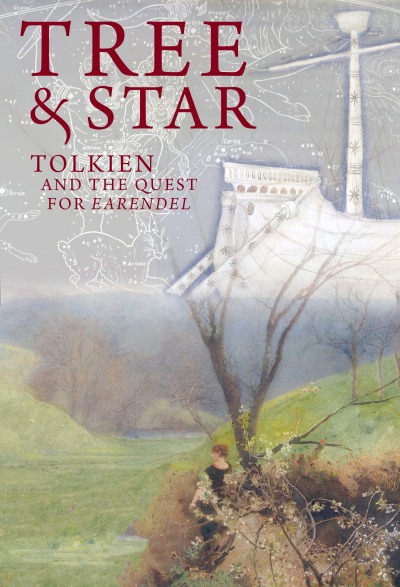
Phew! 458 pages, 200,000 words. Soon. Update: It’s here.
Phew! 458 pages, 200,000 words. Soon. Update: It’s here.
Updated, The Potteries Post. More timely “news you can use” from the city of Stoke-on-Trent, with a focus on wildlife and the arts and history.

A new 53 minute YouTube seminar “Bees in the Medieval Mediterranean: Economic, Environmental and Cultural Perspectives”. Starts at 6:12 minutes.

Some of the accents are a little difficult, but if you listen closely and on headphones they’re not impenetrable. They’re giving an overview of a major pan-European project that’s been partly completed.
The short discussion of the religious aspect was interesting. The thinkers of the medieval world did not know how bees reproduced, even if perhaps the guilds of industrial-scale medieval bee-keepers came to discern something of this over the centuries. Thus bees were deemed “virginal” by the thinkers, and could then be closely associated in the minds of the religious with the chastity and sweetness of Mary and Christ. This made their wax especially suitable for church candles.
The seminar’s listener learns that the Baltic not only had amber, but also bees-wax as a major portable and durable export. One that went long distances across Europe. “Vast” bee-forests were created within the forbidding forests of the Baltic and Bavaria, leading to “vast” exports of wax to the Black Sea, and thence it found its way to the monks who specialised in making all sorts of religious church candles. The Bavarian wax was especially valued, since the white colour and non-smoky burning were deemed important in churches.
The project’s paper is “Beekeeping in late medieval Europe”, in open access. This adds some detail to the idea of the vast eastern bee-forests…
bee forests were created through hollowing out large spaces in tree trunks and allowing bees to naturally move from tree to tree as they swarmed, protected from the worst of the winter weather within the trees’ cavities.
Logs were also used in some places. One assumes that glades were also created, perhaps by controlled burning, for the flowers and shrubs required by the bees. Such methods obviously produced enormous amounts of wax for white candles. Apparently honey and wax production were quite different things, and such trades did not overlap.
This somewhat intersects with my Gawain book, since the Lord of Alton in North Staffordshire went to fight with the crusaders of the Teutonic Order in eastern Europe. The project’s article tells of how the vast bee-forests were pagan, and there was a quite a religious/political tussle with the highly efficient Order over their control and use. But it appears to have been normalised by the time of Gawain, or at least that is the impression I get from the article. It notes one aspect of the pagan beliefs of that area that I had not noted from the BBC In Our Time programme on the Teutonic Order — that the linden was an especially revered tree.
Ironically, it seems that medieval church candles came either from forests tended by the ‘nominally Christian’ ‘former’ pagans of the Baltic, or the Arabs along the coast of North Africa.
The speakers also touch on the British Isles at one point, and the fringes of the West Midlands. Apparently we know from Domesday and somewhat later census documents that the Welsh Marches were a big bee-keeping — and presumably even nationally exporting — area. For honey rather than candle-wax, was the impression I had from what was said. This was in hives rather than damp Welsh forests, and was likely not monastic in nature. The seminar suggests that northern monastic bee-keeping was often more for medicinal and symbolic purposes (i.e. to demonstrate to novices the ‘ideal community’ in connection with the heavenly, which the monastery should strive to be like), than for sale.
Neither the recording or paper has mention of the folklore of bees, re: the folk-idea that the bees woke and “sung” at Christmas “a drowsy echo of the angels’ song” in heaven. Or that one must go to quietly “tell the bees” of someone’s death. But this “heavenly messengers” old wives’ lore now makes a bit more sense to me, now I know of the long-standing Christian connection of bees with Christ/Mary.
See also the recent Kristine Larsen paper, “Tolkien’s Blue Bee, Pliny, and the Kalevala”.
New on Archive.org, to borrow…
Warriors, warlords and saints: the Anglo-Saxon kingdom of Mercia.
Historic Staffordshire (1896, 1975 reprint).
Diary of a hunter (1981, ferreting memoirs in Staffordshire).
Psychiatry in North Staffordshire 1808-1986.
The North Staffordshire Railway in LMS days.
People of the Potteries (At last, I’ve been able to see it. It will be noted in my forthcoming update of my bibliography of North Staffordshire folklore, re: the ‘white rabbit’ ghost of Etruria Grove, and the chapter “Bemersley” with its details of a Mow Cop innkeeper and early ‘magic methodist’ named Zacchariah Baddeley).
From the latter book, on the Fowlea Brook at Etruria…
1) From “A Etruria ghost”
“Etruria is much changed from what it was forty years ago [i.e. 1820s-30s]. [Apart from the curving line of houses that formed Etruria, as seen on the Henry Lark Pratt painting…] The whole country was open, and some parts may be described as wild. The sloping hills of the ‘wood’ [later known as ‘Etruria Woods’ by Warrillow?] with its low brushwood and gorse, hemmed the village on one side, although the effect was somewhat spoiled by a marshy meadow which lay between it and the village. The rushes that grew here were a favourite resort for curious birds in winter, and now and then even sea birds would find their way to the place. [The latter still happens today]. One thing helped to make it a safe shelter for such visitors — the brook that runs through the valley would sometimes, after heavy rain, be swollen to a lakelet, filling the whole meadows, and even finding its way to the doors of the cottages.”
From “Alfred Bourne”
“… Foulhay brook. How different was that brook then than now. In the days of which I write its waters were as clear as spring waters, and its embankments studded with willow trees.”
Presumably this then gives the name. On the 1775 Yates map the Fowlea at Etruria is marked as “Fowl Hay”. In other words, ‘the wildfowl(-rich) hay-meadows’.
Newly updated today, The Potteries Post – From the city of Stoke-on-Trent and beyond, news you can use.
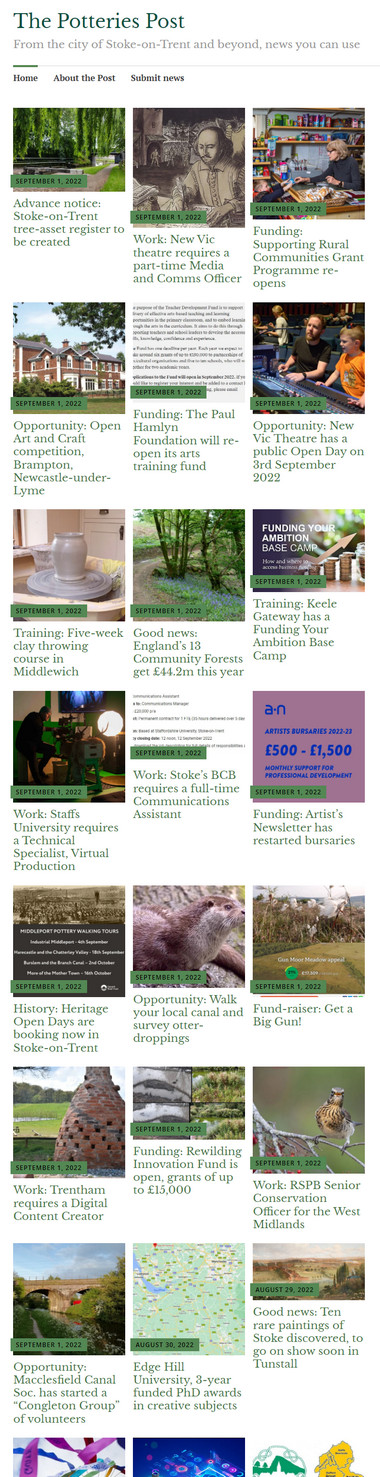
Web links on this blog are now a brighter red, and should thus be more visible to the reader. The links used to be a dull brown-red, and some people had difficulty seeing that they were links.
Tolkien’s old stamping ground the University of Leeds has made public a large collection of English dialects. They are now calling for more to be added to their Survey of English Dialects, following fresh funding from the National Lottery Heritage Fund.
There’s now a website for this with a survey form, The Great Big Dialect Hunt. They’re specifically looking for local dialect words and phrases used in… “your everyday speech with family and friends”.

The survey has a set of structured questions about everyday situations, easy to answer. There’s no “form sent” confirmation sent at the end of survey, but the form then gets blanked and I assume it’s sent.
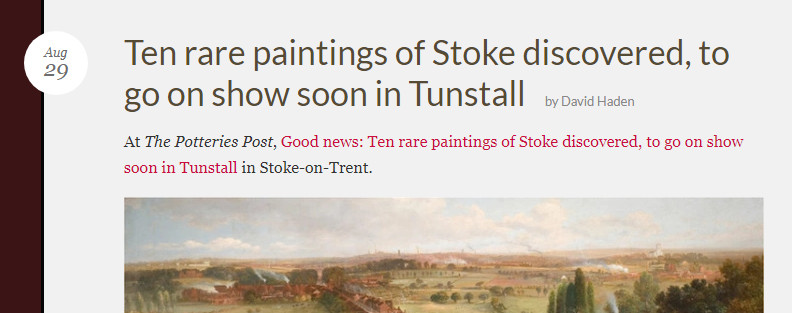
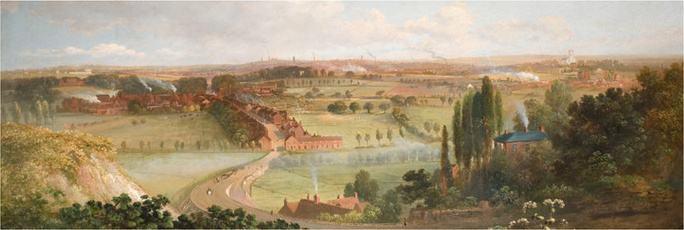
At The Potteries Post, Good news: Ten rare paintings of Stoke discovered, to go on show soon in Tunstall in Stoke-on-Trent.
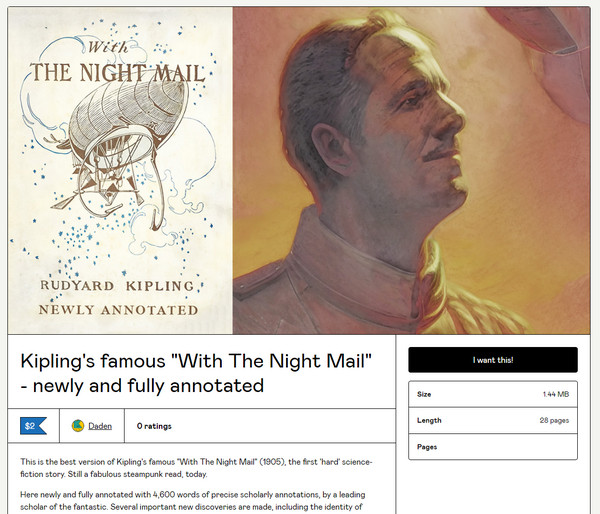
My labour-of-love “With the Night Mail”, annotated edition is available now as a .PDF file on the Gumroad service.
This is the best version of the famous “With The Night Mail” (1905), the first ‘hard’ science-fiction story. Still an absorbing and lively steampunk read, today.
Here newly and fully annotated with 4,600 words of precise scholarly annotations. Several important new discoveries are made, including the identity of “little Ada” — she was a real pilot! All four earliest versions have been checked and cross-referenced, and the modern corrupted text has been carefully cleaned. Differences between editions are noted in the footnotes.
There are 145 footnotes in total, explaining the technology, lingo, and places. One footnote even discovers a long ‘new’ section of dialogue about the risk of plague, unseen since the first publication — and never reprinted until now!
This .PDF is thus as close as we will get to a definitive version of the seminal story that launched the entire genre of hard science-fiction, and which had the honour of opening the highly influential Gollancz survey anthology One Hundred Years of Science Fiction (1969).
As a bonus, there are four new full-page colour illustrations including one of “George”. This labour-of-love e-book is 28 pages in total, delivered to you as a .PDF file. It may interest RPG gamers, as well as scholars and readers.
Many have agreed on Kipling as the first true SF writer in the modern sense:
Kipling was… “the first modern science fiction writer” — John W. Campbell, editor of the seminal Astounding magazine and pioneer of hard science-fiction.
What Kipling was doing in “With the Night Mail”… “had never been done before. There is no such subtlety in the contemporary proto-SF of H.G. Wells and Jules Verne. I think we may safely credit him with inventing the style of exposition that was to become modern SF’s most important device for managing and conveying information about imaginary futures”. — “Rudyard Kipling Invented SF!”, by Eric S. Raymond.
“With The Night Mail”… “anticipated the style and expository mechanics of Campbellian hard science fiction fourteen years before Hugo Gernsback’s invention of the ‘scientifiction’ genre and twenty-seven years before Heinlein’s first publication.” Eric S. Raymond, A Political History of SF (2000).
“With The Night Mail” is… “an amazing tour-de-force of inspired genius […] the sort of thing that Verne or Wells would never have dreamed of doing […] Kipling, in 1905, is doing things that science fiction as a genre wouldn’t achieve until Robert Heinlein arrived in the late 1940s.” — Bruce Sterling.
Kipling… “is for everyone who responds to vividness, word magic, sheer storytelling.” — Poul Anderson.
Kipling was… “a master of our art.” — Gordon R. Dickson.
“He was a superb and painstaking craftsman, the most completely well-equipped writer of short stories ever to tackle that form in the richest of languages.” … “”With the Night Mail” is an astounding vision … his influence on 20th century SF writers was probably greater than anyone else’s, except Wells … he was a master at making the fantastic seem credible”. — John Brunner.”
“When you read Kipling, you’re there, [he] builds a total sensory impression that surpasses the language” [which is partly why he will never be taught in schools] — C.J. Cherryh.
“what a good writer he was … the work is superb and he could make words sing. [On looking into the political claims that had dissuaded me from reading him,] I found that most of his supposed sins had been vastly overstated.” — George R.R. Martin.
At SF conventions… “I found that so many SF writers could see his sterling merit that I felt vindicated” [in my early love of Kipling, despite my mundane Eng. Lit. teachers who ignored him] — Anne McCaffrey.
There are two anthologies from science-fiction writers influenced by Kipling. Heads to the Storm: A Tribute to Rudyard Kipling, and A Separate Star: A Science Fiction Tribute to Rudyard Kipling. “Accompanied by introductions [to stories] in which the likes of Poul Anderson, L. Sprague de Camp, Joe Haldeman, and Gene Wolfe describe the impact that reading Kipling has had on their own writing.”
Also, in my new 2022 annotated text I could have mentioned some of the loose predecessors to “Night Mail”, but I didn’t want to speculate too much. I note these here…
1) Possibly Kipling had persevered with trying to fathom Edgar Allan Poe’s rambling “Mellonta Tauta”. A late political satire by Poe, now only comprehensible to those who know the tedious American politics of the period. Told as if letters from a slow balloon voyage around the earth, though there are encounters with faster luxury ‘liner’-like balloons…
“How very safe, commodious, manageable, and in every respect convenient are our modern balloons! Here is an immense one approaching us at the rate of at least a hundred and fifty miles an hour. It seems to be crowded with people – perhaps there are three or four hundred passengers — and yet it soars to an elevation of nearly a mile, looking down upon poor us with sovereign contempt.”
The tedious voyage leads to men struggling to amuse themselves by recalling “the old days” and how things were done then, and hence we get the tortured satire on Poe’s day. Possibly this was uproariously funny to Poe’s magazine readers, but it is almost un-readable now and certainly not the influential precursor to a whole field of later science-fiction.
2) I might also have mentioned H.G. Wells “The Land Ironclads” (1903) as having a slim claim to being the first ‘hard’ SF. But I think Arthur C. Clarke was right when he called it “an engineer’s story”, rather than imaginative futuristic SF. The new invention is deployed in the present-day (Wells’s setting is 1903’s cavalry, bicycle, trench and “Howitzer” artillery warfare of the Boer War) to make various political points. His armoured war-vehicles are 80-foot steam-powered metal tanks — and rather akin in shape to the various armoured land-craft that had, for a decade or more by then, been the staple of the American ‘boy inventor’ weekly story-magazines…
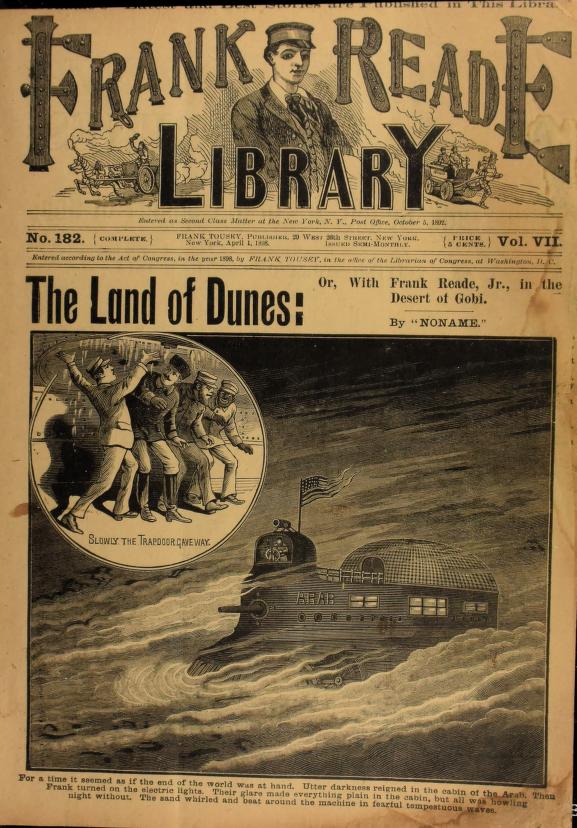
Example from 1898. This ‘land ironclad’ is similar in size and design to those of Wells.
Kipling instead imagines a complete distant-future world with multiple interlocking advanced technologies, attitudes, world-system and economies. And he makes it believable and human. He invents or anticipates numerous things that have since come to pass, and does so in a single tale.
3) There’s also a journalistic account that could have influenced Kipling’s “With the Night Mail” prior to 1905. This point has been suggested as such by the author of the free “Night Mail”-based RPG game Forgotten Futures. This short true-life article was Edward John Hart’s “With Her Majesty’s Mails to Ireland”, in The Strand Magazine in April 1895, being a brisk journalistic account of a mail packet journey across the Irish Sea from Holyhead in Wales to Kingstown. This article is now freely online at Archive.org. There is a similar encounter with a dingy tramp steamer, but Hart has him being avoided and gone in a few seconds. There is a similar recounting of shipping lights seen and passed, but such things are to be expected. The mail-ship ‘meets the dawn’ before her arrival. Those are the only similarities I can see. Possibly the general idea of such an account was all that taken by Kipling, if he had even noticed it.
Until 23rd December 2022 at the Haggerty Museum of Art in Wisconsin, the exhibition “J.R.R. Tolkien: The Art of the Manuscript”. 147 items on show from two U.S. archives and from Oxford, including… “many which have not been previously exhibited or published”.

Design for a page from the Book of Mazarbul.
Time for another “MegaTolk”. Newly appeared interesting items on Tolkien that are open and public, since my last round-up in which was back in May 2022…
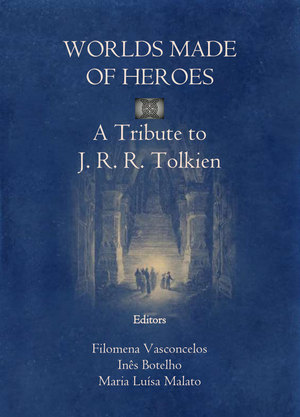
* Worlds Made of Heroes: a tribute to J.R.R. Tolkien. A complete scholarly ebook in open access, from the University of Porto. Includes, among others…
– The importance of songs in the making of heroes.
– Wounds in the world: the shared symbolism of death-sites in Middle-earth.
– From epic narrative to music : Tolkien’s universe as inspiration for The First Age of Middle-earth: a Symphony.
– Character and perspective: the multi-quest in J.R.R. Tolkien’s The Lord of the Rings.
– Geoffrey of Monmouth and J.R.R. Tolkien: myth-making and national identity in the twelfth and twentieth centuries. (Also a useful survey of Tolkien’s West Midlands patriotisms)
– Mythology and cosmology in J.R.R. Tolkien’s The Lord of the Rings.
* Song Lyrics in The Hobbit: What They Tell Us (Detects in the lyrics the different relationships that each race has with time).
* “Pearls” of Pearl: Medieval Appropriations in Tolkien’s Mythology. (Excellent study of the likely influence of Pearl)
* The image of the tree as the embodiment of cosmological and solar aspects in J.R.R. Tolkien’s works.
* The Joys of Latin and Christmas Feasts: J.R.R. Tolkien’s Farmer Giles of Ham.
* Medieval Animals in Middle-earth. (Found from 2021).
I’ve now seen the new Boggart Sourcebook. The unglue.it aggregator has it and usefully offers a “Save to Dropbox” feature that works in getting the PDF file. The normal PDF download is still not working.
The new book has the usual Kidsgrove boggart article and gives it as a good fully transcribed text…
* ‘Up and Down the Country: Ranscliff’, Staffordshire Sentinel and Commercial and General Advertiser, 6th December 1879.
It also brings to light…
* A newspaper article on a Harecastle tunnel rape trial (Wolverhampton Chronicle and Staffordshire Advertiser, 16th August 1843, page 4), which shows the lore was well-know to boatmen in 1843.
* Leese, Philip R. The Kidsgrove Boggart and the Black Dog, Stafford: Staffordshire Libraries, 1989.
Full title of the latter is found to be: Philip R. Leese, The Kidsgrove Boggart and the Black Dog: A Version of the Story and an Examination of the Written Source. A 32 page booklet. This is new to my North Staffordshire Folk-lore bibliography, and will be in the next edition.
Not published as full-text or identified as North Staffordshire in the Boggart Sourcebook is the reference…
* Wigfull, Chas. S. ‘Alton Addenda’, Derbyshire Advertiser, 6th May 1927, page 31.
I suspected this was Alton in the Moorlands. Cross-referencing this with the list of ‘Boggart Names’ in the book shows that this newspaper article had noted a named “Barberry Gutter Boggart”. This gave me a lead to follow. Folk-lore journal (1941) usefully stated that the Gutter was located “on the road from Alton to Farley”. In Folk-lore, the places referenced either side show that the Manifold Valley area is under discussion. Hence, this is Staffordshire’s Alton and not some other Alton.
The new book offers a useful ‘Boggart Census’ for Derbyshire, none of which are items shading over toward Staffordshire. The same is true of Cheshire. It then appears our Kidsgrove Boggart is very much an outlier.
But my above winkling out of the “Barberry Gutter Boggart” at Alton now gives North Staffordshire one more boggart.
Where, then, is or was the Barberry Gutter? Folk-lore tells us this was “on the road from Alton to Farley”, and interestingly one also finds there a headless horseman riding a white horse and clad in armour (again, according to Folk-lore). Such rural tales are admittedly common and often late confabulations, but it might be interesting to know if it can be found before the re-discovery of the very nearby head-chopping tale of Sir Gawain and the Green Knight.
A study of local molluscs for the journal of the North Staffordshire Field Club (1921) adds a little more data to the location of this Gutter. The diligent mollusc-hunter Mr Atkins noted a colony thriving under damp fir-bark at Alton on or near the…
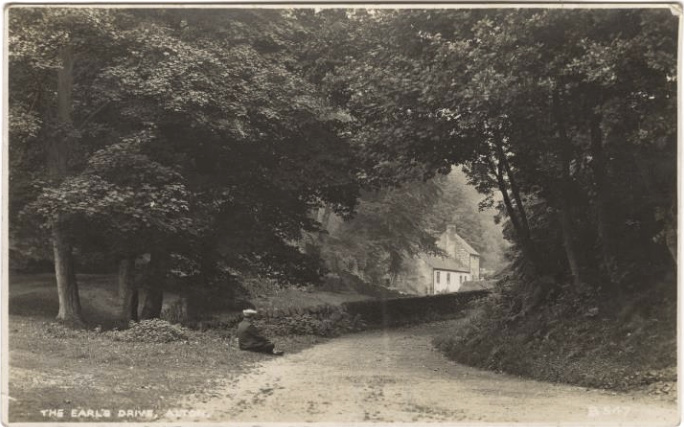
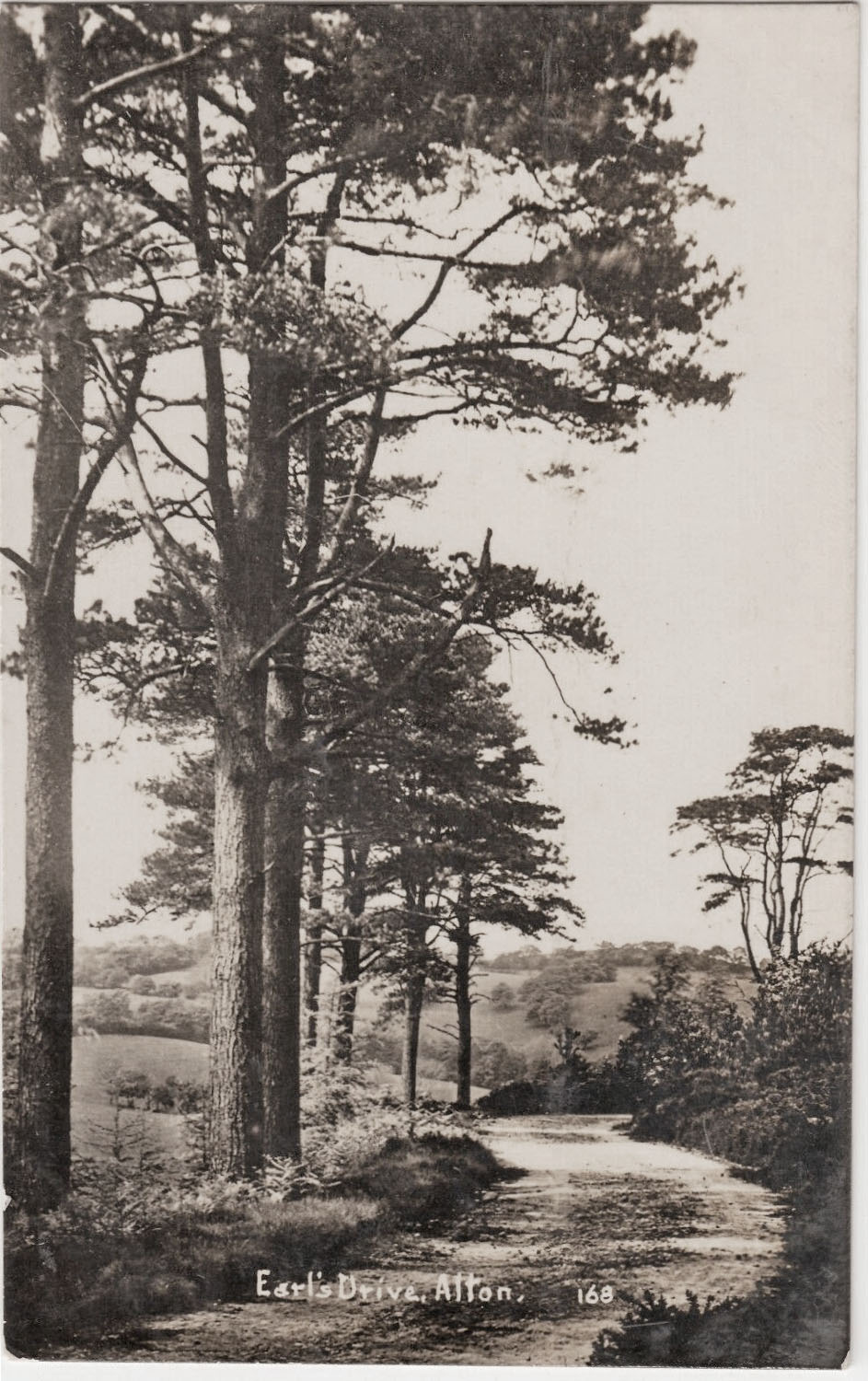
Earl’s Drive, Barberry Gutter
The boggart could then be somewhere along the well-known “Earl’s Drive”. The drive having been built in the 1800s by the Earls of Shrewsbury, a lovely ride going over damp ground by a series of bridges. So far as I know this could also be used by the public.
An old map then reveals the correct location of the Gutter, seen here spelled as “Barbary” and in relation to the Towers and the Castle…
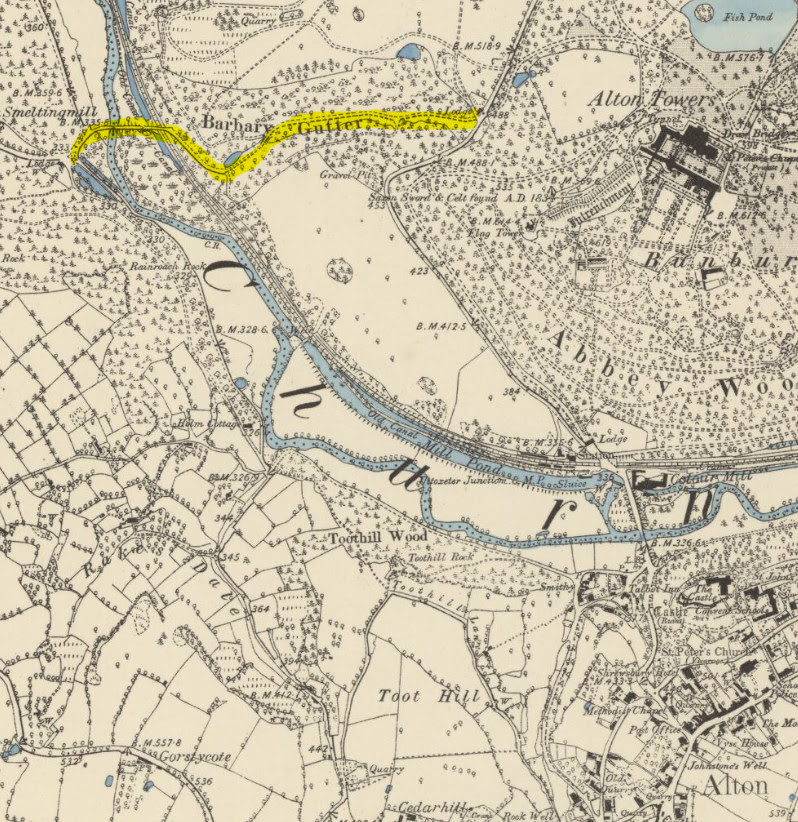
It is thus also the location of the “Chained Oak”.
(This modern Earl’s Drive is not to be confused with the medieval Earlsway).