The Potteries Post has updated. More news you can use from the Staffordshire Potteries.

The Potteries Post has updated. More news you can use from the Staffordshire Potteries.
Update, 23rd February 2023: The path is now open at the southern end.
Since spring is just about to start I wondered if the ‘new river’ path along the River Trent was now ready, down in Stoke town. You’ll recall that the whole of the Trent was re-routed at Boothen (site of the former Stoke F.C. ground) and a massive new river channel was constructed. So… I took a look.
The answer is: not quite yet, but it looks like it could be relatively soon (April??). Actually, you can walk along most of the new path. But you can’t then connect with the old river path at the end of the new path. That end is currently blocked, as I show below.
So at February 2023, here’s a step-by-step guide to how to access the Trent path as a pedestrian, when starting on the Trent & Mersey canal.
1. Come off the Trent and Mersey towpath at the low arched bridge at the Council House car-park at Stoke town (Stoke-upon-Trent). Go up these steps.
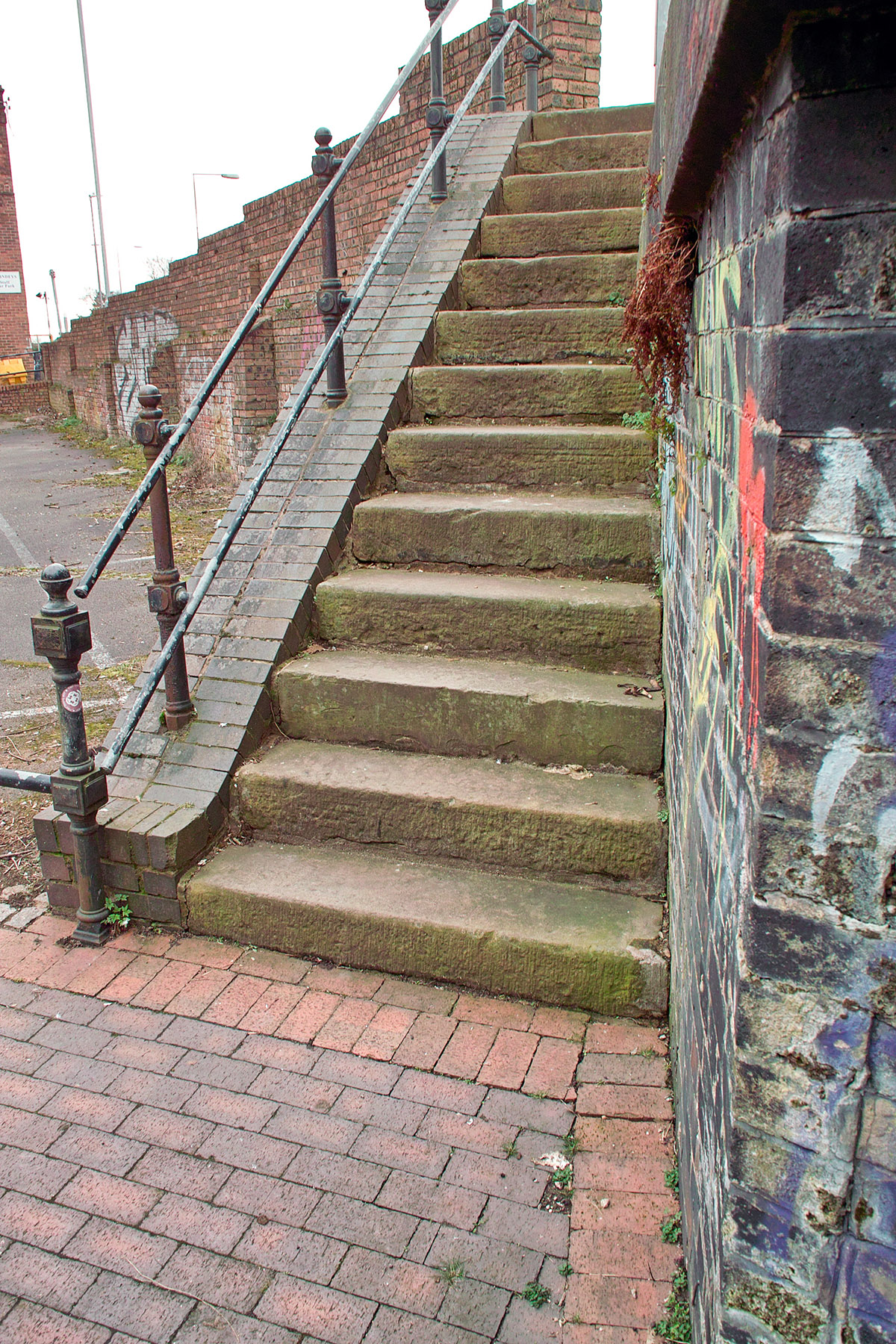
2. From the top of these steps you briefly cross the Council car-park entrance (“Wharf Place”, on maps) and go over the short but big bridge that crosses the A500 dual carriage-way road. This is too horrid to photograph but is very short, only 50 yards or so.
3. Once across the bridge, take the short curving pedestrian path down to the Minster (church).
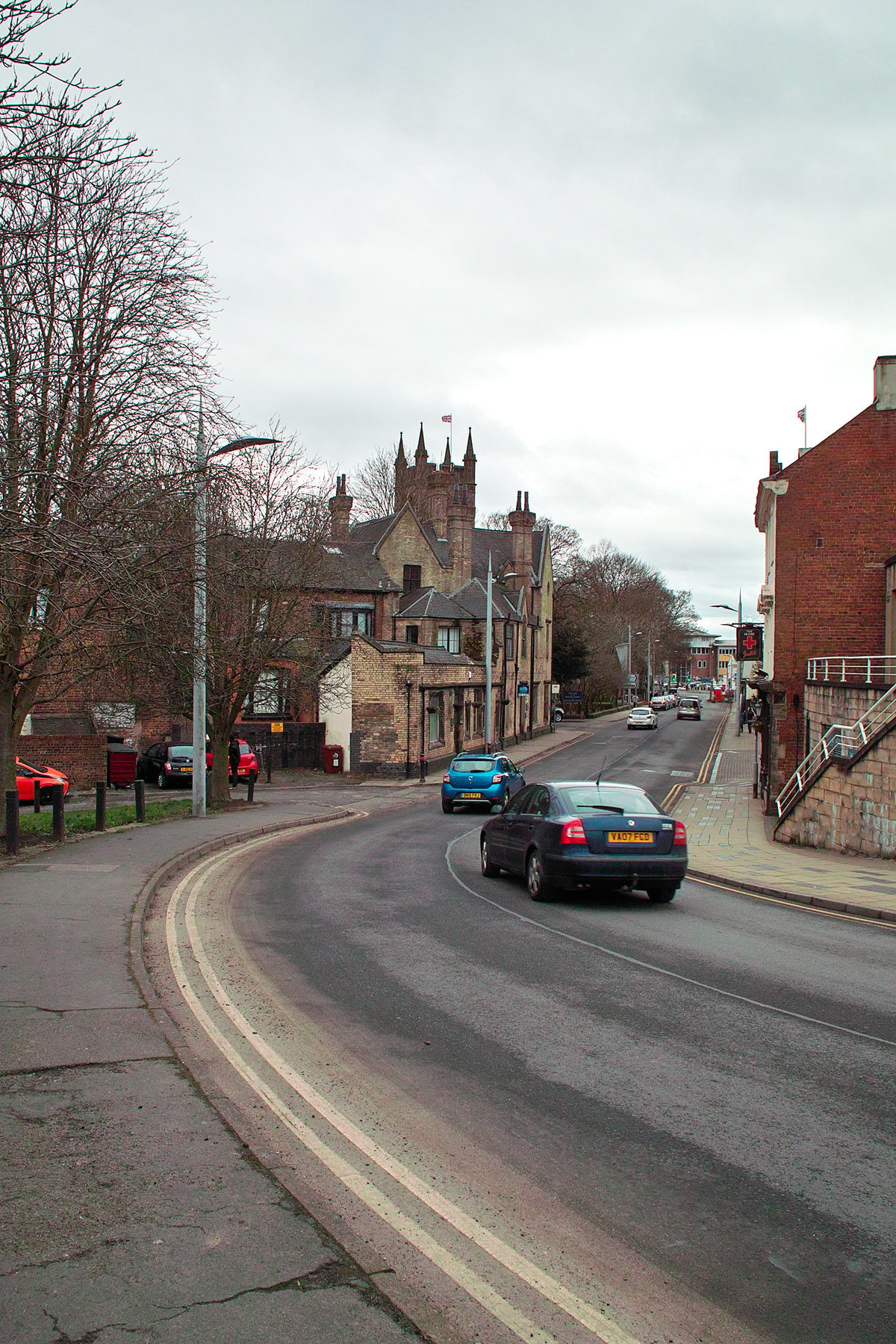
4. At the bottom of the curve, you will find yourself at the corner of the Minster churchyard at Brook Street. Enter the churchyard, and then go across it under the large mature trees.
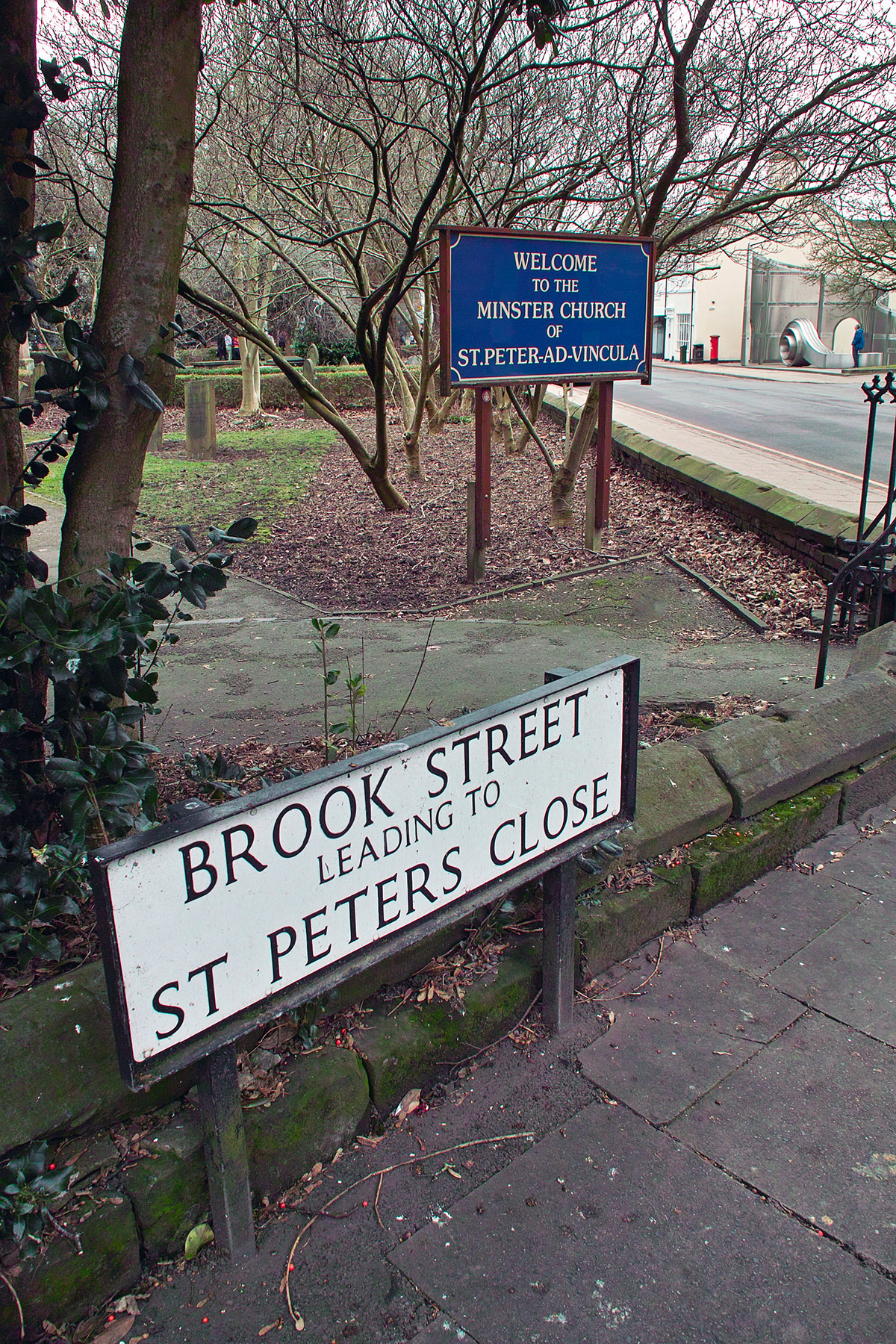
While at the church doors, peep through the trees on your right and across the road… to see Stoke’s new £10m townscape heritage fund at work. They’re renovating a row of shops that had been grotty eyesores for decades. There is also an ancient Anglo-Saxon cross and other Saxon stonework in churchyard, if you care to find it.
5. Take the path in the picture that curves away to the left. On exiting the churchyard, nip across the Church Lane bus-lane via its handy traffic islands. (Less nimble folk should instead use the right-hand path, and use the pedestrian crossing).
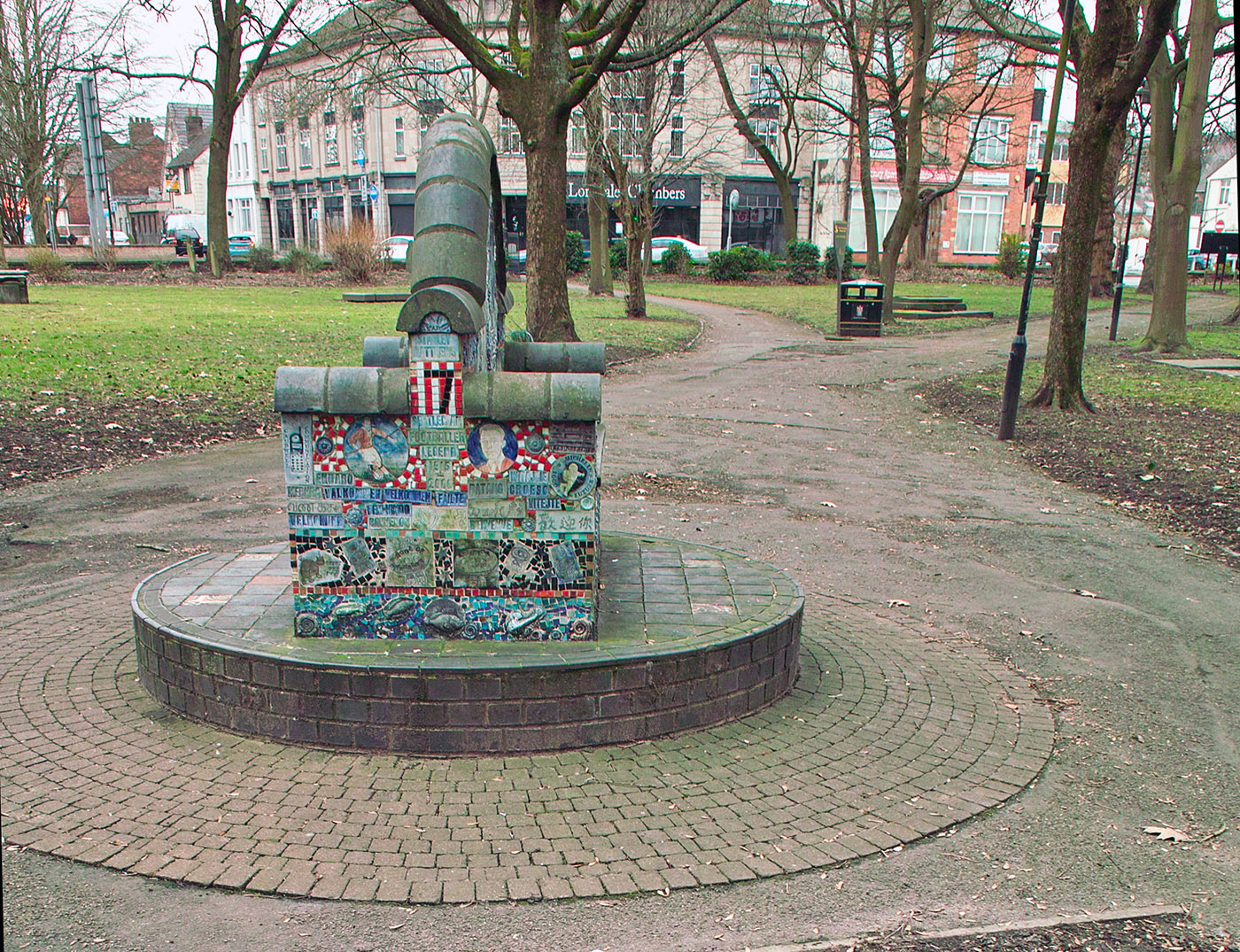
6. You will now be on the other side of the road and thus alongside the ‘other half’ of the churchyard. Go left along the side of this and toward the steps you can see in the distance. They’re about where the river-path starts, at its northern Stoke end.
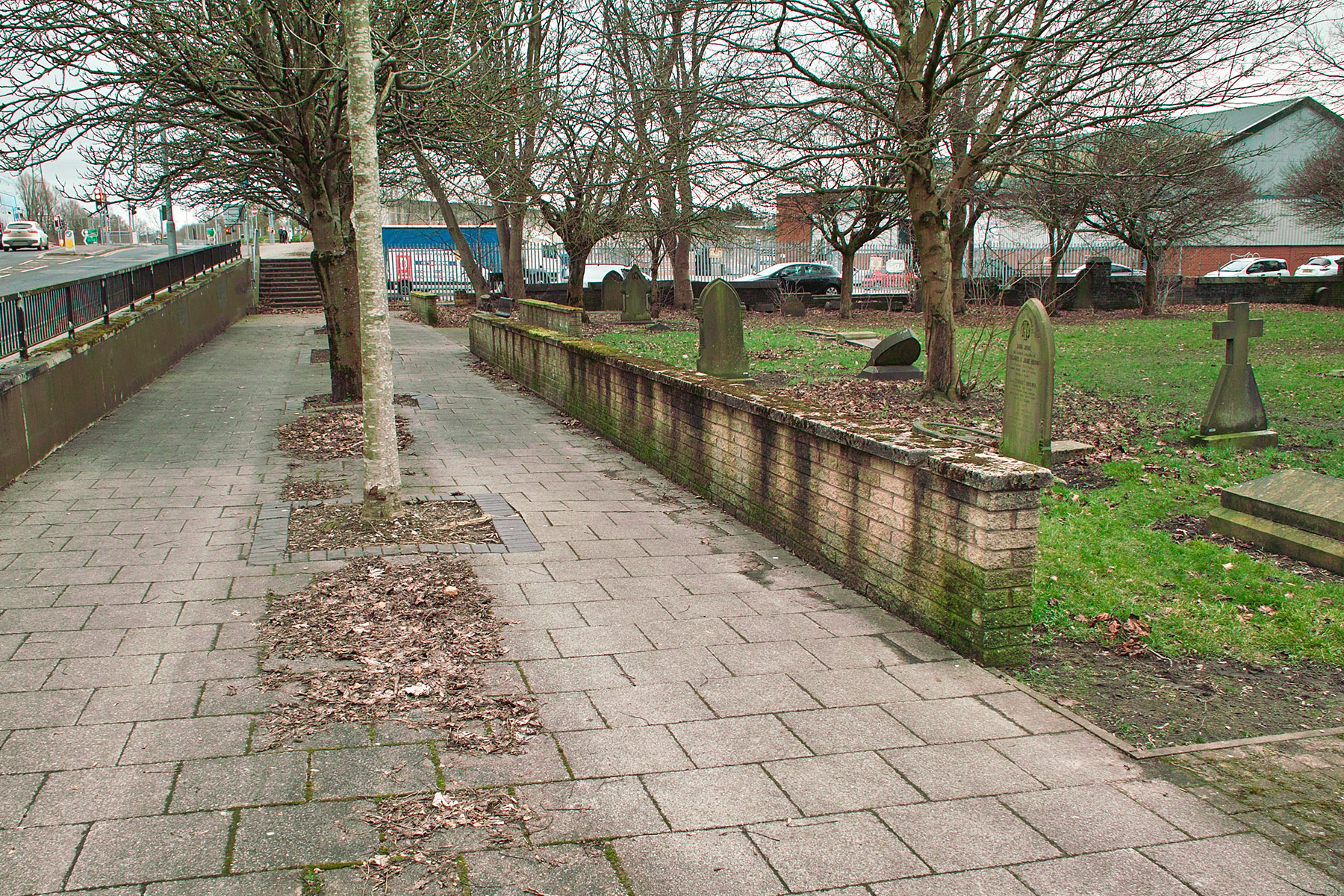
As an alternative, you might try the short and quiet Bowhead Street (side of the cemetery extension, where the parked cars are in the above picture), then turn left into the quiet Woodhouse Street. This option has the advantage of avoiding the steps and a close encounter with all the idling traffic fumes at the mega-junction.
7. Either way, you’ll find yourself on the start of the first (most northerly) section of the paved River Trent path at Stoke. It’s a bit grotty, especially at the “dossers’ bench”, but it does the job. Follow this paved path along for a few winds and turns, until it ends here in a rise…
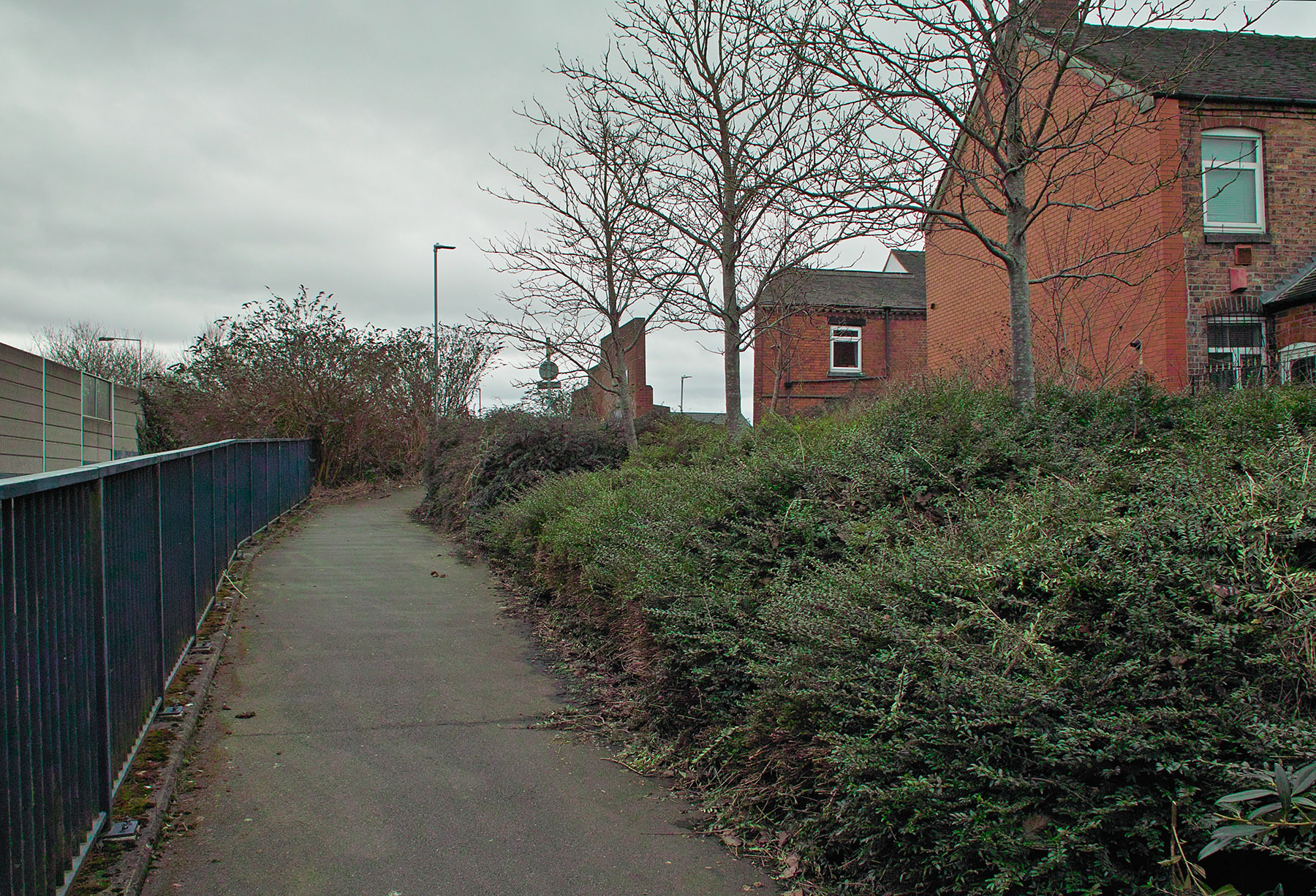
… and at the top of this rise you are then enticed to go across a pedestrian bridge by a cunning ‘cycles and pedestrians’ sign.
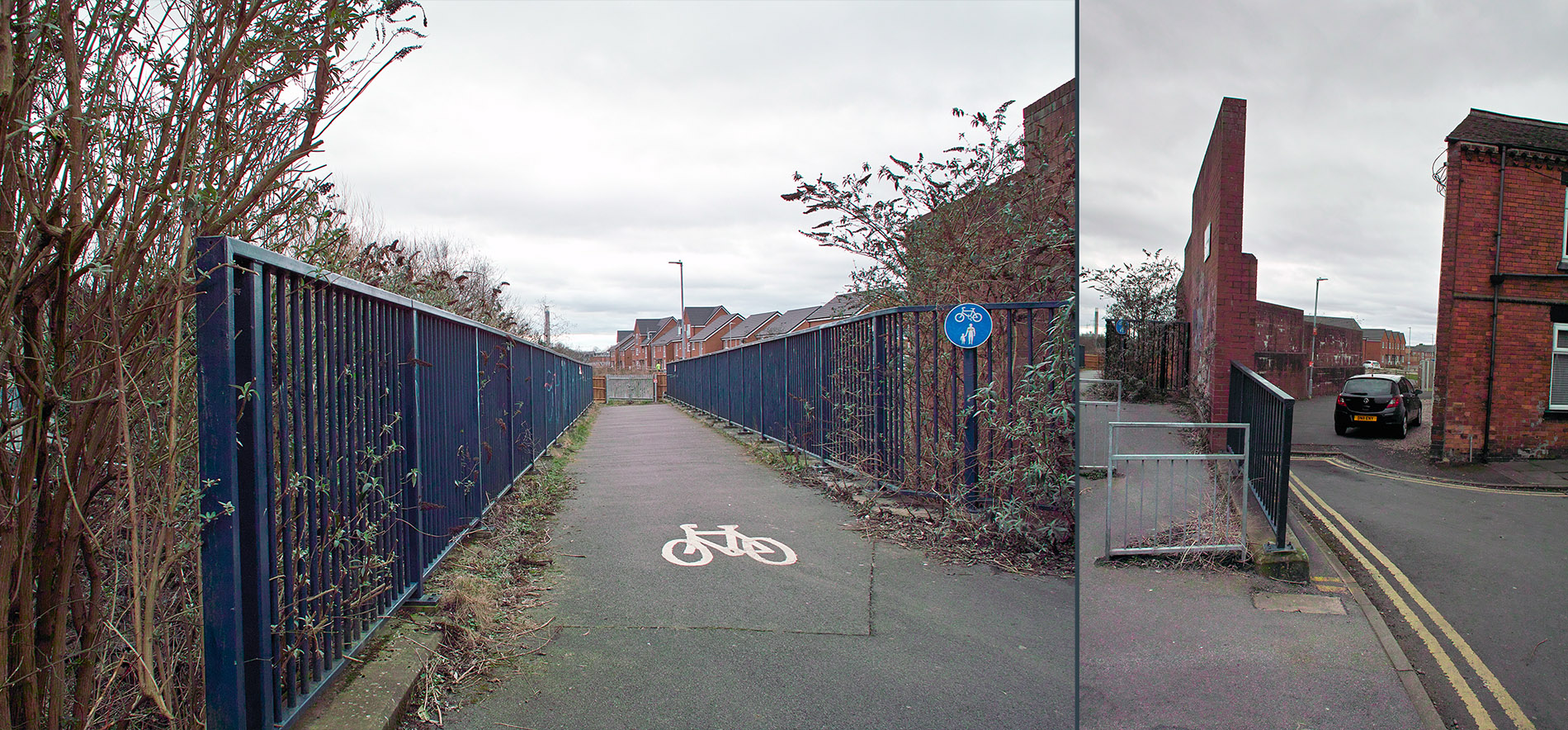
Once upon a time that worked to get you to the river, but no longer. Today it will only get you onto the Whieldon Road and on the way to Fenton, or over onto the canal with a bit of a wiggle.
So, instead, in 2023 you now go down the side of the bridge, as seen above in the picture on the right.
8. Yes, it looks like it might be someone’s parking-space. But go a few yards further on and you will have found the start of the new river-side path along the ‘new’ River Trent!
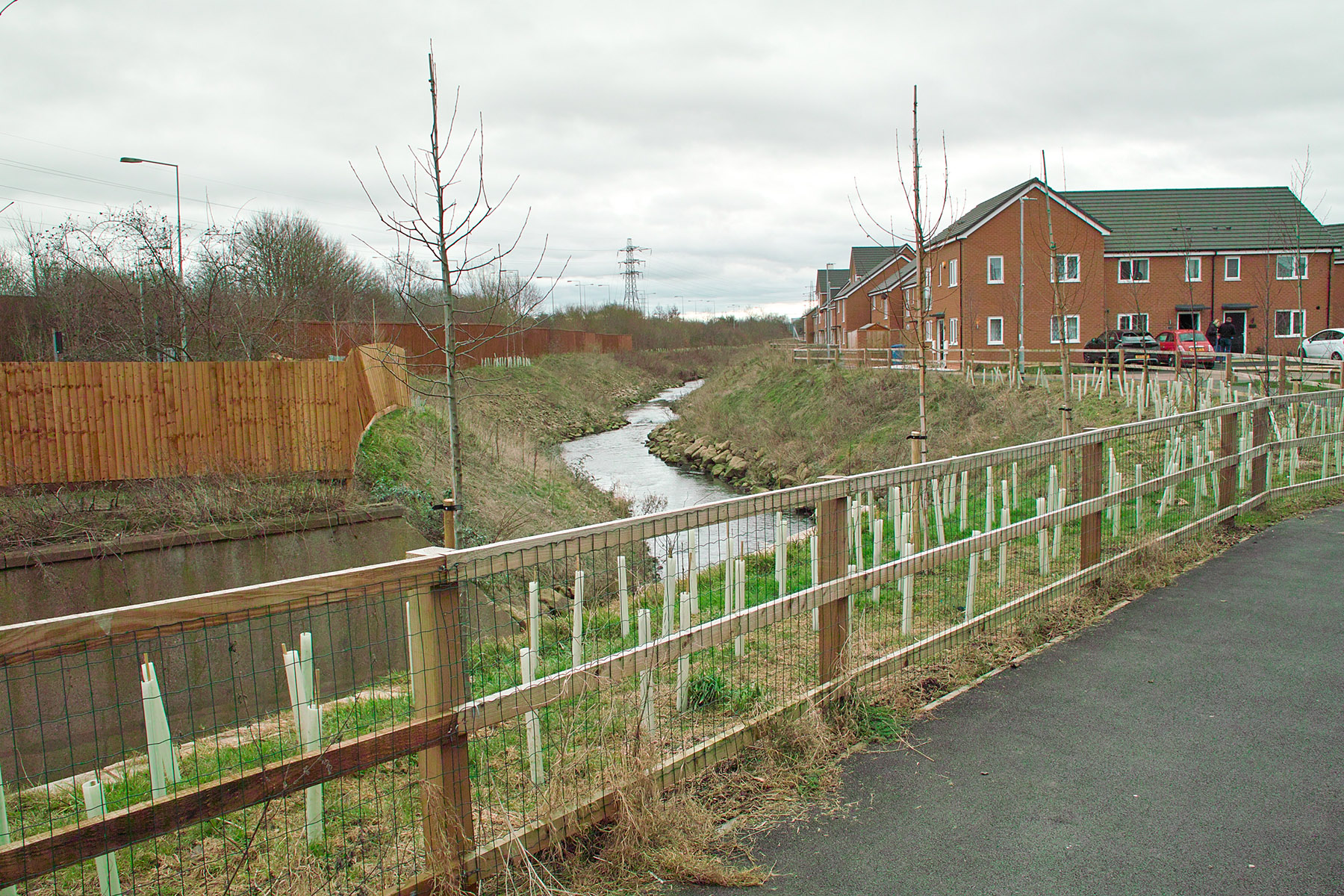
For now, before the trees grow and the vegetation takes over, you can look over the wooden fencing and admire the new nature-friendly banking and pebbling. So far, there’s not much rubbish being chucked over. But, as we all know, it only takes one feckless family and a few flytippers to ruin it for everyone else. Enjoy it while it’s rubbish-free.

9. Go all the way along this new footpath…
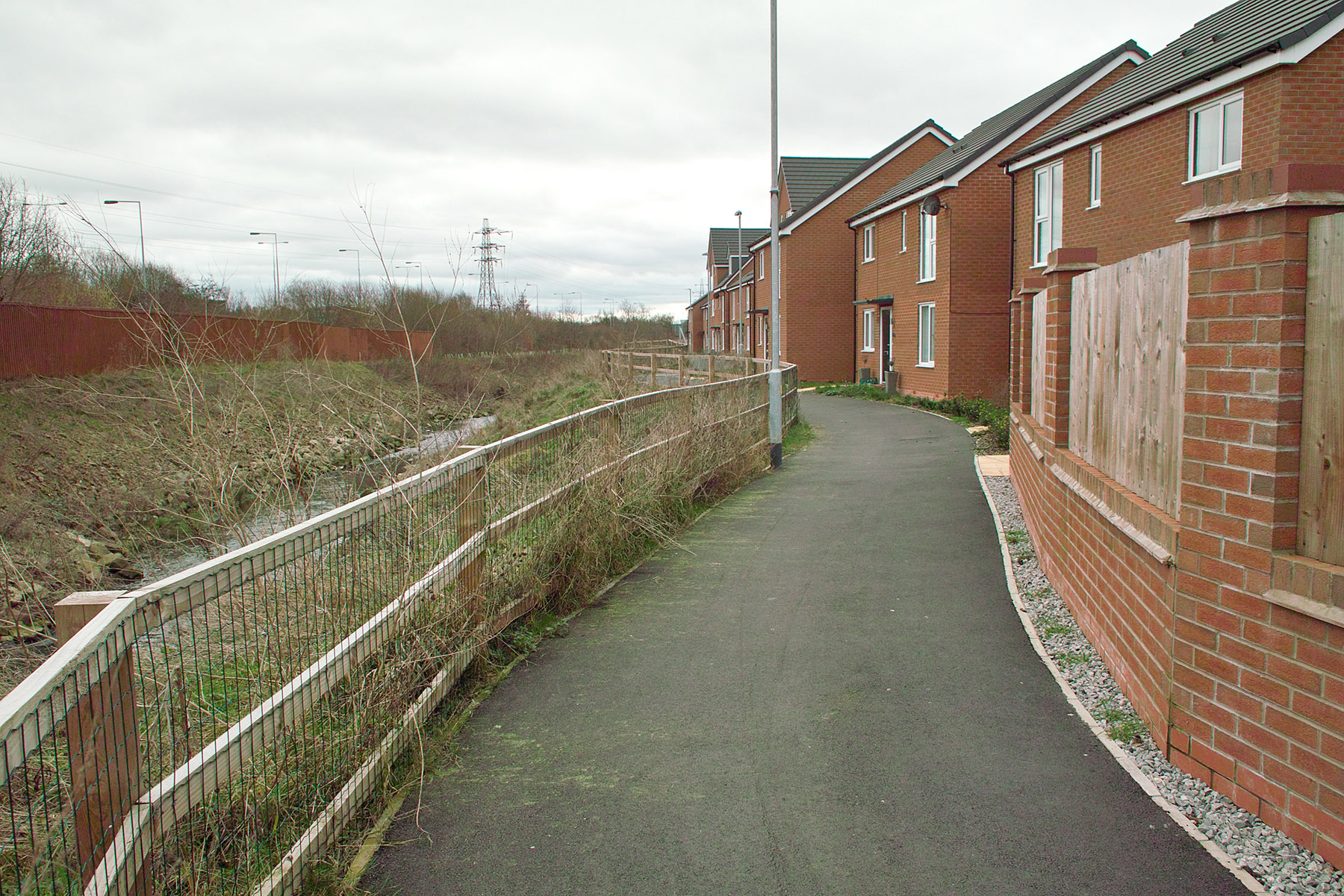
Now on a bike in summer, you’d have to be very careful. The houses are rammed against the path and they have tiny front gardens. With many young families and hundreds of blind corners for small kids and dogs to pop out of, there’s no way you’d be able to safely race along this path on a bike at 25 mph. Boy-racers beware.
Ok, so after a while you get near the end of the path… only to find it’s blocked and not finished yet (February 2023).
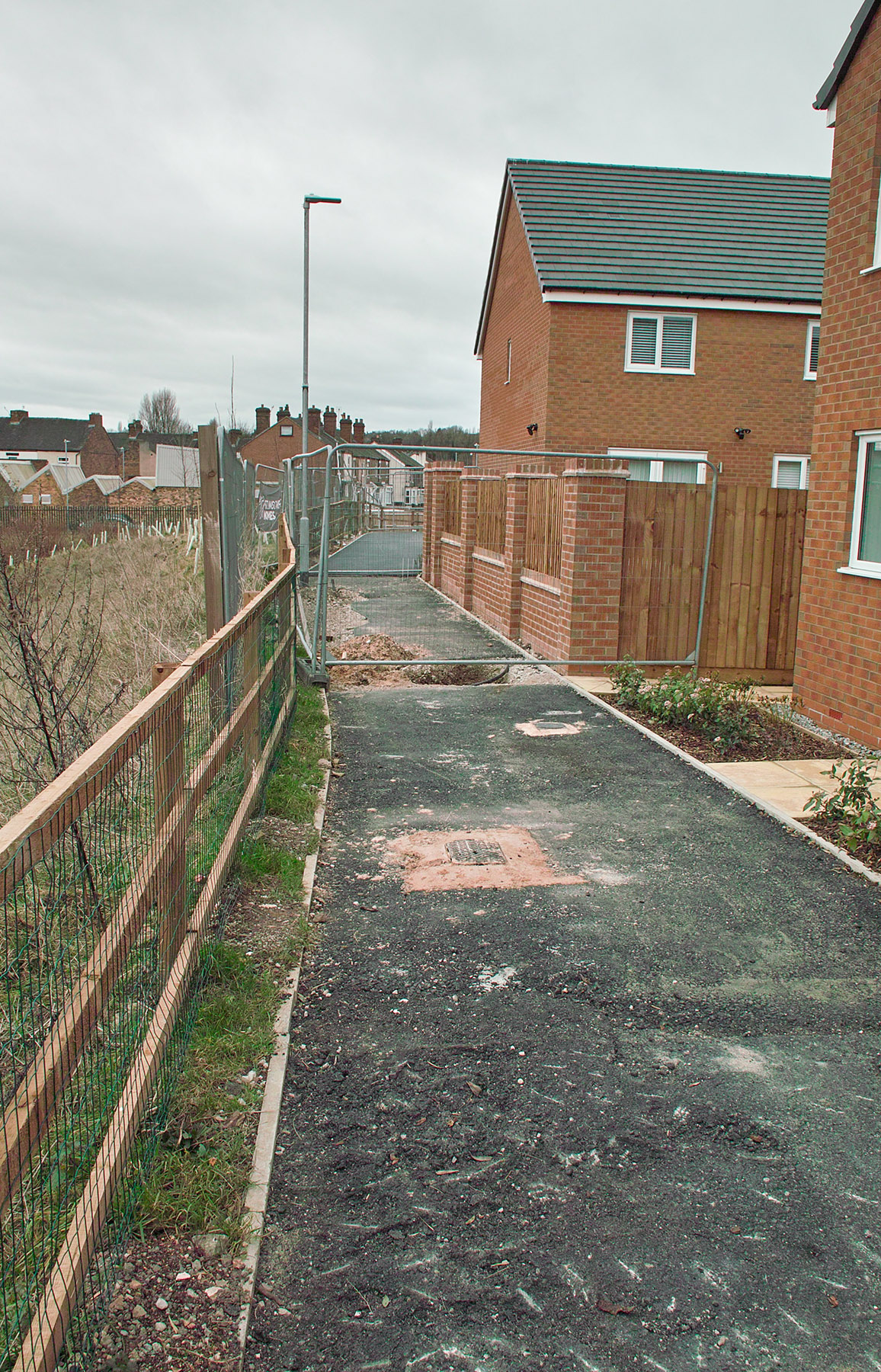
10. You might try to hook around through the estate, hoping for a bypass for this short blockage, and… still no access. The end point of the path is also not finished yet. Looks like it could be another six weeks work yet, especially if they first need to finish the “phase two” of the estate that’s currently going in alongside the path’s ending point.

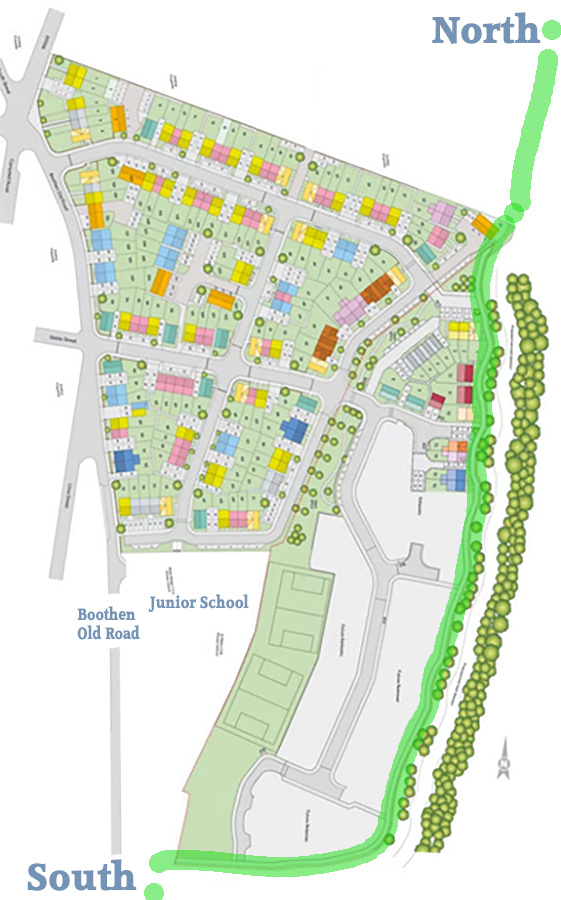
11. That’s Boothen Old Road you can see on the other side, a little south of the junior school. The entrance to the old established riverside path is a few yards further down on the left. Judging by the estate map seen below, it could well be a ‘nature bit’ at the southern end of the junior school’s new playing fields.
Here’s a half-built estate map showing how it should run. The path is in green.

Good old Boothen Old Road, hurrah!
Due to the above blockage, for now you would instead need to go as far as Step 8 in the list above. But then you would:
9. Go a little way along the new riverside path, but then cut into the estate along Paul Ware Street, to reach the northern end of the Boothen Old Road.
(Bob McGrory Street may also be available through the estate, and a bit shorter. But possibly it would be easier to miss the turning of the path).
10. Now you’re on the start of the Boothen Old Road. You don’t want to go up that very tempting but very long cobbled alley on the right. Instead, keep on the gently curving road that goes down toward the junior school.

The obvious ‘bad parking and big bins’ problem means it can be a bit tricky to navigate the footpath down Boothen Old Road, but it’s not too bad.
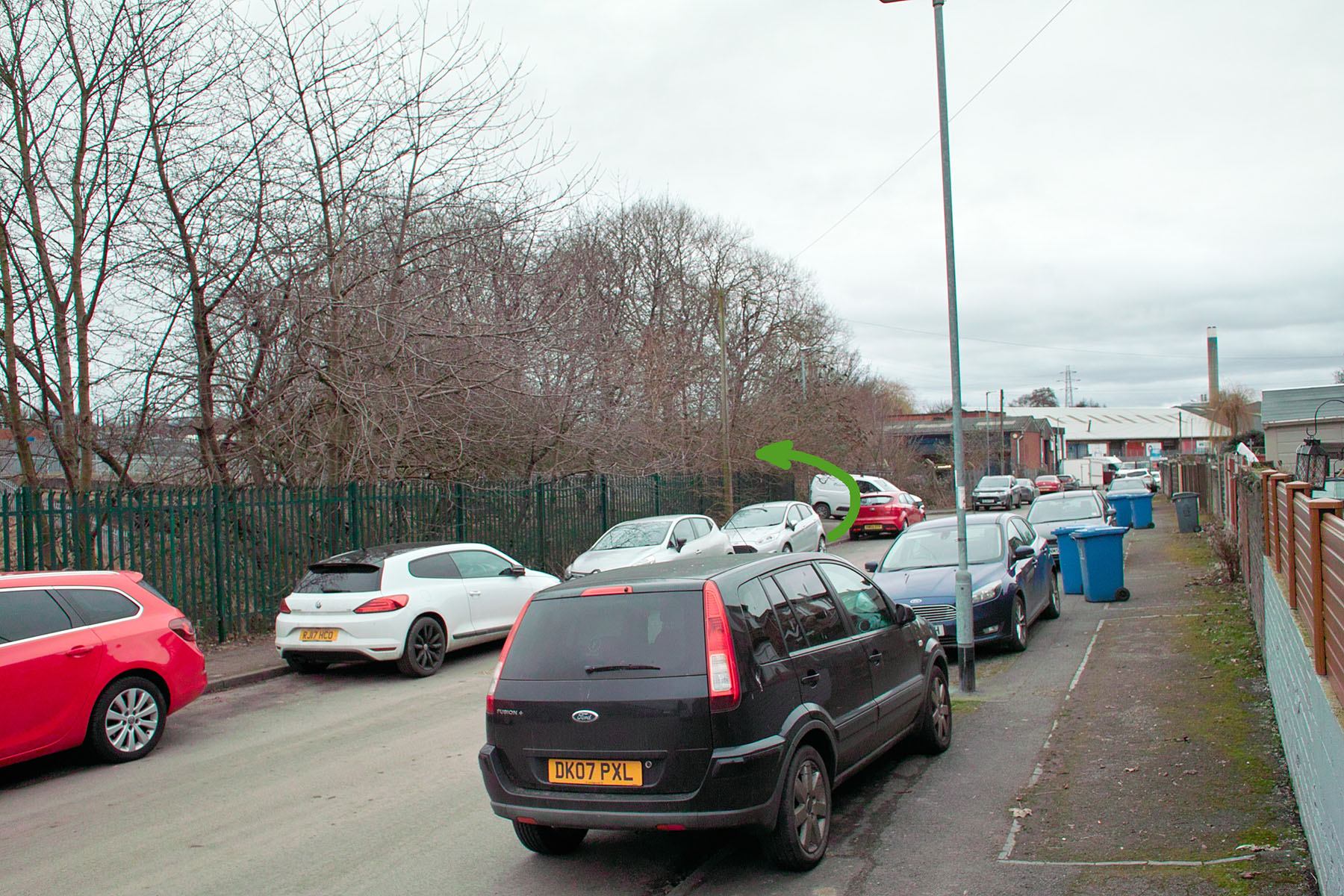
11. Go a short distance past the School, and you will see the (currently) blocked-off end of the new path. That is where you would have come out, and will do once the new riverside path is open. As you can see from the picture below, you may now think you’re headed into some industrial estate cul-de-sac. But the entrance to the old river path is hidden from view on the left. My green arrow shows where it is.
12. Ok, so by either route, you will now be standing at the entrance gate which will take you onto the longer-established river-path. You may still be unsure however, as it looks like you’re heading into a big dangerous electricity compound.

13. Have no fear though, no Thor-like electrical bolts will zap you if you step though. Go through the bike-gate and onto the bridge and you’ll see you’re on the right track. The river is below you.
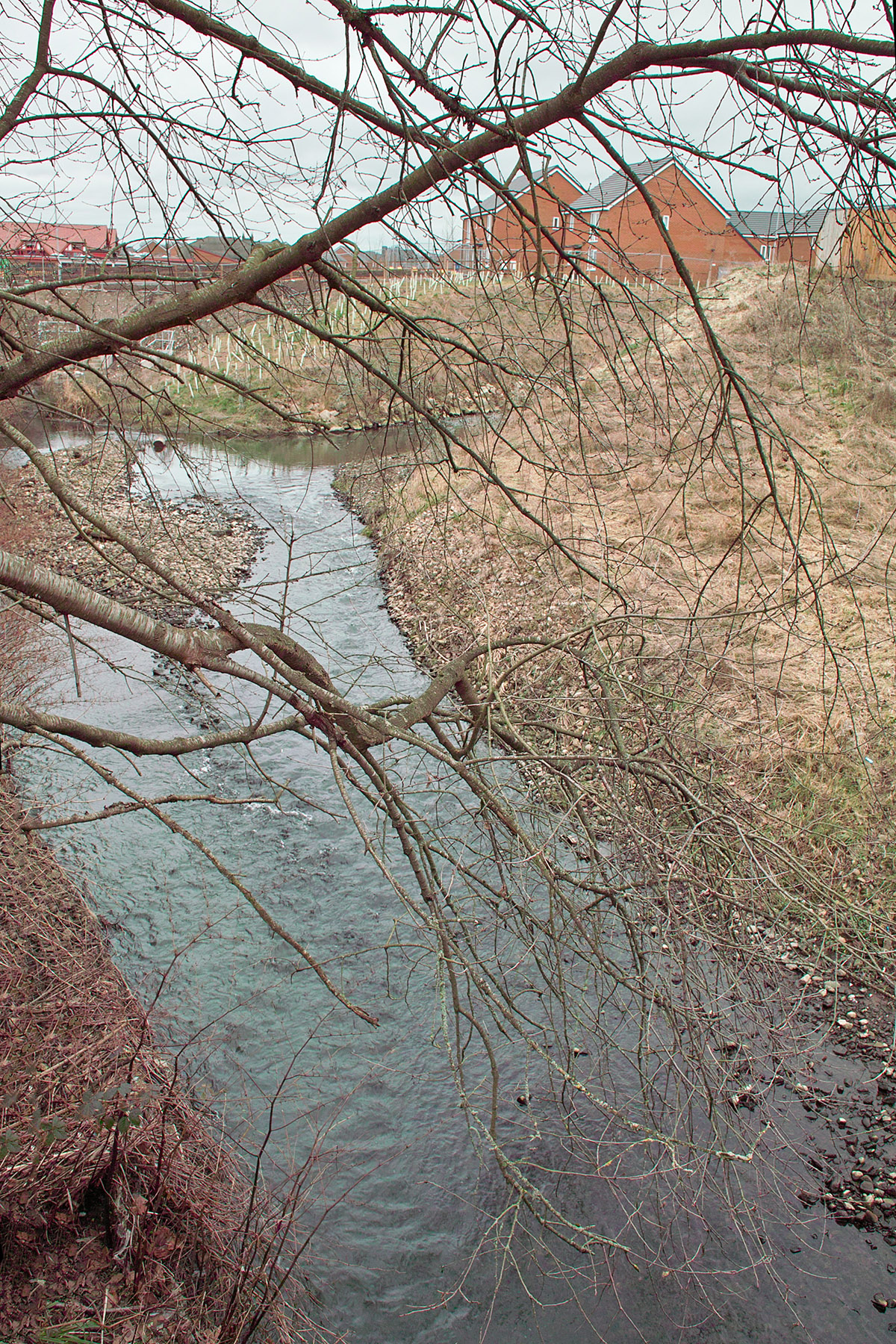
Again, you can see how the new river channel has been banked and shingled. Most of this view will soon be covered in leaves and greenery.
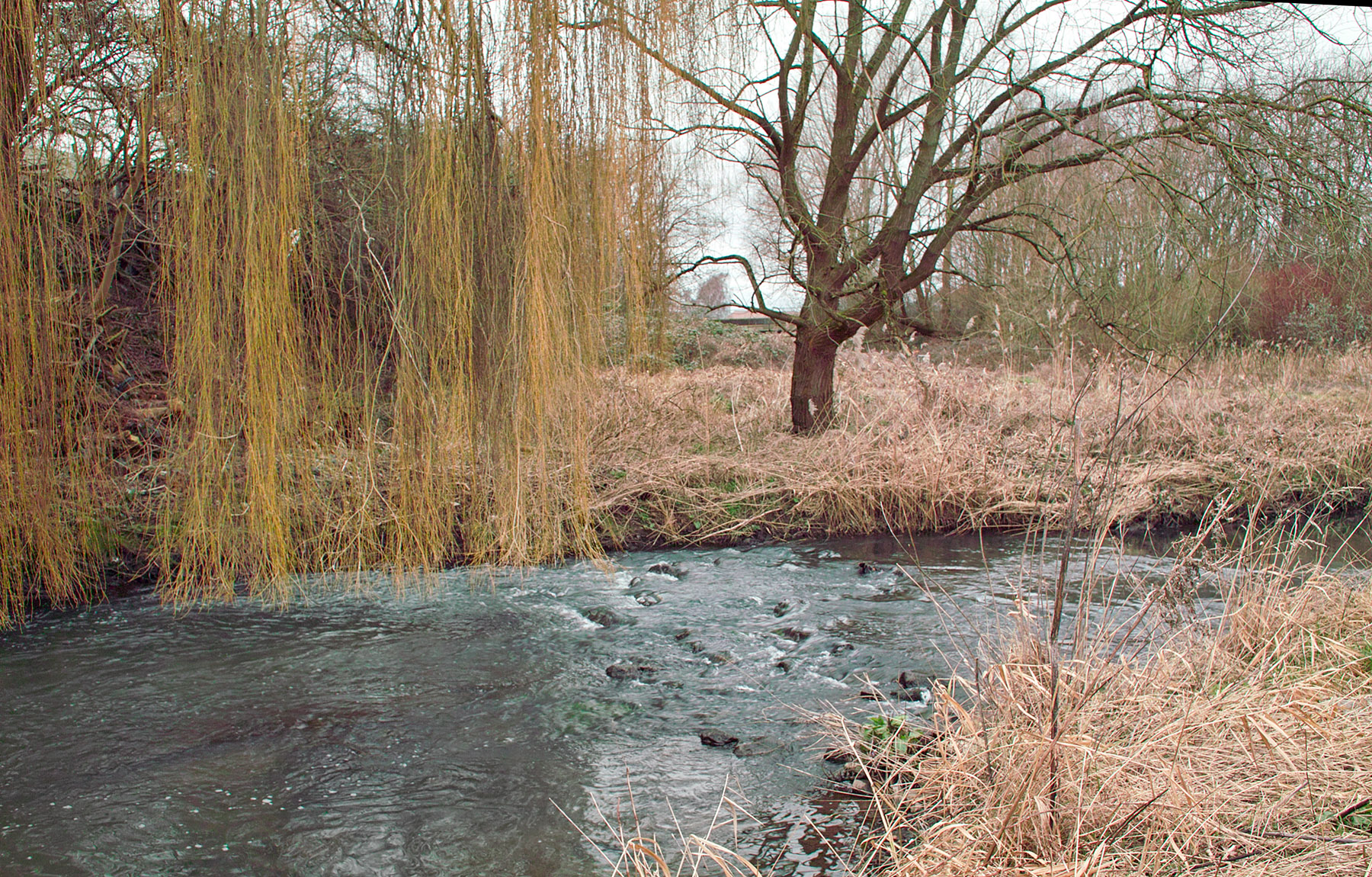
14. Finally follow the very grotty and litter strewn bit of the path, as it goes around the electricity compound. Druggies have obviously camped in the trees here. Hopefully the entire path from the Minster Churchyard to Hanford will get a very thorough litter-picking (and new signage) to celebrate the opening of the complete new path. But the path gets better after 50 yards, and eventually you see the paved path that runs down to rejoin the river. From here the nice and straightforward 1½ mile path will take you all the way to Hanford along the riverside (for an onward walk to Trentham Gardens and the Trentham Estate). The only problem you might have here is a bit of shallow flooding (only a few inches) of the path in the winter or early spring, after heavy rains. But that problem was caused by the river rising, and my guess is that the new upstream channelling and re-shaping will prevent this in future.
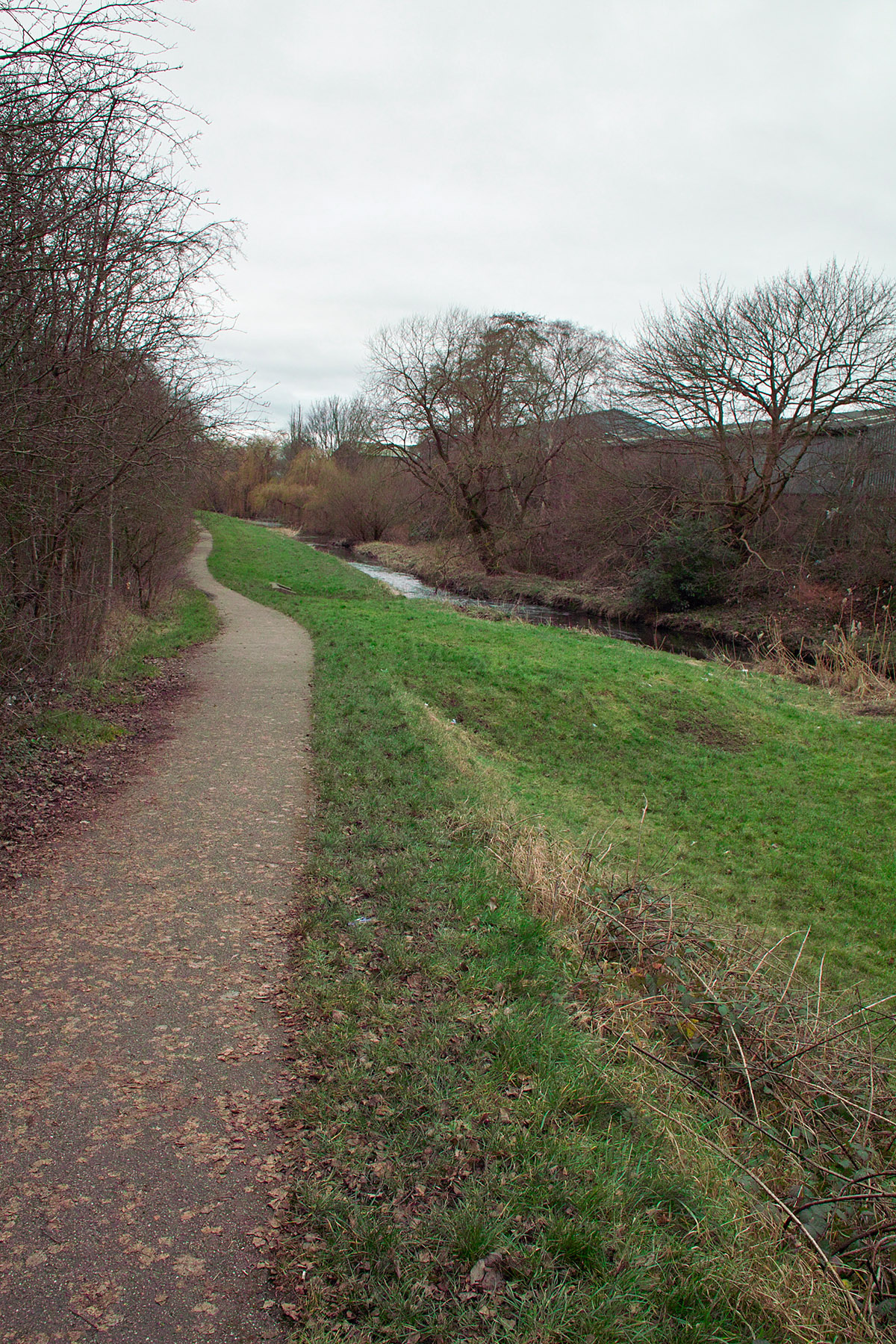
That’s it. Admire the many tree-ish views as you walk along the young River Trent!
Excellent news. Stoke-on-Trent City Council’s road-widening contractors have accidentally completely destroyed what was (to my mind) a rather disrespectful sculpture of Wedgwood, a stolid work which few will mourn and which implied he had a ‘mind of bricks’. This had long languished in front of his house on Festival Park. Good riddance.
Another for a hypothetical “Strange and Surreal Stoke” ceramics exhibition at the Potteries Museum. An “ent vase” by Anita Harris, who works at Longton in the south of the city.

* Published yesterday, the new book Tolkien’s Library: An Annotated Checklist: Second Edition Revised and Expanded. A simultaneous release in hardback, paperback and Kindle ebook.
* On Archive.org, free to borrow, J.R.R. Tolkien: a descriptive bibliography (1993). This is an out-of-print table-trembler of 434 pages. The book is deemed ‘collectable’, and thus appears to be effectively unavailable to scholars except at Archive.org.
* Newly announced at the Avila Institute, SSF279: Healing the Imagination: A Reading Course in The Lord of the Rings. Dates are “to be decided” but, judging by its position on the course-list, summer 2023 seems likely. Avila is a legitimate ‘Catholic online studies’ teaching service, with a global reach.
* A one-hour video from the “Tolkien et le monotheisme” conference in May 2022. On YouTube, with auto-translation of sub-titles to English. The conference was…
“organised by the CUFR of Dembeni in its amphitheatre. The conference is entitled ‘Tolkien and Monotheism: Religion in the life and work of J.R.R. Tolkien'” … “though the Catholic religion had a preponderant place in the life of the writer, his writing nevertheless reveals a cosmogony not simply reducable to this monotheistic religion.”
* And finally, a “family photo” of ‘Bag End’ made by a later owner. Uploaded 2018 by a descendent, and seemingly un-noticed by Tolkien historians. Regrettably a very poor and small picture, possibly taken out of an 8mm cine-reel by the look of it, with an ND grad filter on the lens. This is about the best I can do with it in Photoshop…
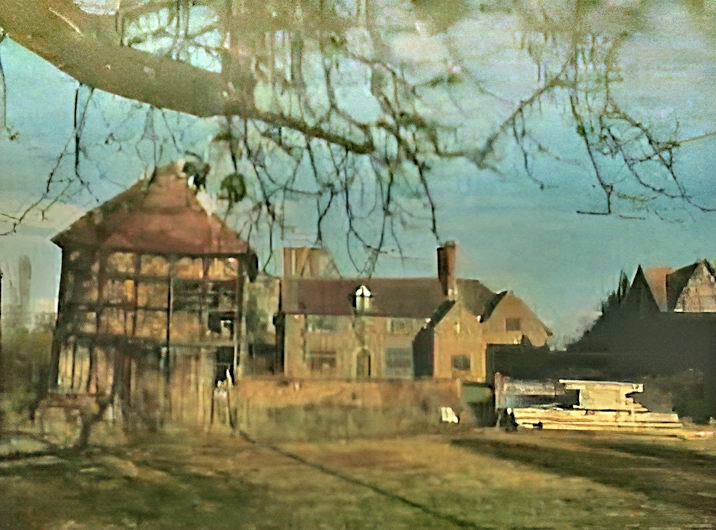
Definitely not a pristine glass-plate picture, but better than the source:
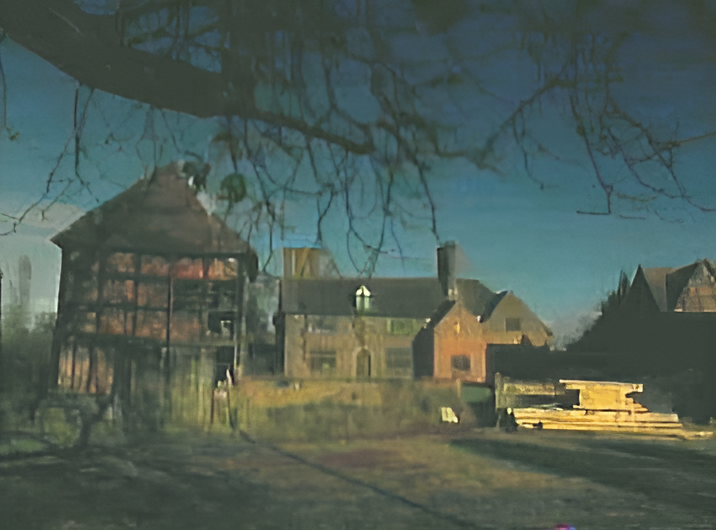
My guess would be post-war, maybe the later 1960s? There are of course many half-timbered buildings dotted about Dormston. But for confirmation of the site, cross-reference with the pictures of the real ‘Bag End’ at the Tolkien Library.
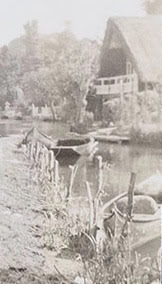
* New unseen Tolkien family photos, early 1930s. Tolkien himself is not seen, and presumably he was the one making the pictures with the camera. The discoverer of the pictures says…. “I’ll be sending high res versions over to the Bodleian shortly”, but has kindly posted low-res versions on Reddit. Tolkien is known to have gone to Lamorna Cove in 1932, but there’s no way these pictures show Cornwall. The scene could be anywhere on a lowland English river, south of the Peak and east of Exeter. Though the distinctive waterside thatched boathouse, boat-type and willow-pollarding might be able to be cross-referenced to a postcard, and thus the location identified. My guess on that would be that one would start looking around Evesham, where his brother was living. Possibly also along the River Stour over in Worcestershire or near Oxford.
* A book from late last summer, and new to me, The Road to Fair Elfland: Tolkien On Fairy-stories: An Extended Commentary (September 2022). This appears to offer the text with…
“references to Tolkien’s precedents and sources for the themes he treated in his essay” and also examples of how the famous essay “proved to be influential or even ahead of its time in the decades following”
The book is on the Kindle, so the free 10% ebook sample should get you the complete preface.
* Kent State University Press has announced the book To Rule the Fate of Many: Truth, Lies, Pity and the Ring of Power (forthcoming). Thankfully it appears to be nothing to do with That TV Series, despite using a similar name. Seems to consider how … “Tolkien could encompass in his sympathy Christian religion and pagan mythology” and thus was able to craft a dynamic place in which he could deeply consider “truth, lies, pity” and bring them “onward to a more philosophical and theological treatment”.
* Tolkien’s Mythic Meaning: The Reader’s Ontological Encounters in The Lord of the Rings. A 2020 thesis for the University of Manchester, now available online.
* And finally, “Australians are LARPing”.

* A new 2023 review of An Anthology of Iberian Scholarship on Tolkien (2022). “Iberian” here means both Portuguese and Spanish. The review is in German, but the page is in HTML and thus easily auto-translated.
“Simonson [examines] the function of the trees on the continents of Valinor and Numenor, in which beauty and utility are combined. […] only the balance between materialism and aestheticization can guarantee a responsible approach to nature.”
* Call for chapters: Theology, Religion, and Dungeons & Dragons. Relevant to Tolkien, given the formative influence LoTR had on Gary Gygax’s original classic D&D. Deadline: 15th February 2023, with the chapter to be submitted by the end of the summer.
* A public on-site talk titled “The Life and Thought of J.R.R. Tolkien”, in Houston, USA. 24th April 2023. Free and booking now.
“Professor Holly Ordway will provide an enriching presentation about the life and thought of J.R.R. Tolkien”.
* From Country Life magazine, rare images of J.R.R. Tolkien from 1961. Regrettably the magazine has sandwiched the online article with an unexpected auto-playing video of a mass of crawling insects. All video on the site can be perma-blocked, by pasting the following to your uBlock Origin ‘My Filters’ block-list…
! https://www.countrylife.co.uk
www.countrylife.co.uk##.jwplayer-margin-bottom.jwplayer-container
Or, if you want to perma-block all such nonsense in their online articles, videos or not…
! https://www.countrylife.co.uk
www.countrylife.co.uk##.injection
* And finally, on the BBC this week…
“Russell Kane and his guests discuss whether the writer [Tolkien] was evil or genius.”
Seriously. That’s their blurb. For BBC Radio Four. And they wonder why few pay any attention to the BBC these days.
* An update on Signum University Press. The Press is barely six months old, but now has a firm slate for 2023 and beyond. In Tolkien studies there’s news of the book Cardinal Vices of Middle-earth (September 2023), a new “comparative analysis of the role of chosen vices and virtues” from a Catholic perspective; and “An interview series with Verlyn Flieger”.
* A casting-call for Fellowship: Tolkien & Lewis… “an upcoming limited [screen] series, based on the friendship, faith, and fantasy of C.S. Lewis and J.R.R. Tolkien.” Filming in London in early spring 2023, and the call has a rather tight deadline. Why do such projects/jobs always seem to have a ‘rush-rush’ deadline of days, rather than at least a month or so?
* Wheaton University now has its list of summer school 2023 courses. Includes “The Makings of Middle Earth: Creation, Creativity, and J.R.R. Tolkien’s Lord of the Rings“, and the “Otherworlds of Imagination in C.S. Lewis”. Seems to be aimed at regional students who want a long taster of what the university can offer. I had to look up “Wheaton, IL”, and it turns out that this well-known university is on the edge of the city of Chicago.
* Issue 2 of my Tolkien Gleanings as a PDF magazine, now available for download.
* And finally, oh dear… more PR piffle for bamboozled tourists from the city of Birmingham. The Birmingham University tower… “is famously believed to have been the inspiration for the tower of Orthanc, the black tower of Isengard”. Will the city ever learn that there’s a really moving true story to tell about Tolkien and Birmingham? They don’t have to make it up.
Worzel Gummidge: The Complete Restored Edition is finally shipping in Blu-ray, after several delays over Christmas. Judging by the January 2023 reviews on Amazon UK, people are very pleased with the restoration. The earlier VHS and then DVD editions had really terrible picture quality despite the classic TV series being made on film. Just another example of the criminal lack of archival care given to British 1960s-80s TV shows, at a time when the UK should have been funding a proper national preservation archive. Instead it’s been largely left to the fans and collectors, who have done a marvellous job in difficult circumstances.
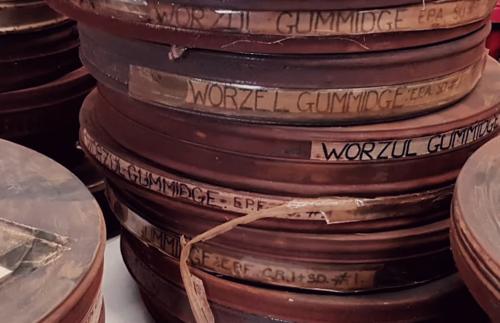
This rare full restoration, previewed with some screenings at the BFI and by all accounts an amazing job, is due to the discovery of the 16mm film cans by two old-TV sleuths. As one reviewer puts it…
How fitting is it that the original 16mm film negatives were discovered in a barn, after 40 years!

The Potteries Post has updated. North Staffordshire ‘news you can use’, in the arts, creative industries, history and wildlife.

My Tolkien Gleanings issue 2 (Jan-Feb 2023) is now available for download. A handy PDF magazine format for Tolkien scholars, collecting all my recent ‘Tolkien Gleanings’ news postings since the last issue. I also add some articles, vintage pictures and a book review. Contributions, especially scholarly book reviews, are welcomed for the third issue.

“33, an important number”
* A two-day conference on “G.B. Smith and J.R.R. Tolkien: a meaningful friendship” at Corpus Christi College, Oxford. 22nd-23rd March 2023. Looks excellent. Booking now.

* Starting in May 2023, a new Signum University course titled “Tolkien Illustrated: Picturing the Legendarium”. “Two 90-minute live lectures and one 1-hour discussion sessions per week as assigned (4 hours total weekly).”
* A new issue of the open-access journal Fafnir. One review is of interest, of the book A Sense of Tales Untold: Exploring the Edges of Tolkien’s Literary Canvas.