Tolkien Gleanings #153

Tolkien Gleanings #153.

* The Tolkien Collector’s Guide takes a seasonal look at collecting Tolkien’s Father Christmas Letters, on YouTube. Not the original letters, but rather the many book editions which have collected the letters for children.

* New on John Garth’s website, a long essay on “Goblin caves, ancient scripts and Tolkien’s gift for invention”. We get the opening of the article, and then it’s “Continue reading for free via my Steady crowdfunding project…”. But I see no clickable link through to the little-known Steady. It turns out that his full article is freely available here.

* The National Review on “J.R.R. Tolkien and His Catholic Faith” ($ probable paywall), reviewing Holly Ordway’s new book.

* Free this week in Omnes magazine, an interview with Holly Ordway.

* Want to read Gothic like Tolkien? Starting at Signum University in early January 2024, the online course “Introduction to the Gothic Language”. Booking now. I see that their course “Tolkien & Science”, with Kristine Larsen, is still in development for a possible 2024 slot.

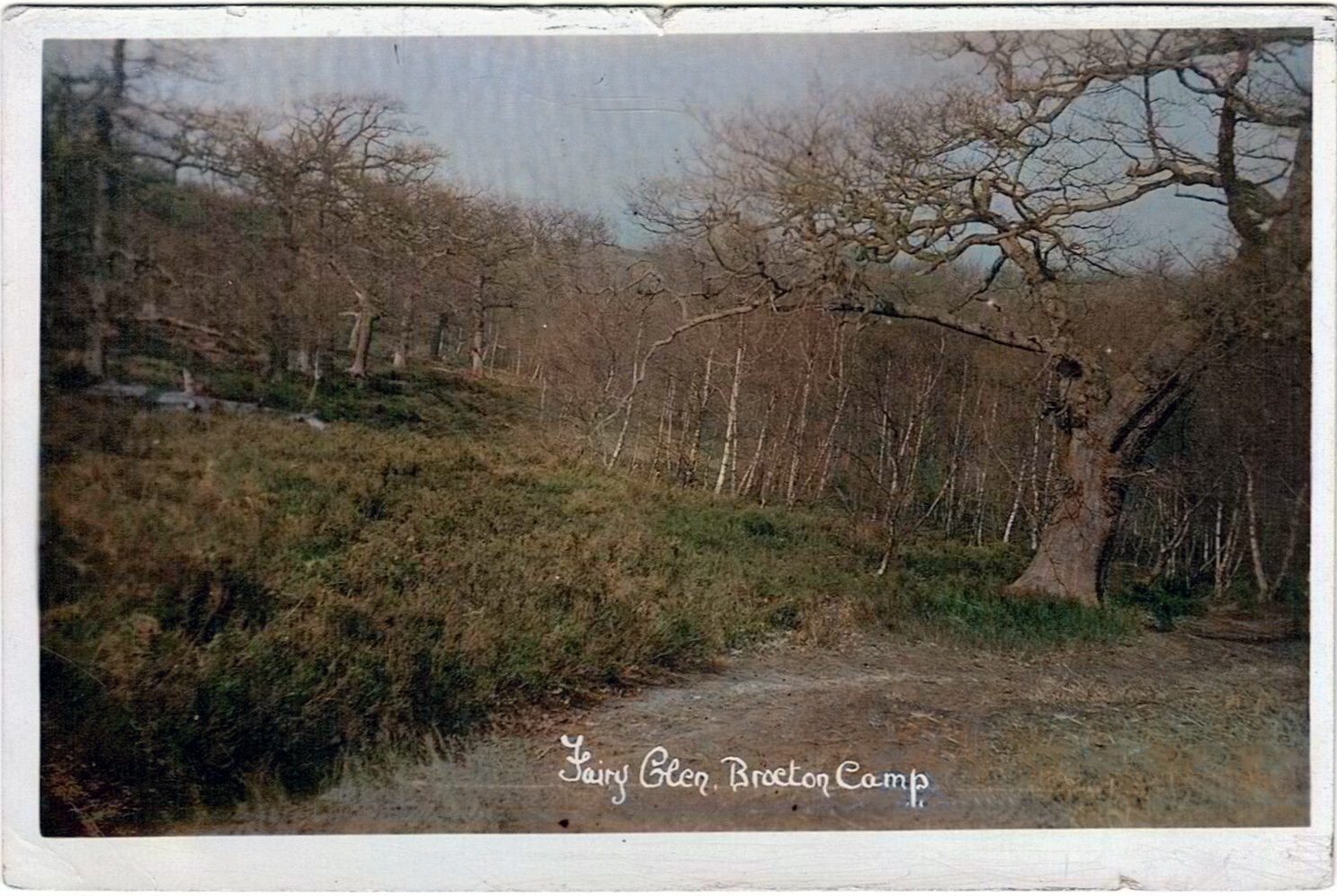
* And finally, a winter postcard from the ‘fairy glen’, which was near to Tolkien’s Brocton army training camp on Cannock Chase, Staffordshire. The card was probably made near to the time of the First World War, if not during, and is here newly colourised. One can almost image a Black Rider coming past on the track, and two hobbits hiding behind the fallen tree.

Tolkien Gleanings #152

Tolkien Gleanings #152.

* “Tolkien and Lewis Manuscripts Donated to Public Domain” through the Bodleian Library…

“A treasure trove of invaluable manuscripts and letters penned by famed authors J.R.R. Tolkien and C.S. Lewis has been generously donated to the Public Domain by the family of a private collector. This significant move was orchestrated as part of an agreement with the government to evade inheritance tax liabilities. The donated items feature drafts of renowned works by both authors, personal correspondence, and other documents that provide a unique insight into their creative process and friendship.”

* The Wall Street Journal reviews the new expanded edition of The Letters of J.R.R. Tolkien ($ paywall).

* Tea with Tolkien reviews the nine-lecture online course ‘The Liturgical Imagination of J.R.R. Tolkien’.

* New in the Journal of the Association of Young Researchers on Anglophone Studies, a survey of “The Celtic Elements in The Lord of the Rings”.

* A useful transcript of the newly-available “The Man Who Invented Hobbits” (1974/75) radio documentary…

“I gather, though I wasn’t there at the time, that Professor Tolkien submitted [to the potential publisher Unwin] the entire incohate manuscript of The Lord of the Rings, in one huge packing case” (Rayner Unwin).

* The UK’s Plymouth University put up a What’s On page for a 2024 event, then 404-d it. But evidently there’s to be a public talk by Joel Merriner on Tolkien illustrations from the old Soviet empire, set for spring 2024.

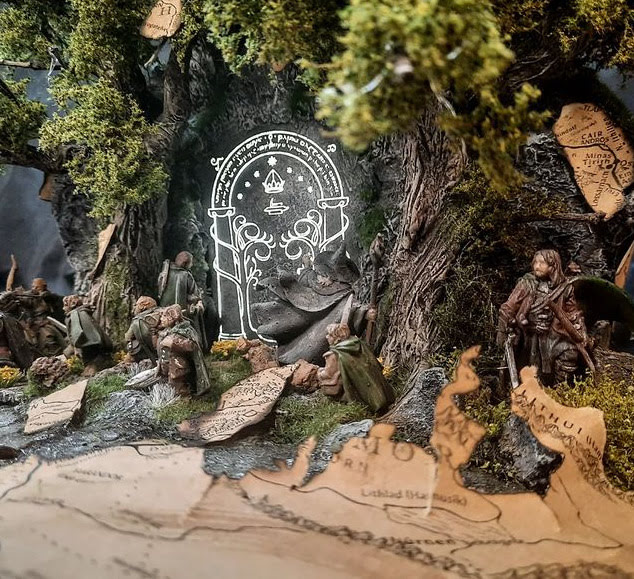
* And finally, an article in Hungarian on Gyenvar Adam and his Tolkien dioramas. Gyenvar’s portfolio is at Helm Hammerhand. His resin dioramas are auctioned for charity.

Tolkien Gleanings #151

Tolkien Gleanings #151.

* A new keynote conference lecture on YouTube, “The ‘Modern’ Tolkien: The Keys to the Enduring Appeal of Middle-earth”. Start at 28:00 minutes in, to skip the very general ‘introduction to the impact of modernity and rural nostalgia in England’, and get to Tolkien. The lecture concluded the Seventh International Conference on Myth in the Arts (November 2023), held at The University of the Basque Country in the north of Spain. Tracking this event down led me to find the entire conference in video form. Includes, among others…

   – Glaurung, Heir of Fafnir: Tolkien’s Reading of Old Norse Dragon Myth (UBC website);
   – Faerie is a Dangerous Land: J.R.R. Tolkien and Fairy Tales (YouTube);
   – Gandalf: One of the Maiar in Tolkien’s Middle-earth (YouTube);
   – The Mythopoetic Value of the Tree of Gernika and its Impact in Tolkien’s The Lord of the Rings (YouTube);
   – In the Beginning there was Music: The Interrelation between Music and Philology in Tolkien’s Work (YouTube);
   – The Sea as a Threshold in J.R.R. Tolkien’s Legendarium and Modern Media (YouTube).

* In the late summer I see that the Sarehole Mill pizzas were reviewed in the article “A Margherita in Tolkien’s Middle-earth”. The food reviewer also remarked that for food…

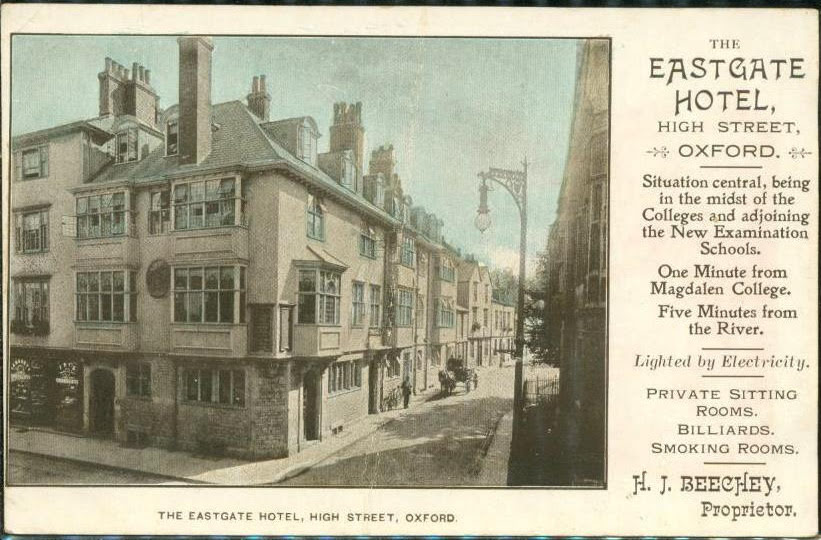
“Tolkien would normally visit the Eastgate Hotel on Merton Street, Oxford, a gloomy inn next to the college where he taught philology while writing The Lord of the Rings. There is [today] something insatiably unhappy about the Eastgate, as if the Boer War[s] were still ongoing. Even so, Tolkien liked it, and he ate there when he lived next door at No. 21.”

The Eastgate was also the site of a seminal debate that one would love to have had recorded on tape…

“[The] clash of ideas culminated in 1954, when Arthur C. Clarke met with [C.S.] Lewis at the Eastgate hotel in Oxford; the former brought with him fellow [British Interplanetary Society] member [and leading British rocket engineer] Val Cleaver, the latter was accompanied by another distinguished Oxford don and fellow writer, none other than J.R.R. Tolkien, and there the interplanetary debate was thrashed out over several hours”. (The British Interplanetary Society and Cultures of Outer Space, 1930-1970, citing From Imagination to Reality – An Audio History of the British Interplanetary Society, 2008).

2024 will be the 70th anniversary of that debate. One wonders if it might be recreated in 2024, patched together from the writings of the four men and presented in a promenade performance at the Eastgate?

* The latest Art of Manliness podcast discusses “The Hobbit Virtues” with the author of Hobbit Virtues: Rediscovering J.R.R. Tolkien’s Ethics from The Lord of the Rings (2020). The show-notes include a link to the interesting article “Against the Cult of Travel: or What Everyone Gets Wrong About The Hobbit” (2021).

* And finally, booking now is an expensive 2024 summer school at the University of Oxford, “An Introduction to Tolkien’s Mythology”.

Tolkien Gleanings #150

Tolkien Gleanings #150.

* The Past Daily digs up “The Man Who Invented Hobbits”. A one-hour NPR radio show (the U.S. government-funded broadcaster, via the Corporation for Public Broadcasting). Apparently broadcast on 1st January 1975. I can find no reference to a radio documentary on Tolkien under that exact name, in Tolkien material, but it was reviewed in the SFRA Newsletter #70, April 1979, when it was issued on cassette by the U.S. Center for Cassette Studies. Which is perhaps how it’s survived. The .MP3 download link is here. It’s a remarkably good documentary. Now it’s been released at last someone will no doubt put Ken Burns-style images to it and make it into a video. [Update: Zionus suggests it’s the same as a BBC Radio Oxford local-radio documentary of 1974].

* The Catholic Theology podcast has a new episode titled “On Tolkien and Myth”

“Can myths and fairy stories help us to better understand reality? Today, Dr. Michael Dauphinais and Catholic academic Joseph Pearce discuss J.R.R. Tolkien’s essay ‘On Fairy Stories’.”

* Popping up on eBay, a rare and very Shire-like view of Etching Hill, two miles from Tolkien’s Great Haywood in Staffordshire and near the road to the town of Rugeley three miles from Great Haywood.

* A new article in The Dublin Review of Books, on “Dunsany’s Careless Abundance”. Dauntingly so, as it’s very difficult to know where to start on reading him. Interesting to learn in the article that this other, and far more prolific, fantasy writer also served on the Somme…

“When [the book] Fifty-one Tales appeared, Dunsany had just served as an Army captain ‘in the deserts of the Somme'”.

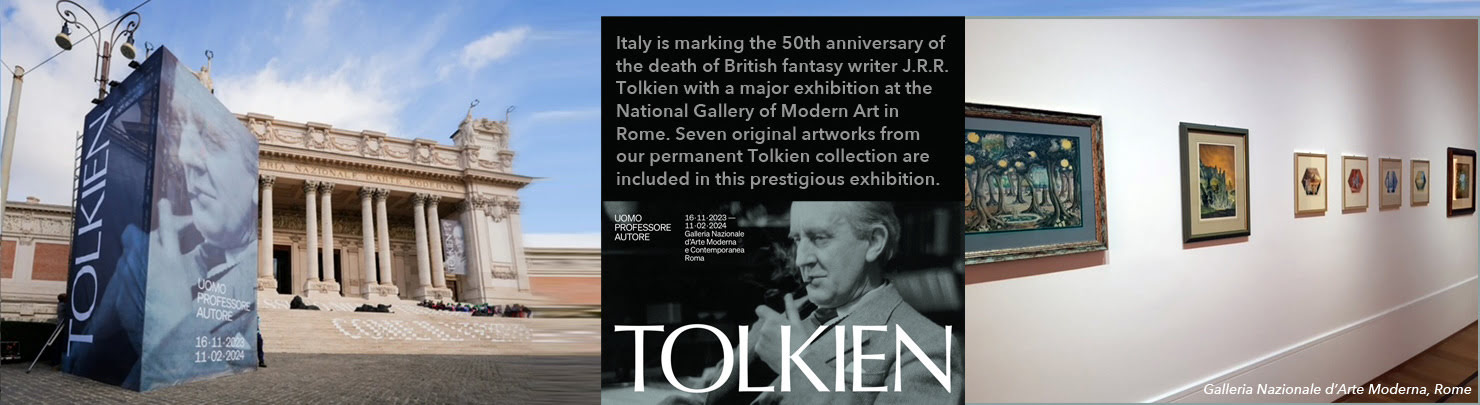
* “Lezant artists’ illustrations part of Tolkien exhibit in Rome”

“The beautiful illustrations, which are currently on display in La Galleria Nationale, Rome, were created by the late Roger Garland and his wife Linda, who have a permanent Tolkien exhibition at Lakeside Gallery, Lezant. Lakeside Gallery was established in 1989 by Linda and Roger primarily to exhibit their own work, but also to promote book illustration as a serious art form.”

And the Lakeside Gallery website reveals their own gallery has on show… “over seventy paintings and drawings commissioned by the original publishers for many J.R.R Tolkien’s books”. It turns out that “Lezant” is not in Italy, but is about 25 miles west of Exeter and in the middle of Cornwall, England. Sounds like a suitable site for a biennial ‘Tolkien Art & Artists’ convention, I’d suggest?

* And finally, a large exhibition on Fairy Tales at the Gallery of Modern Art in Queensland, Australia.

Etching Hill

New on eBay, an evocative ‘shire’ postcard of a site near to Tolkien’s Great Haywood. Located about two miles south-east.

The Google Maps search result is deceptive, unable to locate the hill it sends you instead to a road and a school, making it look like the hill has been built up as a housing estate. It hasn’t. Since a little searching finds that the hill is still there. With the help of the local M.P., in 2018 the Friends Of Etching Hill fought off an unwanted Forestry Commission plantation proposal and…

“established that the Hill is classed as common land / village green and that the management as such, should be left in the hands of the Charitable Trustees, who are supported by volunteers from the Friends Of Etching Hill.”

Other basic information…

“the hill itself rises steeply to 454 feet above sea level and is 100 feet above the houses of the village”.

“a well-known viewpoint on the north-eastern edge of Cannock Chase, with a distinctive, flat sandstone top”.

I’ve no idea if Tolkien knew it, but it would have made a pleasant stop on a three-mile road walk from Great Haywood – Little Haywood – Rugeley.

Tolkien Gleanings #149

Tolkien Gleanings #149.

* The next issue of the Journal of Tolkien Research has its first content, this being a long review of Holly Ordway’s Tolkien’s Faith and an essay on “Echoes of the Spanish Civil War in Tolkien’s Legendarium”. Both are freely available.

* Posted a few days ago, the .MP3 for the Oxford talk “J.R.R. Tolkien: The Making of a Philologist”

“A talk by Professor Simon Horobin on Tolkien’s long-standing career and interest in philology. Part of the series to mark the 50th anniversary of Tolkien’s death organised and hosted by Exeter College and the Faculty of English.”

Poor sound-quality, regrettably, and almost un-listenable. Reminder to public lecturers… always make a podium recording of your own lecture, even if the institution is also making one.

* A been-and-gone event at the University of Chichester’s venerable Chichester Centre for Fairy Tales, Fantasy and Speculative Fiction, on 11th December 2023. It was a public talk on “J.R.R Tolkien, C.S. Lewis, and Doctor Who: peculiarly British fairy tales”

To mark the 50th anniversary of the death J.R.R. Tolkien, the 60th anniversary of the death of C.S. Lewis, and the 60th anniversary of the first broadcast of Doctor Who, Paul Quinn will be giving a lecture about fairy tales in the work of Tolkien and Lewis, demonstrating how the types of ‘fairy tales’ found in Middle-earth and Narnia, and fairy tales in general, impacted on Doctor Who.

* Gramarye, the journal of the UK’s Chichester Centre for Fairy Tales, Fantasy and Speculative Fiction, has a call for content for the next issue. Deadline: 24th March 2024. Note that potential contributors can bag a… “complimentary e-book of the most recent issue” by enquiring.

* Advance news of Signum University’s UK Moot. Set for 27th April 2024 in the ancient city of York, and there to discuss the twin themes of… “Death and Immortality: The Great Escapes”.

* Freely available online, the new article “La artificialidad temporal o magia en los reinos elficos en The Lord of the Rings”. Seeks to use the Confessions of Saint Augustine as a lens to examine Lothlorien, as an elven creation which appears to stand apart from time.

* The new book Speculative Poetry and the Modern Alliterative Revival: A Critical Anthology ships tomorrow. Mostly the movement occurred in fantasy and science-fiction poetry, which meant it was almost unknown outside of those circles. The book has no Google Books preview, thus one can’t know if Tolkien is in it. There’s no mention of him in the blurb, and I’d suspect costly reproduction rights may have kept him out?

* And finally, Walking Tree has increased the prices of their books.

Tolkien Gleanings #148

Tolkien Gleanings #148.

* Dimitra Fimi on “Tolkien and the Fairies: Faith and Folklore”. Seemingly newly published, the blog-post article is the text of her 2010 Oxonmoot presentation.

* Arriving in late February 2024 according to Amazon, a 144-page graphic-novel version of The Hobbit, published by Morrow. Which probably means about 120 pages of story, plus padding.

* Amazon currently has “10th January 2024” as the date for the ebook version of the English edition of the biographical graphic-novel Tolkien: Lighting Up The Darkness.

* New to me, the book Easter: A Pagan Goddess, A Christian Holiday, and their Contested History. Not on Amazon UK under that title, nor discover-able via Google. The publisher is Uppsala Books, Tom Shippey’s new imprint, which lists the title and dates its page as “2023”. Possibly still ‘forthcoming’, at a guess?

“The purpose of this book is to explore the principal claims and counter-claims that now surround the goddess Eostre (recorded once by the Venerable Bede in 725 AD) and the origins of the Christian paschal festival. It critically examines the substance and history of these ideas from their earliest sources to the present day.”

* And finally, new on Archive.org is the Journal of Conchology (i.e. shells and their makers). Not a journal in which one might expect to find Tolkien considered. But its two-part 1991/92 “Mollusca in fiction” survey delighted in finding a snail as a key plot-point in The Hobbit

“The works of J.R.R. Tolkien are much read and admired, but most readers have probably failed to notice the passive, fleeting, but crucial role played by a snail in The Hobbit. [Plot recap, then…] at the last moment as the sun sinks a thrush flies down and cracks a snail upon a large stone. The last rays shine upon the key-hole as they stand by the stone and they are thus able to [plot spoilers]. T.E. Crowley observed that it was impossible to anthropomorphise a snail. It has, however, now been done.”

Actually H.P. Lovecraft did it first, as with so much else. See the Lovecraft / Rimel collaboration on the Dreamlands tale “The Sorcery of Aphlar” (published in The Fantasy Fan, 1934).

A small mystery in Hanley…

I can’t believe the headlines that Stoke-On-Trent is the most air polluted place in the UK. Apparently the reading was made in “Parliament Street”, taken “over a two-week period”. It measured PM2.5 particulates in the air.

The first problem is… there is no Parliament Street. I assume they mean Parliament Row in Hanley, since Google Maps knows nothing of any Parliament Street in Hanley or indeed in Staffordshire. I hope we’re not being confused with the busy Parliament Street, in the centre of Nottingham?

The study was by some organisation called GRIDSERVE. No, I’ve never heard of them either. Apparently they want to sell you so-called ‘zero carbon’ solar energy. They’re not exactly official, and I can’t discover if their research-design and methods were peer-reviewed for validity. Looks like a headline grabbing exercise to me, aiming to build up a contacts list for their sales force?

Anyway… our Parliament Row is pedestrianised. It’s where the Stanley Matthew statue is, and Waterstones. A fair distance away from the new bus station, and the roads used by buses hauling themselves up to it. And it’s elevated, on top of a hill. Meaning that most often, it’s as windswept as only Hanley can be, with nothing between it and the Cheshire Plain.

How then can it possibly give the highest road-pollution reading for PM2.5 particles in the UK? If measured in the high summer, were the Hanley druggies perhaps smoking right next to the sensor… and blowing their smoke at it? It’s the only thing I can think of.

Tolkien Gleanings #147

Tolkien Gleanings #147.

* A student’s lengthy November 2023 summary-report of an “Oxford professor’s USC visit” and the lectures given there…

“USC’s Nova Forum for Catholic Thought invited Pezzini for a weeklong speaking series on Tolkien’s literary contributions from a Catholic perspective.”

* Advance notice of an Easter Tolkien talk in the UK, “J.R.R. Tolkien and the Hope of Easter”.

* Now on Archive.org, Colin Wilson’s Tree by Tolkien chapbook (1973), seen here in its 1974 U.S. edition…

Not to be confused with the notoriously-wrong critic Edmund Wilson. The only commentary on it that I can immediately dig up is in the Tolkien Encyclopedia

“It could be said, fundamentally, that no ‘mainstream critic’ appreciated The Lord of the Rings or indeed was in a position to write criticism on it. […] The best possible exception would be Colin Wilson in his 1974 Capra Press pamphlet Tree by Tolkien, in which he compares Tolkien somewhat oddly (but in the end perhaps perceptively) with Jeffrey Farnol.”

Actually I find the comparison is short, and then a later passing comment suggests Wilson intended it to apply to the initial walking journey from the Shire to Rivendell. But the observation made me look into Farnol. He was one of the many accomplished Edwardian writers of popular adventure-romance novels. He was from Aston in the north of Birmingham, so not far from Tolkien. But at age 30 he married his 18 year-old love and they set off for America. There he became a successful writer, robust but with a strong dash of romance added so as to appeal to women readers. Also a strong taste for the old English rural highways and byways, Regency highwaymen and ‘country characters’ being then very much in demand. Four of his novels are on Archive.org

As I sat of an early summer morning in the shade of a tree, eating fried bacon with a tinker, the thought came to me that I might some day write a book of my own: a book that should treat of the roads and by-roads, of trees, and wind in lonely places, of rapid brooks and lazy streams, of the glory of dawn, the glow of evening, and the purple solitude of night; a book of wayside inns and sequestered taverns; a book of country things and ways and people. And the thought pleased me much.” (Opening of The Broad Highway, 1911).

Update: I heard the first fifteen or so chapters via the LibriVox reading. No great resemblance to Tolkien, so far, other than the love of English landscape.

As for Colin Wilson, there are some perceptive moments. But he reveals that the first read of LoTR was a three-day gallop, and we later learn that he skipped large sections. The second was a read-aloud to his children which meant many “long speeches” skipped and the book’s reading also re-ordered so as to focus on Frodo and Sam. Partly, Wilson’s reading doesn’t appear to have been deep or complete enough. Nor does he have anything much of the biography to grasp, seemingly having to intuit the Catholicism rather than to know about it. Still, as possibly the first worthy criticism after Auden, it’s fairly creditable. Unlike many critics of the time, he had actually (mostly) read the book.

* A short new book from the University of Wales, Introducing the Medieval Fox (2023).

* And finally, advance news of a short summer 2024 exhibition at the Getty in the USA. “The Book of Marvels: Wonder and Fear in the Middle Ages” will run from 11th June – 25th August 2024.

Leaf it out…

Several new research findings, as noted in the latest New Scientist. Most people think that thick wet…

“blankets of fallen leaves can choke plants beneath them, especially shorter species like lawn grass […]. The surprising thing is, this received wisdom has only recently been scientifically scrutinised, with a range of studies all pointing to the exact opposite conclusion.”

So long as the lawn isn’t heavily swamped, meaning less than 20 percent coverage, then…

“the fertility benefits of this light leaf coverage far outweigh the drawbacks – the leaves will quickly break down and help next year’s lawn grow far better than if you had raked them”.

If the grass has 50% leaf-wad coverage and it’s thick, it’s said it’s best wait for a dry spell (easier said than done, in the British Isles), then shred the dry leaves with a good lawnmower. Probably a lightweight hover-mower, I’d guess. Then just leave the shreds for the spring rains/winds and the worms to deal with.

All of which saves time, bin-bags, bin-men hassle (“we’re not taking that…”), smoky bonfires and roasted hedgehogs, the tiring use of hand-rakes or the hire of neighbour-annoyingly leaf-blower machines.

Of course, paths are different. I know from experience there that it’s best to let them get wet and wadded if you can. Then take them off via slicing and lifting with a shovel as if they were peat sods. Then brush and let the rain do the rest.

Tolkien Gleanings #146

Tolkien Gleanings #146.

* New at Word on Fire, Holly Ordway on “Tolkien, “Beloved Bernadette,” and the Immaculate Conception”. It appears to be a new essay, and not an extract from the new book Tolkien’s Faith.

* This week Ad Fontes has a review of Ordway’s Tolkien’s Faith.

* A YouTube interview I’m fairly sure I missed, back last January. The one-hour podcast “Tolkien as Philologist and Oxfordian Catholic” interviewed Dr. Yannick Imbert. Imbert is author of From Imagination to Faerie: Tolkien’s Thomist Fantasy (2022) and Professor of Apologetics at the Faculte Jean Calvin in France.

* The latest European Conservative has a long freely-available peice “Further In and Further Up: 50 Years with J.R.R. Tolkien” by Joseph Pearce. It appeared in the Fall 2023 print edition of the magazine, and has been newly released online.

* I see that the Weston Library, Oxford, recently held the event “Henry Bradley (1845-1923): A Celebration of his Life and Scholarship”. The date was 17th November 2023…

“It has been Henry Bradley’s fate to be remembered as ‘only’ the second Editor of the Oxford English Dictionary, always overshadowed by James Murray. This event aims both to celebrate and recontextualize his achievements – not just as a lexicographer, but as a writer, historian, and scholar in a variety of contexts. When he died in 1923, his former OED assistant J.R.R. Tolkien paid tribute to him, in Old English, as a sméaþoncol mon (a ‘man of subtle thought’). One hundred years after his death we offer a long-overdue reappraisal of his life and scholarship in a series of papers.”

Somewhat Gandalf-ian? But I suppose many fellows had such an appearance around the turn of the century.

* ““What a tale we have been in”: Emplotment and the Exemplar Characters in The Lord of the Rings and the Harry Potter Series” is a new journal article coming from the jargon-filled field of educational theory. Freely readable, but not downloadable without paying. Putting the abstract into plain English, as much as possible, gives…

“[The] admiration [of the young reader for characters] involves wonder and distance, and is best evoked by mixed or flawed characters … [Through such admiration a child may come to understand that they themselves may be part of] larger narratives [in the real world]. [For the writers under discussion, the child’s admiration of virtue is aided by the writer’s uses of] moral realism.”

I’d add time-scales as well as “larger narratives” (by which most teachers would probably assume immediate things like family structures, the daily news, etc). The most intelligent child reader will over time learn to draw more deeply from the past, as well as anticipating further ahead into the future. The classics of fantasy and science-fiction literature will ably serve these rare text-readers in forming such habits of mind. The Lord of the Rings especially offers them deep lessons in “The Long Now” — with a number of characters operating and planning over far longer time-scales than the hobbits are aware of.

* And finally, a 50 minute video tour of a $4-million dollar home library, including Tolkien treasures…