Tolkien Gleanings #228

Tolkien Gleanings #228

* Exeter College, Oxford, will be hosting a public talk on the “70th Anniversary of The Lord of the Rings”. With Holly Ordway, on 17th October 2024. Tickets available from 9th September. This will be first of another series of eight seminar talks at Exeter College, to be given in person during the Autumn 2024 term. It appears the new series will focus on the initial publication and reception of The Lord of the Rings. No details of topics, as yet. Only the names of the speakers and the dates.

* At The Washington Stand, another fisking of the recent New York Times article which appears to have misunderstood Tolkien…

“Tolkien’s view, expounded throughout his work, is not [as the NYT article claims] that power is evil, but rather that authority is good, and power must be subject to that authority. Aragorn is not evil for seeking dominion over Gondor and Arnor; in fact, that is itself, in Tolkien’s view, a good, because Aragorn has the authority to wield that power: he is the King.”

* A new Masters degree dissertation, “Coining Personal Names to Build Connections among Characters: Lexical Creativity in Tolkien’s The Lord of the Rings” (2024). Freely available as a .PDF file.

* Newly posted on YouTube this week, the Lore of the Ring podcast 084: ‘Interview with a Tolkien Journalist, Larry D. Curtis’ (2023).

* “The Inklings Yearbook Goes Open Access” at The Stacks

“Starting with volume 40, the Inklings Yearbook will be published in our online repository, The Stacks. [There you can freely] download all individual texts [or] a PDF of the whole volume. We are currently in the process of digitizing older editions of the Yearbook as well – volumes 23-27 are available in part already…”

* Reading the latest Amon Hen magazine (August 2024), I notice the editors say they are still seeking a Graphic Designer.

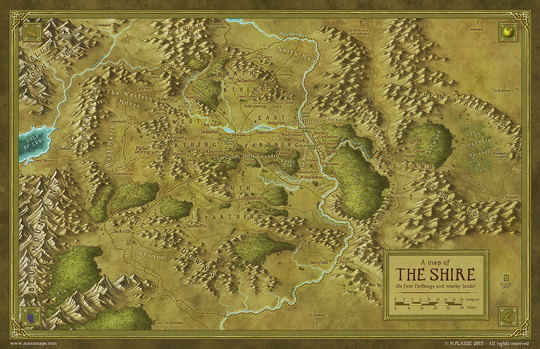
* A pleasing if rather sickly-yellow map of the Shire, found freely available to view at Max’s Maps.

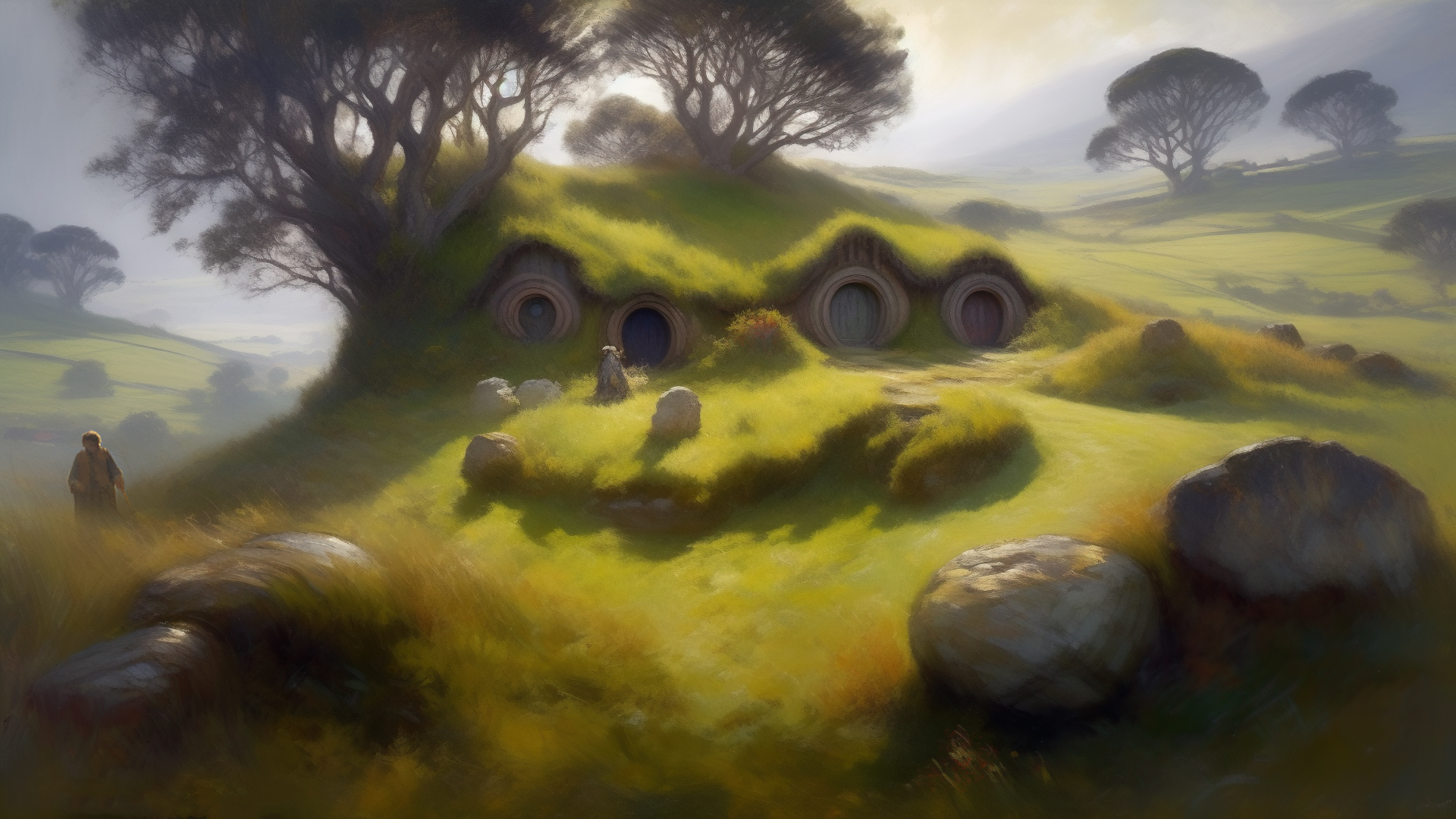
* And finally, a new free 1920 x 1080px widescreen wallpaper, ‘Hill End, above Little Delving on the western moors of The Shire’. Free to use, as I’m placing it under ‘Creative Commons Attribution-NonCommercial-ShareAlike’.

Staffordshire oak wood project reports

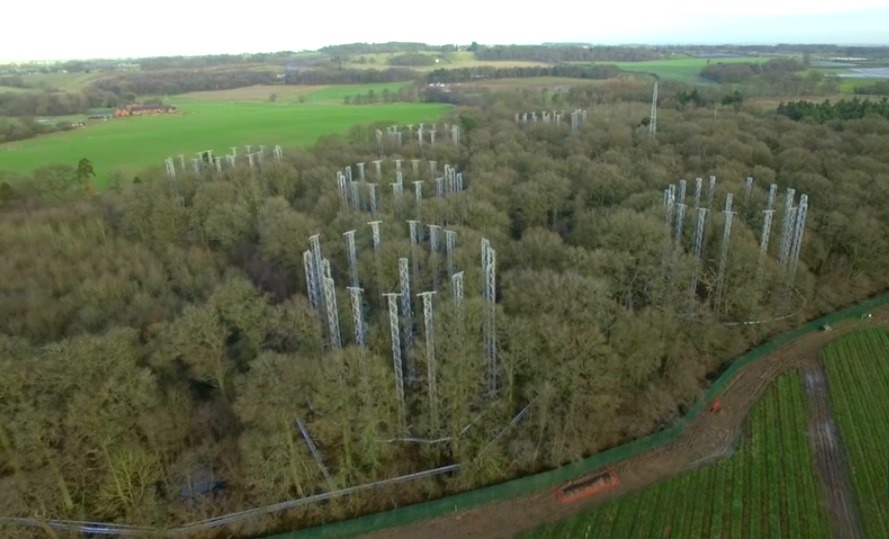
The seven-year oak wood project in mid Staffordshire has reported its findings, in the journal Nature. The wood being studied is the 46-acre Mill Haft, full of mature English oaks, around six miles west of the county town of Stafford. In this wood, various plots of 32 yards diameter were studied, these being pumped with CO2 over seven years.

The results, now in, show that…

“over the seven years of treatment, tree growth was 9.8% greater […] Most of the observed increase was attributable to wood production; there was no difference in fine-root or leaf mass production”.

Also note that…

“Exudation of organic carbon from roots is rarely included in estimates [by others. But here, our repeated] analysis indicated a significant overall effect [stated as between 43% and 64% more exudation, depending on year].

Which means (in layman’s terms) that not only is elevated CO2 being used by the tree to make a bit more wood (hardly noticeable to the eye, for most people), but the tree is also rather usefully pumping a lot more of it underground than before. As the report suggests, this then benefits the microbes living in the soil below the tree…

[the exudation is] “disproportionately important to ecosystem biogeochemistry [since it primes] the microbial community and associated nitrogen and phosphorus cycling” [in the soil].

All of this is to be expected, as CO2 is ‘plant food’. But it has not before been proven in temperate mature woodland. Overall, the project’s results clearly contradict earlier assumptions that…

“older, mature forest systems have no capacity for response to [elevated atmospheric] C02”.

The project plans to continue for another seven years.

Tolkien Gleanings #227

Tolkien Gleanings #227

* A new Masters dissertation, “Reclaiming Stoicism: Aragorn as the Epitome of Healthy Masculinity in the Modern Era” (2024). Freely available online.

* On YouTube, the Chasing Leviathan podcast interviews Dr. Graham McAleer on ‘Tolkien, Philosopher of War’. His book of the same name is set for publication at the start of November 2024. For background, last week The Imaginative Conservative had the article “J.R.R. Tolkien’s Vision of Just War”.

* In Spanish, “Recreacion De Elessar En Art Noveau” (2023/24). An account of a student design project to… “recreate [Aragorn’s green] jewel by creating a design for its illustration, via an analysis and study of the literary descriptions given by Tolkien of the jewel and its materials, as well as an analysis of the symbology of all the elements that represent it.” Currently in a university online repository, but under an unspecified embargo.

* A complete table-of-contents for the long-delayed Tolkien Studies Volume 20… “published in August 2024, but actually being the 2023 issue”. Has the article “The Year’s Work in Tolkien Studies 2020”, and a bibliography for 2021.

* On YouTube, the playlist Wonders of the Wade, with the latest addition to the series being “Wonders of the Wade #15: J.R.R. Tolkien’s desk and pen”.

* New in the journal Studies in Philology, Pearl and the Fairies of Romance: Hermeneutics and Intertextuality in a Fourteenth-Century Religious Dream Vision” ($ paywall). The author… “argues that the Pearl-poet is consciously engaging with readily identifiable fairy themes and motifs” of the period.

* And finally, two online previews of new watercolours to be included in the 2025 Beyond Bree Tolkien Calendar.

Tolkien Gleanings #226

Tolkien Gleanings #226

* Newly added to the latest Journal of Tolkien Research, the first of the issue’s articles. “A Speculative Ethnomusicology of Gondor” is freely available online.

* Just published, a new issue of the open-access SELIM: Journal of the Spanish Society for Medieval English Language and Literature. Includes a review of Tolkien’s The Battle of Maldon Together with the Homecoming of Beorhtnoth (2023). Freely available online.

* The August 2024 issue of Amon Hen, is now available to members ($ paywall). It’s a poetry special, but also has the substantial bio-article “Aragorn: The Early Years”, and a review of Speculative Poetry and the Modern Alliterative Revival, A Critical Anthology (2023).

* The latest issue of Canada’s Catholic Insight magazine, on “Tolkien, Discernment, and Vocation in The Lord of the Rings”. Freely available online.

* On YouTube, the Tolkien Collector’s Guide interviews Australian “Peter Kenny — Tolkien fan, collector, and educator”.

* The delayed OUP book Tolkien on Chaucer, 1913-1959 now has a 17th October 2024 release date, according to Amazon UK. Pre-orders are now being taken. “Bowers and Steffensen reveal how the Reeve’s Tale was a source for Tolkien’s description of Merry and Pippin’s battle with Saruman”, according to the blurb.

* And finally, Cate Blanchett has claimed that “no one got paid anything” for Lord of the Rings movies. Looking briefly at this… I noticed the actor who played Legolas also had “nothing”, according to an interview he did. But it appears that when an actor says “nothing”, they actually mean “$175,000”. Which is what he then admitted to the interviewer that he was paid, as an almost-unknown actor at that time. In today’s money, 1999’s $175k is equivalent to a hefty $330,000. Not bad, for an unknown actor. One would imagine that Blanchett (Galadriel), with more star power but less screen-time and physical work than Legolas, should have had something similar to that. Unless, perhaps, she deliberately worked for free? The total budget for making all three films was reported to be $270m (Variety), which would be about $500m today.

Tunstall ‘ginnels’

An interesting word I hadn’t encountered before. In parts of Tunstall, people call their rear alleyways “ginnels”, according to a local newspaper report today on fencing these to keep druggies out.

The word ginnel appears to come originally from Yorkshire, according to 19th century sources. Though one early Lancashire dialect book also found it there. There was speculation that it may perhaps go back to the Anglo-Saxon gin, a narrow channel, open. Similar, I would suggest, to the Old Norse gin, meaning mouth, open. Given the Yorkshire core of usage it may well come from Norse rather than Anglo-Saxon. Although Anglo-Saxon gynian was ‘to yawn’, so there were evidently close similarities between the two.

An early memoir gives it as “goonhole”, presumably as an onomatopoeia (writing down a word as it sounds), which would seem a strangely congruent folk-twist on Old Norse ‘open mouth’. If such it was.

Dialect studies now also note it being found in Manchester and across larger towns of the East Midlands, used to refer to back-alleys. And evidently now also in Tunstall, Stoke-on-Trent. Today it seems it can also be applied to un-walled paved “footways between strips of land” between estate houses (e.g. such as the ones which criss-cross the Bentilee estate in Stoke, though I’ve no idea what residents there call these).

Tolkien Gleanings #225

Tolkien Gleanings #225

* Sessions set for the 2025 International Congress on Medieval Studies, among others, include: “Fire, Dragons, and Jewels, O My: Medieval Poems and J.R.R. Tolkien”; “Tolkien and Old Norse”; and “Tolkien and Medieval Conceptions of the Sea”. The calls are now online.

* The Messengers from the Stars open-access journal seeks contributions for a special issue in 2025 to be themed “‘Getting Medieval’: Fantasy and the Middle Ages”. Deadline: 3rd February 2025.

* Found, another 10-year embargo dissertation for an Irish B.A. (Hons.) Design for Stage and Screen degree. But different from the one noted in Gleanings #224. “The Safe Haven: The depiction of salvation through sanctuary and scenography in The Lord of the Rings” (2014 undergraduate dissertation, released after embargo April 2024). A study of the visual aspects of the archetypal spaces of sanctuary with reference to LoTR. Identifies architectural methods that “creatively retain what threatens to disappear”, and considers the presentation of salvation “via ornamentation and embellishment”. Freely available online, and under Creative Commons.

* The Federalist magazine fisks a newspaper journalist who “Completely Botches Lord Of The Rings”… “It is untenable to equate the Ring simply with power. Tolkien did not write a story about why power is evil, but about why domination is evil. To understand Tolkien, it is essential to distinguish between the two.” Freely available online.

* On YouTube in Italian, “Fear leads to suffering”: myth and hope in the subcreation of J.R.R. Tolkien”. A May 2024 conference interview with Eduardo Segura at the University of Granada, Spain.

* In Brazil and in Brazilian, International Meeting for Mythopoetic Studies: The Lord of the Rings – 70 years of The Fellowship of the Ring, a three-day conference held in July 2024. The programme is still freely online as a PDF. The talks included, among others…

   – From heavenly Jerusalem to Gondolin: hermeneutics of applicability: Tolkieniana as contemplation of celestial realities.

   – Narrative solutions to editorial problems in The Fellowship of the Ring.

   – Pseudotranslation as a creative principle of The Lord of the Rings.

   – How medieval is Middle-earth? Understanding medievalism based on the works of J.R.R. Tolkien.

   – What about second breakfast? Food and eating habits of the hobbits in The Lord of the Rings.

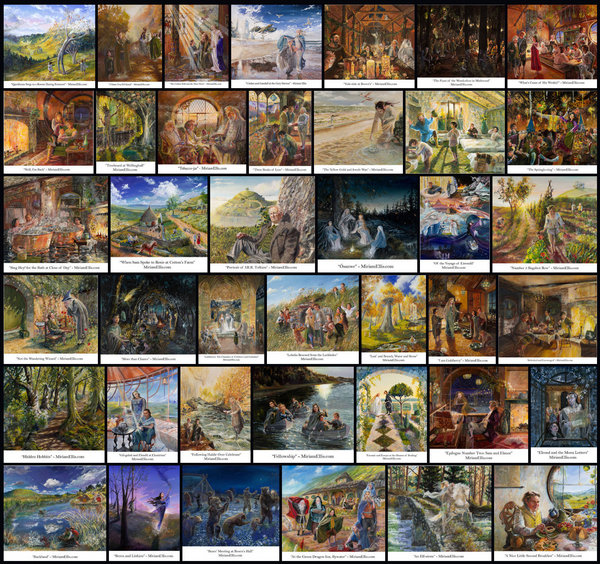
* A new set of Tolkien scene paintings by Miriam Ellis, posted in July 2024 on DeviantArt.

* And finally, an ‘Ink of Ages’ contest from the World History Encyclopedia with Oxford University Press. Submit your “historical or mythology-inspired short fiction”, telling a story in English in “under 2,000 words”, by 15th September 2024. Free to enter. No mention of AI assistance being allowed, or not.

Tolkien Gleanings #224

Tolkien Gleanings #224

* The Leo Carruthers book Tolkien et la religion: Comme une lampe invisible (‘Tolkien and Religion: An invisible lamp’) is to be (re?)published by the Sorbonne shortly, and apparently runs to a chunky 340 pages. This suggests an expanded edition, compared to the page count of the earlier 2016 edition, but that’s just my guess. Amazon UK currently lists the book for publication on the 12th September 2024. [Update: Yes, I’m right. The Sorbonne list it as a “2ème édition”, 2nd edition].

* Another conference paper, newly added to the latest Journal of Tolkien Research, “Tolkien’s Orphaned Heroes: Kullervo, Hurin and the Limits of Fostering”. Freely available online.

* “A Lord of More Renown than Arthur: Tolkien’s Corrective and Compensatory Approach to the Arthurian Tradition in his Legendarium”. A lengthy non-fiction item in a new undergraduate collection from The University of Price Edward Island in Canada, titled Into a New Tongue. This being the UPEI Arts Review edition for Spring 2024. Freely available online.

* From the Institute of Art, Design + Technology, Ireland, Authentic Fantasy: The representation of the Shire as a nostalgic arcadia (2013 with a 10-year embargo, freely online April 2024). Being an undergraduate dissertation for a B.A. (Hons.) Design for Stage and Screen degree, “a study of the visual and design references within the Shire in the film adaption of The Lord of the Rings“. The core focusses…

“on the Victorian era from which Tolkien drew inspiration in creating the Shire and its characters. Director Peter Jackson and conceptual designers use this era strongly as a reference within their research and design methodologies, and the study explores how, although we are looking at the Victorian era, there is a strong use of medievalism within the design reflecting the influence of the medieval period on Victorian art and aesthetics.”

* Signum University’s October 2024 modules are now listed. Note the eight-session course “The Music of Middle-earth”, and also the unusual “Ink Spots and Tea Stains: What we Learn from C.S. Lewis’s Writing Habits”. Booking now.

* Oxford is to host another repeat of Tolkien’s ‘Lecture on Dragons’. This time it will be staged at The Story Museum in Oxford, on the 22nd September 2024. Free, and booking now. Tolkien originally gave this lecture on New Year’s Day 1938 at the University Museum, Oxford, as part of the Museum’s Christmas lecture series for children. In 2024 its recreation will be… “Presented by Professor John Holmes, [who will] re-run Tolkien’s lecture featuring his original slides.”

* The Arkhaven Nights podcast is to interview Rachel Fulton Brown. Scheduled for Friday 9th August 2024. Also, it appears that Fulton Brown’s huge Tolkien lecture series, previously paywalled, may be going free. I’ll post more on that later, once a few more free recordings are posted.

* And finally, Sami Makkonen’s gritty 300-page graphic-novel adaptation of The Kalevala is still sticking to its 24th September 2024 release-date for the English translation. Preview pages are now floating around the Internet. His workflow is to ink the page manually, with marker pens on board. Then to scan the page, to be able to digitally colour and tweak it in the computer.

Witt Collection now online

The Witt Collection of British Art is now scanned and online. Over 500,000 reference cards with good images from auction listings and magazines, seemingly omitting the ‘portrait of a long-forgotten local worthy’ type of auction picture.

Regrettably it doesn’t seem possible to search by ‘location of scene’. Thus a search for “Birmingham” becomes swamped by items once belonging to Birmingham City Museum etc. Nothing for “Staffordshire”. Over 1,000 items from Samuel Palmer, though. Also many by Edward Lear and Turner.

Tolkien Gleanings #223

Tolkien Gleanings #223

* Added to the latest edition of Journal of Tolkien Research, a new review of the book Germanic Heroes, Courage, and Fate: Northern Narratives of J.R.R. Tolkien’s Legendarium (2024).

* The UK’s latest Country Life magazine has an article on the wealth of Tolkien letters currently up for sale. No paywall on this article, at least for me.

* “Tolkien: A Thoroughly Modern Medievalist”, a new episode of a one-hour podcast which discusses the links between “faith and beauty”. This episode “featuring Dr. Holly Ordway” for a wide-ranging discussion on Tolkien in historical and national context.

He’s extremely English, and he has very English habits of expression. Which include at times being extremely hyperbolic, and at other times being extremely understated […] I’ve been spending a lot of time in England, for more than a decade now. It sunk in gradually that the English, for all they have outwardly similar appearances to Americans, are very different from Americans. [Tolkien’s English / West Midlands / Oxford manner] has made it extra puzzling for Americans in particular to puzzle Tolkien out.

Since his hyperbolic comments, largely meant to be amusingly offhand and/or playfully conversation-provoking, have sometimes been taken literally. Tolkien’s mumbling, and the nature of printed-word interviews conducted by journalists, also means that the vital role that intonation plays in English speech is missed.

* Also new on YouTube, the Digital Tolkien project offers advice on “How to use Search Tolkien and Cite Tolkien”.

* At Word on Fire, “Celebrating the Epochal Publication of The Fellowship of the Ring 70 Years On”.

* New to me, an abstract for an ambitious undergraduate dissertation from Bangladesh, “Beyond the Walls of Night: Completing Tolkien’s Untold Armageddon”. In English, from 2021…

“Despite the copious amount of notes that Tolkien left behind, no definitive conclusion to this narrative has been released by the Tolkien Estate so far. Various hints and clues, however, have been scattered by the author [and thus the dissertation attempts] to compile into a coherent conclusion [the extant details of the] Final Battle [in which, as prophesied] the world would be destroyed and renewed.”

* And finally, scholars may be interested in easy bulk-backup of a list of precious Web URLs, using the cryptically named Save Page WE. This is the only Windows desktop freeware I know of that can take a .TXT list of URLs, and work through them automatically, saving each URL (Web page) as an encapsulated archival .MHTML file. If you have 100s to save, be sure to first tick ‘Close tab after saving page’ in Settings or you’ll run out of system memory. Free for Chrome-based Web browsers.

Some new local items on Archive.org

Westward on the High-Hilled Plains: The Later Prehistory of the West Midlands.

The Color Blue In Pottery And Porcelain.

The Gawain Country – extended with bonus chapters.

The Staffordshire Hoard: An Anglo-Saxon Treasure.

A Month in the Midlands. Humorous sketches from a fox-hunting and horse-racing tour.

Letters to a Young Constable. A 1947 book by the Chief Constable of Stoke-on-Trent. General advice in a short book, no specific Stoke content that I noticed.


Ecological flora of the Shropshire region.

Vegetation of the Peak District.

War and society in medieval Cheshire, 1277-1403.


Also, some idiot has added archive.org’s PDF download URL to a default blocklist in the popular Ublock Origin browser add-on.

So, either remove the blocklist altogether, or select “do not warn me again” when the ‘blocked’ page comes up.

Tolkien Gleanings #222

Tolkien Gleanings #222

* New to me, and published without fanfare a few days ago, the new book Cities and Strongholds of Middle-earth: Essays on the Habitations of Tolkien’s Legendarium. 13 essays on the topic. There was a call-for-papers exploring Tolkien’s built places, back in 2019 in Amon Hen #279. Then a series of panels on the topic at a Mythcon a few years ago. Essays in the finished book include, among others: “Re-Enchanting Built Spaces: On Dwarves and Dwarven Places”; “Stone Monuments and Imperfect Cultural and Personal Memories in The Lord of the Rings”; and “The Many Faces of Lake-Town”.

* B&W artwork relating to 1981 BBC Radio adaptation of Tolkien’s The Lord of the Rings. Destined for the BBC’s Radio Times listings magazine, by the look of them.

* More recently newly at the auctioneers, and still for sale, a long letter under the title “Sherlock Holmes letter from 10th January 1947”. Original and signed by Tolkien.

The letter describes Sherlock Holmes and Mycroft as having “quite a sniff of priggery about these two precious gents” and Conan Doyle as “not himself distinguished as a particularly acute thinker”.

The “gents” concerned might instead be Holmes and his creator Doyle, it’s left a little ambiguous. But on balance I think the letter-owner’s description is probably right. Doyle had died in 1930, and he had long been deeply deluded by spiritualist charlatanry. Thus I doubt any Sherlockians will quibble with Tolkien’s other assessment. But evidently Tolkien in 1947 was familiar enough with the Holmes tales to feel able to make his judgements. Did he perhaps re-read Holmes to pass the long nights of fire-watching duty during the Second World War? Just my guess.

Update: the letter sold for £20,000.

* New in the Sage journal IDS, the article “J.R.R. Tolkien’s Legendarium as Heterodox Palaeoscience” ($ paywall)…

“… the influence of a range of palaeoscience topics on Tolkien – some of which were outside the mainstream of his time before becoming accepted – are [not] well known. This article synthesises research into the conception of Tolkien’s usage of heterodox palaeoscience in his works, [in order to then] explore the reception of those themes in his fiction.”

* Tolkien scholar David Robbie is launching his new book Great Haywood, Past and Present, People and Places, at Rugeley Public Library on 9th September 2024. “Pre-booking not required. A short talk, followed by Q&A and discussion”. The village of Great Haywood, in mid Staffordshire, was well known to the young Tolkien during the First World War. The talk is part of the nation’s annual Heritage Open Days at various venues, which will take place in early September.

* From the Italian Tolkien scholars, a new article in Italian on “Tolkien in Bulgaria”, this being a profile of Lyubomir Nikolov who translated The Lord of the Rings. This follows this week’s news from Radio Bulgaria that “Bulgarian writer Lyubomir Nikolov has passed away at 74”.

* And finally, The Lord of the Rings is 70 years old tomorrow. Imagine popping down to the local bookshop, on what the untampered original weather records show was a dry and pleasantly cool summer day, at the end of July 1954. A Thursday appropriately enough (the day being named after the thunder-god Thor, as you’ll recall). Then strolling home with a crisp newly-printed Fellowship hardback neatly wrapped in brown paper.

Post-lockdown reading trends

It appears ‘the lockdown effect’ on reading has not lasted, which seems a pity. At least among adults in the UK, if the most recent survey can be trusted. A new Reading Agency report, following their survey of 2,000 over-16s in the UK, found…

* In younger people, 24% of 16-24s tell the survey teams they have “never been regular readers”.

* 50% of all UK over-16s now read regularly for pleasure, down from 58% in 2015.

* 15% of UK adults have never read regularly for pleasure, an 88% increase since 2015.

Substantial changes then, especially in “reading for pleasure”, which are perhaps partly due to many older people passing away during Covid. Perhaps also partly because some of the “representative consumers” here surveyed may not have been born in the UK (the survey methodology is not at all clear, even in the PDF), which would then make comparison with older surveys problematic. The earlier survey was of “randomly selected British adults”, which seems to me likely to be a different baseline from a market research body’s set of “representative consumers” in the UK.

And, as always, one would want to know if unabridged audiobooks are considered to be “reading”. Or are the surveys only asking about print? Perhaps there has just been, among some, a shift to a new format?

Another factor is that many books have become so damned expensive, and postage likewise (Amazon free delivery, excepted). A paperback that was £15 before lockdown will now likely be £30.