Tolkien Gleanings #204.
* A new article from Oronzo Cilli on “Tolkien’s Proposed Translation of Old Norse Egilssaga”, aka ‘Egils Saga’ or ‘Egil’s Saga’.
* As part of Archive.org’s ongoing ingestion of recent open-access books, up pops Tom Shippey’s Hard Reading: Learning from Science Fiction (2016, Liverpool University Press). There’s no Tolkien, but the essay on “The Golden Bough and the Incorporations of Magic in Science Fiction” may interest some. Also newly ingested, and of possible interest to Gleanings readers, a book on the famous early videogames Myst and Riven, Myst and Riven: The World of the D’ni (2011).
* On 10th June 2024, the final public lecture in the current Magdalen College Tolkien lecture-series, John Holmes (University of Birmingham) on “A Veritable ‘Middle Earth’: Tolkien and the Palaeoanthropological Imagination”. “Palaeoanthropological” hopefully = Tolkien in the context of the British anthropology and ethnography of his time. I say “British” because, circa the 1890s-1930s, there were apparently very strong national barriers between schools of anthropology. (Update: no, it’s about study of the anthropology of prehistory — early man etc — rather than the early history of anthropology and ethnography as a field of study).
* The website of musical composer Paul Corfield Godfrey reports, in addition to the already-announced LoTR opera, a forthcoming album of his solo piano works…
“Also coming early 2025 [a new album with] the epic piano rondo Akallabêth, a solo piano version of the ‘Wedding March’ from The Fall of Gondolin and a new work composed specifically for […] this album – The Passing of Arwen.”
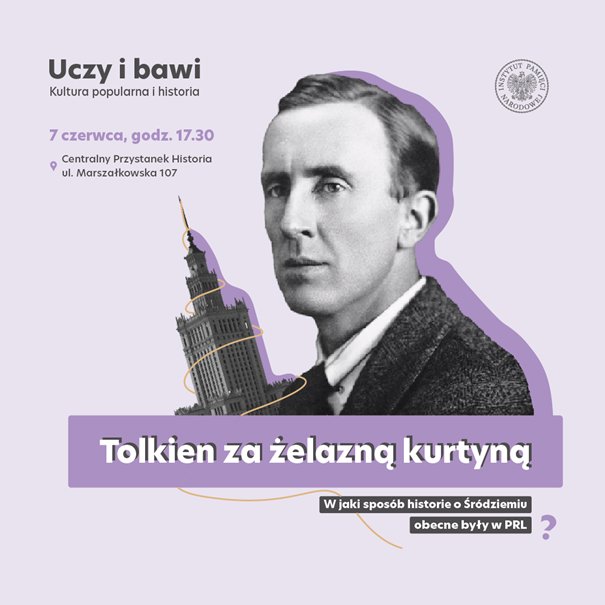
* In Poland, an event to discuss the history of Tolkien under communism. 7th June 2024 at what translates as the “Central History Station” in the city of Warsaw, and the “meeting will be broadcast on the IPNtv channel”. The event will ask how the tales of Middle-earth found their way to Poland, how a ‘Tolkien fandom’ arose, and how the tales were understood under the communist dictatorship. According to the Tolkien Encyclopedia (2006) The Hobbit and LoTR had appeared there 1960-63, in faithful translations — but ones subject to unspecified censorship. I also recall reading that Polish copies were sometimes smuggled into Russia prior to the 1980s, for those Russians who could also read Polish and were brave enough to put aside thoughts of the prison camps.
* My reading of the first 50 Mallorn issues is yielding up some interesting nuggets. One such is that in 1972 James Ead of Stone in mid Staffordshire wrote to Mallorn, giving his notes made from a face-to-face talk he had with one “Father C.J.R. Tolkien”. Ead and his local Smial had ventured a few miles north of Stone to visit Fr. Tolkien in his home at Hartshill, Stoke-on-Trent. By 1972 this was also where the elder Tolkien had spent many post-retirement holidays with his son. The elder Tolkien, it was reported, “knows the ‘language’ of trees as the wind sighs through the branches and the noises they make when moved by the wind.” (Mallorn #5, 1972, page 7). Recall here Anglo-Saxon ‘prognostics’, Tolkien’s uses of wind as a subtle sign of possible divine presence in LoTR, and also Tolkien’s “The Horns of Ylmir” (Spring 1917)…
‘Twas in the Land of Willows where the grass is long and green –
I was fingering my harp-strings, for a wind had crept unseen
And was speaking in the tree-tops,
Compare the German poet Ernst O. Hopp ably evoking the poignant Biblical event of Moses being shown the Promised Land (which he will never reach) while hearing the voice of god, in a poem of 1876…
So wie einst beim Abendstrahle
Moses von des Nebo Gipfel
Niederwärts im Jordanthale
Rauschen hörte leis die Wipfel,
So like that long-past glimpse at evening
Moses had from the Nebo Peak
Gazing out into the Jordan Valley
Quietly listening to the treetops speak, (my translation)
* And finally, from 2015 but new to me, Tolkien’s annotated map of Middle-earth transcribed… “a map of Middle-earth featuring annotations by J.R.R. Tolkien had been re-discovered in a copy of The Lord of the Rings owned by the late [Tolkien illustrator] Pauline Baynes.”
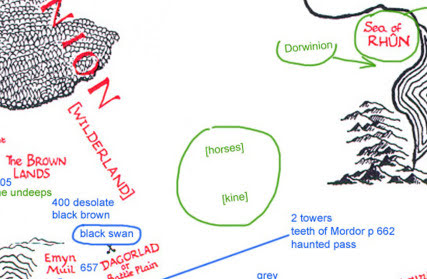
Tolkien places horses and cattle (kine) in the wide empty land between the desolated Brown Lands and the gardens and vineyards of Dorwinion. Presumably wild and un-tended, with ‘herds’ implied. This presence suggests that the desolation of the hills of the Brown Lands was only of limited extent, giving way to relatively dry grasslands (presumably dry, because no major rivers) most suited to ranging herds of horses and wild cattle. I imagine small shaggy steppe-like horses, with neutral-colour coats to blend with their surroundings. The cattle perhaps more akin to shaggy and long-horned Scottish highland cattle than to modern milkers. We can at least know something of the equine colouring and size because, in the years leading to the events of LoTR, Barad Dur could not find its desired large black horses in such nearby terrain. Instead Sauron’s orcs have to raid the battle-horse herds of Rohan for such beasts (as Eomer says: “choosing always the black horses”).