A bit more on walking and fantasy writers, following my last Tolkien Gleanings. I found a list of long walks taken by C.S. Lewis and his brother. One walk had possibly been taken near me, in Derbyshire.
“13th–16th January 1936 in Derbyshire”
So I briefly looked into it. Tolkien was not with them, and according to the Chronology was hard at work preparing for his new academic term and dealing with tedious Early English Text Society business. But I wondered where the walk was anyway, perhaps for the benefit of some future Tourist Board leaflet. Was it on the west or the east of the Peak? The location took a bit of tracking down, but Lewis’s brother kept a diary that records a visit to the church at Taddington, which is rather amusingly described by the American diary annotator as “north of Oxford”. England may be a very small place, compared to America, but we’re not that small. More precisely Taddington is just a little east of the spa-town of Buxton, in the far west of the Peak. No further details of the precise spot are known. But logically the trip would then be on the train from Oxford – Birmingham – Derby – then onto the local milk-run train through the Peak and then off at Miller’s Dale station just before Buxton… and then brisk and chilly walking in and around the fabulous Miller’s Dale (aka Millers Dale) and probably staying in the local pub there.
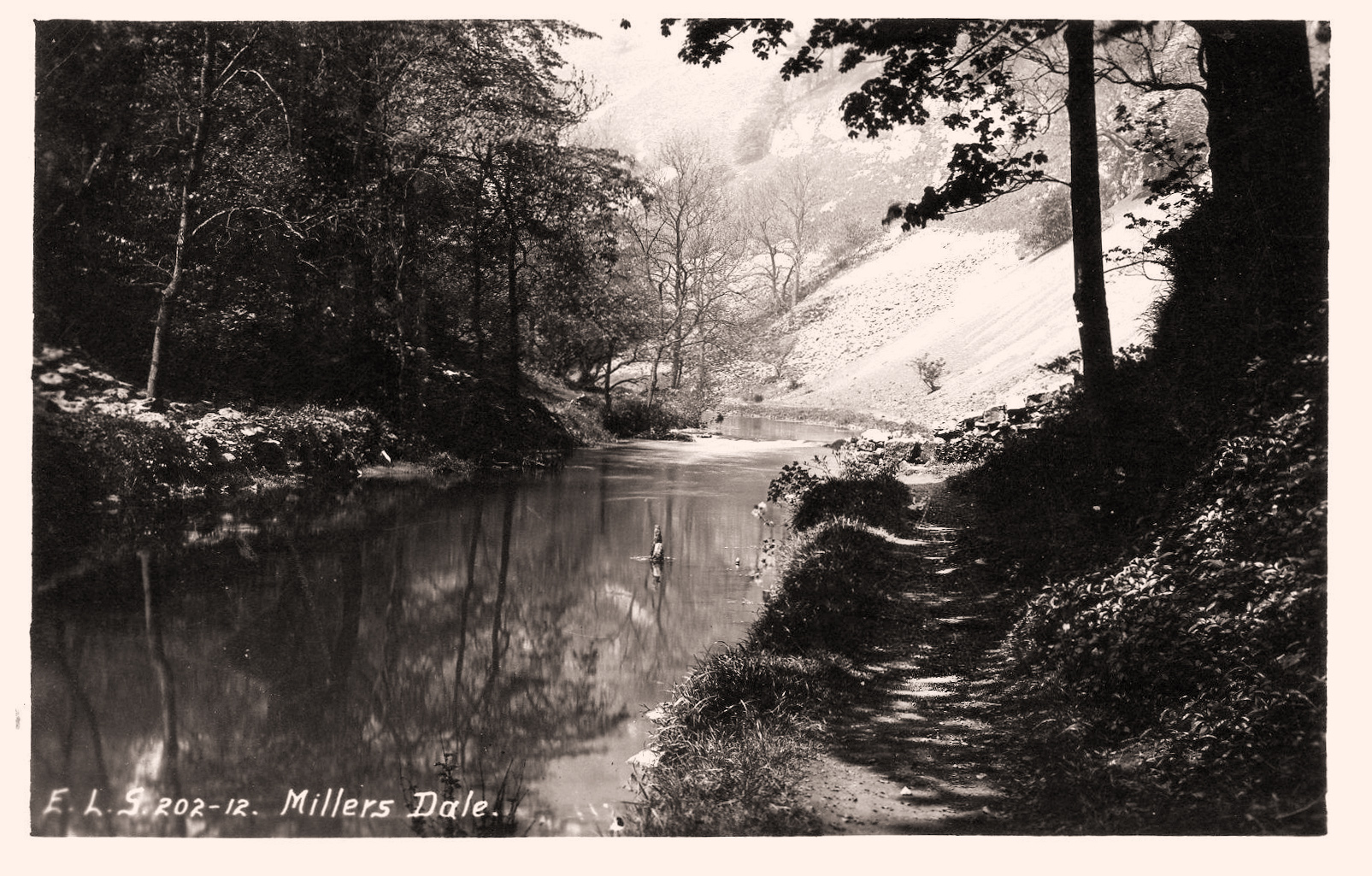
Walking in the snow, since “lovely snow clad trees” feature in the diary in the entry for their final day there. A 1930s winter, with heavy snow, in the Peak, in January. Not something that even the most ardent Lewis-ite would want to re-create today, I’d imagine. Even if they could. Today even the fall of a few snowflakes could be enough to stop all transport and prevent you from getting there on public transport. Not so back then, when we had more grit and gumption.
Along the way I found a small transcription error re: another walk, the error being caught in George Sayer’s important 1992 speech “Recollections of J.R.R. Tolkien”…
I had the impression that he [Tolkien] had never walked the [Malvern] hills before [August 1947] though he had often admired the distant view of them from [his brother’s at] the Avon valley near Evesham. Some of the names of the places we saw from the [Malvern] hills produced [in his talk] philological or etymological footnotes. Malvern was a corruption of two Welsh words, “moel” meaning bear, and “vern” derived from bryn or fryn meaning hill. This of course told us that the area was in early times heavily wooded, though the ten-mile ridge of the hills was not.
I was puzzled for a moment by this, unable to ‘see the bear for the woods’. But I realised that “bear” (animal) should be “bare” (bald), from the Welsh moel (bare, bald, often applied to a prominent hill). From the Malvern Hills one looks east across Herefordshire and into Wales.
The error is repeated in Tolkien: A Celebration (1999), in which the speech is reprinted. So, no… sadly Malvern does not mean Bear-hills, but simply Bare-hills.
[…] My unearthing of the location of C.S. Lewis’s 1936 walk near Buxton, Derbyshire, plus a small correction to an important memoir of […]