Could the young J.R.R. Tolkien have seen the now well-known pre-Raphaelite collection at the Birmingham Museum, circa 1903-1911? In those years he was at school in Birmingham city centre, and was aged 11-19.
Perhaps. But he appears never to have recalled them in either letter or interview, so far as I can discover. Which in itself is quite remarkable. Nor does he ever appear to have been asked about them, even for the official biography, which is even more remarkable. What were the Birmingham Tourist Board of the 1960s and 70s thinking of, not to pin him down on the topic and get a few quotes for future marketing purposes? Well, they probably weren’t even considering such things. In those days Birmingham wasn’t exactly on the tourist map of England, except as a big void to avoid.
But what of the Edwardian era, before the planners and the car-culture ruined the city centre? Were unaccompanied youngsters not allowed into the Museum at that time, perhaps? Were there no ‘school visits’ back then? Tolkien’s school was at the opposite end of New Street, so they wouldn’t even have needed to hire a charabanc to visit the place. Just troop the lads up the gentle hill.
Yet all that can be found in the scholarship is Garth remarking that “Tolkien once likened the TCBS to the Pre-Raphaelites”, stated in passing and with no reference given. Tolkien’s official biographer mentions the same, in a similarly fleeting and un-referenced manner. But perhaps Garth was remarking on unpublished letters, which he was allowed to see at the Bodleian when writing his Great War book?
We do know that the leading pre-Raphaelite Edward Burne-Jones (d. 1898) was a Birmingham lad from Bennett’s Hill, and a romantic artist whose early life and student fellowships (with William Morris and fellow Brummies) Tolkien knew about. He admired and read Morris, and would have seen Burne-Jones works and designs in print. Had he fully read up on Burne-Jones’ biography it would have offered him something of a life-template. Indeed, a little later Tolkien would follow in Burne-Jones’ footsteps and become an undergraduate at Exeter College. Again it’s then very difficult to imagine that the young Tolkien wasn’t popping into the local Museum on rainy afternoons after school, admiring works by Burne-Jones in the company of members of the TCBS or Edith. Or perhaps moving solemnly around St. Phillip’s Cathedral, which was located a stone’s throw from both Barrow’s Stores tea-rooms and Cornish’s bookshop, to admire the building’s fine Burne-Jones stained-glass windows (fully installed there by 1898).
But were pre-Raphaelite works on general public show in the Museum at that time? It’s very difficult to discover what was on show back when, either permanently or in time-limited exhibitions. Surprisingly no-one ever seems to have put together a comprehensive history of the early pre-Raphaelite exhibitions in Birmingham, between the death of Burne-Jones and the First World War. Possibly there were none, simply a gradual growth of the collection. Though I can find hints which suggest Birmingham Museum’s collecting began relatively early. For instance I can discover that in 1891… “an exhibition of examples of the English pre-Raphaelites was held in the Birmingham Museum in October [1891]” (The British Architect trade journal, 1892). “The Star of Bethlehem” was the star attraction. “The Last of England” was also on show. These remained at Birmingham, and both works spoke to themes that would become important to Tolkien. A wealth of drawings had been added to the collection by 1906, and one might assume the best of these were exhibited in a temporary show within a few years. Some of the remarkable Burne-Jones series of giant Holy Grail Tapestries were… “presented to the Museum in 1907” (Journal for Weavers, Spinners & Dyers), and presumably these were suitably hung for the public before a few more years had passed. Visual depictions include Sir Gawain and a magnificent medieval ship in tapestry-stitch. Though it’s possible “The Ship” was not then at Birmingham.
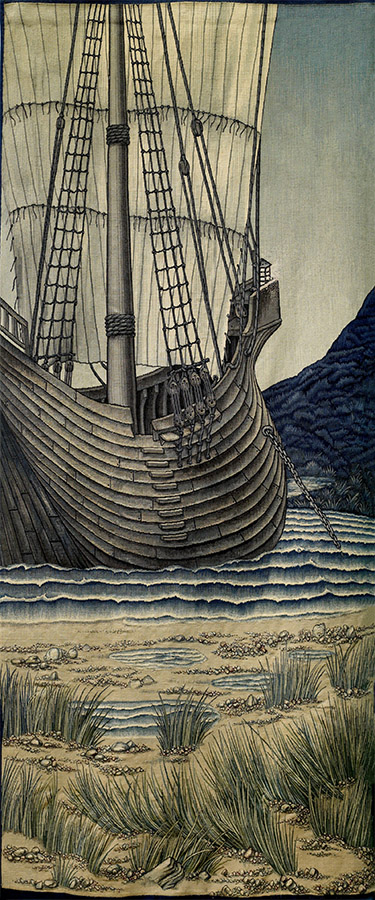
Thus it sounds to me like a core collection of pre-Raphaelite paintings, tapestries and drawings was present in Birmingham by circa 1908-11, and probably were on at least some sort of permanent public display there by 1911 — however limited due to the chances of fading etc. A glass-plate photo appears to confirm for 1911, at least.
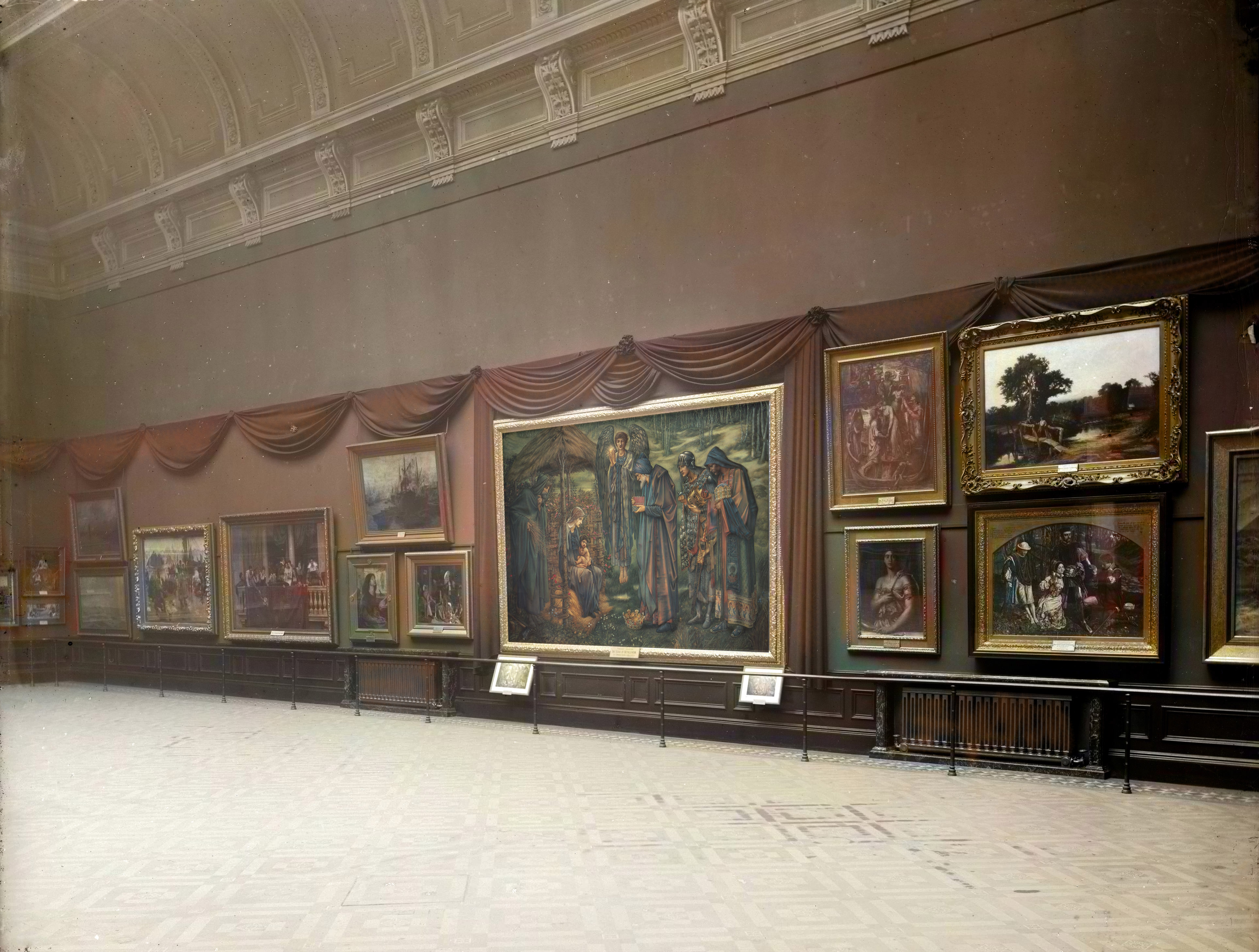
A pre-Raphaelite Gallery at Birmingham in 1911, suggesting a permanent public display by that date. “The Star of Bethlehem” in the centre.
But we still don’t know for sure that Tolkien saw them, and we probably never will now — unless perhaps some new youthful letters are eventually released for publication.
[…] As posted here yesterday, my new musings on the question “Could Tolkien have seen the pre-Raphaelite collection at Birmingham?” along with my newly colorised picture of the interior in […]