Natural Navigator: a lichen mnemonic

I was watching a Tristan Gooley (Natural Navigator) video on YouTube, where he shows how to tell north from where certain rusty shades of tree lichens grow on tree trunks. Find a couple of large patches on a lichened tree and you can be sure where north is. It seemed to need a new mnemonic rhyme for children, so I made one…

  Round and round the trunk we goes,
  to find the way the wind a’ blows.
  Where large the rusty lichen grows,
  to that way point your northy nose.
  Now sniff the wind, and off we goes!

Once you know where north is, and can tell from that what the prevailing wind direction is, then all sorts of natural indicators become available from that. Such as cloud movements seen inside woods, which side of copses birds are sheltering on, where spiders have spun webs on bushes, and suchlike.

Insense

Insense: a word which survived in use in Staffordshire until at least the late 1820s. Seeming to mean: to inform or briefly instruct a group of people about information useful to them, thus helping them to make sense of a situation.

Source: The Gentleman’s Magazine Library: being a classified collection.

The Monthly Magazine of 1806 talks of…

insense, to instruct, or put in the head of any one: as for instance, the judge is said to insense the jury how to bring in their verdict”

The Atheneum of 1827 referred to it as Scottish and/or Scots-Irish…

“to unravel those mysteries which the people want taste and leisure to study for themselves, and to insense the multitude (I like that Hibernicism) on their dearest interests”

It is referred to as “a north country expression” in a memoir of 1869 (A Memoir of H. Hoare), so was at that time either dying out or had never existed in the south of England.

But, since Shakespeare used it, it may once have been present as far south as south Warwickshire.

Ceramics in board-game sets

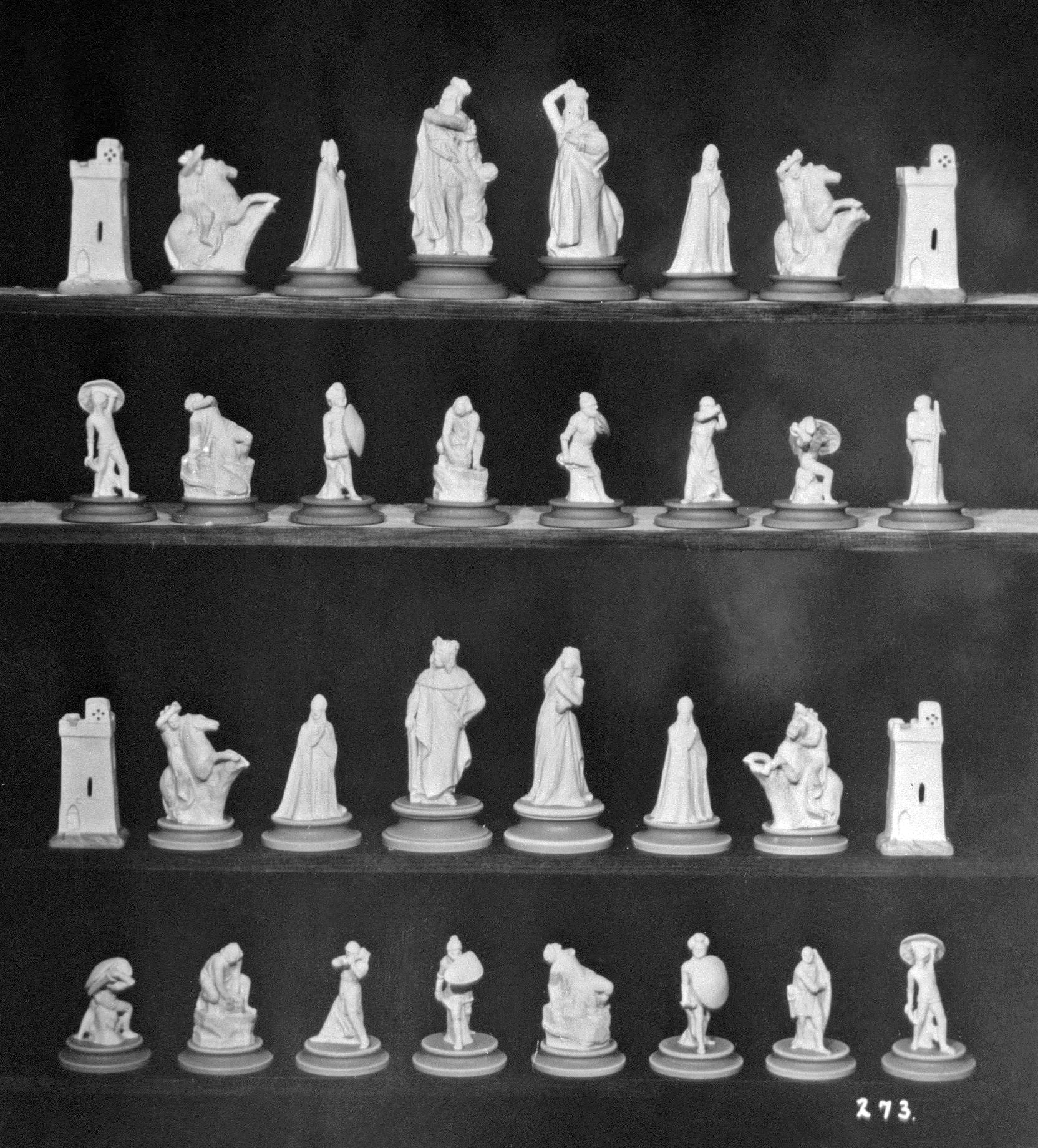
A jasperware chess set, made in north Staffordshire and most likely by Wedgwood, perhaps 1800-1820s.

I suppose the fragility of early ceramic meant it wasn’t favoured for small board-game pieces. Too easily brushed off the table, to smash on the floor. But now the industry has the unbreakable Steelite-style of ceramics, one wonders about a revival of the use of ceramics in board-game sets?

Erasmus Darwin’s The Botanic Garden – a survey of the best podcasts and ebook version

As a sidelight on my new book on H.G. Wells in the Potteries, I’m currently reading Erasmus Darwin’s book-length poem The Botanic Garden: the Economy of Vegetation (1791) in its free Gutenberg version (clean in .ePub and Kindle .mobi, with the original footnotes, corrected long-s, and line numbers).

Here are some recommended introductory podcasts on local man Erasmus Darwin:

* “Erasmus Darwin: People, Language, & History Connections”, a nippy little fast-paced and friendly 15-minute introduction, from a popular podcaster.

* The 14 minute “The Poetry of Erasmus Darwin’s The Botanic Garden is also rather good. The best of a mostly rather dry series of such videos made by academics, apparently for the public.

The only broadcast documentary I can find is John Scotney’s “A Mind of Universal Sympathy”, though it’s not online. It was a long BBC Radio 3 partly-dramatised narrated documentary, broadcast in September 1973. Re-broadcast in 1974 and 1978, but probably now lost due to the BBC’s criminal policy of not preserving their archives in the 1980s and 90s. Such a pity that our regional archives never thought to record such key broadcasts on good reel-to-reel tape. An oral history interview with Desmond King-Hele, via the British Library, reveals more…

I also should mention the radio programme in 1973 called A Mind of Universal Sympathy. This was commissioned by John Scotney, one of the producers at the BBC, and it was really quite difficult to write, it was a dramatised documentary about Erasmus Darwin for Radio 3, it was forty five minutes [Radio Times suggests one hour] and it was a drama with Freddie Jones as Erasmus. It was very successful actually and financially one of my most successful things, because it was repeated several times on Radio 3 and they gave fees for those as well. I did another similar type of radio drama called The Lunatics covering the Lunar Society of Birmingham, again with Erasmus Darwin in a major role.”

Possibly these scripts might be rescued from archives somewhere, and re-made as a new semi-dramatised feature-documentary?

Illustration for The Botanic Garden, via The British Library.

I had been recommended to read The Botanic Garden years ago, I forget by whom, but was reminded of it again by Wells’s “The Cone”. In this macabre revenge short-story Wells has a wife talk of her iron-master husband and his… “dreadful theory of yours that machinery is beautiful […] It’s his great theory, his one discovery in art.” Thus for my footnotes to “The Cone” I investigated the extent of the ‘heavy industry and machinery is beautiful’ sentiment at the time, in art and literature, to see if there was an obvious source Wells might have been gesturing toward and expecting his readers to recognise. There was no obvious source, but few choices at that time. Darwin’s “The Economy of Vegetation” certainly celebrated the rising new industries in no uncertain terms, and had both a Etruria (Stoke) and a Staffordshire connection (Darwin was a Lichfield man). It was a best-seller and went through multiple editions, and thus was likely to be easily available in used and reprint copies in the Potteries by 1888. There were also pirated Irish and American editions due to its immense popularity.

In it there is a striking use of a vengeful husband and his revenge, as a metaphor for the earth’s making of iron in the earth, with fits with the theme of “The Cone”…

Indignant Vulcan eyed the parting Pair,
And watch’d with jealous step the guilty pair

[… he traps and fixes them in a mesh of metal, in their love-bed]

Hence dusky Iron sleeps in dark abodes,
And ferny foliage nestles in the nodes;
Till with wide lungs panting bellows blow,
And waked by fire the glittering torrents flow

With the book-length poem’s visions of a future Empire in the air with airships (“The flying-chariot through the fields of air. Fair crews triumphant, leaning from above”) and in submarines under the sea (“Britain’s sons shall guide | Huge sea-balloons beneath the tossing tide; The diving castles, roof’d with spheric glass, […] Buoy’d with pure air shall endless tracks pursue”) and a great many other items of interest to a budding purveyor of the future, one has to wonder if Wells may have read The Botanic Garden in 1888 or thereabouts. Certainly the botanical aspects of the didactic poem would also have interested him, complete with Erasmus’s own fascinating scientific footnotes. In 1888 Wells appears to have been somewhat light on the botany half of biology, and in need of ‘cramming’ on the topic if he was to teach the subject, perhaps another reason to ‘give it a go’.

However… I can find not a whit of hard evidence that Wells ever mentioned Erasmus, despite Erasmus’s pioneering championing of the cause of “enlisting the imagination under the banner of science”, and his practical linkage of Romanticism and speculative optimistic science (and thirty years before the birth of Jules Verne, to boot). Given Wells’s immense and prolific output, and his effective founding of futurology, this absence in itself is perhaps indicative of a key influence being cloaked from public scrutiny. But the lack of hard evidence has to mean that a Wells connection can only be very tentatively suggested.

Still, The Economy of Vegetation is proving to be an interesting read, especially when viewed as in part an early work of science-fiction. Interestingly, Lovecraft had a copy in his library, and he no doubt adored the blend of the 1700s poetic style with speculative science. The long-s style of Pope and Erasmus Darwin was by then deeply unfashionable, but it was one Lovecraft doggedly championed in public until well into the 1920s.

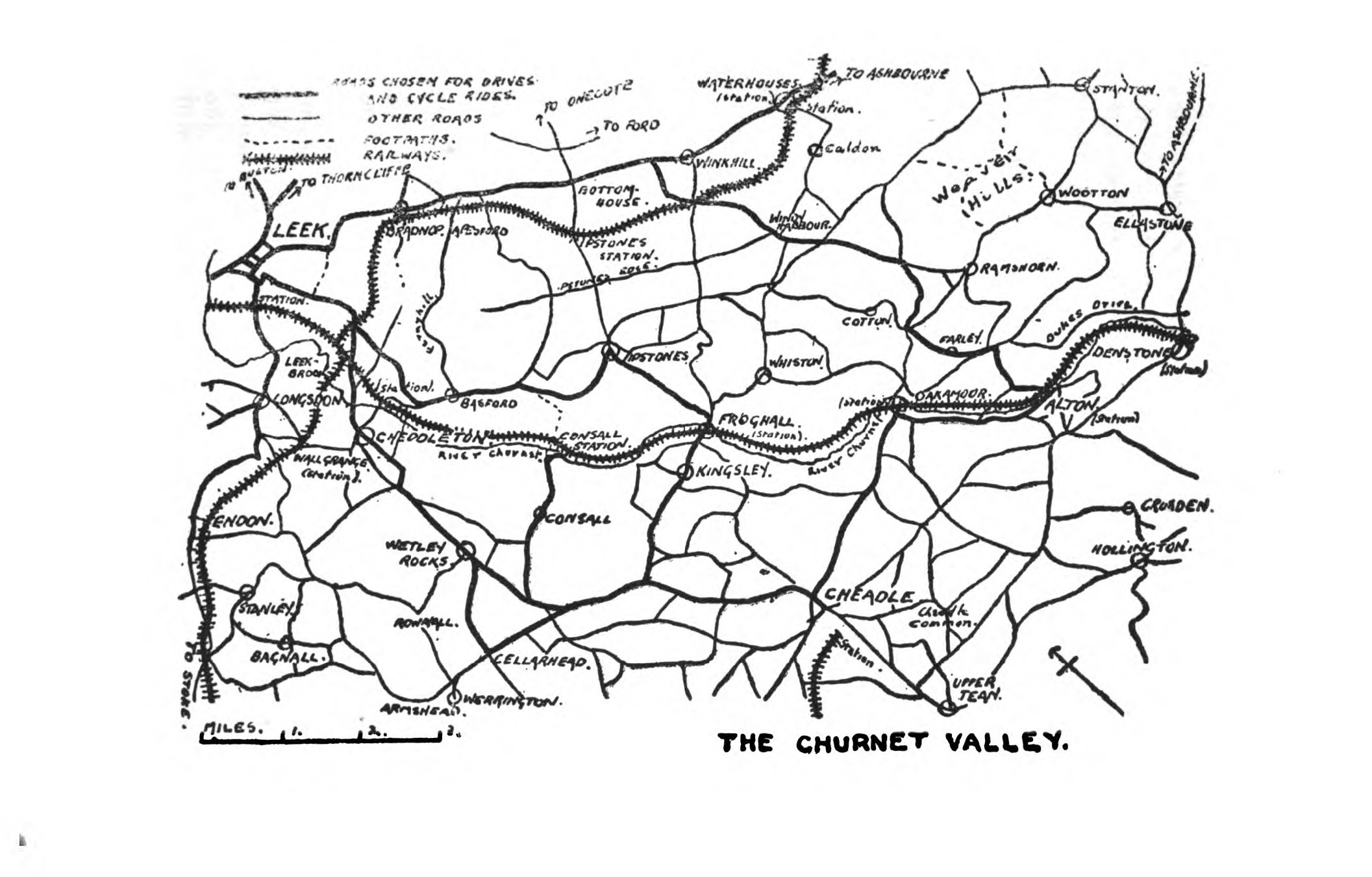
There’s more to be had locally, and very much in the Darwin style, in The vales of Wever, a loco-descriptive poem (1797) by John Gisborne. It ‘Erasmus-ifies’ Wootton, near Alton Castle, complete with the same style of explicatory footnotes. Rather usefully, the poem throws several lights on the otherwise-unknown natural history of the Gawain landscape.

Enville Gardens

The Victorians certainly did know how to create a stylish glassed-in greenhouse. Enville Gardens, near Stourbridge, part of a 100-acres of gardens open to the public since at least the 1860s. This connects with my family tree, re: glass-making at nearby Wordsley and then Birmingham, and the new market appreciation for glass. Also, it seems likely that some of the family members would have visited there.

It had a fine send-off. It was spectacularly blown up with explosives as a practice demolition exercise by the Royal Engineers, before they embarked for the Second World War.

“The Garden of Forking Paths”, time travel and North Staffordshire

It occurs to me that Stoke-on-Trent can claim to have had a part in not one, but two seminal stories about the nature of Time. The first is the famous The Time Machine by H.G. Wells, the earliest version of which was largely written at Basford and later went on to introduce to the world the concept of a time-travel machine. The other, which I’ve only just remembered has a local connection, is the Borges story “The Garden of Forking Paths” (1941). This introduced to the world the idea of multiple branching ‘time-paths’, down which… “Time forks perpetually toward innumerable futures”.

Unlike The Time Machine, the famous Borges story actually takes place in North Staffordshire. Specifically the story is framed by the wartime summer of 1916 and substantially set in a large rural house which, according to an address given by the phone book is in “a suburb of Fenton” which is relatively near the centre of Stoke-on-Trent. But which the narrator reaches by alighting from his train at a fictitious and very rural halt called “Ashgrove”, and then walking through a lush countryside of “confused meadows”. It helps to know here that Stoke is a strange side-by-side intermingling of the industrial and the verdant, as Arnold Bennett and others have observed. We can know the story is set locally because the spy tells us that the spy’s superiors knew only that…

“we were in Staffordshire” […] The telephone book listed the name of the only person capable of transmitting the message; he lived in a suburb of Fenton, less than a half hour’s train ride away. The station was not far from my home […] I was going to the village of Ashgrove but I bought a ticket for a more distant station.”

So anyone local will know this means the German spy must live in the county town of Stafford. This location is logical for a spy, since it is quiet and yet central to the country and has excellent frequent train connections. He has the local phone book easily to hand, which also establishes that he lives there and is not simply a visitor. From Stafford station he takes a local train to “the village of Ashgrove” to reach “a suburb of Fenton”. Ashgrove has its own rural halt…

The train ran gently along, amid ash trees. It stopped, almost in the middle of the fields. No one announced the name of the station. “Ashgrove?” I asked a few lads on the platform. “Ashgrove,” they replied. I got off. A lamp enlightened the platform but the faces of the boys were in shadow. One questioned me, “Are you going to Dr. Stephen Albert’s house?” Without waiting for my answer, another said, “The house is a long way from here, but you won’t get lost if you take this road to the left and at every crossroads turn again to your left.” […] The road [from the station] descended and forked among the now confused meadows.”

So this is again congruent with his living in Stafford. The spy is on the local stopping ‘milk-run’ train service from Stafford to Stoke-on-Trent, since he doesn’t change trains and some of the few passengers aboard are described as “farmers”. The isolation and terrain of the rural Ashgrove station can then only suggests the real-life halt at Trentham. Trentham serves as the green ‘grove’ for the industrial ‘ash’ city of Stoke, hence ‘Ashgrove’ is an apt coinage. The spy stands to face the road on exiting Trentham station, turns left and then turns left at every proper crossroads.

The spy could not have arrived there by travelling to the nearer Fenton train station, since that station was not on a train line to Stafford. Nor could he have gone on a little further to Stoke and then changed trains to go back toward Fenton, since i) he is being hunted, and time is of the essence and ii) he needs to avoid heavily policed and militarised places such as the mainline station at Stoke during wartime. He may also suspect that his pursuer will have phoned ahead from Stafford to Stoke. Thus he chooses the lonely rural halt of Trentham (the station near the famous Trentham Gardens), from where his map indicates he can walk unseen around the lanes to reach the “suburb of Fenton”. His pursuer, secure in the knowledge than any oriental man will be detained at Stoke, boards the next train and from the slide-down train window enquires at each platform (Stone, Barlaston, Trentham) if an oriental man had alighted there.

The spy thus arrives at Great Fenton, the “suburb of Fenton”, ahead of his pursuer. At that time Great Fenton had a cluster of several fine large houses…

“I arrived before a tall, rusty gate. Between the iron bars I made out a poplar grove…”

Great Fenton Hall had been demolished in 1900, so either Bank House, Great Fenton House or Heron Cottage are the obvious candidates for the house. Heron Cottage, though sitting on the crossroads rather than on a left turn off it, has the most interesting and relevant history…

At the south-east corner of the cross-roads at Great Fenton stood Heron Cottage, described in 1829 as a ‘small but superb edifice’ and c. 1840 as ‘agreeable for its seclusion’ and having ‘the character of an episcopal seat’ […] with Gothic features which included a cloister; Mason added a large redbrick dining-room and a ballroom.”

This seat of a local China plate manufacturer (seen above) has a historical link to armaments and ancient documents and dangerous murderous strangers, all elements found in “The Garden of Forking Paths”…

“August 1842 during the Chartists Riots, when it [Heron Cottage] was attacked in no uncertain terms. The rioters expected to find a large store of firearms as the large mansion was used as a depot for the Volunteers during the last war. Upon reaching the house, the mob smashed the windows and took possession of the house and plundered it, breaking all the furniture into pieces and throwing the beds through the upper windows onto the lawns below. There followed an attack on the wine cellar where its contents were quickly consumed and the larder cleared of its contents. Further damage was done when the mob set fire to ancient parchment documents relating to the history of the family. There were found on the premises only a couple of guns and a brace of pistols and a couple of swords.”

“… they plundered and almost gutted [Heron Cottage], stealing and destroying a vast amount of property. […] the whole country was in the utmost terror [of the mob, until dispersed by the military in Burslem]” (Gardener’s Chronicle, 1842)

In relation to this, note the spy’s vision of the many “invisible persons” surrounding the house, in “The Garden of Forking Paths”…

Once again I felt the swarming sensation of which I have spoken. It seemed to me that the humid garden that surrounded the house was infinitely saturated with invisible persons. Those persons were Albert and I, secret, busy and multiform in other dimensions of time.

Borges’s grandmother gives him a link to radical politics in north Staffordshire. She was the educated free-thinking Staffordshire girl Fanny Haslam, born and raised in north Staffordshire, specifically Hanley. She then moved to the British Argentine around 1870 in her 20s, where her father was an anarchist journalist. She was the one who taught Borges fluent English, and raised him in what was basically an English household. (A Companion to Jorge Luis Borges, page 11). Her grandfather had been one of those primitive Methodist preachers which North Staffordshire excelled in producing, and whose currents fed into various radical political sects later claimed by Marxists. This then gives Borges a family connection with north Staffordshire (Hanley is a stone’s throw from Fenton) and also to the Chartist riots associated with Heron Cottage.1

After the sacking and renovation, Heron Cottage became the home of Thomas Battam circa 1848-55. Battam was a fine painter of miniatures, Art Director at a local world-famous pottery, and the author of the “Guide to the Great Exhibition” (1851) at the Crystal Palace. This was a world-changing event, organised and promoted at the highest levels by Prince Albert. It was also a maze, of a kind, and a prism-like set of multiple turning points to the new future. Battam’s Guide to the Exhibition was a rather multifarious Borgesian catalogue of a sort…

A Guide to the Great Exhibition : containing a description of every principal object of interest : with a plan, pointing out the easiest and most systematic way of examining the contents of the Crystal Palace.”

It seems the sort of book likely to have been in Borges’s Anglo-Argentine father’s library.

The Staffordshire Advertiser, of 5th November 1864, called Battam on his death…

“a man of very refined and cultivated tastes […] sincerely respected by art circles in London”.

So far as I can tell Battam was not a Sinologist, as Stephen Albert is in “The Garden of Forking Paths”, but he was evidently a man of a similar nature and also concerned with china (of the pottery type).

It appears that Heron Cottage may have been standing in 1916. It stood just off the crossroads at Great Fenton in 1916, but Victoria County History states that… “The site was built over by the early 1920’s.”

Was Borges interested in the history of the Crystal Palace or its Great Exhibition, which may then have enticed him to write a story set at the home of its chief cataloguer? There is some evidence on that. In 1951 on the 100th anniversary of the Great Exhibition at the Crystal Palace he published an essay on ‘Coleridge’s Dream’. This mused on how a dream-like archetype of such a palace had been passed from Kublai Khan’s dream-inspired stately pleasure dome at Shang-tu in the 13th century, via Coleridge’s dream of it in 1797 (famously interrupted by the irritating “person from Porlock”). Borges thought of the idea of the “stately pleasure dome” as…

“Perhaps an archetype not yet revealed to men, an eternal object (to use Whitehead’s term) only gradually entering the world; its first manifestation was the palace; its second was the poem.”

Left unsaid in Borges’s essay, written on the 100th anniversary of the Crystal Palace, is that the Palace might — in Borges’ mind — have been the third such manifestation.2

Interestingly, H. G. Wells had this same Crystal Palace on his horizon for much of his childhood, and as such it must have been the inspiration for the distant Palace of Green Porcelain in The Time Machine. A fourth-such manifestation, Borges might have called it.


1. An amusing use was later made of this Staffordshire grandmother. In 1983 the Keele University medieval history lecturer Colin Richmond hoaxed the scholarly journal The Downside Review with his article “A Blatter of Rain and the Origins of Penkhull”. He…

“described how, in the steps of Edmund Bishop, he had followed the trail of the reliquary of St Penket (an obscure Anglo-Saxon virgin) from the cathedral of Fribourg in Switzerland to the Potteries and, eventually, to the garden of Jorge Luis Borges’ grandmother’s home at No. 21 The Villas (home of the then Head of Department at Keele) in Stoke-upon-Trent.”

2. In another related essay, “Coleridge’s Flower” (1945), Borges points out a passage in Coleridge which may seem to some to re-appear in Wells’s The Time Machine

“If a man could pass through Paradise in a dream, and have a flower presented to him as a pledge that his soul had really been there, and if he found that flower in his hand when he awoke -Ay!- and what then?”

Borges concedes that, on Wells’s powerful use of this same motif in The Time Machine

“Wells was probably not acquainted with Coleridge’s text” [but in Borges’s mind this does not matter, since for Borges…] This is the second version of Coleridge’s image. More incredible than a celestial flower or a dream flower is a future flower, the contradictory flower whose atoms, not yet assembled, now occupy other spaces.”

Dreams apart, Borges is likely correct on the matter of actual literary influence. The publication of the passage in Poetae: From the Unpublished Note-books of Samuel Taylor Coleridge (1895) was late in 1895 and thus could not have influenced The Time Machine. A review in the book-trade journal The Bookman of December 1895 shows that Poetae appeared for the Christmas market of 1895/96, and that it was made up of previously unpublished texts. The date of publication was thus around five or six months after the final book publication of Wells’s The Time Machine. I have also checked all of the earlier partial publications of fragments of the Notebooks. Clearly Wells’s motif of the flower originates in his fateful meeting in Etruria Woods in the spring of 1888, and not with Coleridge.

It’s a gas… or not

A small note on the possible significance of the gas-lighting in the Richmond house of the Time Traveller in The Time Machine by H. G. Wells. It’s come to my attention via an R.D. Mullen review that Leon Stover claimed that the Time Traveller’s house at Richmond was lit by gas. Paul Kincaid, in an otherwise scathing review of Stover in “Reprint: (Mis)Representing Wells”, cedes that…

Stover makes a revealing point about the gas light in the Time Traveller’s home and the presence of the provincial mayor at his dinner party: the mayor would have been responsible for the political decisions that prevented the spread of electric lighting to the town of Richmond, an example of local politics getting in the way of scientific advance.

I don’t yet have a copy of Stover’s edition of The Time Machine but Google Books obliges me with part of the relevant snippet…

“It is precisely this kind of muddle, created by the primacy of local patriotisms over the translocal imperatives of large-scale modernity, that kept electricity out of Richmond in favor of gas. Indeed, one of the Time Traveller’s guests is the very man responsible for that. He is the Provincial Mayor. Reactionary politicians like him provided a market for “incandescent” gas lighting in competition with Edison bulbs … Elsewhere the new technology [of electricity] redefined the old political territories by its translocal reach, whereas the Electric Lighting Act confined it within existing bounds.”

But a few minutes of research suggest this is incorrect, in terms of what was going on at Richmond at the time when The Time Machine was being written.

‘The Richmond (Surrey) Electric Lighting Order, 1883’ was confirmed in 1892, an agreement having been made with the Corporation on 8th December, 1891. The local Corporation (i.e.: the local council, aka the local authority, the town having incorporated in 1890) and a contractor formed a joint venture, the Richmond (Surrey) Electric Light and Power Company, which was announced in The Times newspaper on Friday 22nd July 1892, launching a limited company capitalised at £50,000. This company set about installing electric lighting across Richmond, for at least three years, most likely beginning in earnest in the spring of 1893 when allotment letters were issued. A short biography of one Percy Northey states he was “Chief Engineer constructing and running Richmond (Surrey) Electric Light and Power Co., for 3 years until 1896”, which suggests a three-year roll-out. Possibly there was a long transition period of dual supply, and not everyone living locally would have immediately swapped to electricity. Perhaps there was not immediate supply into every nook and cranny of the district. But there seems no indication in the historical record of “local patriotisms” or “local politics getting in the way of scientific advance”. The Provincial Mayor of The Time Machine, if the Mayor of Richmond, was not in 1893-94 holding back the local roll-out of electricity.

Interestingly, the elected mayor of Richmond in 1893-94 was Sir James Weeks Szlumper, the “civil engineer concerned with the construction of the London Underground” and as such hardly a provincial stick-in-the-mud (though Richmond was then under the county of Surrey, rather than London, hence the “Provincial” stands). One wonders if Wells, given his novel’s concern for the far-future development of underground spaces, was aware that Weeks Szlumper might be identified by his Richmond readers as “The Provincial Mayor”. Specifically in 1893-94 Weeks was the chief engineer and planner of the Brompton and Piccadilly Circus Railway (the modern Picaddilly Line), a modern all-electric underground train line, then a major planning proposal and which eventually went ahead after Parliamentary approval in 1897. It connected central London with Wells’s beloved South Kensington.

Actually it’s by no means certain that the Time Traveller’s house was lit by gas. So far as I can tell gas is not mentioned in the 1895 text, only the opening “the incandescent lights” from which Stover infers gas-lighting. Yet a 1886 report of the British Association for the Advancement of Science talks of “the type of dynamo for the incandescent lights”, meaning electric lights. The Electrical Engineer magazine of 1893 talks of “the additional decorative effect of the electric light circles of numerous incandescent lamps” and in 1894 of a church where “The lighting effects are obtained by means of four arc “calcium” lights — two in the orchestra and two in the wings. … Incandescent lamps form the stamens of the lilies”. The Supplement to the Encyclopaedia Britannica (1889) lauds the “value of the incandescent light, as introduced into private houses” specifically “its healthfulness” because it “does not to some extent poison the atmosphere [like gas]”. Clearly “incandescent” meant electric in 1894.

The Time Traveller’s electric lamps — albeit augmented by flattering after-dinner candles and a portable oil lamp at which cigars can be lit — are thus rather evidence of his advanced and cultured nature. Being not just electric light but light in the arts & crafts form of Tiffany-style flowers, a form which foreshadows the use of flowers at the end of the novel. The melding of electricity with flower forms appears to have been quite common at the time. For instance, a Popular Science News report of an exhibition at Frankfurt in 1891 lauded the ways that electric light was being shaped into flower forms…

It seems as though proof enough lay before us to convince us that the electric light is, of all others, the most capable of artistic handling. No longer need we be bound to ugly, upright globes to shade our lights; here are lily bells, roses, trumpet flowers, their petals glowing from stamens of electric light.

Cryptobotany

Cryptobotany Books, three anthologies of short stories of strange plants and fungi, most from the 1880s and 90s.

For a later sustained take on the theme, check out Frank Belknap Long’s 1940s ‘John Carstairs, Curator of the Interplanetary Botanical Gardens’ horror-pulp series. Although that was very much a wartime boys’ series.

New book: H. G. Wells in the Potteries

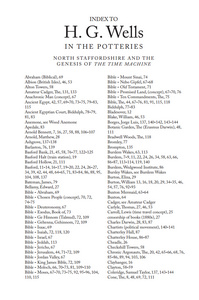
I’m pleased to announce the publication and availability of my new book: H. G. Wells in the Potteries: North Staffordshire and the genesis of The Time Machine (2017). In 6″ x 9″ format, a 35,000 word scholarly essay from a highly experienced source-hunter. With footnotes and over 50 illustrations. Plus a closely annotated edition of the Potteries short-story “The Cone”, and more. Lots of new discoveries, and the book should please Wellsians and Stokies alike.

Online bonus, an index for the book:

Promotional video:

[youtube https://www.youtube.com/watch?v=5bbBkRiHWUQ?rel=0&w=560&h=315]