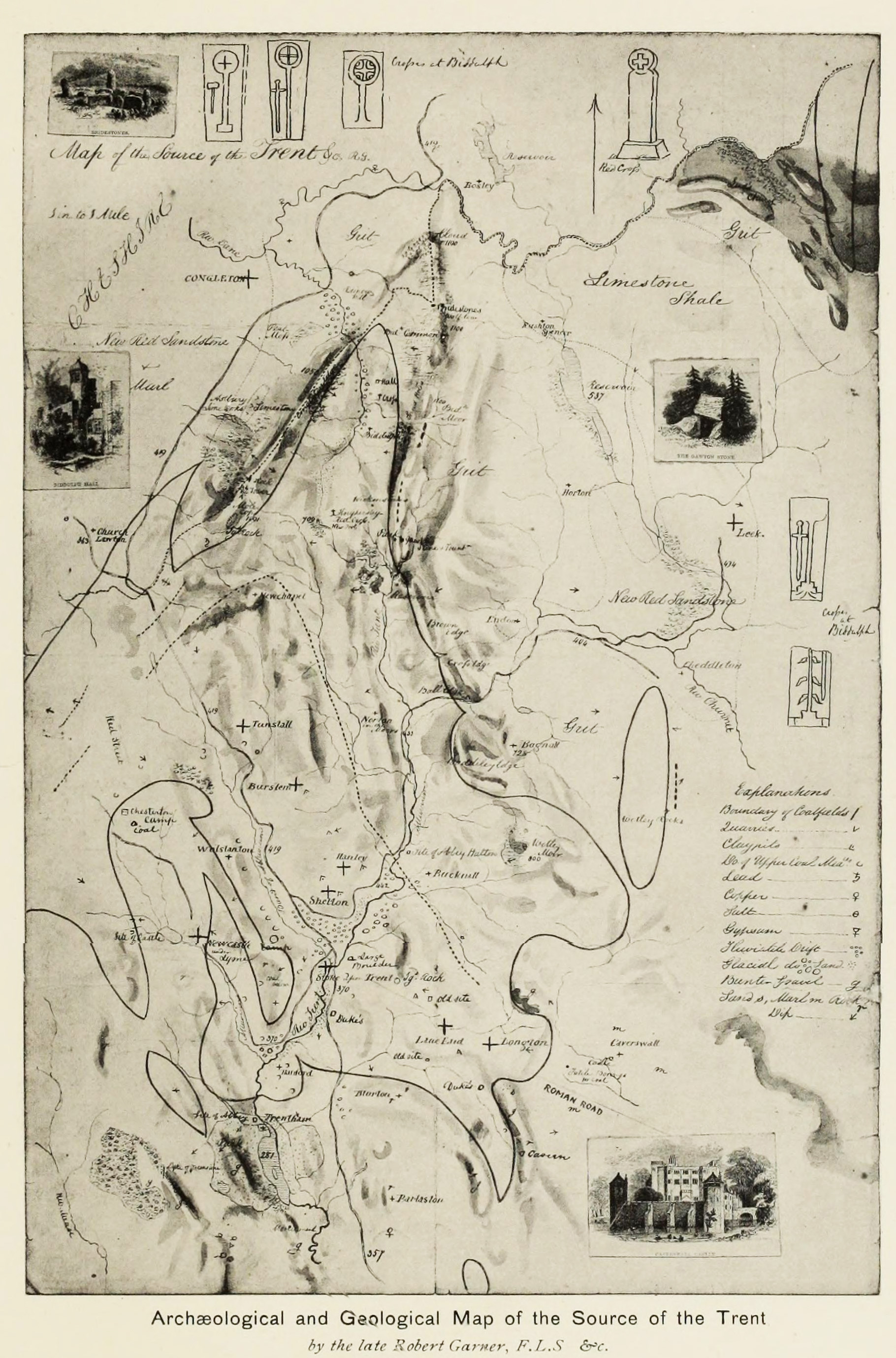
Archaeological and geographical map of the source of the Trent, c.1895. From Staffordshire Knots, 1895.
Archaeological and geographical map of the source of the Trent, c.1895. From Staffordshire Knots, 1895.
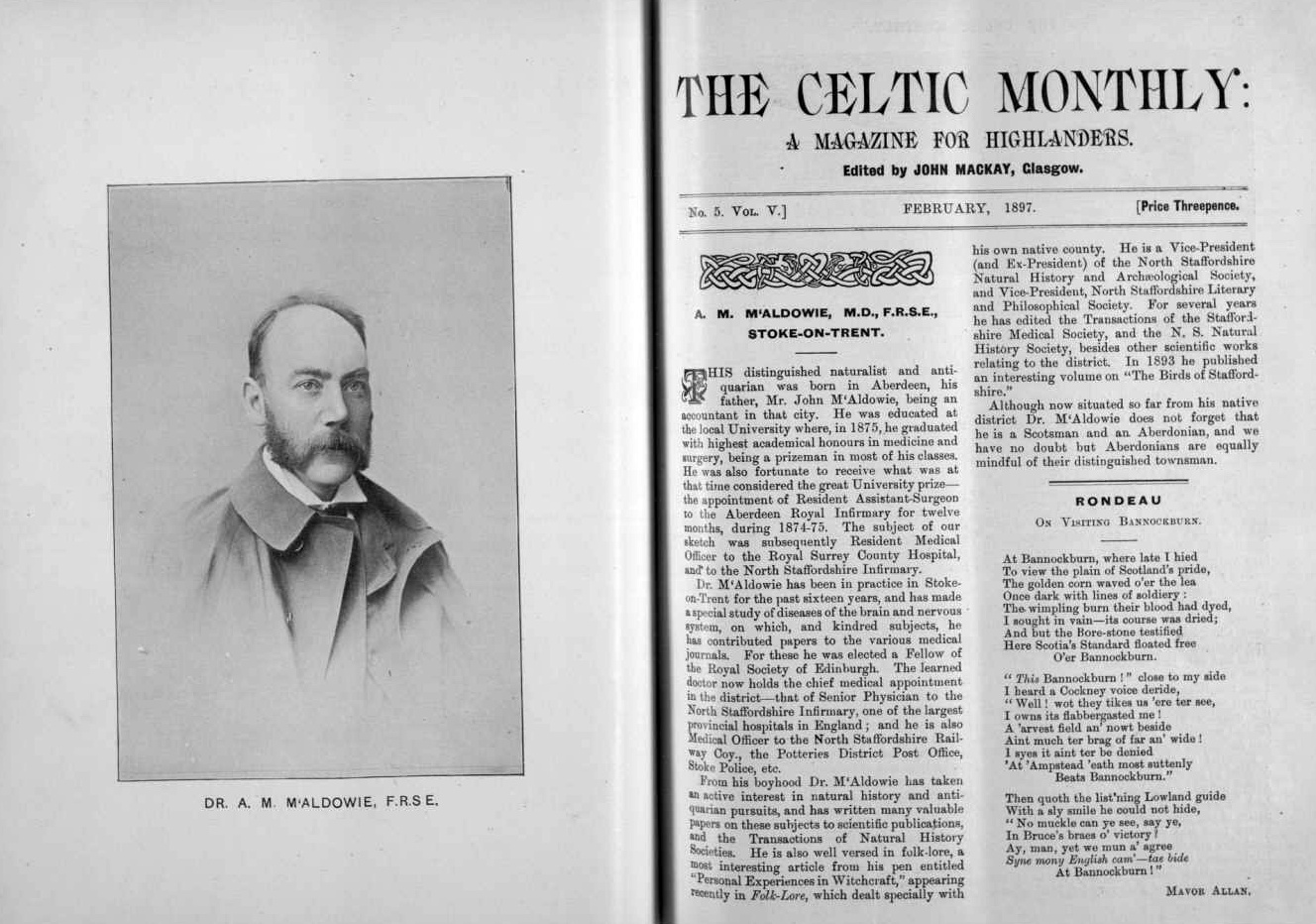
Alexander Morison McAldowie, from his article “Personal Experiences in Witchcraft”, Folk-lore journal, 1896…
“My first experience of witchcraft began at a very early age, before I was an hour old, in fact. My maternal grandmother, a pure-bred [Scottish] Highlander, held me close to the fire, and, taking care that she was unobserved, quietly fastened this witch-brooch beneath the ample skirts of my baby-garments. This form of brooch, fastened in the manner above described, was firmly believed to possess the power of driving the witches, which lay in wait for all newly born children, up the chimney. It protected the wearer from their malevolence, and brought good luck. The rite was practised universally in rural districts throughout the north in my grandmothers time. [His brother Robert had a small collection of witch-brooches] The two witch-brooches set in brilliants [i.e: set around with brilliant cut stones] [my brother] found in Staffordshire. One was the subject of a paper read before the North Staffordshire Field Naturalists’ Club in 1890 [Transactions, 1891]. It is interesting to note that the second specimen, which he obtained after the paper was read, is identical in every respect with “Shakespeare’s brooch,” found at Stratford-upon-Avon about seventy years ago.”
Alexander Morison McAldowie was the editor of Staffordshire Knots (1895), and Vice-President of the North Staffordshire Literary and Philosophical Society (c. 1897).
“Born in Aberdeen in 1852, Alexander Morison McAldowie moved to Staffordshire in 1876 when he was appointed House Physician at the North Staffordshire Infirmary. He later had a private practice at Brook Street, Stoke on Trent until his retirement in 1909. He then moved to Cheltenham, where he died in 1926. He was a member of the North Staffordshire Field Club from 1877 and was a keen amateur naturalist. He was also a Justice of the Peace for Stoke on Trent.” (from Staffs PastTack)
Here is his brother Robert McAldowie’s 1891 North Staffordshire Field Club Transactions article on the “witch brooch”…
NOTES ON A STAFFORDSHIRE WITCH BROOCH.
BY ROBERT McALDOWIE.
The small brooch which is the subject of this notice is heart-shaped, not of the conventional shape seen on a pack of cards, but is unequal sided, one side being full or rounded, the other indented. In size it is one inch wide and a little more than one inch in height. It is made of silver and set with eighteen crystals in what is called a fancy setting, that is, each crystal is set separately in a piece of silver, and then the pieces are soldered together in the required shape. This is the first example of this kind of setting I have met with, all the other heart-shaped brooches I have seen, set with stones, had a plain setting, just a band of silver with the stones set in it. The most peculiar thing about this brooch is its method of fastening. The pin is hinged on the back, comes through the open loop in the centre, and then the point rests on the front, so that no catch is necessary. This is a particularly safe fastening, for once the brooch is fastened on a piece of cloth it will not become undone unless the fingers are used, and this was a very necessary requirement for this kind of brooch. It was not an ordinary piece of ornamental jewellery, nor was it always used in what we, now a-days, would consider a useful manner; yet in the age in which it was worn it was a very essential article to the peace of mind of a certain class of people—namely the superstitious, who believed in witches and in luck. From the peculiarities I have described I have no doubt this is an example of what is known as a “Witch Brooch.” They were usually bought along with the wedding ring, and were supposed to keep away witches and bring good luck to the wearers. The lady wore it first but not exposed to view; then it was transferred to her children by a trustworthy nurse, who put it on their little garments while sitting by the side of the fire-place, so that if a witch had got a hold of the child, that evil being would find a ready mode of exit up the chimney, unable to withstand the influence of this miraculous charm.
The wearing of this brooch was thought to be an infallible safeguard against all kinds of evil, and it was considered a very foolhardy thing if parents neglected to put one of some kind on their children’s garments. I have examples of home-made brooches of such common materials as brass and mother-of-pearl, which I found in Scotland, the people who made them being, very probably, too poor to buy silver ones, but determined to have a “heart” of some description to keep their children from being witched.”
[A section on the fading away on the tradition in Scotland, which was within living memory at 1891, followed by a section on the “Shakespeare brooch”]
One of the brooches I have here to-night has this word [“love”] engraved on the back of it, and I have seen them with a scripture text, usually there are the initials of some persons. This Staffordshire one has no inscription of any kind. I got it in Lichfield, in a jewellers, who had bought two of them from an old servant of a family once living near the town; the other brooch he could not find, he thought it had been melted down for old silver, sharing the same fate as many others of the kind. I have inquired at many jewellers in North Staffordshire for these brooches, several remember seeing them but long ago, others have had them and consigned them to the melting pot as useless, of no interest, and not worth keeping. I should be very pleased if these few notes should help to preserve, or bring to light in this neighbourhood, some of these quaint and interesting old brooches.
As his brother states in his article “Personal Experiences in Witchcraft”, Folk-lore journal, 1896, Robert later found another witch brooch from Staffordshire some years after this paper was published.
From EXAMPLES OF FOLK MEMORY FROM STAFFORDSHIRE.
BY SAMBROOKE A. H. BURNE, M.A., BARRISTER-AT-LAW.
In The Transactions of the Folk-Lore Society, 1916.
[…] a lullaby or jingle which in 1892 was heard sung to a child at Harriseahead, a remote colliery village in North Staffordshire. The singer was an old woman, and there were several verses, but only one was noted :
” Ding a dong ding.
Ding a dong ding,
I heard a bird sing.
The Parliament soldiers have gone for the King.”
[…] This rhyme is not confined to North Staffordshire. A member of the North Staffordshire Field Club writes that she remembers it being sung to her in her childhood by a nurse, “probably a Cambridgeshire woman, and almost certainly from the Fens.”
Interesting conference in 2014, A Fiend in the Furrows: Perspectives on ‘Folk Horror’ in Literature, Film & Music – 19th-21th September 2014. Queen’s University Belfast, UK.
I’ve had a go at putting the North Staffordshire Souling Song c.1894 into a more singable form, added a rhyme back in on the fourth line, and stripped out the clunky Christianising of the end lines…
“Soul, soul, an apple or two
If y’ave non apples, pears u’ll do ;
Up wi’ your kettles, down with y’ pans,
Pray, good missus, a soul-cake, do!
Souling-day comes once a year
When it comes, it finds us ‘ere.
The cock sits up in t’ yew-tree,
The hens came cackling by,
I wish yer a merry Christmas,
And a good fat pig i’ the stye.
All us stand at yonder gate
A’ waiting for a souling-cake ;
One for sorrow, two for joy,
Three for a star to sail o’er all.”
A newly discovered novel, set in the Potteries. Charles Francis Keary‘s The Mount (1909) is set in his home place of Stoke-on-Trent…
“The scene of The Mount is that part of Staffordshire where the towns lie beneath an almost unbroken pall of smoke, and the chemicals with which the air is laden bite into the face of Nature, pitting, discolouring, and withering everything. Those who were not tied to the place by industrial connexions have fled before the blight, and a new ‘aristocracy’ has arisen…” [the novel not for everyone, such as] “the hasty reader whose palate cannot taste fine shades of flavour will perceive no reason for the insistence on minute differences of tone and meaning. Mr. Keary does not write for him, and is, we suspect, splendidly indifferent to his judgement.” (The Spectator review, 4th September 1909).
Sadly the book is utterly obscure and unobtainable. Keele Local Collection doesn’t even have it. I didn’t even know about it, re: my recent survey of local novels (FactoryMag #1). There’s one copy in the British Library, and a Google-scanned copy in Hathi is on an annoying and unnecessary copyright lockdown.
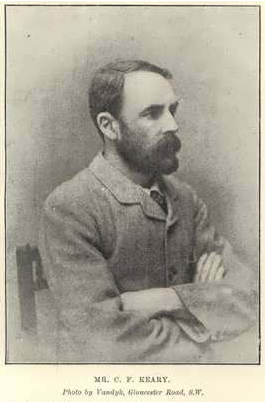
C. F. Keary was the son of the borough of Stoke-on-Trent’s first Mayor, and the brother of the local folklore collector Miss Keary. His book of weird tales Twixt Dog and Wolf was admitted by James Joyce to have been an influence on Dubliners.
From the Times obituary…
[His novels] “The Journalist” (1898), “High Policy” (1902), “Bloomsbury” (1905), “The Mount” (1909). Keary’s novels, aiming at depicting life, after the manner of the great Russian writers, in its chaotic reality and avoiding conventional selection and arrangement, never had a large popular circulation. They were, however, very highly though of within the limited literary set. Besides his novels proper two little books of Keary’s call for notice. One was a small volume “The Wanderer” (1888), published under the pseudonym H. Ogram Matuce, in which Keary strings together a number of disconnected thoughts and criticisms under the assumed person of a retired man of letters, somewhat in the manner of Gissing’s “Papers of Henry Rycroft.” This is perhaps the most perfect and charming of Keary’s prose works. The other little book is a series of short sketches in the weird and macabre, “Twixt Dog and Wolf” (1901), excellently done.
If there is perhaps another Stoke or Staffordshire setting hidden in these titles, other than The Mount, is unknown.
Update, Feb 2020: The Mount is now online for free at Archive.org.
Miss Alice Annie Keary, confirming in 1896 the habit of the Potteries people in the 1880s and 1890s to naturally speak as in sing-song proverbs and poetic epigrams, but not to realise that they were doing it…
“…proverbs I have for myself found very difficult to collect, owing to the Poyser-like habit of our people of expressing themselves in an epigrammatic and metaphorical fashion which may be proverbial, but is quite as often extemporised.”
Keary, though the key North Staffordshire folklore and folksong collector of the mid 1890s and presumably rather experienced at such things, thus found it very difficult to distinguish between ordinary speech and proverbs. Keary alludes above to Mrs. Poyser, a proverb-spouting character in the novel Adam Bede by George Eliot.
Keary had grown up in Stoke and at the time of her observation lived at Oakhill, Trent Vale.
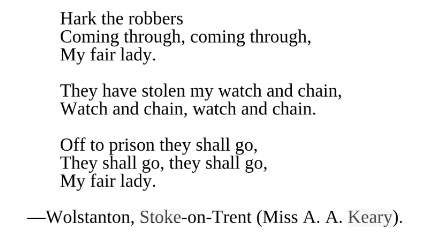
Sadly it appears her papers and work-books have completely vanished, and we are left only with bits that can be picked up from publications. Such as this Wolstanton children’s game-song, collected by Miss Keary and published in The Traditional Games of England.
The North Staffordshire folklore and folksong collector of the mid 1890s, Miss Alice Annie Keary of Oakhill, Stoke-on-Trent, on riding her white horse in Penkhull…
“Not long ago [c.1894] I was told of a person (not quite an uneducated person either) who excused herself for having adopted, without much enquiry, a black kitten which had strayed from another house, on the ground that “she had always understood it was very lucky to have a black cat come to your house.” A similar belief in the luckiness attending white horses must have been inculcated in the minds of a party of children in no more remote a village than Penkhull, who “one day about fourteen or fifteen years ago [meaning circa 1880], saluted me, as I rode past them on a whitish grey steed, with the rhyme,
“Good luck to you, good luck to me,
Good luck to every white horse I see.”
[The association of black/luck with the doorway of a home, evident with the black kitten mentioned above, was evidently also present in New Years Eve traditions … ]
“Another old-world notion [in North Staffordshire] is impressed on the mind of the householder who is roused from his bed at midnight on New Year’s Eve by a thundering knock at the door; and on asking who is there, is informed that So-and-so “just thought he’d like to have the New Year let in for him.” Possibly in some cases the hope of a “tip,” or at all events of a glass of beer is mingled with a neighbourly regard for the householder’s welfare during the ensuing year, but there are many people even now-a-days who would feel that such an offer should not be lightly rejected, at least if it came from a man with black or very dark hair. For it is well-known that it is very unlucky to “let the New Year in” by being the first person to cross your own threshold on January 1st and also that it is very important that this office should be performed by a dark-haired man. An old woman of our acquaintance who lived for the greater part of her married life in Trent Vale, told my sister that her husband, being a very dark man, was quite in request among his neighbours, at that season.”
Miss Keary was the sister of Charles Francis Keary. Also the very good friend of the famous folklorist Miss Charlotte Sophia Burne, who until circa 1894 resided at Pyebirch, Eccleshall.
From Staffordshire Knots, 1895…
“I should be greatly obliged to anyone who could give me the whole of this “souling song” which I heard some Trentham school children singing only a few months ago and took down at the time. I understand that it used to be always sung in the neighbourhood [while going trick-or-treating] on [the eve, 1st Nov, of] All Souls’ Day but there used to be more to it.
“Soul, soul, an apple or two
If you have no apples, pears will do ;
Up with your kettles, down with your pans,
Pray, good missus, a soul-cake !
Souling-day comes once a year
When it comes, it finds us here.
The cock sits up in the yew-tree,
The hens came cackling by,
I wish you a merry Christmas,
And a good fat pig i’ the stye.
Peter stands at yonder gate
Waiting for a soul-cake ;
One for Peter, two for Paul,
Three for Him who made us all.”
So interesting a relic as this, which must have come down with little alteration from mediaeval times, certainly ought not to be lost.”
Elsewhere she writes…
“In the north of the county [of Staffordshire] we have the custom of Souling, or [children] begging for apples [at the doors of local homes] on the Eve of All Souls’ Day, November 1st.”
Miss Alice Annie Keary was the North Staffordshire folklore and folksong collector of the mid 1890s. She was the sister of Charles Francis Keary. Also the very good friend of the famous folklorist Miss Charlotte Sophia Burne, who until circa 1894 resided at Pyebirch, Eccleshall.
The final three lines are, of course, a Christianised version of the famous children’s magpie counting rhyme: “One for sorrow, two for joy, three for a girl, four for a boy… etc”.
THE BRIDESTONES (1895)
By J. T. Arlidge, B.A., M.D., F.R.C.P.
ON the southern slope of Cloud Hill, lying to the east of the town of Congleton, is a group of massive stones commonly known as the Bridestones.
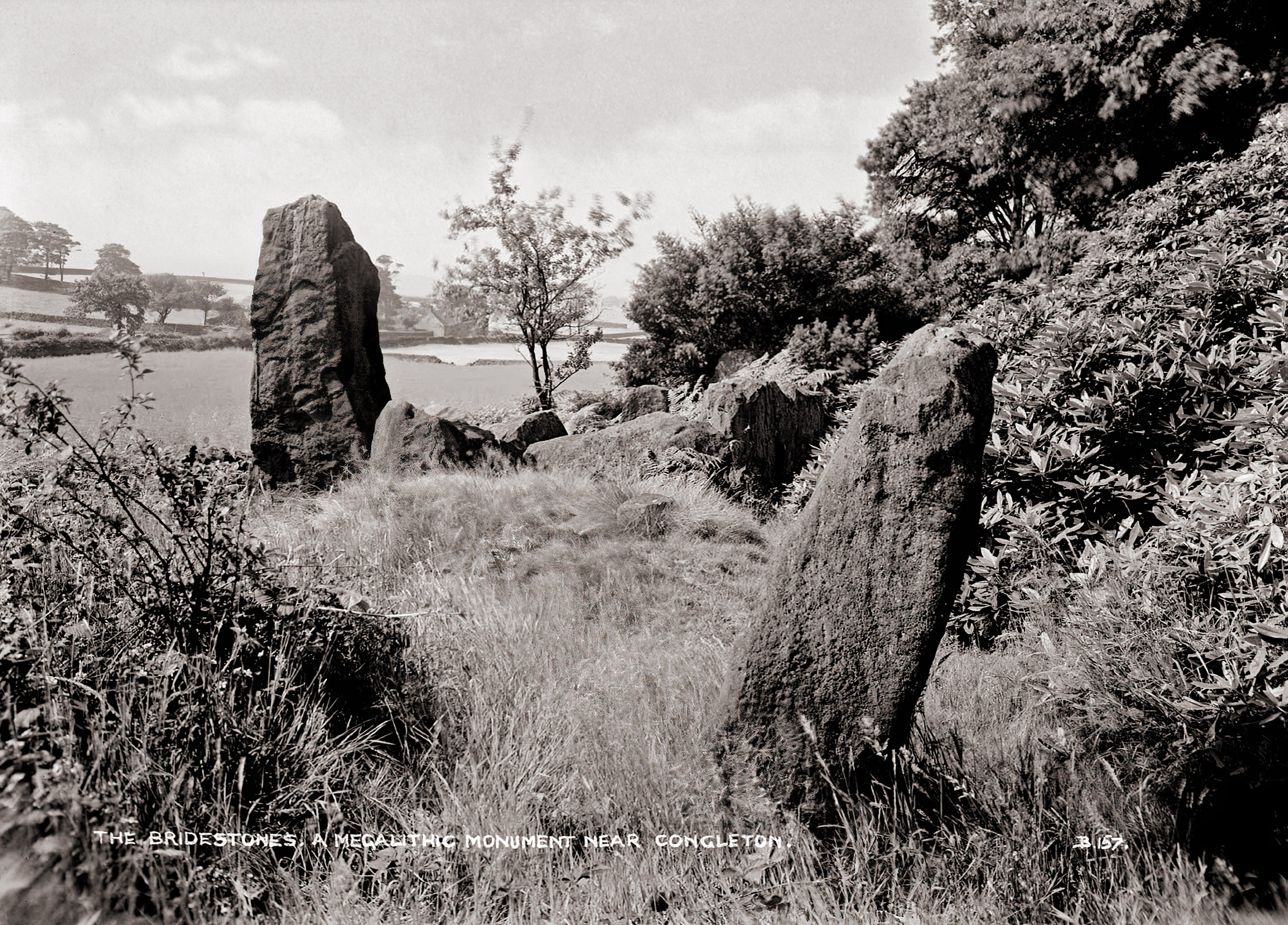
The greater part of the stones, composed of the millstone grit of the neighbourhood, are employed to form an oblong box, much like a gigantic coffin, 18 feet by 11 feet. In the interior, about a third from the east end, is a cross stone, only a little above the level of the soil. The side stones are of irregular flat shape, stood on edge, but seem to have been roughly cut so as to fit together at the angles of contact. This is well seen in one large side stone now prostrate, but which, if raised, would fit in and make up accurately the vacant gap. Ward states that the whole of this side of the Kistvaen was originally of one stone, but that owing to a bonfire made in the enclosed area it was split, and this portion fell outwards. On what authority this assertion is made I know not, and I am not prepared to receive it, at least in its entirety.
Near the north-east angle of the stone enclosure is the largest rock on the ground. It stands quite apart from the Kistvaen — for such is the structure described in the nomenclature of Druidical remains. This stone is about eight feet high, three feet wide, and a foot and upwards in thickness, and roughly hewn, and its upper edges are rounded at the angles by weather and by destructive visitors.
It might be compared to a great headstone of a grave, but it is not placed in line relative to the direction of the Kistvaen. This pillar-like block calls to my mind some stones found in Ireland, in the Isle of Man, Scotland, and elsewhere, which bear those very primitive and difficultly deciphered markings known as the Ogham characters. My examination of it was too hurried and superficial to enable me to say if any trace of such characters exist upon it. I fear, indeed, that if ever they did so the mischievous hands of ignorant visitors and the wear and tear of the elements have destroyed them.
Further away and to the north of this largest mass is a smaller rock set upright, and about four feet high, much damaged by weather and other causes of injury.
But the surface of the ground within the enclosure clearly indicates the existence of other stones, which it would be interesting to uncover. For it is clear that we have not before our eyes the whole of this interesting monument as originally constructed. In fact, I was told by the present owner of the locality, that some very large stones were removed many years since to cover a neighbouring culvert or drain in an adjoining field.
The name applied to this monument — the Bridestones — admits of no explanation other than it is a corruption of some ancient word. Legend, however, has found for it, as in many like instances, an explanation to suit the word, asserting that a bride was buried on the spot; or, according to another version, that, in ancient British times, marriages were celebrated at the spot.
Mr. Abner Dale, the present owner of the spot, called my attention to the existence of very numerous long mounds, resembling grave mounds, in the adjoining fir coppice. These mounds are placed all in the same direction, east and west, and in parallel lines. They certainly have not the look of accidental elevations, and Mr. Dale informed me farther that when dug into the soil was found to be a mixture, and not virgin soil ; also that, having on one occasion to dig into a rabbit burrow, he came upon an impression in the earth bearing the semblance of a human form, and especially of the chest and ribs. I could much wish that some archaeologist living not far from this region would, with the kind permission of the owner, carefully open up two or three of these mounds.
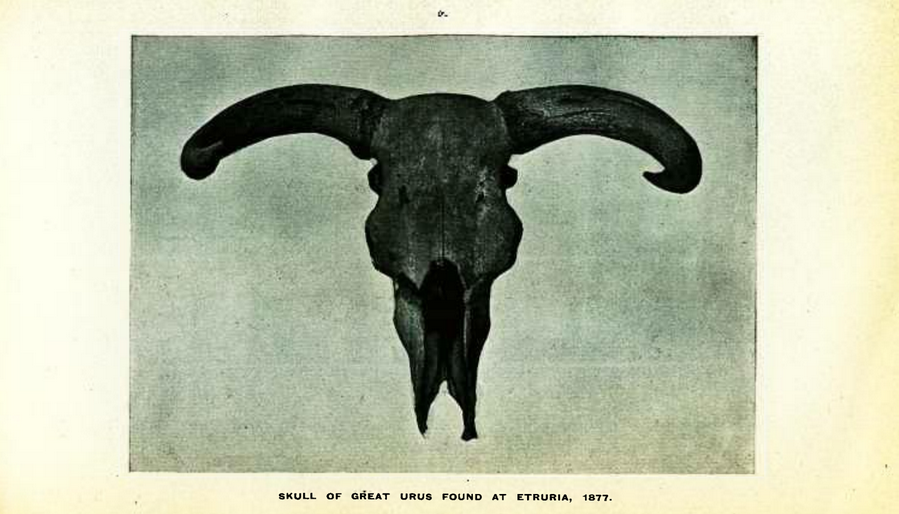
The sub-fossilised skull of an auroch (Bos primigenius), was found in 1877 during the major work on the foot of Basford Bank, Stoke-on-Trent, during which there was filling and levelling work done around the adjacent banks of the Fowlea Brook and the Etruria train station. Aurochs were giant wild cattle, which survived in Britain into the Roman period but which are now extinct. The skull was found… “buried 16 feet down in black clay, whilst making alterations to the course of the Foulhay [Fowlea] Brook near Etruria in Stoke-on-Trent.” Currently in the care of the Potteries Museum & Art Gallery.
The original environment would be the often-flooded water-valley of the Fowlea, wide and damp, but offering a rich flowery cud for cattle in the summertime. The original appearance of the beast would have been akin to this…
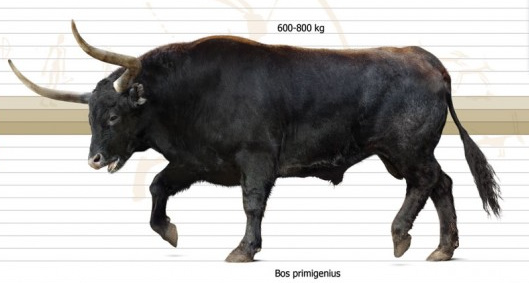
If anyone was thinking of a statue for the entrance to the final bit of development on Festival Park, bringing the auroch back all life-sized and hairy would be a suitable nod to the history of the valley.
New Kindle ebook of Staffordshire Strange Tales: The Potteries, from Stephen Harvey…
