W. Wells Bladen (1847-1914)

The excellent hyperlocal website Little Bit of Stone has an article by local historian Philip Leason which places online the plot and words of Stone town’s traditional Christmas “guisers play”. Here’s a section of dialogue from the opening, in which a doctor is questioned about what he can cure…

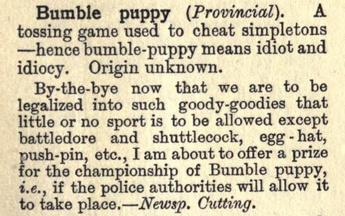
“The itch, the pitch, the palsy and the gout. If a man’s got nineteen devils in his skull, I can cast twenty of them out. I have in my pocket crutches for lame ducks, spectacles for blind bumble bees, and plasters for broken-backed mice.”

The words were part of an article on folklore by W. Wells Bladen (1847-1914), for a 1900 issue of the The Annual Report and Transactions of the North Staffordshire Field Club (sadly not even the contents-list of said journal has been made available online — needed are a Heritage Lottery application for digitisation and a website).

His “Notes on the Folk-lore of North Staffordshire, Chiefly Collected at Stone” was reviewed (seemingly in the form of 35-page pamphlet reprint of 1901) by E. Sidney Hartland, in the journal Folk-lore, XIII, 1902. Hartland notes that the article included a rare recording of the local children’s culture…

“Counting-out Rhymes, his collection of Singing-games, and his diagrams of Hopscotch as played at Stone”

Which might be something that the modern local schools at Stone would be interested in. The original journal article appears to be…

W. Wells Bladen, “Notes on the Folk-Lore of North Staffordshire, chiefly collected at Stone”, The Annual Report and Transactions of the North Staffordshire Field Club, XXXV, 1900-1, pp. 167-174.

We can only hope that this 8-page article was not expanded for the 35-page pamphlet, since the pamphlet version now seems lost to history. Neither the British Library, Keele, or Staffordshire record any copy of it in their catalogues.

The same reviewer also notes of W. Wells Bladen’s…

“recording [of] the words of the Guisers’ Play as performed at Stone, [that it] differs materially from the version performed at Eccleshall, only six miles away, and recorded by Miss Burne (Folk-Lore journal, IV, 350). This again differs noticeably from that of Newport, nine miles distant.”

W. Wells Bladen also published pamphlets on the “Terraces and Earthworks at Stone” and “The Stone Terraces and Their Possible Origin”, which appear to be about what are still open fields in the north-east of the town, at the start of the footpath to Barlaston. His suggestions on the ancient human origin of these do not, however, appear to be tenable today. They are more likely to be from the time of the Jacobites.

The archaeology of HS2

Ooh, I’ve just realised what sort of wonderful archaeology we’ll get, ahead of and during the construction of HS2 in the Northern Midlands… a real “slice through history” from The Trent at Stone – through to Keele and Crewe. Roman roads, previously unknown settlements, maybe even a few artifacts or perhaps a horde. Here’s hoping that the fenced off route will be opened up to citizen archaeologists and metal detectorists for a year ahead of actual ground-breaking construction, in areas not identified by the County archaeologists as being “reserved for the professionals”.

The Boy Who Shuddered, free audio book

My new 22 minute reading of the short tale “The Boy Who Shuddered” (aka “The Boy Who Left Home to Learn Fear”), from the famous book of folk tales transcribed by the Brothers Grimm. I’ve adapted and abridged the tale. My audio book version is now on Archive.org, under a Creative Commons licence. The downloadable MP3 has none of the slight crackle that the audio in Archive.org’s Flash preview player has.

Helmets and animals

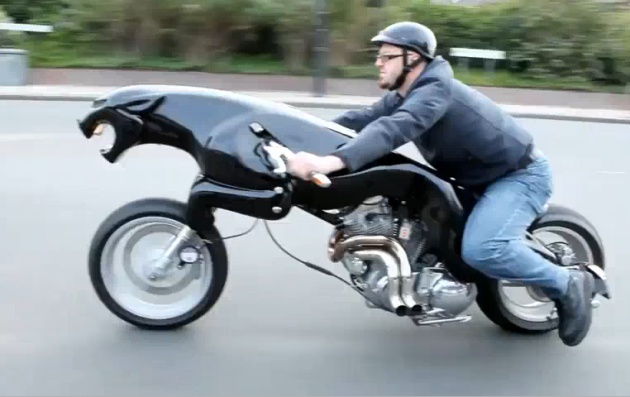
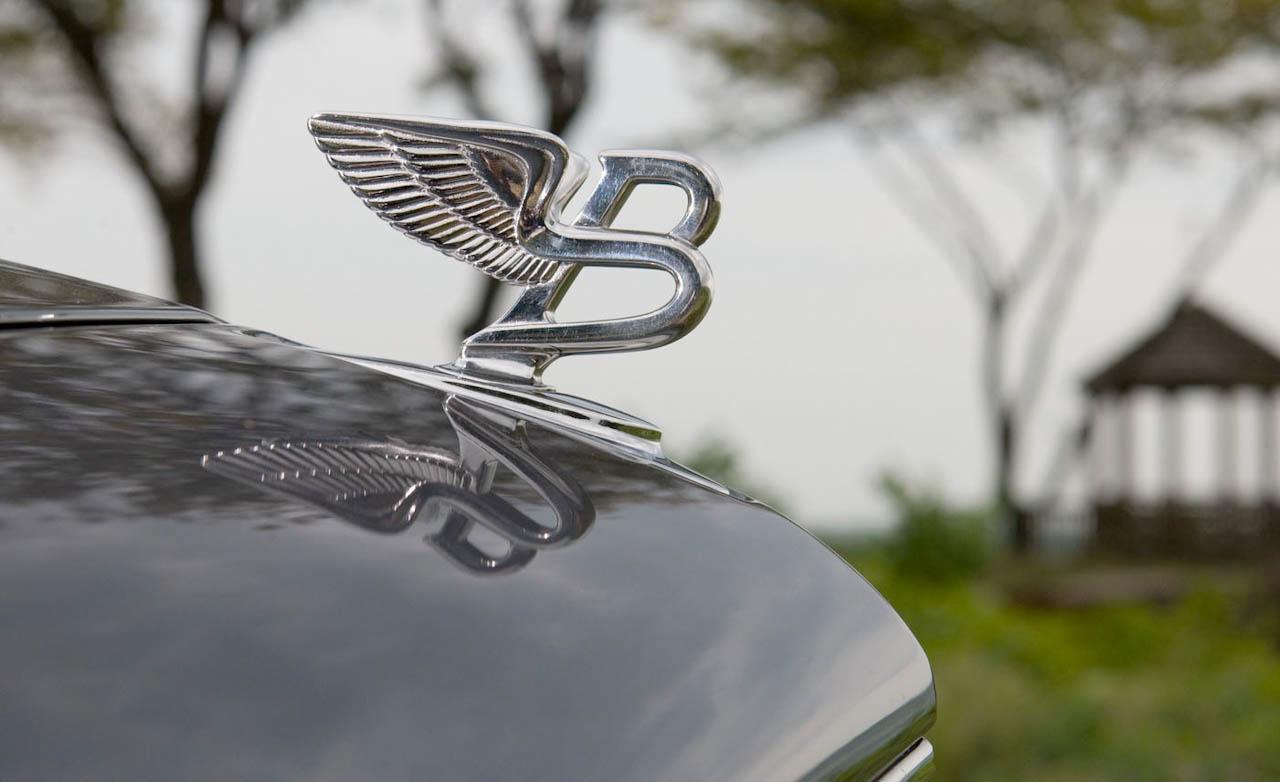
A passing thought about the Staffordshire Hoard. The Anglo-Saxons wore metal totemic animals (such as wild boars) on their battle helmets. But today we still sometimes have animals and similar totemic emblems on the front hoods of our cars. Midlands examples would be Jaguar’s big cat (Birmingham); the serpent-like winged B of the Bentley (Crewe); the Dark Ages ship on the Rover cars (Birmingham). Cars could even be understood as the modern equivalent of war helmets — metal status-symbols that protect the body.

This Jaguar marque fan would certainly be instantly recognisable to an Anglo-Saxon, in terms of the blue woad-dyed cloth and the totemic animal and the, er /cough/ “helmet extension” nature of the vehicle…

Off with the fairies

Margaret Drabble writing in The Spectator in 2011 explained: “The Potteries are one of the strangest regions in the British Isles”. It’s quite true. There are even people who still believe in fairies in Stoke-upon-Trent town. I went into the newsagents to get a paper today, before going to the allotment. There was a pensioner in there, obviously well known to the newsagent (who had a bemused smile on his face), telling the newsagent about: “the hob-elfs, they call ’em — they has little arrows, tiny ones, with stone points… they fires ’em at you… you look out for ’em, they’re sharp…”

Wedgwood Institute as a symbol of “savage inequality”?

I was listening to the second of two BBC Radio 4 programmes on the history of philanthropy, when I was startled to hear something said by local Labour M.P. Tristram Hunt. He said of the Wedgwood Institute in Burslem…

“we’re standing in front of this beautiful elegant Wedgwood Institute, built from the gas industry and the ceramics industry and all the rest of it, and it’s meant to show their generousness, but you can also see — behind it — young men and women dying at 13 and savage inequality.”

Firstly I’ve always read that the Institute was funded by a wide public subscription, rather than being the result of the “generousness” of industry alone. The science classes and Library at the Institute in the 1870s were publicly funded, specifically by adding a penny on the local rates (i.e.: via a general local property tax) which meant they were being funded by a wide spread of local people. The books for the library were indeed donated — by John Ruskin, most famously, and he can hardly be called a slavering capitalist. I admit I haven’t ever seen the full listing of contributors to the Institute’s public subscription (has anyone?), and that the dilapidated old Brickhouse Works site was purchased by ceramics manufacturer James Macintyre for the building of the Institute. But it seems to me that — rather than the Institute being solely a monument to paternalistic largesse, as Hunt seems to imply — it was rather a generous gift from all of the town’s people. One meant as a living monument to the memory of Wedgwood, and open for the benefit of all.

Perhaps Hunt was thinking of William Woodall as a person who might justify his linkage. Woodall who was a key driving force behind the building of the Institute, being the Secretary of the Committee set up to fund and build it. But Woodall’s job as a young Burslem gasworks manager, and as a partner in the James Macintyre and Company china firm (later Moorcroft), hardly seems to be sufficient cause to damn the Wedgwood Institute as being somehow emblematic of child death and “savage inequality”.

Perhaps Hunt was thinking specifically of cobalt blue, used for the making of “Staffordshire Blue” ware at Macintyre & Co., in which Woodall was a partner. Hunt disparagingly mentions cobalt glazes earlier in the radio interview, so this seems a possibility. Cobalt could then contain up to ten percent arsenic, a known poison. At that time over 300,000 pounds of the ‘zaffre’ type of cobalt was imported annually to the UK, from Saxony and Prussia (now Germany/Poland). Although it was used in the glazes in a highly diluted form (1:150000), and the German industrial chemists were on the verge of developing ways to remove the arsenic.

Yet I can find no mention, in the historical record, of any deaths or health problems in the Potteries specifically attributed to the mixing or firing of cobalt glazes. Indeed, a modern article by Jeff Zamek, “A Problem With Cobalt?”, states that…

“A statistically accurate study of potters and their use of raw materials was sponsored at the 2000 NCECA [National Council on Education for the Ceramic Arts] meeting [and] a search of the National Library of Medicine data banks and other medical libraries did not reveal any diagnosed cases of potters contracting cobalt, manganese or arsenic poisoning.” [my emphasis]

Nor can I find, in any old book or government report, an instance of Macintyre & Co.’s Washington Works at Burslem being singled out as having notably bad working practices or health problems.

There certainly were health problems arising from some specific types of jobs in the wider Potteries: painters ingesting lead during painting, got from licking their brushes to get a point on them (many manufacturers responded by introducing leadless or reduced-lead glazes); scourers could inhale flint silicate dust, when polishing up the pots after kiln firing (responded to by manufacturers with forced ventilation, often inadequate); child labour had indeed been a general problem. There were around 4,500 child workers in the potteries at the 1861 Census, with many of the worst cases a result of a combination of alcoholic parents and small backstreet workshops. Some children would be sent to work by their inebriated parents “in the place of” the adult. But three Parliamentary commissions of inquiry, a strident and effective Victorian welfare movement, and a host of new laws were all regulating hours and conditions by the time the Wedgwood Institute was being planned and built in the 1860s.

Finally, what of Hunt’s claim for gas? This again points to his thinking of William Woodall, then a manager of the Burslem gasworks and also the Secretary of the Institute Committee. I suppose it’s possible that the Burslem and Tunstall Gas Company gave an especially large amount to the Institute’s public subscription? Perhaps it even installed gas lighting in the Institute for free? Even so, it does seem a little far-fetched to imply that Victorian gas lighting was therefore to blame for child deaths and “savage inequality”. Gas lighting was generally seen as a public good, by the 1860s. By that time domestic gas had also meant a huge reduction in the very unhealthy coal-smoke pollution. Gas street lighting, which all of Burslem had by the 1860s, meant the streets were safer at night, and on dark and icy mornings. Admittedly, mid-Victorian gasworks did not have a reputation as pleasant or healthy places to work — but the Gasworks Clauses Act of 1847 had long since been passed by Woodall’s time, and this strictly regulated the pollution from gasworks. Ground and air contamination outside of a gasworks grounds was apparently severely policed, especially in residential districts. We might also hope that the Burslem gasworks, apparently under the control of the progressive and enlightened William Woodall (schooled as a Congregationalist, a Chief Bailiff of Burslem, and later a Liberal M.P. and a tireless champion of women’s rights), was well run and had an eye on worker safety.
Clockwork typewriters

Readers of my novel The Spyders of Burslem may remember that there was a very casual passing mention of “clockwork typewriters”. In the novel these were spotted by the hero on a brief visit to the office of The Burslem Cosmograph newspaper. My thanks to Steve Sneyd, who has mentioned this “clockwork typewriter” notion to a typewriter collector contact of his in the United States. He had a lengthy reply on the topic, from which the following…

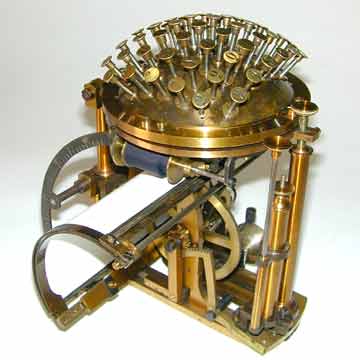
the only typewriter on the market at that time [1869] was the Mailing-Hansen “typing ball” which resembled clockwork, in that it was made of brass and had a mainspring and an escapement.

[If what was] meant by “clockwork” [was] that a typewriter was automatic, that was actually done. It was cumbersome and I don’t think it was widely used, but there was a device on the market — made by Hoover, I think, that generated punched paper tape, and this [tape] could then be used in an automatic typewriter to type the same letter as many times as needed.


Above: the Mailing-Hansen typewriter. Hansen’s first model was built in 1865, and many hundreds were sold.

The novel is of course, set in an “alternate” semi-steampunk 1869. The hero has only a very brief and flustered look inside the offices of The Burslem Cosmograph, and is anyway recounting past events from a distance of over 40 years afterwards. Which might account for his vaguely remembering the office’s typewriters as being of a generally “clockwork” design.