I recently had the opportunity to take a look around the naff wasteland that is Google Play’s mobile phone app store for Android, while specifically looking for local apps. There’s not much available, but here are the results: a quick 2015/16 North Staffordshire / Stoke-on-Trent ‘App Survival Kit’ for visitors.
Free wi-fi access:
I assume that all UK based visitors will arrive in the area already having installed at least one of the UK’s main “free wi-fi access” apps. Of these, O2 seems the best choice for short-stay and overseas visitors…
* O2 Wifi (in Stoke: McDonalds, Subway, Argos, Homebase, B&Q etc) which is open to all after a simple registration. 10Gb download limit per month.
* BT Wi-fi (in Stoke: larger Tesco supermarkets, HSBCs, Starbucks, GAME shops, Job Centres etc) is for BT broadband subscribers only (note that the app’s maps don’t show BT home routers that share, so for detecting those use the excellent Wifi Tracker app. Note that Tesco limits BT Wi-fi users to 15 minutes every 24 hours.
* FastConnect (The Cloud free wi-fi, mostly offered in bars and pubs). Showed a nasty initial “you have a virus” spoof advert, during our test.
Note that our local public libraries and buses are laggards in offering free wi-fi, though some of the privately run libraries such as the Burslem School of Art do offer it and there’s apparently also a Stoke Train Station — Keele University bus that offers it. But in terms of free wi-fi Stoke-on-Trent is certainly not yet one of the coming wave of ‘SuperConnected cities’ that exist elsewhere the UK.
Stoke does have excellent UK-leading mobile network connections and speeds, though, so long as you can pay for the data. That speed may well decrease as you go into the adjacent Moorlands and the Peak District National Park.
Local news:
There’s no local app for BBC Radio Stoke news and traffic, though their web page will give you ad-free local headlines and they have an excellent BBC Radio Stoke daily coverage timeline. The latter would make a great app. Sadly neither page has an RSS feed.
The Sentinel newspaper has a pleasantly slick app but it only gives you the paper’s main evening news story, and the app doesn’t include the Saturday edition. The best option for a visitor is thus an RSS reader app, the paper’s RSS feed, and (to view the news stories) a mobile Web browser running a good ad-blocker.
The community radio station 6 Towns Radio has an app.
BBC Weather is excellent for reliable(ish) hourly and five-day local weather. Note that “Sideway” (alongside the main A500 road) is a good central valley-bottom weather station, and may be a better option than more elevated weather stations such as Hanley (the city centre).
I assume that any football / sports related visitors will already have their phones crammed to the rim with specialist sports news and team fanzine apps.
Transport:
All the UK train apps seems to use the same live information and timetable feeds, and they’re all fairly similar. You probably have one already, but if you’re an overseas visitor just arrived at Birmingham International or Manchester Airport then you might try installing the Virgin Trains app, which is robust and well designed. Virgin Trains also offer cycle hire from Stoke train station, although I seem to remember it’s a service confined to first class ticket holders only. Sadly the basic app doesn’t allow one to book a bike from the station, though I guess it might if you were fully logged in with them and you had a ticket number. Update: Virgin lost the franchise to a (rather shoddy) low-bidder, Avanti.
First Bus is likely to be your choice of bus travel app in Stoke, the Potteries, and north Staffordshire. The app is useful, offering geo-located bus stops and related timetables. It’s not perfect, though: routes should have direction-of-travel arrows; the ‘final destination’ place-names are shoddily labelled; and there is no geo-filter on route numbers (if the app knows the user is in the Potteries, then it shouldn’t even offer namesake bus routes from other cities).
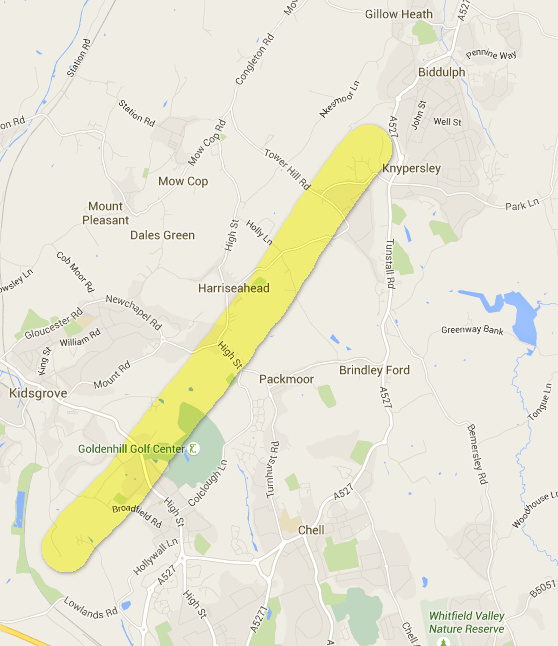
With more than 100 miles of off-road cycle network in the city, and a new cycle-path connecting Stoke to the Peak District, cycling maps may be useful. The older SUSTRANS app has long since given way to their recommended commercial app, CycleStreets. Note there are two app downloads for this, the route finder and the maps pack.
Google Navigation is an alternative that many will have preloaded, but in tests it proved to “know nuurthing” of our city’s green cyclepaths and towpaths, and sent us down an ugly main road despite being switched through to the Cycling / Walking tabs. Seeing Stoke via the main grotty roads is certainly not ideal when there are so many back-paths, greenways and canals to walk and cycle on.
Canals / wildlife / litter:
Tens of thousands of canal boat holiday makers pass through Stoke on the Trent & Mersey canal each year, and also go up to the Moorlands town of Leek on the Cauldon Canal. Those visitors have a couple of useful official apps from the Canal & River Trust, as well as their more general UK canal apps. Canal & River Places to Visit and Canal & River eNatureWatch. The eNatureWatch is rather nicely made and will be fun for kids and young teens, and it also allows spotter photo-reports to be sent, but it is not meant for real naturalists.
Sadly there is no spotter/report app from the Staffordshire Wildlife Trust. There are wildlife apps for the Moorlands and Peak District National Park, and even a Peak MoorPLANTS and MoorMOSS app for spotting the moss and plant types found there.
There’s a total lack of litter / dumping reporting apps, even from Stoke-on-Trent City Council (which doesn’t seem to ‘do’ apps at all), though you might get the FixMyStreet reporting app to install — it refused to install on our slightly-old android smartphone.
Arts and visitor attractions:
There is a surprising lack of apps from the city’s now-thriving pottery firms, ranging from the industrial giant Steelite through to must-see heritage potteries such as Middleport Pottery. All we could find was an app for Moorland Pottery. Nothing from big tourist draws such as the Potteries Museum & Art Gallery or the new Wedgwood Museum, either.
No app from Trentham Gardens, which was a surprise, since it’s one of Europe’s biggest outdoor upmarket attractions. Nor Uttoxeter Racecourse, another surprise. But the huge theme park Alton Towers has an official app for the whole resort and also a Halloween Alton Towers Scarefest app.
To hook into where the local creatives are going, simply install the Facebook Groups app and point it at the Creative Stoke Facebook group. Over 2,000 members and tight curation/moderation ensures a usefully informative news group aimed at local creatives. Update: Creative Stoke is now at The Potteries Post.
Keele University has a campus guide app n’ map, something Staffordshire University appears to lack.
That’s it!