The new set of postage stamps, from the Royal Mail, celebrates the Ancient British…
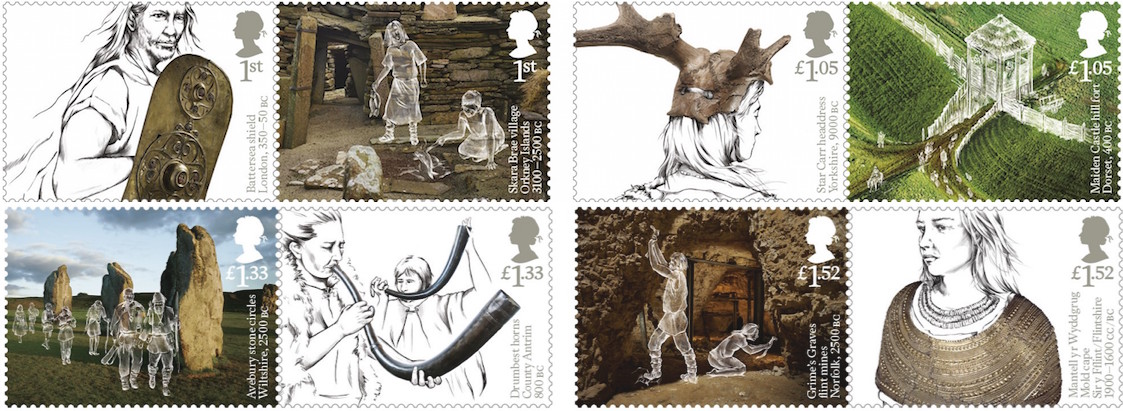
The new set of postage stamps, from the Royal Mail, celebrates the Ancient British…
“He is free of his horse, who never had one” — a saying by a wise-man named “Hendyng” who thrived in the mid 1200s, and was from what is now the south of the West Midlands (though he may have modified his language so as to be intelligible to a more southerly audience).
In April 2016, hearing about the new sci-art blue.dot festival which was set to happen at the nearby Jodrell Bank radio telescope observatory, I made a proposal on Facebook for some kind of Stoke-on-Trent fringe event that might link up with it. The core idea was a suggestions for a new “symphony” in 2018 called Skywave which would link our science heritage with ceramics. I’ve now remembered it again, and have found a little time to work it up as a poster proposal.
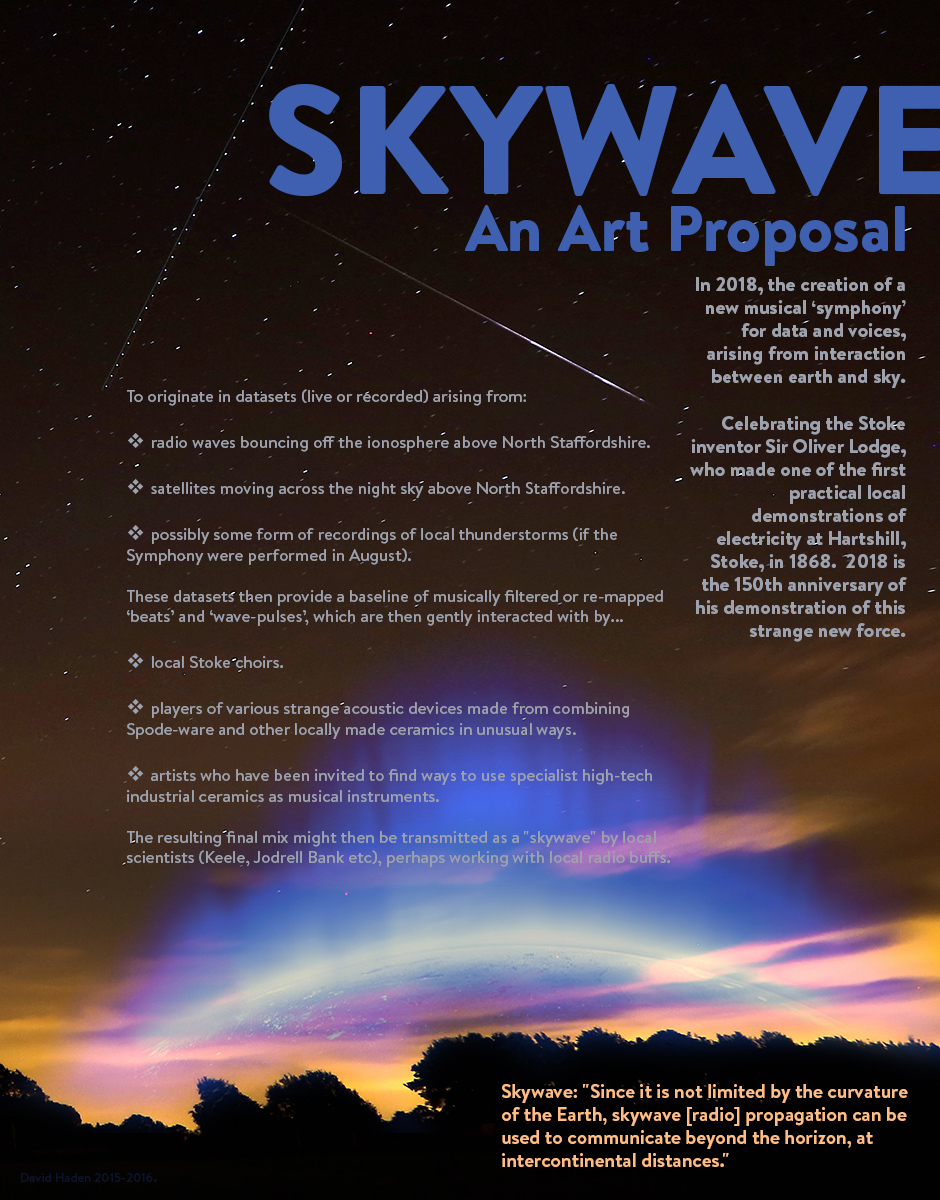
Slight correction: I’ve since found, during the research for my book on H.G. Wells in Stoke, that Lodge’s demonstration of electricity must have been at his new home at Wolstanton.
There’s an essay on “Romantic Quest in the West Midlands. Staffordshire and Cheshire Landscapes in ‘Sir Gawain and the Green Knight,'”, in the book collection of essays The Gawain Country: Essays on the Topography of Middle English Poetry, Leeds Texts and Monographs series, 1984.
The essay is not online, but the book may possibly still available by mail-order for £9 — according to this order page which dates from about circa 2011. (Update: no, still totally out-of-print and not online, at early 2019).
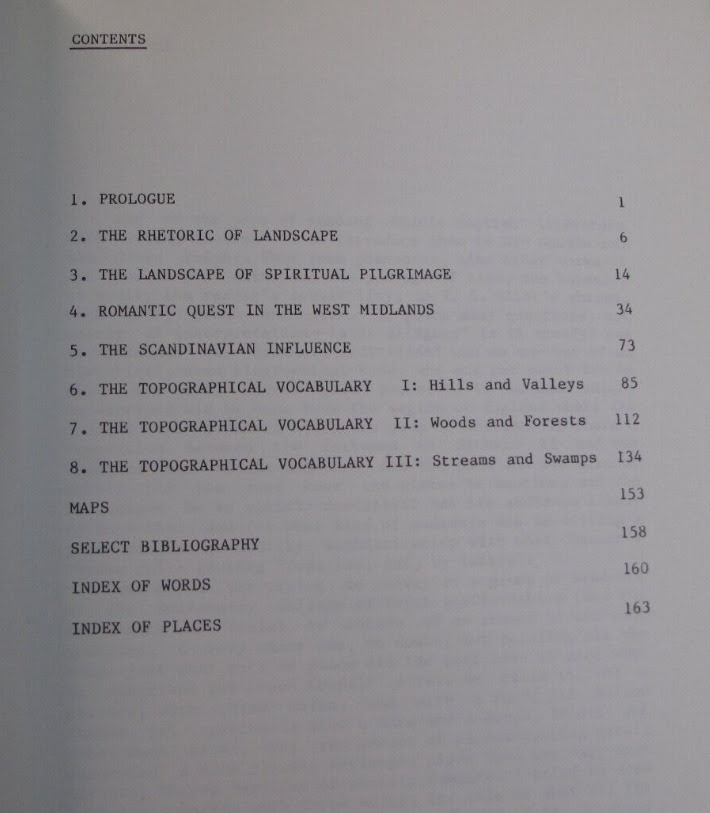
It also appeared as “Staffordshire and Cheshire Landscapes in Sir Gawain and the Green Knight” in the North Staffordshire Journal of Field Studies 17, 1977, pages 20-49.

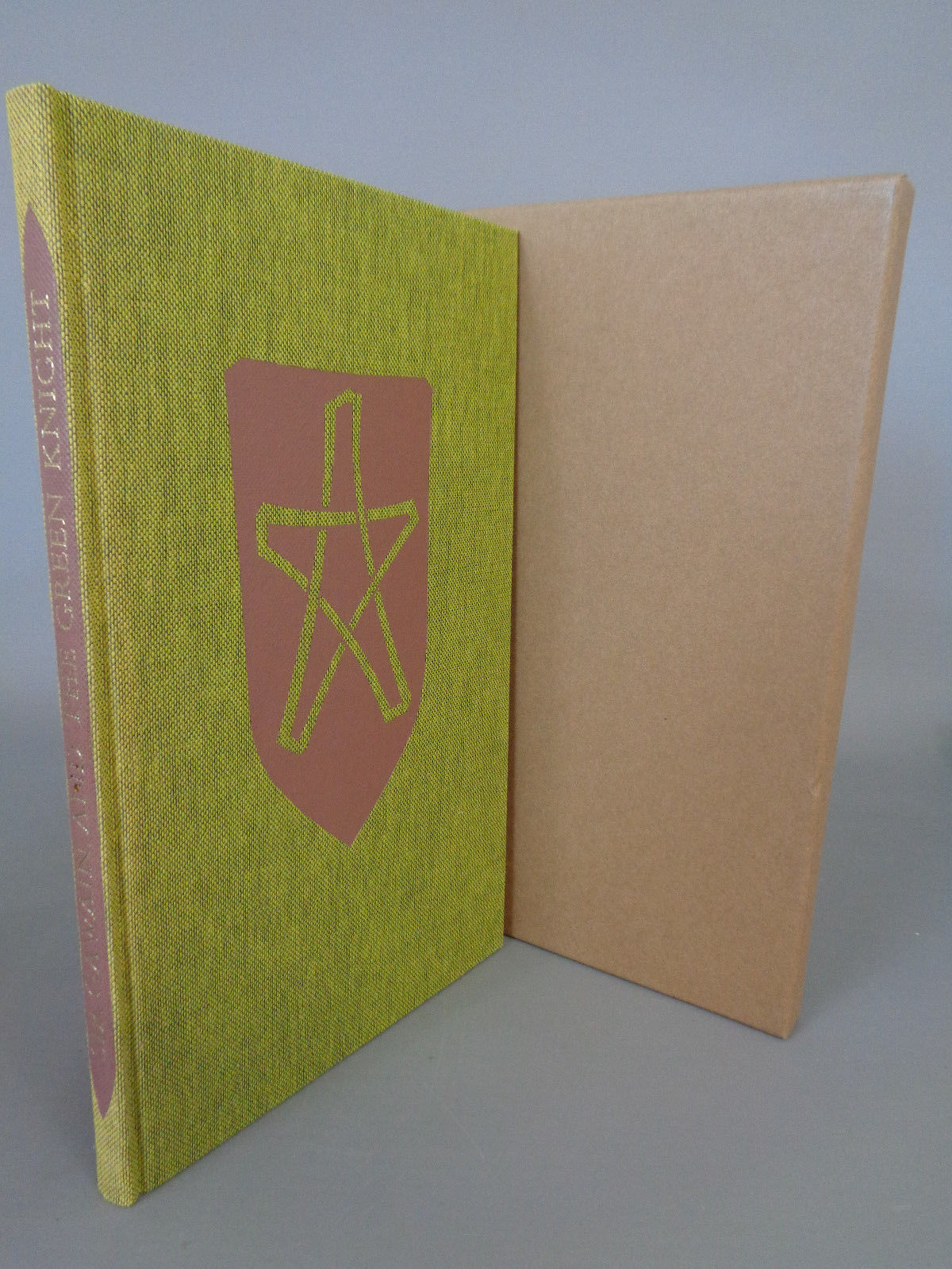
Incidentally, the pentangle on the shield (seen above) is not a pagan artist’s modern imposition on an ancient text, it’s something detailed in the text…
It is a symbol that Solomon designed long ago
As an emblem of fidelity, and justly so;
[…]
Therefore it suits this knight and his shining arms,
For always faithful in five ways, and five times in each case,
Gawain was reputed as virtuous,
The Folio Society found a way to detach the symbol from its contemporary “naff hippie-shop pentangle” connotations, by ingeniously and elegantly making it more like a figure…
My early-alpha version of a basic annotated catalogue of the contents of the North Staffordshire Field Studies journals and successors has been expanded to 1895. It’s currently a rough ‘finding aid’, rather than a proper polished bibliography to library standards. The gap in coverage of the main annual volume is now narrowed to: 1896-1959. Also, keyword search from the search-box is now enabled.
Did slavery profits bankroll the Midlands industrial revolution, as local socialist M.P. Tristram Hunt (Labour) would have had you believe in his recent speech in Stoke?
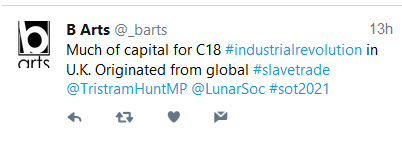
Erm, no. Slavery did not fund a major share of the capital that went into our industrial revolution. If you put together all the combined profits of the slave trade and the West Indian sugar plantations in general, together they did not even add up to five percent of Britain’s national income, either before or during the Industrial Revolution. Even a Midlands-specific claim doesn’t hold water — that exports to colonial settlers might have made huge profits for our early textiles and small metalworking industries. Such activity was at best of minor importance, and overall profits from the colonial trade were low…
“Profits from the colonies and imperial trade and capital accumulation in Britain”: [when put together, all of the] commerce with the ‘periphery’ [i.e.: with fringe areas of the world and colonies] generated funds sufficient to finance only 15 per cent of gross investment expenditures during the Industrial Revolution [… and such] external trade was only a small proportion of Europe’s economic activity and most industries did not depend upon imported raw materials … historians have argued that sugar did not furnish a sufficiently large total output to be a major contributor to the savings that funded the Industrial Revolution … It is equally difficult to prove that merchant capital amassed from colonial commerce [even taken as a whole] was decisive for British industrial growth.” — Kenneth Morgan, Slavery, Atlantic Trade and the British Economy, 1660–1800, Cambridge University Press.
The book is described by Cambridge University Press as… “An up-to-date synthesis of work on slavery, Atlantic trade and the British economy … essential reading”.
The socialist notion that that the industrial revolution was funded largely by slavery arose from the rabidly Marxist 20th century historian Eric Williams, about whose work…
“the majority of scholars working on British industrialization tend to be highly skeptical” [today, because…] “Eric Williams and his followers probably exaggerated the profitability of the slave trade and slave plantation complex.” — from a review of Slavery, Atlantic Trade and the British Economy, 1660–1800, in Reviews in History, June 2002.
Further, it’s more recently been determined that only around 7 percent of the UK’s historic national elites can be in any way connected with slavery. Indeed, far more of our elites actively fought against it.
Long unavailable except at huge cost, there’s now to be a second printing of one of the most important books for fantasy research. The cheap paperback edition of the collected correspondence by letters between R. E. Howard and H. P. Lovecraft. The two-volume set will be officially released on 22nd January 2017, albeit at a still-hefty $60 plus shipping for both volumes. Advance orders are now being taken at the Hippocampus website. Hopefully there will eventually also be a cheaper Kindle ebook version, in time.

Penkhull Wassail and a processional Morris in January. Apple and fruit-tree wassailing is an ancient tradition, taking the form of a New Year procession. I was pleased to see it revived recently in Stoke-on-Trent, and it’s happening again in January 2017. Traditionally, the apple and fruit trees of a district are each visited in turn, on foot. The men sing to them, toast their health in cider and the boys tap their trunks with whippy sticks in a sun-wise direction, in order to ‘wake up’ the trees and ‘turn them back toward life’.
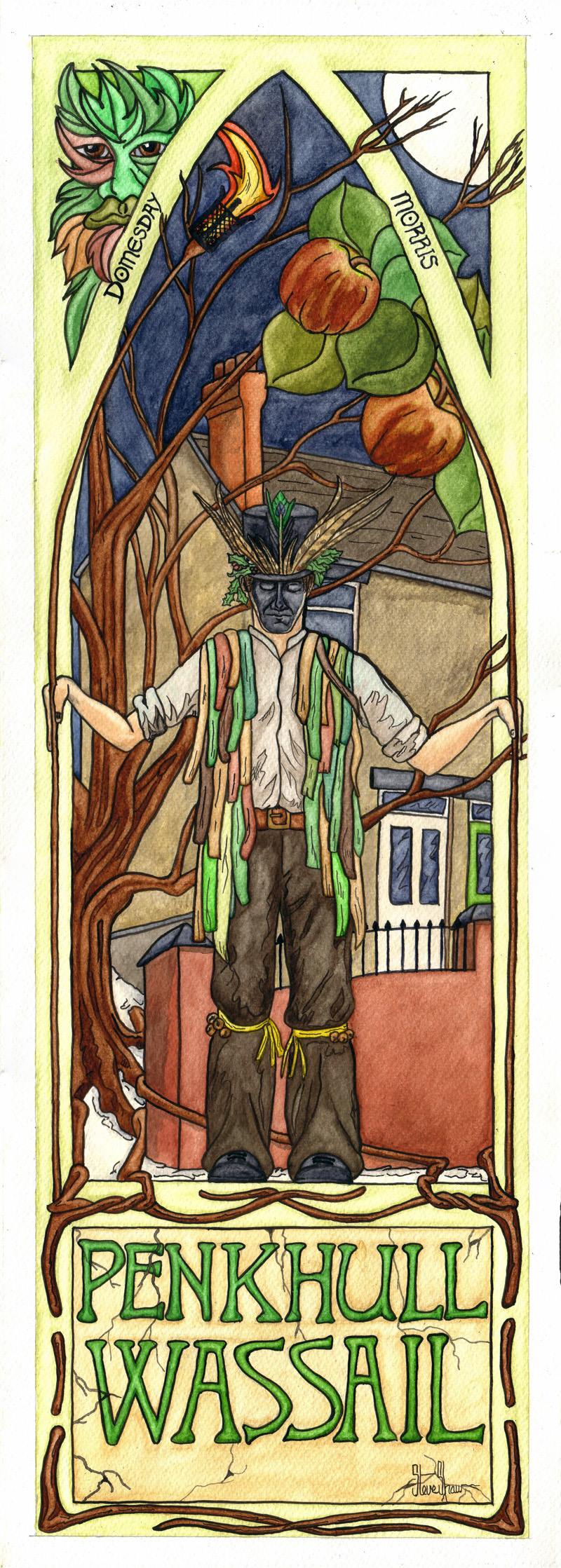
Art by Steve Shaw.
What’s slipping into the public domain in the UK in January 2017? Of course H.G. Wells leads the public domain pack, in terms of science-fiction.
Others of note are:
* Otis Adelbert Kline who “contributed numerous stories to Weird Tales magazine”, wrote some pulp novels in the Edgar Rice Burroughs ‘planetary romance’ style, and who was later a literary agent for the great R. E. Howard.
* Lionel Atwill who was a horror and supernatural screenwriter for RKO, Fox and Universal, with films like Sherlock Holmes and the Secret Weapon and Frankenstein Meets the Wolf Man and House of Dracula.
* Walter S. Masterman, a British mystery novelist whose titles seem to put him on the ‘macabre’ shelf.
* Cyril G. Wates, who had a number of pulp stories in the science fiction pulp Amazing Stories in the late 1920s.
* Albert Leffingwell, an American author of quality mystery novels.
* Booth Tarkington, author of The Magnificent Ambersons and many others.
* Karl Hans Strobl, Austrian fantasy and horror writer. The English translations would, of course, not be going into the public domain. But the plots and approaches will be. Some of his youthful stories have been hailed as classics of the genre. Probably little published now, because in his old age he became a member of the Nazi Party.
* Dion Fortune was a British occultist of the highest degree of loopiness, but was also a 1930s imaginative novelist (mostly under the pen-name V. M. Steele)
* Ernest Thompson Seton was an American fore-runner of Baden-Powell and the Scouting movement. Lots of wood lore books, such as How to Catch Wolves, Animal Tracks and Hunter Signs, as well as some heart-tugging wild animal stories which might be suited to graphic novel / fantasy-makeover adaptation.
* Ernest Rhys, the British scholar and author of English Fairy Tales (1913). Some of the books he wrote might become the basis of a graphic novel, such as his concise historical introduction to London: The Story of the City and his novel Blackhorse Pit.
* Damon Runyon, a punchy and slick professional American short-story writer and newspaperman. He appears to have had a vast output over several decades. The slangy American wise-crack language may not be to today’s taste, but it seems likely that many of his plots would still hold up today.
A fascinating New Scientist iconographic, showing the archaic symbols that appear to have been used in-common by prehistoric cultures around the world. Possibly most are the result of mimicry of common natural forms, in combination with the limitations of very similar types of early tools. But they also tantalisingly suggest a shared mental ‘vocabulary’ of the environment. One wonders if these symbols can also be traced through into the historic era, via a study of the symbols of frontier hunters and trappers, nomad bands etc, something which might be discovered by scouring the 19th and early 20th century ethnography?
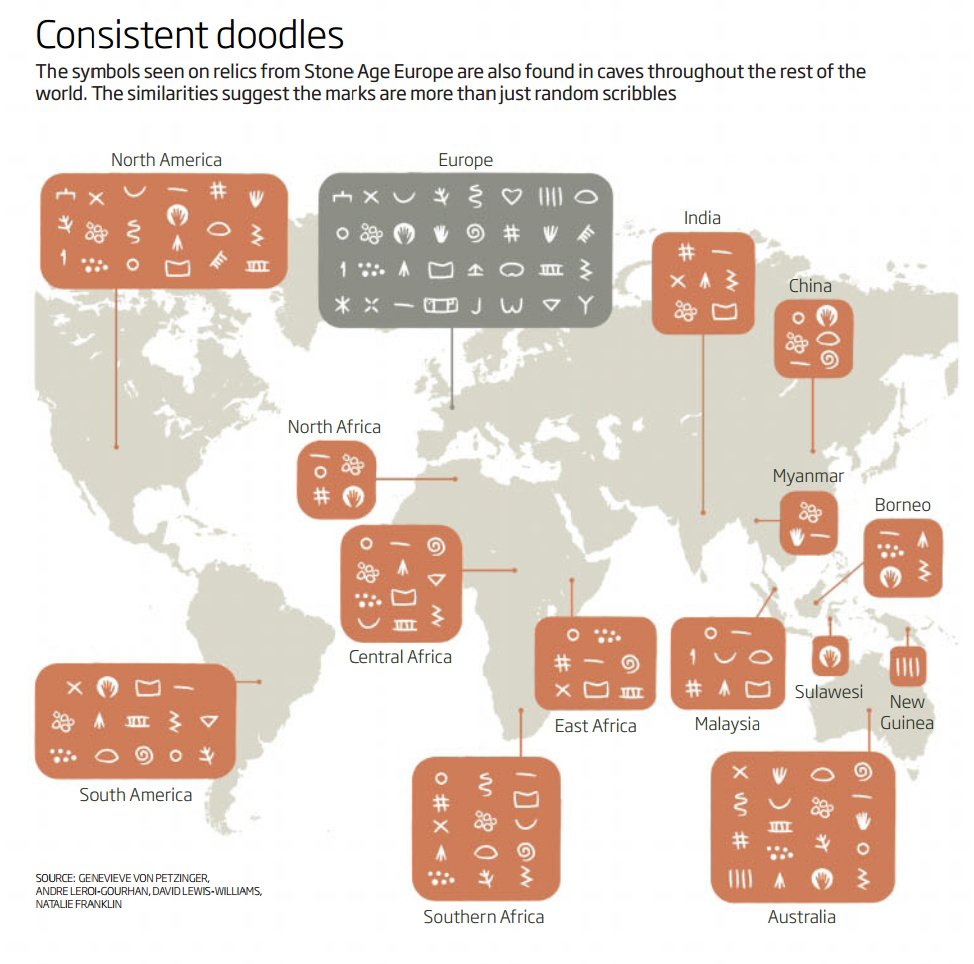 from “Hidden Symbols”, 12th November 2016.
Newcastle-under-Lyme… with a small group of placard-waving protestors against fairy tales, of all things. Not sure they’re too happy about the dancing Christmas puddings, either…
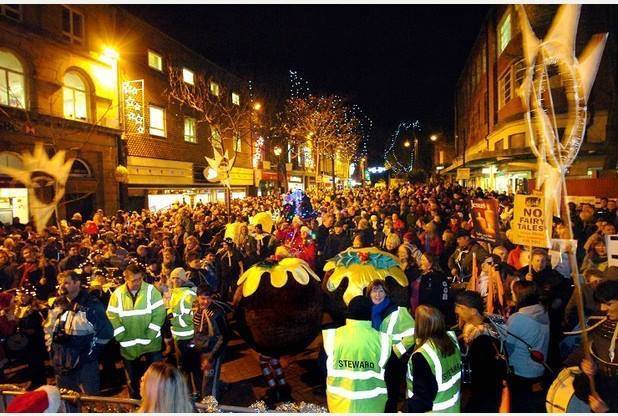
Apparently not a spoof art-stunt.
Early Tourists in Wales. A searchable database directory of… “over 1,200 published and manuscript accounts of tours of Wales, 1700-1900”. With relevant comments extracted and available on themed pages. Mostly these relate to travel and the sort of exterior material culture easily observed in travel, e.g. washing day or coracles. But there is also some focus on churches, graveyard customs and harp music.