The journal Arthurania reviews the new The Historical Arthur and The Gawain Poet: Studies on Arthurian and Other Traditions, with a focus on the longer Gawain section. The whole review is paywalled on Project Muse, but the opening chunk is available for free. However if you’re cunning, you can also find the review’s conclusion topping another review in its page-image.
Category Archives: Uncategorized
A small mystery in Hanley…
I can’t believe the headlines that Stoke-On-Trent is the most air polluted place in the UK. Apparently the reading was made in “Parliament Street”, taken “over a two-week period”. It measured PM2.5 particulates in the air.
The first problem is… there is no Parliament Street. I assume they mean Parliament Row in Hanley, since Google Maps knows nothing of any Parliament Street in Hanley or indeed in Staffordshire. I hope we’re not being confused with the busy Parliament Street, in the centre of Nottingham?
The study was by some organisation called GRIDSERVE. No, I’ve never heard of them either. Apparently they want to sell you so-called ‘zero carbon’ solar energy. They’re not exactly official, and I can’t discover if their research-design and methods were peer-reviewed for validity. Looks like a headline grabbing exercise to me, aiming to build up a contacts list for their sales force?
Anyway… our Parliament Row is pedestrianised. It’s where the Stanley Matthew statue is, and Waterstones. A fair distance away from the new bus station, and the roads used by buses hauling themselves up to it. And it’s elevated, on top of a hill. Meaning that most often, it’s as windswept as only Hanley can be, with nothing between it and the Cheshire Plain.
How then can it possibly give the highest road-pollution reading for PM2.5 particles in the UK? If measured in the high summer, were the Hanley druggies perhaps smoking right next to the sensor… and blowing their smoke at it? It’s the only thing I can think of.
Leaf it out…
Several new research findings, as noted in the latest New Scientist. Most people think that thick wet…
“blankets of fallen leaves can choke plants beneath them, especially shorter species like lawn grass […]. The surprising thing is, this received wisdom has only recently been scientifically scrutinised, with a range of studies all pointing to the exact opposite conclusion.”
So long as the lawn isn’t heavily swamped, meaning less than 20 percent coverage, then…
“the fertility benefits of this light leaf coverage far outweigh the drawbacks – the leaves will quickly break down and help next year’s lawn grow far better than if you had raked them”.
If the grass has 50% leaf-wad coverage and it’s thick, it’s said it’s best wait for a dry spell (easier said than done, in the British Isles), then shred the dry leaves with a good lawnmower. Probably a lightweight hover-mower, I’d guess. Then just leave the shreds for the spring rains/winds and the worms to deal with.
All of which saves time, bin-bags, bin-men hassle (“we’re not taking that…”), smoky bonfires and roasted hedgehogs, the tiring use of hand-rakes or the hire of neighbour-annoyingly leaf-blower machines.
Of course, paths are different. I know from experience there that it’s best to let them get wet and wadded if you can. Then take them off via slicing and lifting with a shovel as if they were peat sods. Then brush and let the rain do the rest.
Offa’s Dyke Journal #5
Offa’s Dyke Journal has reached volume 5. This latest is free in PDF, and includes one article of local interest… “Treaties, Frontiers and Borderlands: The Making and Unmaking of Mercian Border Traditions”. In this it’s interesting to learn that Staffordshire pottery appears to have bank-rolled the defence against the Vikings…
Working at pace on multiple fronts, [Queen] Aethelflaed frequently used the Mercian royal tradition of ‘common burdens’ [to raise funds] for military works [which were raised from centres] such as Stafford, known for its ninth-century kilns.
Slow Ways
Slow Ways aims to map the best ways to walk from place to place across the UK. Their Stoke to Newcastle-under-Lyme suggestions are awful and don’t inspire any confidence. One would have you trudging alongside traffic and buses all the way on the Hartshill Road. The other is a strange steep dog’s leg to get through to… the Hartshill Road again.
I’ve marked in blue the actual good walker’s route from Stoke Station to the Ironmarket, alongside their two suggestions (purple and green). Almost no main roads required for my route, only one steep short climb, and you also avoid landing up in the grotty end of Newcastle-under-Lyme town centre…

Admittedly in weather like this there will be just a few patches of mud to negotiate on one path, and in extremely wet weather the route would best be varied by going via Lock 38. But better that, than breathing traffic fumes all the way through Hartshill and being puddle-splashed by passing cars and buses.
Not suitable for cyclists, who might do better to continue on the canal near Stoke Station (rather than forking off along the old Market Drayton Line) past Hanley Cemetery, then cut through Lock 38 and thus get onto the dedicated traffic-separated bike lane on the Shelton New Road. The latter road has recently had quite a bit of taxpayer cash spent on making it better for cyclists.
Needless Alley
This shows why Needless Alley was needed in the centre of Birmingham. By using this pedestrian Alley someone in the upper part of New Street (and heading for upper Corporation St.) could avoid having to battle through the very busy ‘foot’ of Corporation St. (seen left) at its junction with New St.

Pop offline…
“According to the WMCA [West Midlands Combined Authority], approximately 22% of the population of the West Midlands is offline completely” (Public Sector Executive magazine, report on the WMCA, September 2023). It gets worse. The WM Digital Roadmap states that in total… “46% of the population are non or limited users of the Internet”.
And the supposed ‘West Midlands Combined Authority’ actually only covers the central urban parts, not the proper West Midlands…

Thus it’s not as if rural stick-in-the-muds are skewing the figures. “Offline completely” presumably means no mobile phone, either. Something to remember when your marketing guru tells you that Instagram and TikTok are everything you need to aim for.
The further problem is that many people who are minimally online also have no passport or driving licence, and thus can’t log on to many online government systems.
Wither the North Staffordshire oatcake?
Morrisons supermarket appear to have removed North Staffordshire oatcakes from their Stoke store. I found no trace of them in-store, on my last three visits, either in their usual forlorn standalone basket, on the bread aisle, or in or near the bakery. And nothing via a search on the Morrisons websites.

My guess is that the cost of making them has killed the product? I think they were a hefty £1.30 for six, at my last sight of them. ‘Luxury pricing’, for many in Stoke. I vaguely recall they used to be about 45p per pack, at one time, and were a healthy staple of poverty. Then they went to 85p, then £1.20 and on upwards and out of reach of daily eating.
Nor can Morrison’s new link-up with Amazon deliver three packs to an Amazon locker, to be picked up with the shopping. All Amazon can offer is the dry Scottish type of oatcakes.
There are recipes, of course, but they’re a lot more palaver than just opening a packet and flinging two in a sizzling pan.
Solution for Morrisons: For now, B&M, just across the road from Morrisons, has them at £1 a pack, and they’re the proper type and brand. Still no oatcakes in Morrisons at January 2024. Update: August 2025: B&M tend not to have them on Mondays for some reason, ‘still baking’ I guess!
Comet time
It looks like we might finally have a decent comet hanging in the skies, in the spring of next year. The last naked-eye one I can recall is way back in boyhood. I vaguely recall that it failed to impress.
Currently hurtling toward the inner Solar System is a comet at least twice the size of the earth’s prehistoric ‘dinosaur killer’ comet. “Will Fly by the Earth and Will Be Visible in the Night Sky” in April 2024, and perhaps into June. It will appear low in the sky (but still above treetops and buildings), if observers look in a East-North-East direction. Which means it won’t be hanging in front of my windows, regrettably, and will be masked by the glow of Hanley.
The Comet (’12P Pons-Brooks’) will not impact the Earth, and calculations show that at the exact orbit-passing time… “the Earth will be safely tucked away on the other side of the Sun”. Good to know.
Tolkien Gleanings #133
Tolkien Gleanings #133.
* Freely available on YouTube, “Sixty Years of J.R.R. Tolkien: A Lecture by Professor Thomas Alan Shippey”. Given on 27th September 2023. The 90 minute recording is listenable, with Shippey in his home study on Zoom and with a reasonably good headset — rather than in an echoing lecture hall in Manila. It was a familiar personal talk, with nothing new for those familiar with his previous talks and interviews. Questions begin at 53:20, and regrettably they go straight into asking about the TV series. It really should be a given at events such as this that the presenters make it clear: “NO movie or TV questions, please”. Requiring the audience to write their questions succinctly on cards, which are then passed to the front, also saves a lot of time and prevents grand-standing.
* The latest issue of the Spanish language journal Peonza: Revista de literatura infantil y juvenil (‘Peonza: journal of literature for children and juveniles’) is themed ‘Fantastic Stories’. There’s an article on ‘Tolkien’s Infinite Stories’ along with articles on Alice, Pinnochio, Jules Verne, Peter and Wendy, and others. The ongoing Peonza appears to be a paper-only journal, which inhibits automatic translation, although the first 132 issues are freely online.
* Now freely available on Archive.org, Christian History magazine #121 (2017) was themed “Faith in the Foxholes”. The issue highlighted faith during front-line military combat.
* Apparently now under Creative Commons Attribution, the book The Sacred Tree: Ancient And Medieval Manifestations (2011) has appeared on Archive.org. The author is suitably wary of neo-pagan writing on the topic.
* “Showcasing lesser-known scholarship on Lewis”, the forthcoming inaugural Undiscovered C.S. Lewis Conference. To be held at George Fox University in Oregon, USA, from 5th-8th September 2024.
* And finally, 2024 seems to offer the possibility of weaving a series of ‘telling stories to small children’ events or publications around that fact that…
“According to Douglas Anderson’s introduction to ‘The Annotated Hobbit’, Tolkien began telling stories to his children around 1924”
2024 could thus be reasonably claimed as the 100th anniversary of Tolkien’s first oral tales.
Stoke-to-Leek train line funded
Good news today. The scrapping of HS2 North has had the effect of releasing the approval and funds to restore the Stoke to Leek line, at last. The grinding bus journey will be cut to just 20 minutes on the train, and will be far more pleasant both in terms of comfort (no swaying around and consequent bus-sickness) and off-road scenery. The re-opened line will also enable local tourism and commuting to/from the intermediate stations (Cheddleton, Consall, Froghall, Oakamoor, and possibly Fenton), as well as boosting the town of Leek as a gateway to the Peak and the Moorlands.
Now it’s just a question of time-scale I guess. It’s already well underway at the Leek end. But now… can what might have eventually been done in 20 years be done in five or six? And without a ‘too many cooks spoilt the broth’ effect, as the consultants and big contractors parachute into Leek?
The station at Meir, on the Stoke-Derby-Nottingham-Sleaford-Skegness route to the east coast, is also to be built. Also mentioned is “funding the refurbishment of Kidsgrove and Longport stations”. Meanwhile… “the popular £2 bus-fare will also be extended until the end of December 2024”.
Retiring to the ‘castle…
Good to hear that Newcastle-under-Lyme made the “top 12 places to retire”. This was run by the UK’s trusted Which? magazine, rather than some headline-grabbing estate agency. North Staffordshire can rival the Outer Hebrides, Exeter, and the High Peak as a retirement spot. While being far more central and with better long-distance transport connections (e.g. direct train from Stoke to Birmingham International airport).
I image the presence of the massive university hospital at Hartshill gave the town a boost? But perhaps not, since Which? were scoring at the local Council data level…
Which? gave each local authority a score out of 10 for healthcare, happiness, green space – specifically parks and playing fields – and also considered house price affordability.
Since the hospital is actually in Stoke-on-Trent, it presumably wouldn’t have counted towards the Which? score…
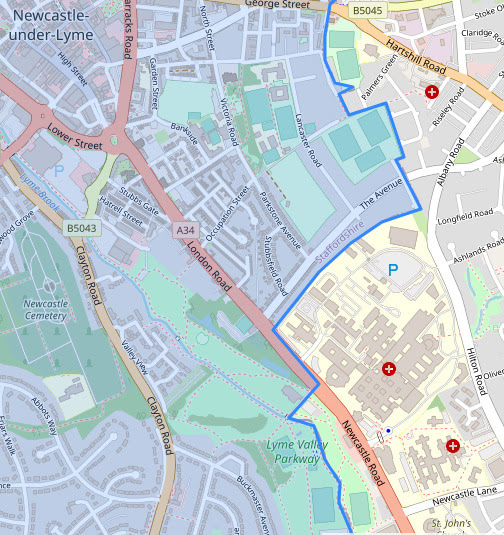
No mention of one of the biggest and best hospitals in the UK and Europe, in the press-release…
Newcastle-under-Lyme was one of the highest-scoring English local authorities for green space, scoring 9.6 out of 10. The area is home to 7.4 parks and playing fields within [a 15 minute walk] on average. It was also rated the joint-happiest English local authority based on data from the Office for National Statistics (ONS), tying with the High Peak. The ONS also reported it has an overall score of 7.9 for health and well-being.
And, as I found a few weeks ago in my photo-report, Newcastle-under-Lyme town centre is looking distinctly better than it was a decade ago. Though the lockdowns did cause the closure of the town’s second-hand bookshop.