How can Warrillow’s major book the History of Etruria be totally unavailable in Stoke-on-Trent libraries? Have all the copies been stolen over the years?
How can Warrillow’s major book the History of Etruria be totally unavailable in Stoke-on-Trent libraries? Have all the copies been stolen over the years?
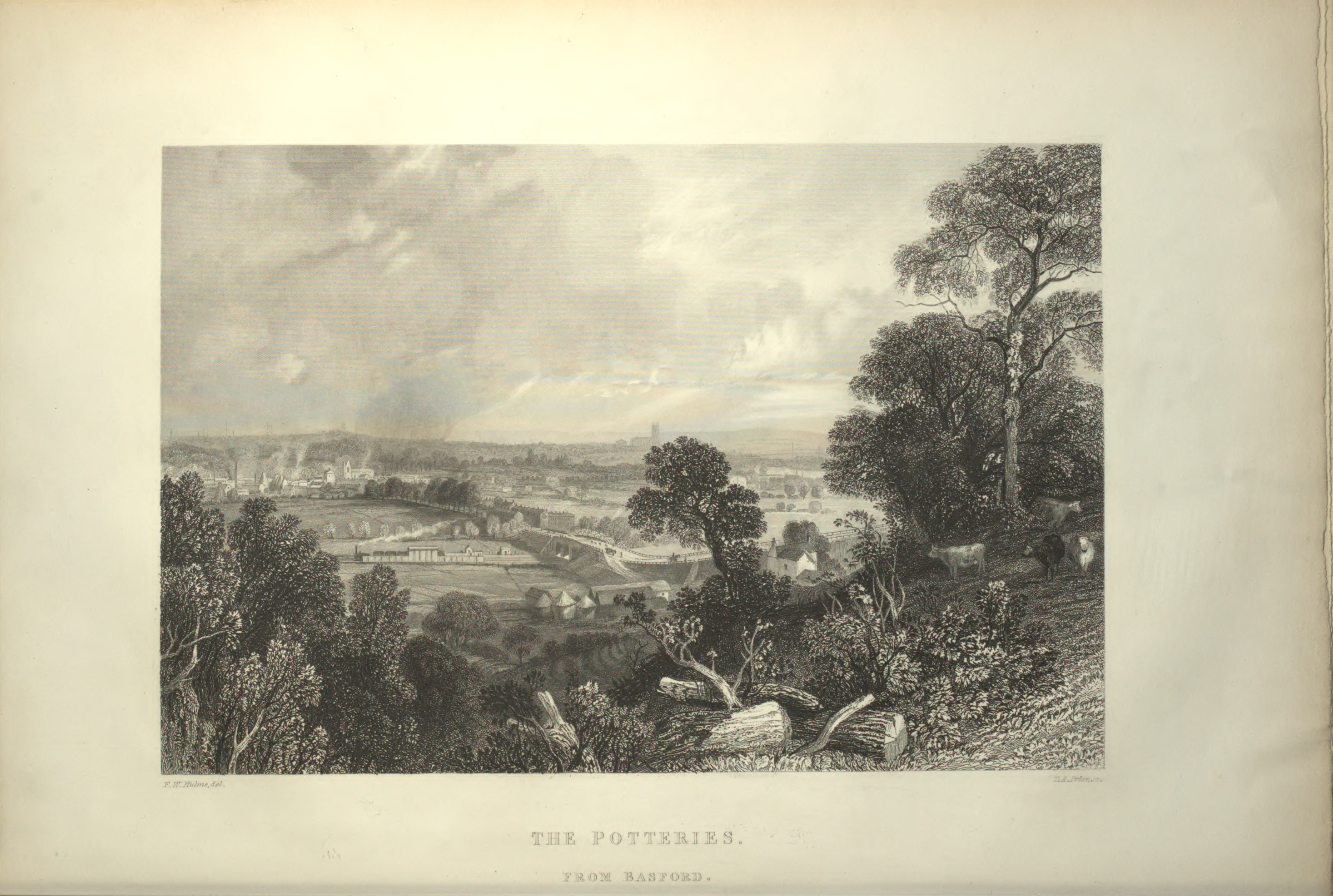
Extracted at hi-res from public domain books:
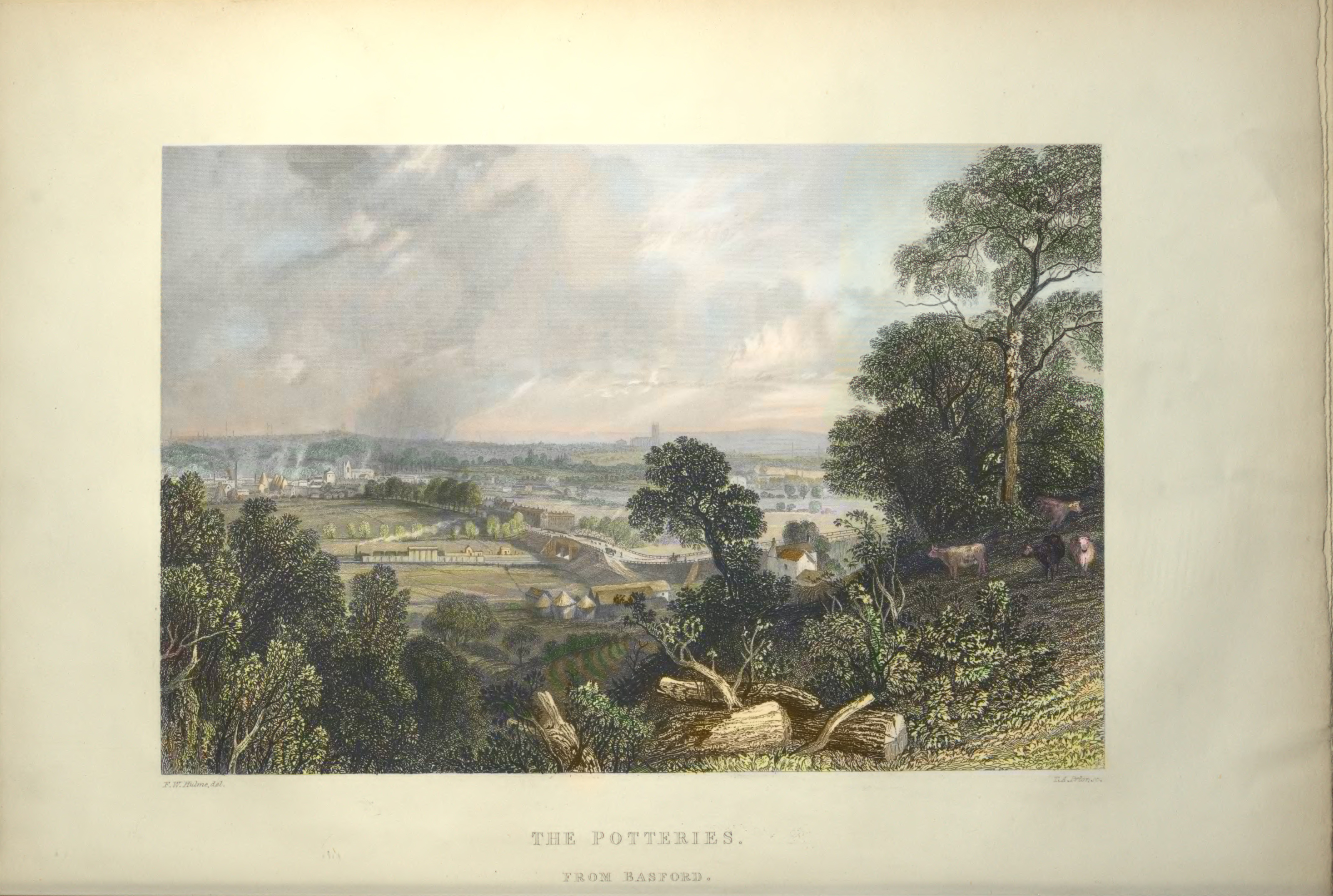
“The Potteries from Basford” engraved by T.A. Prior after a picture by F.W. Hulme, published in The Land We Live In, about 1870. On the ridge just north of Basford Bank, looking across Etruria.
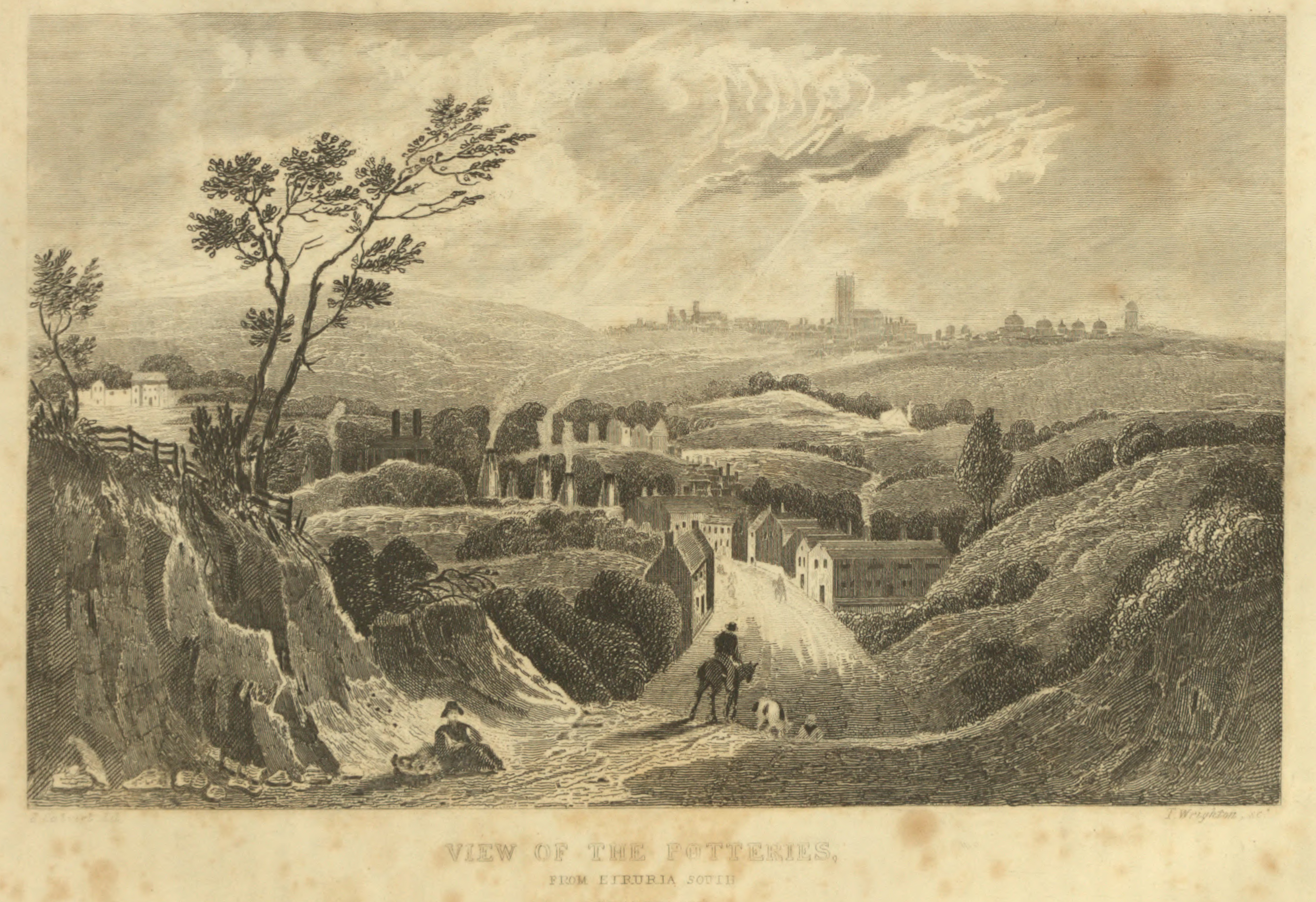
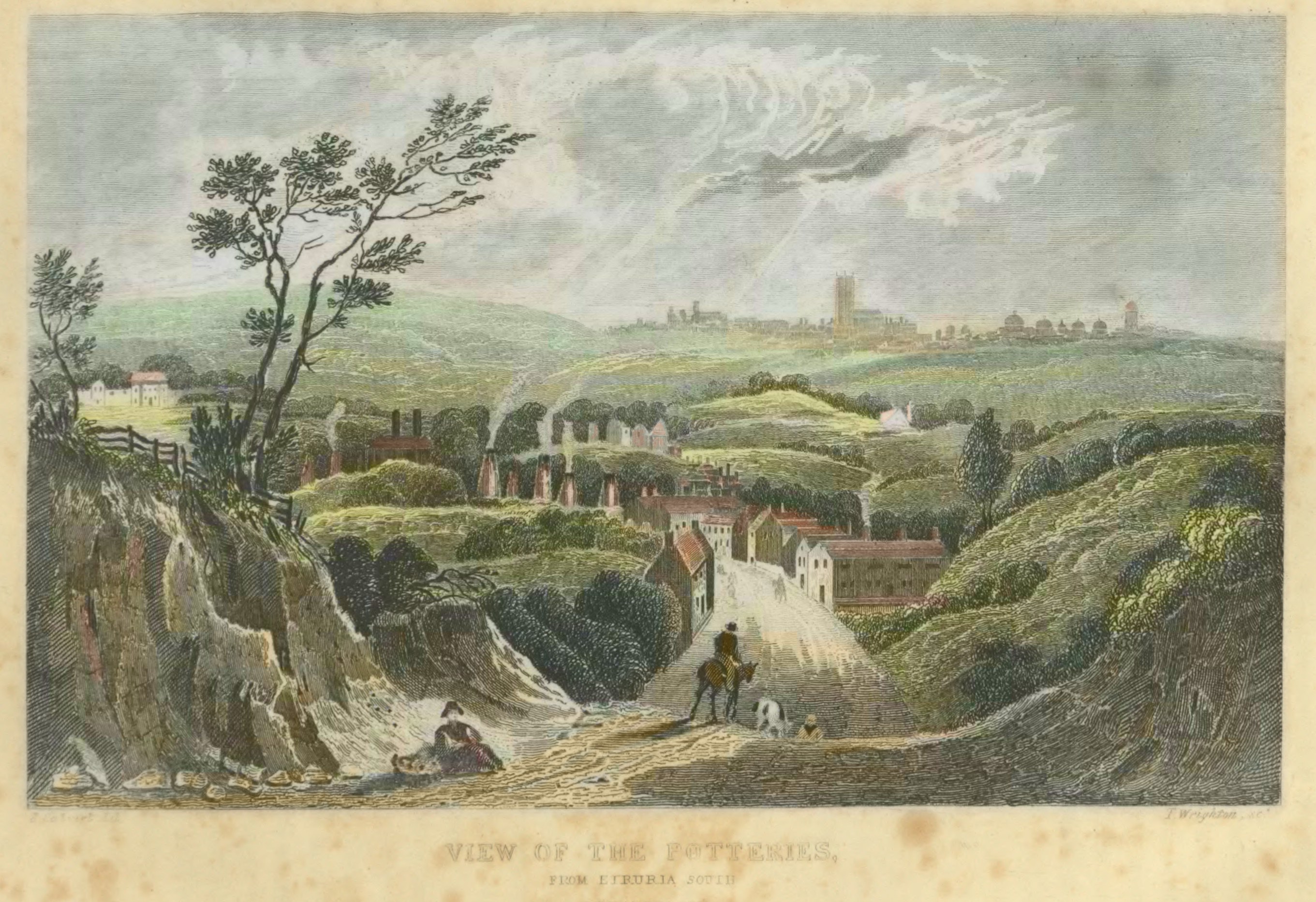
“View of The Potteries, from Etruria South, Newcastle Road” engraved by T. Wrighton after a picture by F. Calvert, published by W. Emans in Picturesque Views in Staffordshire & Shropshire, 1830. In the Basford Bank cutting, looking across Etruria and Cliffe Vale. The theatre-like stylisation of the picture means that the road through Etruria appears much closer than it actually was.
And here they are with a quick colorising:
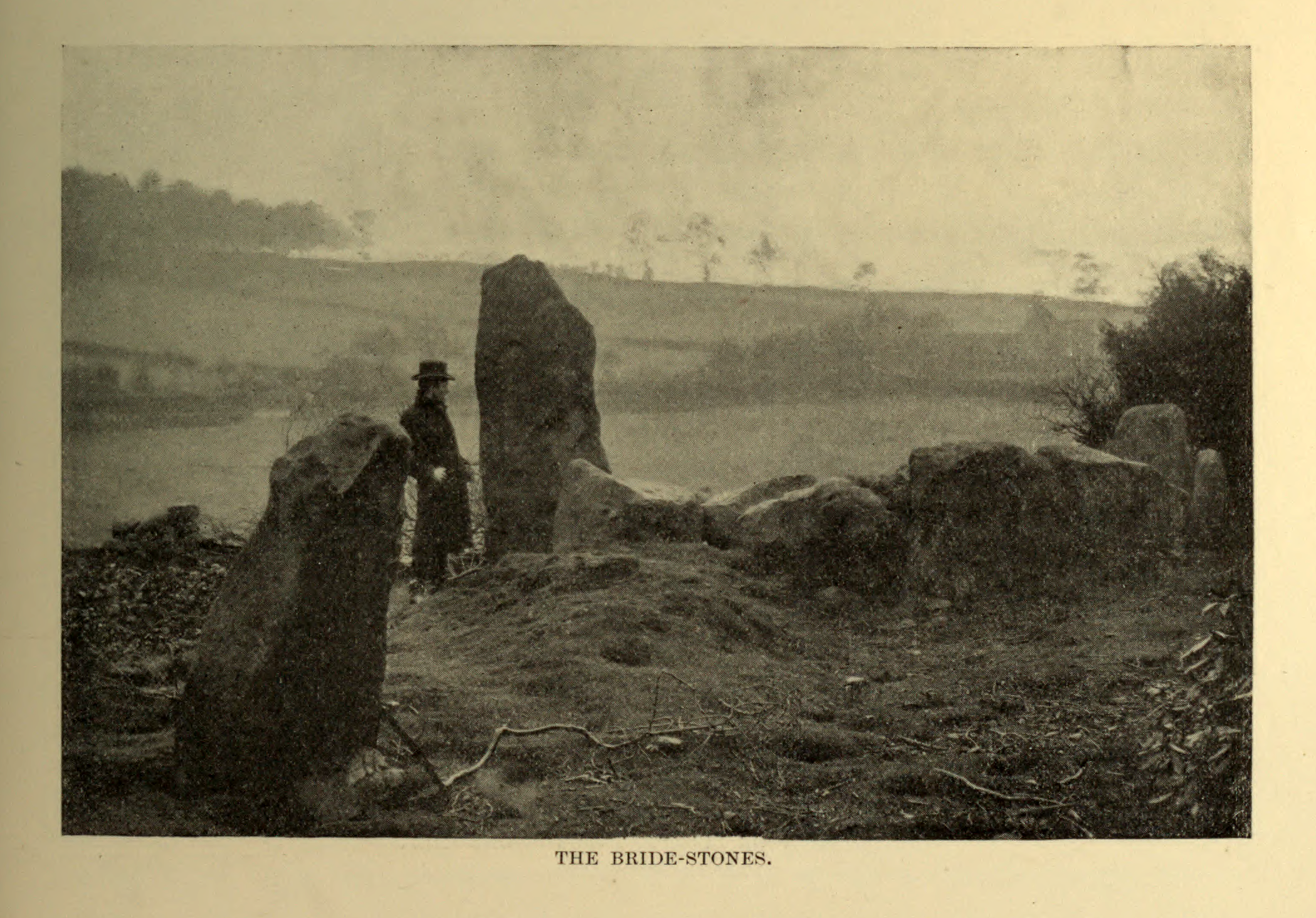
Two views of Burslem’s Queen St., and the ancient Bride Stones.
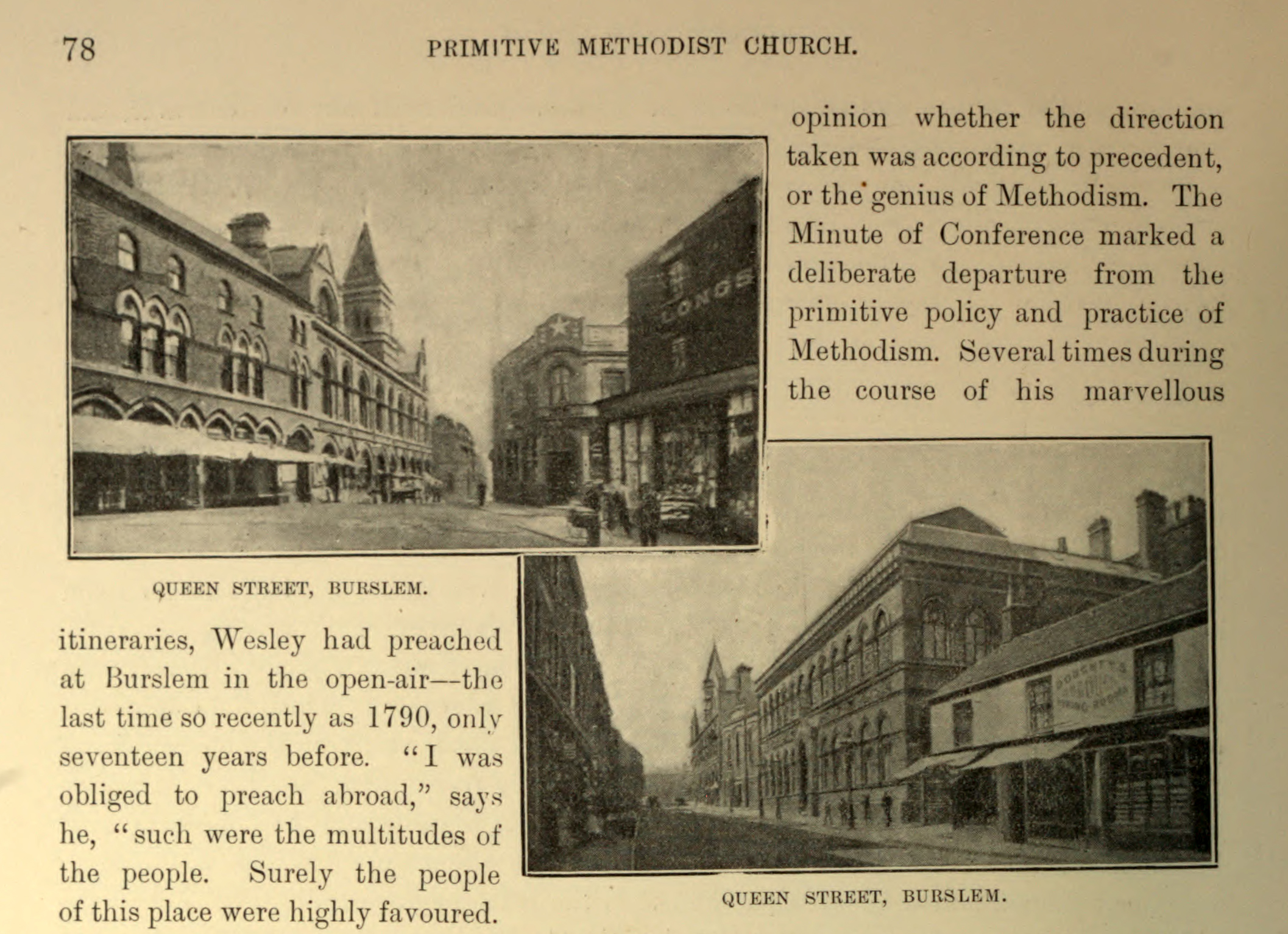
Queen Street features in my novel The Spyders of Burslem. One can see signs for “Longs” and what looks like “Doughty’s Reading Rooms” alongside the Wedgwood Institute. The steepled tower, long-gone, is remarkable. These three pictures were found in the marvellously illustrated The origin and history of the Primitive Methodist Church, and extracted at the highest resolution. They’re public domain, so feel free to re-use. The first half of the book is worth looking at for the wealth of local topographical pictures of Burslem and the Moorlands, even if one has no interest in the history of primitive Methodism. One wonders if the original paste-ups for the book are yellowing deep in some obscure Methodist archive, and might be found and their pictures scanned at hi-res?
I’ve discovered that the British Newspaper Archive online service has no coverage of The Sentinel from 30th December 1881 to 1st January 1889. The microfilm apparently has no such gap, as Stoke-on-Trent City Archives states they keep… “Staffordshire Sentinel, later Evening Sentinel, now Sentinel, from 1854, on microfilm. Staffordshire Advertiser, 1795-1973, on microfilm.” I’d suspect that the British Newspaper Archive’s digitisation contractor accidentally skipped a decade-sized block of the microfilm boxes, when building the online archive.
A public domain map of North Staffordshire, extracted at the highest res (8Mb PNG, 3115px), from “A history of the North Staffordshire Hounds”…

News of a new book, now pre-ordering on Amazon. The very substantial Corpus of Anglo-Saxon Stone Sculpture, Volume XIII: Derbyshire and Staffordshire will be a comprehensive survey presented as a 500-page £100 hardcover from the British Academy and Oxford University Press. To be published 1st October 2017.
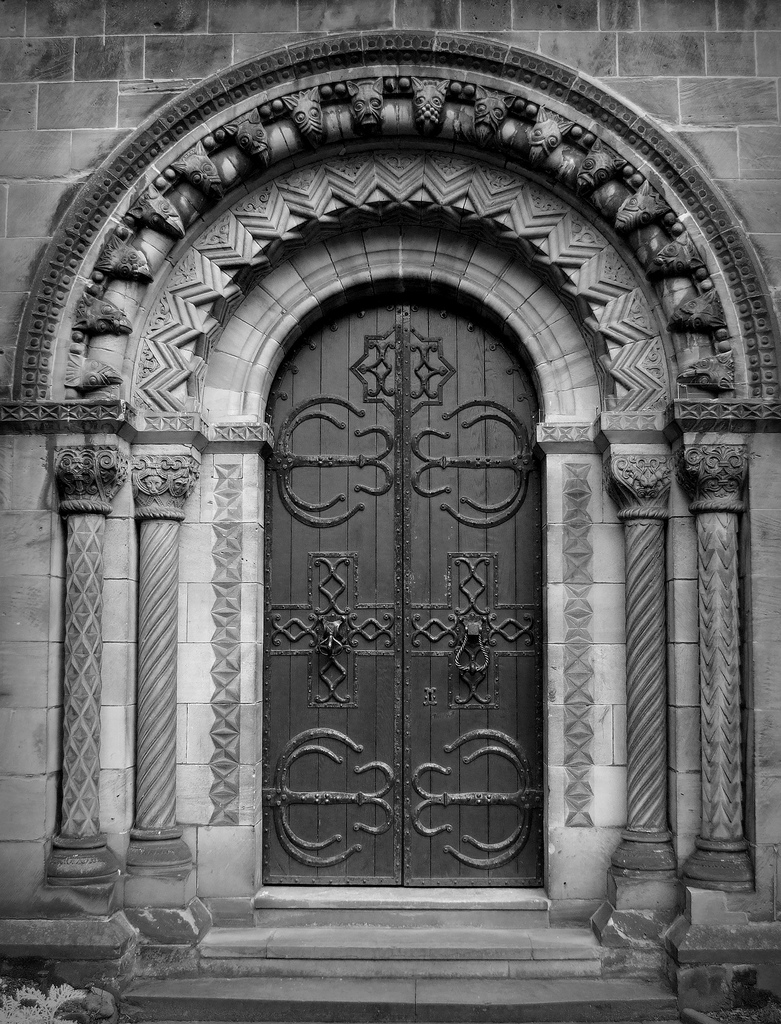 Picture: doorway in the town of Stafford, Staffordshire.
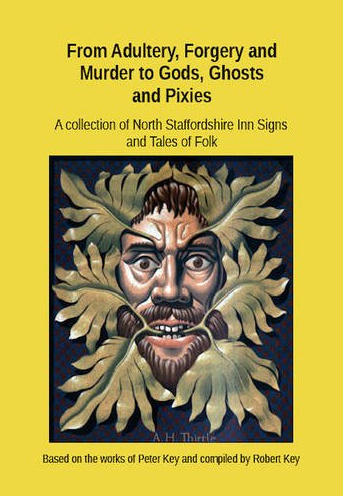
A new-ish book, published summer 2015: From Adultery, Forgery and Murder to Gods, Ghosts and Pixies: A Collection of North Staffordshire Inn Signs and Tales of Folks. 258 pages, and it has good reviews. The approach is an interesting one, proceeding outward from local inn signs to unearth surrounding local folklore and local tales.
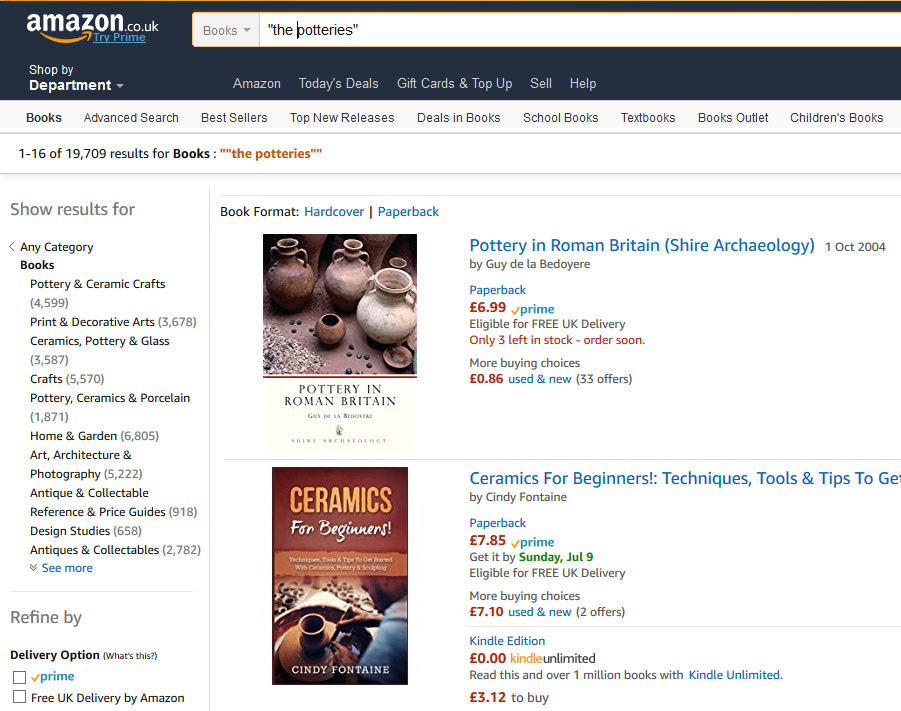
Amazon is so dumb when it comes to search and taste matching. All that brain-power and technology they have at their fingertips, and they can’t even let you search for “Potteries” or “the Potteries”, instead defaulting to results for 19,000 books about pottery. Nope, The Potteries, the place. We exist, we’re a major city, books have been written about us, some of which have “Potteries” in their titles. Nor can one use search modifiers ‘-pottery’ or ‘NOT pottery’ to exclude all the pottery making and archaeology books.
Transactions of The Historic Society of Lancashire & Cheshire, free and public to 1999. Also their Newsletter.
The Transactions can be keyword searched via Google:
site:http://www.hslc.org.uk/wp-content/uploads/ staffordshire
Digital Library of India, mirrored at Archive.org. The Digital Library of India was launched a year ago as a pilot.
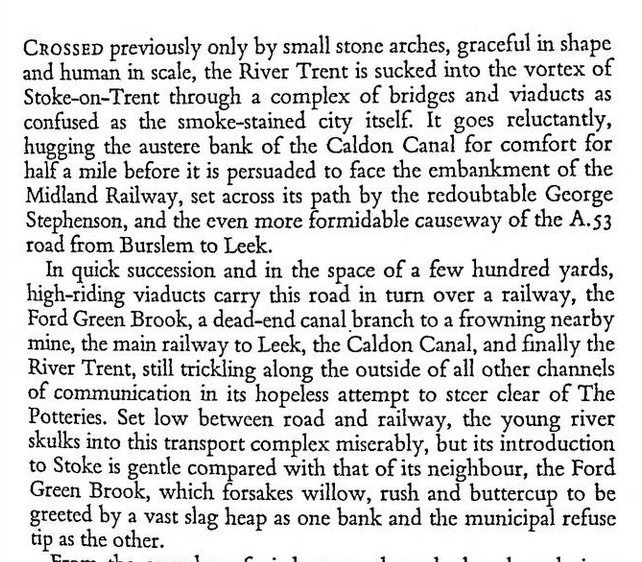
Among the goodies is Peter Lord’s lyrical book Portrait Of The River Trent…
Bill Cawley in the Leek Post & Times, on “The enigma of an eccentric artist”…
“a Leek mystery … an artist named Frederick Murray von Kalkreith Brown, an eccentric artist of seascapes … I believe the artist was really named Frederich Murray von Kalckreuth Braun … He died in September 1933 attempting to rescue a painting [from a fire] but what led him to come to Leek will remain a mystery.”
Valda and others on Rootsweb kindly looked up the census material a decade ago. I summarise the long thread, in narrative form:
* A “Frederick Murray Von Kalckrieth Brown” was born 1856 in Islington.
Birth dates can be a year astray, since it was common to delay registration of male births due to the high likelihood of death for boys. The birth may have been 1855, but not registered until 1856 when the boy was thriving. I’m guessing it’s possible that “Kalckrieth Brown” was a convenient Anglicisation of his family’s German “Kalckreuth Braun”, but then why not also drop the “von”? Possibly because, to English ears, a “von” indicated the chance of some noble title?
* Married in Shoreditch in 1880. He is listed on the 1881 census as “Fredk. M. Brown”, his trade a Battersea watercolour artist.
* At 1891 he’s living at “9 Bleak Street, Burslem, Staffordshire” with his growing family. That street would today be classed by locals as being just over the border into Cobridge rather than Burslem. He works there as an “Artist and Designer”, presumably for one of the local pottery manufacturers. He moved to Burslem around 1889 or 1890, judging by the birth date and place of his one-year old son Leo B. Brown.
* If he retired in 1920 at age 65, then he and his wife may well have chosen the nearby town of Leek as the place of his retirement.
Not to be confused with Patrick von Kalckreuth (1892–1970), the leading German maritime painter of seascapes. Or with the influential London artist and teacher Frederick Brown (1851-1941). Nor with F. M. Brown the Pre-Raphaelite painter.
Some interesting authors going into the public domain in early 2018, having died in 1947:
Horror:
Arthur Machen. (The biggest name for 2018).
Emilio Carrere (The Tower of the Seven Hunchbacks, later a cult film).
Laurence D’Orsay (wrote some ghost stories, had two stories in Weird Tales in the mid 1920s).
Alfred North Whitehead (forgotten today, but a major British philosopher whose 1920s works influenced H. P. Lovecraft).
Science fiction:
J. D. Beresford (prolific novelist, admirer and imitator of H.G. Wells — though with less ‘megaphone socialism’ and more human sympathy. Apparently an influence on Stapledon. His The Hampdenshire Wonder sounds very similar to Wells’s The Wonderful Visit and appears to anticipate The Midwich Cuckoos. Also wrote ghost/mystery stories).
M. P. Shiel (The Purple Cloud, a landmark in science fiction, and a number of fantastical stories such as “The Pale Ape”. Lovecraft thought his “The House of Sounds”… “the most haunting thing I have read in a decade.” when he read Shiel circa 1923).
John Ulrich Giesy (wrote stories for the Munsey proto-pulps and early 1920s pulps).
English rural supernatural/magic:
Forrest Reid (his finely-written Tom “trilogy partakes heavily of the marvellous, involving nature worship, guardian angels, ghosts, magic arts and the bridging of the dream and real worlds”).
Hugh John Lofting (the Doctor Dolittle series, and the historical novel The Twilight of Magic about medieval England transitioning from magic to science).
Charles Henry Cannell (wrote as Jack Mann the ‘Gees’ series of rural supernatural detective novels, in which Gees battles warlocks and werewolves. Also a classic telling of the Adventures of Robin Hood for children).
Herbert Asquith (Wind’s End was the first novel of this son of the Prime Minister, “a novel of violence, mystery and crime detection” in rural England … “also a touch of the mystical here” … “unusually good in rustic characters”).
Adventure and true-life:
Emma Orczy (series of Scarlet Pimpernel novels and stories).
E. M. Hull (desert adventure novels).
John Alden Loring (African Adventure Stories, written from first-hand experience as a field naturalist).
James Willard Schultz (sympathetic and ethnologically-accurate adventure novels of American Indian life and fur traders in the Old West).
Alan Sullivan (lost world novel, and a minor fantasy novel).
Charles Nordhoff (gritty sea adventure in the Mutiny on the Bounty trilogy of novels).
‘Captain Dingle’ (authentic sea adventure stories written for the Munsey-era proto-pulps by a veteran sailor).
John Henry Patterson (the true-life The Man-eaters of Tsavo and Other East African Adventures, filmed three times).
Cecil Madigan (the true-life story of exploring then-unexplored Australia, Crossing the Dead Heart).
Also of note:
Hector Munro Chadwick (his theory of The Heroic Age, in book form in 1912, was an influence on the young Tolkien and tangentially the later sword-and-sorcery genre).
Marie Adelaide Belloc Lowndes (sister of Hilaire Belloc who produced a popular mystery-crime novel a year, one of which became an early feature-film by Alfred Hitchcock).
Margaret Marshall Saunders (an enormously popular children’s animal-story adventure writer from Canada, now forgotten).
Henry Ford (the famous manufacturer, autobiography ‘My Life and Work’ and ‘My Friend Mr Edison’ – his ghost writer Samuel Crowther also died 1947).
Harry Gordon Selfridge (The Romance of Commerce, a popular book-length survey of ancient commerce from Greece onwards, Bodley Head. Might be suitable for adaptation as a non-fiction graphic novel?)
Angela Brazil (cult stories of English girls’ school life, the Chalet School series).
Flora Thompson (Lark Rise to Candleford, Candelford trilogy)
Donald Henderson (“the 1943 psychological thriller Mr. Bowling Buys a Newspaper, which got considerable critical attention in wartime Britain”).
Meredith Nicholson (the best-selling ‘haunted-house/inheritance/romance’ mystery The House of a Thousand Candles, and mystery/espionage thriller The Port of Missing Men).
C. Louis Leipoldt (a major Afrikaans poet whose poetry does not translate, but he also wrote “detective stories”. His English-language historical fiction Boer trilogy The Valley was only published posthumously and with radical surgery to the original drafts, and thus will not be going into the public domain).
Iain MacCormaic (wrote the first novels in Scottish Gaelic).
Bert Kalmar (songwriter for Groucho Marx).
John Archibald Watt Dollar (A Handbook of Horse-Shoeing, 1898 but not likely to be out-of-date due to the traditional nature of this rural craft).
In the USA, the 1960s playwright Joe Orton enters the Public Domain.