Gummage restored

Worzel Gummidge: The Complete Restored Edition on Blu-ray in the New Year. This is the original 1979-81 children’s series, seventeen hours in total over five discs. Reworked by the British Film Institute from the original film negatives, which had been found mouldering away in barn. Pre-release reviews report a sparkling HD picture and excellent sound, for this classic series. Previous releases, even the box-set, had an abysmal sub-VHS picture quality. This was made even worse in YouTube clips.

Great to see such a fine evocation of the countryside given this treatment at last, and we can now see some of the all-time perfect gems of TV (such as “Choir Practice”) as they should be seen.

Tolkien Gleanings #4

Tolkien Gleanings #4

* “Companions in Shipwreck: J.R.R. Tolkien’s Female Friendships” (2019 book chapter, and now newly open-access).

* A new scholarly blog post “Lost in Translation: Ettins in Old English”. It seems the author is pushing back strongly against a lumpy assumption held by a few confabulating pagans, who appear to want to believe that “all giants are ettins” so that they can freely start “equating ettins and ents”. The author notes that… “As far as I am aware, nowhere in the Old English corpus is there an ent who is also referred to as an ettin, or vice versa, so the two appear to be mutually exclusive.”

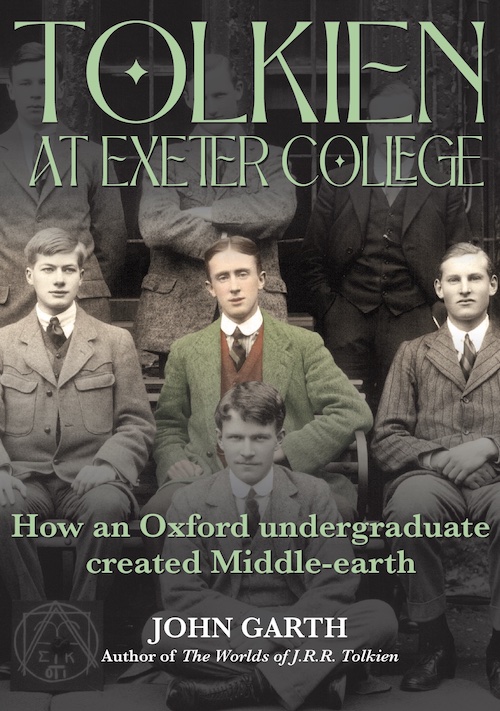
* Cover for the new second edition of Tolkien at Exeter College, now available direct from John Garth’s website. Apparently, according to a podcast interview, there is no expansion in terms of adding details of Tolkien’s tutors and teachers and their research interests.

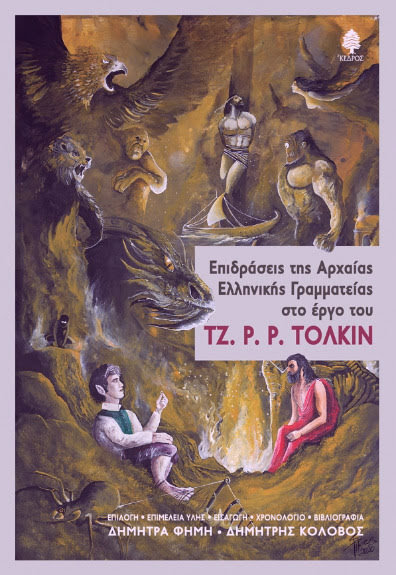
* A new book in Greek, The Influence of Ancient Greek Mythology on the works of J.R.R. Tolkien (2021).

* “J.R.R. Tolkien: The Art of the Manuscript” Catalog. 200 page catalog for the current Marquette University exhibition, which closes 23rd December 2022. The exhibition, and presumably also its catalog, apparently includes unspecified “never-before published works” by Tolkien.

* A thoughtful new blog post from the Deputy Head Girl at Wimbledon High School in London, “How does mapping help to create a fictional world?”, with a strong Tolkien focus.

* Full details of a 30 credit Theology and Religion module Tolkien: Scholar, Critic, Writer at the University of Exeter. With reading list. Tutor Nick Groom… “will also consider how far Tolkien’s experience of place, including his trips to Cornwall, affected his work”. Module devised/approved in 2019, possibly still running annually.

* The Spanish Tolkien Society has a large exhibition on now. Includes a public talk on “J.R.R. Tolkien’s Spanish Connections”.

* And finally, new on UnHerd is “Who cancelled English folklore? Britain is embarrassed by its heritage.”

On Merry and Marmaduke

Merry is the name of one of Tolkien’s key characters in The Lord of the Rings. His real name is Meriadoc Brandybuck, “though that was seldom remembered”. In early drafts Merry had the first name Marmaduke. After some research, it appears to me that both names once indicated much the same thing. A competent assertive male who had both lands and substantial disposable income from his lands. Queen Elizabeth I, writing to Walsingham in a letter, clearly gives this meaning when she talks of a ‘marmaduke’ as a type of man rather than a personal name. Clearly the name is then fitting for the hobbit destined to become the master of Brandy Hall.

There are however some historical candidates who might have inspired Merry’s name(s). Let’s look at these, and see which are relevant to the character and actions of Tolkien’s Merry:

1. There was a Cornish saint, Saint Meriadoc (Meriasek in Cornish), of circa the 5th or 6th century. Originally hailing from Wales, he evangelised parts of Cornwall around Camborne and was later venerated in the Land’s End district. Thereafter he crossed the Channel to Brittany, becoming a hermit there and then a bishop. In the 15th century his Breton cult was sustained and boosted, and his Life lavishly embroidered, by Brittany’s ‘House of Rohan’. This ‘House’ being a large aristocratic grouping of ambitious viscounts — who also fudged and faked a supposed descent from the legendary and probably imaginary 3rd century King of Brittany ‘Conan Meriadoc’ (really). Interestingly they appear to have had early connections into Bohemia, and a ‘House’ there, which I guess could have interested Tolkien re: a possible ancient Goth connection. But there seems little to connect either the saint or the king with Tolkien’s Merry, other than the obvious name of the ‘House of Rohan’. But the fact that the saint originally came from Wales (a fact confirmed by reliable 19th century scholars, rather than the confabulating ‘House’) is useful to know, since it establishes the form of the name there at an early date.

2. The writer Thomas of Britain’s fragmentary Arthurian Tristran (12th century) has one Mariadok as King Mark of Cornwall’s efficient right-hand man. Mariadok spies on the lovers Tristran and Isolde, but fails several times to reveal them to the king. Recall that Tolkien’s Merry is revealed to be a benign spy and spy-master, as well as an efficient ‘right-hand man’ organiser for Frodo and his companions. Readers will recall that this is the function that Merry efficiently serves in the first half of Fellowship. Again, it’s also useful to know the name was in real use in England in the 12th century.

3. There is an epic Arthurian Meriadoc tale (British ms. of the early 14th century), in which the hero Meriadoc is a protege of Sir Kay at King Arthur’s Court and later a knight. His full epic is long and very fanciful, but there are certainly several elements that match with Tolkien’s Merry in The Lord of the Rings:

i) according to one source who read this tale closely, as a young man the story has him riding extensively with the chargers of a large cavalry. This is said to be somewhat unusual for the time. (Recall that Merry rides into battle with the riders of Rohan);

ii) in a later key act to prove himself at Arthur’s court, Meriadoc blows a horn at a ford to summon the fearsome Black Knight from his Black Glade (it has black foliage, and black boars), and he defeats the Black Knight when others have failed. (Recall that Merry defeats the black and seemingly un-defeatable Witch King, and later blows the special Horn of the Mark which has a great ‘summoning’ effect on hearers);

iii) and later, to win his knighthood Meriadoc leaves Arthur’s court to become the right-hand man of another king. He then goes with three staunch friends into enemy lands, and during this quest is deeply loyal to them. (Recall that Merry becomes Theoden’s sword-theign. This is not a right-hand man organiser role, yet he is certainly ‘next to the king’ at several points in the story. He is of course also one of a band of four hobbits in the Fellowship, and his friendship with them is very close.).

Thus, a number of striking similarities with The Lord of the Rings.

4. There is also the name Marmaduke to consider, a widely attested personal name in history though now usually only applied to large gingery male cats or enormous Great Dane dogs. As stated above, Tolkien originally considered using the name ‘Marmaduke Brandybuck’ when the early chapters of LoTR were still Hobbit-ish, and the name only later became the Meriadoc Brandybuck we all know.

Sadly the name Marmaduke is of very uncertain derivation, though there are very dubious ‘Celtic’ claims to be found in the baby-name books. A book review by the eminent Roger Sherman Loomis in the journal American Speech (1940) implies that this dubious confabulation was already in circulation by the late 1930s…

Whence came the strange assertion that Meriaduc is an Irish name introduced into Northern England by the Vikings? It is a purely Brythonic name.

We can however be certain of the early English spellings since they occur in documents. For instance, Tutbury in mid Staffordshire had a “Sir Marmaduc” as steward in the 1480s. So we have Marmaduc and Marmaduk in that period and the two centuries before it. This help a bit. It then looks to me like Tolkien was working back along the following chain:

MarmadukeMarmadukMarmaducMarma— somehow became Meria— – then across the Channel to get Meriaduc (12th century Brittany). There Meriaduc is a landed lord with a large income, and a key character in the Lais of Marie de France which Tolkien knew well. From there it doesn’t seem such a leap for him to get to Meriadoc, assuming there was a -duc -> -doc historical sound-change.

There was a Marmadoc Brandybuck in Merry’s family-tree in the LoTR Appendices, which Tolkien originally had as ‘Marmaduc’ (Peoples of Middle-earth). Geoffrey of Monmouth had a Gorboduc as a mythical king of Britain, and there was also a Gorbadoc in Merry’s family-tree. Thus it looks to me like Tolkien was ‘ageing’ the names by switching the endings from -duc to -doc.

Indeed, by doing this he was probably also bringing the names back to the Welsh Marches and his beloved Mercia. Since the real Domesday Book reveals a Welsh “King Mariadoc” had been granted lands in Herefordshire on the Welsh Marches, the lands then being held by his (non-king) son Griffin. Pair this doc name with the 5th-6th century name in Saint Meriadoc (Welsh) and the 14th century Arthurian Meriadoc (British), and a switching over of -duc to -doc seems justified.

Hence, it looks to me as if Tolkien’s early choice of the name Marmaduke Brandybuck would have been made on the basis of Marmaduke being a valid modern form of the older name Meriaduc (Meriadoc). Though I admit I can find no philologist text to confirm this, and I’d still like to know the philology on how Marma— evolved from the older Meria—. Possibly the use of French in England after the Conquest has something to do with that, at a guess.

5. There is one more curious use to consider. Centuries after Griffin son of Mariadoc was named in Domesday, the author of the Elizabethan stage play John a Kent had his hero Sir Griffin Merridock (Prince of South Wales) come to England to win a bride. His beloved becomes enchanted by a bad magician, but with the help of a good magician he eventually triumphs… “The Abbey Church of St. Werburgh in Chester is the setting for the final scene, in which [the good magician] Kent’s magical deceptions win Griffin Merridock and Lord Powys their brides.” An interesting story and a remarkable historical reaching-back to Domesday, but I can’t see any plot connection here with Tolkien’s Merry — other than to stretch a point and recall the use of casting a magical ‘glamour’ on people’s eyes i.e. not seeing what is in front of you. Recall that in LoTR Eowyn is in disguise and all the Riders pretend not to see Merry as they ride to Gondor. Disguise and detection are key aspects of John a Kent.

Foxy Tolkien?

Is there an overlooked Tolkien source, in the now-forgotten medieval folk epic of Reynard the Fox? There is of course the obvious fact that when Tolkien was growing up versions of Reynard the Fox were still popular reading for children. For grown-ups Joseph Jacobs had issued his Caxton-derived modern-English The Most Delectable History of Reynard the Fox in 1895.

One might encounter Reynard claiming, in chapter 21, to have had a magical Wonderful Ring with a three-coloured stone, red, white and green…

“the red made the night as clear as day; the white cured all manner of diseases; and the green rendered the bearer invisible”. (Dictionary of Phrase & Fable).

Sounds rather similar to LoTR’s red ring of fire and light, the white ring of healing and mending, and then the One Ring itself. Actually, the invisibility is not to be found in either the Caxton or the Goethe versions of the tale. Instead there the green side of the ring’s gem gives victory in a clash of arms, and immunity from injury. Possibly the invisibility is in the 1498 version, which is elsewhere cited by the Dictionary of Phrase & Fable under “Invisibility”. One translation I found hints that the ring can issue a blinding light, which effectively makes the wearer invisible to enemies in a fight.

There is also deemed to be a fine inscription on this ring, as there is in LoTR. An ancient inscription that only the most learned Master of languages in the land can now read…

And furthermore the cunning Master said,
Whose finger bore that Ring, so he had read,
Should never freeze in winter’s direct cold,
And calmly live in years and honors old. [Goethe version]

So here we have a ring with the power of prolonging life, yet not infinitely since…

The power of Death alone it could not curb

The ring is also lost (along with his other imaginary jewels) claims Reynard to the King, but he may yet find it again. Perhaps, suggests Reynard… “We can order the Magician Alkarin to consult his books” and thus he can “search the earth” to determine the location. Again, all similar to LoTR, even including the name Alkarin (in Tolkien, the king under whom Gondor achieved its mightiest power).

Consider also that Reynard further thinks up “Reynard’s Globe of Glass”. This being an invaluable treasure…

“supposed to reveal what was being done — no matter how far off — and to afford any information on any subject that the person consulting it wished to know” (Dictionary of Phrase & Fable).

This sounds rather similar to one of the palantiri or ‘seeing stones’ in LoTR, although admittedly polished crystal ‘scrying’ balls provide a pre-existing template for the literary invention.

As a linked tale-cycle, Reynard the Fox had both the age and the cultural background to have interested Tolkien. In written form, drawing on Flemish (once called ‘Frankish’) folk tales via the wider French-German borderlands, this ‘wily fox’ epic dates from the 1100s and even earlier written fragments can be found. We know that Tolkien was interested in the names and folk tales of the Franks and the Lombards. The Franks had once known of an Auriwandalo (cognate for the Anglo-Saxon Earendel). The eminent Catholic scholar and church historian, Rev. F. G. Holweck, even had it that the great sung Antiphons — monastic chant-song heralds of Christmas, on which the Anglo-Saxon Exeter Book’s fateful earendel lines directly drew — were… “of Frankish origin”.

Later in his life Tolkien was interested in the dialect in English parts of Pembrokeshire, a remote part of Wales, which had absorbed many Flemish [Frankish] families from the continent. In particular from Ghent, which incidentally was once a Vandal city (the Vandal tribal name rooting via philology to a very strong earendel connection).

Tolkien would also have known the great and pioneering scholar Grimm, who had long correspondence with Flemish experts and had early written on Reynard. Grimm (1824) had even mused on Reynard the Fox as being the survival of Frankish and thus Germanic mythological legend… and Tolkien knew his Grimm. Grimm’s early theory of ‘direct’ mythological survival has since fallen by the wayside, but the Flemish version of Reynard (source of all modern versions) might still have been a partial reliquary for bits of archaic folklore. Indeed, the 1911 Encyclopaedia Britannica observed that…

“[Grimm’s] theories, which have been much contested, have received additional support from the researches of K. Krohn, who discovered [1880s and 1890] many of the stories most characteristic of the cycle in existing Finnish folklore, where they can hardly have arrived through learned channels.”

So we also have a Finnish link for Reynard, and of course the young Tolkien was deep into Finnish lore and the Kalevala. Kaarle Krohn was one of the leading Kalevala experts and he was the ‘father’ of the Finnish school of scholars on such matters. It seems inconceivable that Tolkien would not have known of his work, even though he appears to have published mostly in German.

While there was no foxy ur-epic to be found in Finland, looking at the wider distributions of key tales and clusters Krohn detected certain Reynard tale-sequences in existence for over a thousand years. He stated…

“It was clear that into Finland there came from the west Scandinavian versions, and from the east Russian versions of one and the same tale, and that Finland was not a land through which tales travelled, but was rather the final destination of two streams of tradition. … The most southern part of northern Europe which can be conceived of as the home of the tale of the bear and the fox is northern Germany. … We can conclude that in Germany the whole chain of adventures was present before the settling of the Saxons. … From Germany on the one hand the original form with the bear reached Scandinavia and on the other hand the form with the wolf, influenced by the fable literature and the animal epic, reached Russia.” (translated by Thompson, The Folktale, 1977)

Whatever the ultimate national/tribal origins, there is now enough evidence to suggest why Tolkien might have taken notice of Reynard.

Can a date then be suggested for Tolkien’s interest in Reynard? Possibly as early as 1920. In one early version of “The Tale of Tinuviel” (1920), Melko’s lieutenant (“he was in Melko’s constant following”) is called “Tiberth”, demon Prince of Cats (“whom the Gnomes have called Tiberth”). This name is similar to the central tom-cat character in Reynard, called Tibert (Flemish Tibert, Dutch Tybert, Old French Tibert, English Gilbert via a Chaucer translation from the French, all of which likely roots to the Germanic Theobald). Admittedly Tolkien’s use of Tiberth / Tibert is circumstantial, since the word does not necessarily have to come from Reynard, but was once in general use for a dominant male cat.

Skeat has… “I take Tybalt to be a shorter form of Theobald, which again is short for Theodbald … The A.S. [Anglo-Saxon] form is Theodbald, which occurs in Beda, [Bede] Hist. Eccl, bk. i. c. 34.” (Skeat, Notes on English etymology).

Pope usefully adds, for his era in England… “Tibbald (as pronounced) or “Theobald (as written)” (Dunciad). Today we still use ‘Tibbles’ as a common general cat name.

In The Lord of the Rings, Tolkien’s only directly uses ‘Theobald’ once, and in variant form, as Tobold Hornblower. Who, perhaps interestingly, was the inventor of the smoking of pipe-weed and the founder of the Southfarthing industry that was then built around the production of Longbottom Leaf. Yet there seems no implication of ‘cats’ here, unless one can venture a creaky comparison with a cat’s delight in the pungent herb ‘cat-nip’. More likely is that the name carries the conventional English understanding of Theobald as a common personal name conveying people (his folk, leader of) | bold (in jeopardy), i.e. he is ‘a prince who will be bold in jeopardy to protect his people’. In Rohan, the name Theoden partakes of the same meaning.

There is also an Isengrim name in the Shire, this being a key name among the Tooks, since the famous Bullroarer was “son of Isengrim the Second”, the 10th Thain. Isengrim is the name of the wolf who is a central character throughout Reynard. Though even there, the name is uncertain in connection with Reynard, since Isengrim was an ancient tale-name used for a wolf long before the first instances of Reynard are known. Thus the two instances found in LoTR have only a shaky connection with Reynard, if any.

However, if I’m right about a Reynard source for Tolkien then this may illuminate the appearance of a talking fox. This male fox occurs near the start of The Lord of the Rings and his appearance rather jars some readers. We might now see this fox as not only an attempt to ease the reader’s transition between The Hobbit and the LoTR. It may have also been Tolkien’s nod to Reynard the Fox.

Wetton in winter

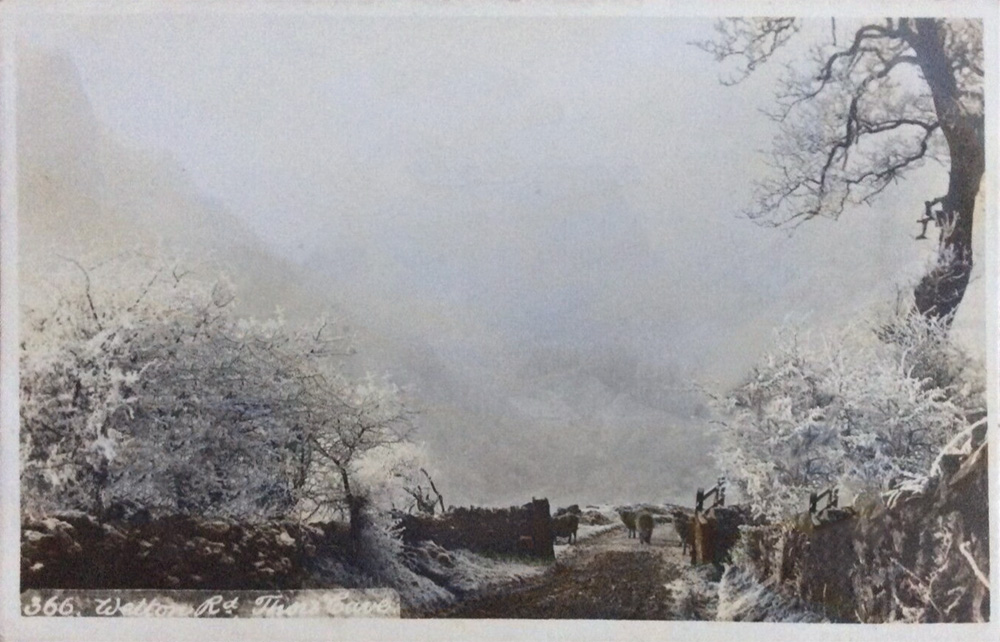
A rare if fuzzy picture of Wetton in winter, perhaps early 1900s since it was posted in 1909. Shows the unpaved track-like Wetton Road with the site of Thor’s Cave indicated in the mist above. Relevant to getting a feel for the setting and season encountered at the conclusion of the poem Sir Gawain and the Green Knight.

Mow Cop and Bede

A couple of local items were discovered while searching for new items for the new edition of my local Folklore bibliography…

1)

Mow Cop is in an unusual position. As evidenced by an interesting observation by D. Sylvester in the article “The hill villages of England and Wales”, The Geographical Journal, 1947…

“Mow Cop is probably unique as a hill village in that it lies across a fourfold boundary line dividing two parishes, two counties, two dioceses, and the two provinces of Canterbury and [missing word, probably “York”]”

Reminds me a bit of Tolkien’s Bree, also a liminal hill-place at the meeting of many ways. Apparently there’s now also a “Mow Cop relay” for the giant Jodrell Bank radio-telescope up there, which perhaps adds another and rather more cosmic “line”.

2)

Mid Staffordshire can claim the honour of saving the Venerable Bede for the nation. J. Baker, “Old English saete and the historical significance of ‘folk’ names”, Early Medieval Europe, 2017, has…

“The Old English Bede may well have been produced in the region around Staffordshire (T. Miller (trans.), The Old English Version of Bede’s Ecclesiastical History of the English People, 2 vols (London, 1890), I, pp. xiii–lix)”

Yes, ok… “Staffordshire”. It’s a big long place. Where exactly? Baker’s cited source (Miller) is on Archive.org and offers an exhaustive analysis of the dialect and words. He plumps with equal vagueness for “North Mercia” as the place that made the Old English Version of Bede, but usefully states that it must have been very near the area of the production of the Rushworth Gospels and the Vespasian Psalter. On the current thinking about the Gospels and Psalter that means somewhere around Lichfield. Which chimes with Miller who notes that… “Lichfield also early possessed a notable monastery”, and he further suggests Wenlock Abbey (15 miles SW of Stafford, over in Shropshire) as the site of the initial preservation of that copy of the Old English Bede. But where was the “notable monastery”? Probably very near Lichfield Cathedral, or else the monastery at Burton-upon-Trent (if that lines up with the dialect). But the precise answer will likely be found in the new scholarly book Lichfield and the Lands of St Chad (2020), which it’s said has done a huge amount of new work on this neglected topic in Mercian history.

Lichfield may also have had a role in preserving Beowulf, since the first known owner of the Beowulf original was the Bishop of Lichfield.

The Folklore of North Staffordshire, version 1.8 (2023)

Slightly earlier than usual, though very suitably released on Bonfire Night, here’s the annual update of my The Folklore of North Staffordshire annotated bibliography.

Download: folklore_north_staffordshire_18_2023.pdf

This is now at version 1.8 (2023), as 14,000 words in 54 pages. It’s been subject to a big expansion (the last version was 40 pages), with numerous additions and some expansions of older entries. New additions are noted at the front, by name. It’s also had a lot of proof-reading for small typing and formatting errors.

Please update any local .PDF copies you may be keeping. There’s no print version, but it should be printable onto 14 sheets with booklet-making software. To then be folded and slipped between card covers.

Older versions of the .PDF have now been deleted from the blog.

I welcome descriptions of bibliography books that you may own or have access to, and which I have not yet been able to see.

It’s all gone “bang!” in Stone…

Sad to hear that the the annual Stone Town Bonfire and Fireworks Display is unavailable, at least for the foreseeable future.

It seems the problem is simply space. The Town Council for the mid Staffordshire town is said to have somehow managed to redevelop the main Park in such a way that… “the area used for the bonfire will no longer be available”. Durh. It’s said that the town has no other suitable space for such a large and popular public event.

Although several options spring to mind, off the top of my head…

i) the Stone Common Plot would be an ideal site, though only for those walking the short distance from the town centre to it. There’s no car parking that I can recall, and a temporary wooden mini-bridge / ramp would have to be hoisted over the entrance stile. Still, a feature might be made of “leave your car at home” as part of the event. That might even attract some funds from a health charity, re: walking.

ii) rural places around about Stone may take up the slack. An opportunity for a nearby enterprising farmer with a big parking field, perhaps, in partnership with a trusted events company? What about Kibblestone Scout Camp, which is presumably able to cope with large roaring campfires at least — and perhaps something larger?

iii) there’s Wedgwood at nearby Barlaston, which I recall has both the parking and several big flat fields. And is used to handling public events. Trentham likewise, though that’s a bit further away and not really walk-able (Barlaston can be walked from Stone via the Common Plot and Downs Banks NT) and would likely be much more expensive and upmarket. What appears to be needed for Stone is something a bit more community-oriented.

iv) ideally there would be a giant flaming bonfire up on the ancient Bury Bank, as there probably once was, but that’s highly unlikely given the steep access problem and the huge amount of flammable bracken.