New and local on Archive.org

Some new and local items for free on Archive.org:

The Two Universities Way: a green route to walk from Staffordshire University to Keele University (2012).

Mountain Bike Guide: Midlands (1994).

The Technique of Pottery (1962).

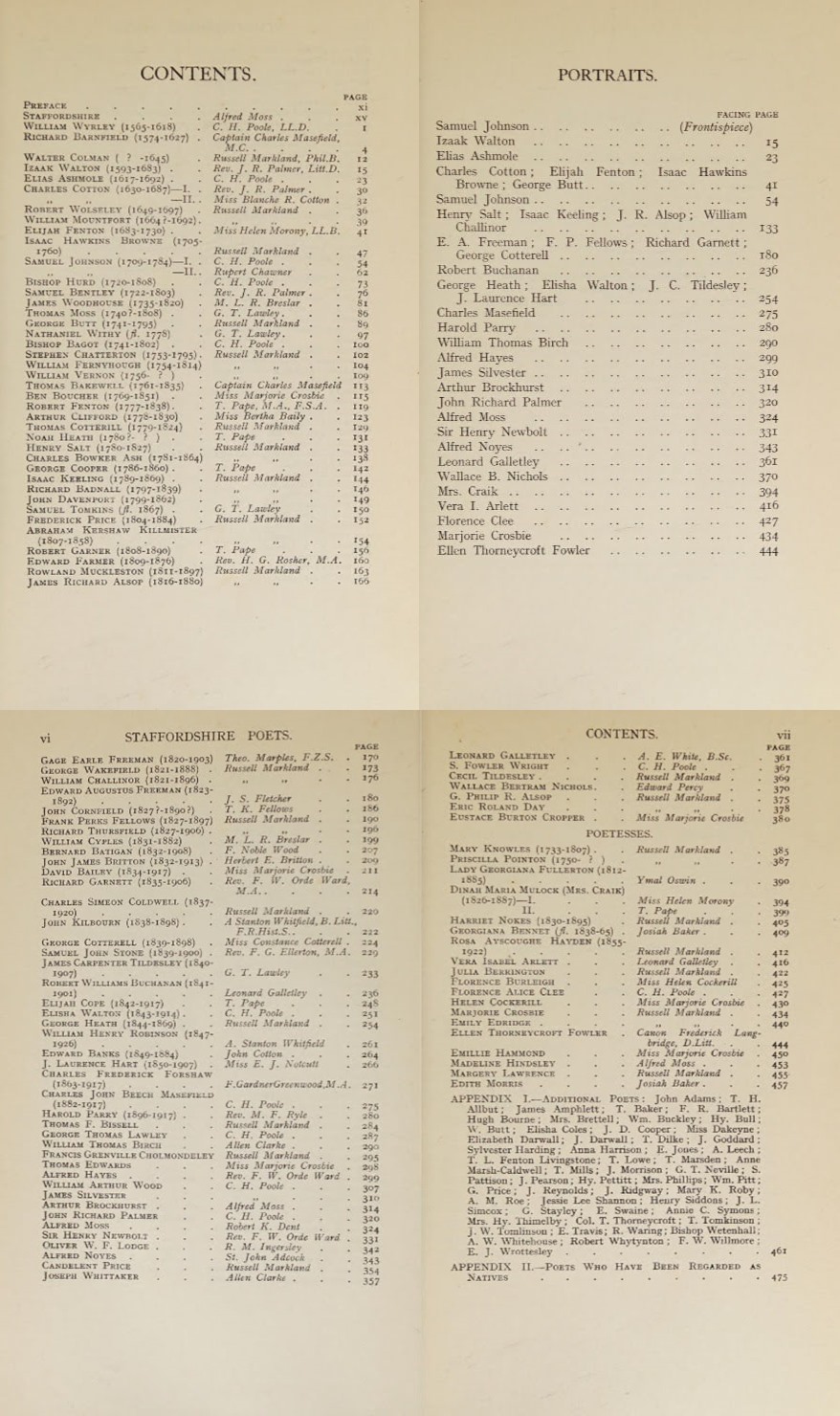
Staffordshire Poets (1928) (Poets of the Shires series).

Anglo-Saxon burial mounds : princely burial in the 6th & 7th centuries (partly a survey of Midlands mounds).

And I also found this commentary by the writer A.S. Byatt, recalling her Stoke great-aunt, and possibly also a Stoke headmistress…

“I made a story, ‘Racine and the Tablecloth’. It was written partly to defend Racine and ‘the gods in the blood’ against the schoolteachers who were encouraging my ambitious daughter to ‘be a gardener, if she wanted to’. She didn’t. She wanted to learn enough French to read Racine and go to university, but they wanted to persuade her that ambition was bad, competition was bad, French was for railway stations […] Into my story of my wrath and despair [at this attitude…] I wove an image of my great-aunt Thirza, who was photographed when she was over eighty, in her house in Stoke-on-Trent amongst her exquisitely bright tablecloths and cushions, embroidered on ivory satin, of the kind sold for wedding dresses. She was a mythical figure. my great-aunt Thirza. ‘She had blonde hair so long she could sit on it’ my aunt would always say. I believe that as well as following the linear shadowed ‘transfers’ (like neo-Platonic ‘forms’) [in her embroidery] she sometimes invented her own fruit and flowers, boughs and garlands. I have several of the cushions still. The silks are still bright. In my story my great-aunt Thirza stood for my ordinary origins, and her own bright work, for women making things in snatched time. But she was not allied with my levelling, ladylike headmistress, who haunts my dreams still: the nay-sayer, the antagonist, the fairy godmother who turned gold threads back into dull straw.” (Ovid metamorphosed).

Also on early education in the Potteries…

[In the early part of the Industrial Revolution affordable books for spelling, reading and writing – and their associated small paid-for single-teacher ‘dame’ or ‘penny’ schools – served] “a rapidly expanding middle class market, but they were so cheap and published in such numbers that it was not difficult for a working-class parent to get hold of something like Mayor’s English Spelling Book. The local newspapers in the Potteries for instance, regularly carried bookseller’s advertisements in the 1830s and 1840s for manuals on reading and writing at prices from sixpence to two shillings.” (Silences & images : the social history of the classroom).

Finding a Wright’s ‘Coal Tar’ Soap alternative

I was annoyed this week to find that Wright’s Coal Tar soap bars have switched down from 125g to 100g (though still 80 pence, at supermarket prices).
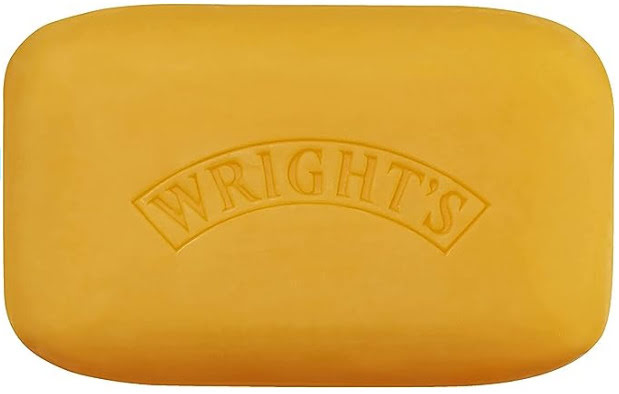
On researching this I was further annoyed to find that it’s no longer even Wright’s Coal Tar soap. The EU blocked proper coal tar soap from open sale from around 2012. Wright’s is now merely billed as ‘traditional soap with coal tar fragrance’. And not so much of the old ‘coal tar’ fragrance at that, since the smell is now emulated via a blend of other scents. Quite a toned-down smell, and quite variable from bar to bar. Sometimes hardly even noticeable, I’ve been finding. I put this variability of ‘the coal tar smell’ (which I like and find pleasant) down to the lockdowns and supply problems, and gave the company the benefit of the doubt. But I now discover the horrible truth about this much-loved ‘heritage’ brand.

Wright’s soap is now said to be made in Turkey at the behest of a brand owner in Solihull, near Birmingham. The old original Wright’s firm having sold out at the end of the 1960s. The active antiseptic ingredient is now the cheap and ubiquitous ‘tea oil’, rather than coal tar (aka liquor carbonis).

Even the vintage “Original” Wright’s bars, occasionally for sale on eBay, show by their wrapping that the smell was being reduced before the EU ban…
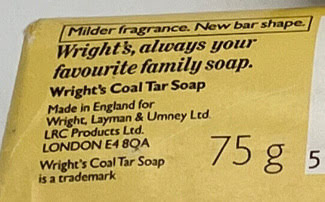
Note the “milder fragrance” claim. It’s definitely not a smell loved by all, and some (especially women who have to live with it on their men) hate it.

Ok, so are there alternatives in 2023 that have real coal tar and the proper smell? I took a look. ‘Kind of’ is the answer.

First, avoid a Russian seller on eBay. There’s a Russian ‘pine tar’ soap which a canny Russian seller passes off as ‘coal tar’, banking that the clueless buyer won’t know the difference. But pine tar is not coal tar.

The only genuine coal tar soap of any reputation in the UK seems to be Cosalic soap made by Salvia of India (aka Coslic or Cosilc on eBay). 3% coal tar. Possibly this is branded as Bistar in India, since Bistar has the same distinctive bar shape and colour as Coslic. They actively play on the “coal” idea, by making it look like a shaped lump of black coal. Nice idea, and delightfully politically incorrect.
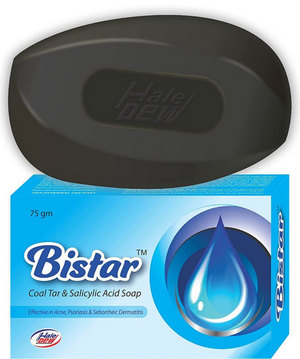
Regrettably though it’s very expensive either way. Even a 6-pack on Amazon UK will cost £3.88 a bar. That’s £3 a bar more than Wright’s! The India Bistar version seems to be even more expensive, probably due to shipping hiding in the ‘free shipping’ price.

I also found some U.S. sellers on eBay, from expensive back-room hand-made soap makers to the slick and incredibly expensive U.S. Dermabon brand (£28 a bar!).

It seems that part of the cost problem is that the equipment needed to get coal tar can only be used for coal tar extraction, not multi-use for other products. And that complying with health regulations for the extraction workers is now quite costly for the manufacturer. Once extracted the crude tar material (‘coal tar BP’) is flammable and thus presumably needs guards and a fire extinguisher system. Trade papers also report post-lockdown shortages (summer 2022) of the items needed to then make the raw coal tar into a retail consumer product.

Thus, while Cosalic soap is freely available in the UK via Amazon… it is only barely a replacement for Wright’s due to cost… and also because Cosalic’s soap appears to disguise the smell with all sorts of other things. Still, it may be worth trying. Like I said, it’s openly sold on Amazon UK.

I also found the trusted and UK-made Polytar Scalp Coal Tar Shampoo 150ml, also freely sold in the UK by Amazon. Under £10 for a 150ml bottle. Has 4% coal tar. It’s better value than the competing 2% Neutrogena T/Gel Therapeutic Shampoo 250ml, also freely sold (Tesco and Morrisons also have T/Gel on open shelves). Note that the UK’s official body NICE offers public advice on coal tar shampoo use… “applied once a week, left on for one hour and then shampooed off”. I’m not qualified to offer medical advice here, but this top-level official tip seems useful. It’s evidently best left on for a time, rather than washed off after three minutes.

Anyway, Polytar is by all accounts great for the coal tar smell, and the NICE advice means the shampoo can be left on for much of one’s bath-time. Thus it seems to me that the way to get the authentic olde 1960s ‘Coal Tar’ experience would be to apply your Polytar shampoo shortly after entering a bath, while also sparingly using a very expensive bar of Cosalic. Perhaps also have Wright’s cheapo ersatz 80p bar on hand too, to make the soap go a bit further.

Update: No Polytar at Morrisons or Tesco, but apparently Superdrug, Lloyds Pharmacy and Boots carry it on their shelves in the UK.


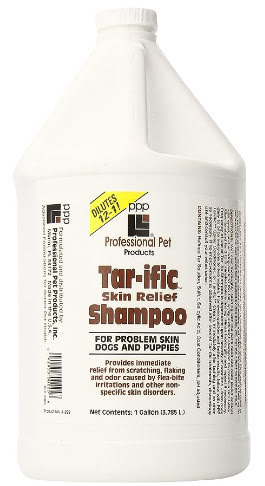
Interestingly in America they don’t care about EU nonsense, at least for dogs. I was amused to discover that their “PPP Tar-ific Skin Relief Dog Shampoo” sells over the counter, and by the gallon(!) and with 2% coal tar.

Also, I see that the EU has banned Zinc Pyrithione as well, from March 2022. If you were wondering why your anti-dandruff shampoo no longer works half as well as it used to, now you know. So far as I can tell the EU’s reasoning on such things is: it’s safe, but there may be ‘suitable alternatives’, thus it must be banned. That’s how the EU’s bizarre logic works. Of course, in time the ‘suitable alternatives’ may turn out to be… unsuitable. As such I’d rather stick with what’s been proven to be safe for over 50 years and billions of real-world human uses.

Update: Discovered Sudocrem. Amazing stuff! After decades of E45 with little result, I tried Sudocrem instead and… eczema clears up in 48 hours! Get it in the baby aisle of the supermarket (it’s in heavy demand for nappy-rash), at around £2.50 per pot. Cheap and easily available and… works. What’s not to like? The zinc in it, I guess, and I’d be willing to bet the government would ban it (see note on the zinc shampoo ban, above), if they thought there would not be a mother’s uprising that would sweep them out of power within a week.
September Heritage Days

The annual September Heritage Days are coming up. Some local places of interest…

* A chance to don a builder’s hard-hat and get inside the refurbishing St. Marks in upper Shelton. Saturday 9th September 2023, 11am to 3pm, no booking. Heavy restoration is still going on, replacing the roof trusses and more.

* Our Lady of the Angels and St. Peter in Chains, the large Catholic Church on the edge of Hartshill, Stoke-on-Trent. 16th-17th September 2023, noon to 5pm, no booking. Of tangential Tolkien interest. The adjacent Convent Pools, where the Catholic Convent school-girls did Botany studies, can be visited at any time in the adjacent Hartshill Park, and the pools and their walkways were restored about a decade ago.

* The Milton Building opposite Sainsbury’s in Stoke town. Formerly the city’s first School of Art, more recently as NHS offices, and today it’s what appears to be a centre run by an evangelical church. Note the “talks include Phil Rowley’s presentation on the Schools of Art in Stoke-on-Trent”. Saturday 16th September, 2023, 11am to 4pm, no booking.

I seem to recall from the past that the annual list may expand a bit in the next few weeks, with last-minute additions.

Get your thermals on…

A decade on, will the geothermal ‘Stoke Heat Network’ have to be added to the list of ‘mythical beasts of Stoke-on-Trent’? Oh, sure… they’ve built the pipe network and are continuing to do so. But have you ever seen even a tiny bit of steam from below ground, in a practical local demonstration of even a basic closed-loop system? I haven’t. It seems they’re just assuming we have very “hot mine-water” somewhere deep below the old Festival Park greenhouses site and/or the Chatterley Whitfield mine works.

My guess is that, after next year’s drilling, this £52m (and growing) network of empty pipes will eventually have to carry fibre-optics, when the promised heat either fails to materialise or is just not constant enough to do what’s been promised. What is promised is feeble anyway, supposedly reducing energy bills for those on the Network “by up to 10%” according to the city’s official figures supplied to the government.

So 100% free energy it is not, even if the scheme works and the heat can be sustained for years. I’ll be as pleased as anyone if it does. But you have to wonder if it would be more cost-effective to buy two pairs of Damart thermals for everyone concerned in central Stoke.

In the meanwhile, I wonder if someone at the city Museum has spotted the opportunity for a “Hot Rocks!” local geology exhibition in 2024/25? Possibly to be wryly paired with an exhibition of all the white elephants in the Museum’s collections.

Ken Dodd Exhibition in Liverpool

Finally, after many decades… a reason to go to Liverpool. There’s to be a major Ken Dodd exhibition, at the Museum of Liverpool. Opens on 9th September 2023, and runs until 3rd March 2024. Could be a tickle-some treat to liven up one of those grey weeks after Christmas / New Year. Tickets £5, for what sounds like a huge exhibition. Booking now.

An AI knows who Ken Dodd was and what he looked like. What a day to be alive… Thankfully, it can’t yet write the jokes.

Two Stoke canal projects, announced today

Two Stoke canal projects were today announced as being newly funded by ‘Levelling Up’ money…


1)

Trent Rivers Trust – £189,993 to run the “Rediscovering the Trent Valley Way in Stoke” project which will develop and deliver a variety of initiatives through Stoke-on-Trent along existing rights-of-way.

Interesting. ‘The Trent Valley Way’ is a ‘source to sea’ path for the Trent along public footpaths and canal towpaths….

Map One: Biddulph Moor to Hanley (OS map)

Map Two: Hanley to Trentham (OS map)

So the communities there are likely to be Birches Head, Abbey Hulton, Northwood, Shelton, Fenton.

Perhaps also Boothen and Hanford… since it looks to me like the route could now use the river rather than the canal at Stoke-on-Trent, now that the city has the Boothen Ground path giving the new link through to the long riverside path to Trentham. Here’s the part of the map showing the existing Way (red) along the canal, and my suggestion (green) for a new possible ‘beside the river’ route. This would however entail making the footpath from Hanford across to the canal passable and motor-bike proof. It wasn’t, last time I looked. Though that was some years ago now.

Anyway, it’ll be interesting to see what £190k does, and if it gets match-funded to do more.


2.

Canal and Rivers Trust – £109,633 to deliver a community-led placemaking project which will reach out to work across two waterside communities on the Trent & Mersey and Caldon Canals.

Again, interesting. The “two waterside communities” could be anywhere. But if it’s going to overlap with the above Trent Rivers Trust ‘Trent Valley Way’ project, and if the two communities are close together, then that would mean lower and upper Shelton. They take in the Trent & Mersey and the Caldon Canal, and align with local political priorities.