“The Cone” – a Stoke-set tale as a free audiobook

A local tale as a new audiobook. “The Cone” by H.G. Wells is a macabre revenge tale set in Basford, Basford Bank, and Etruria, in Stoke-on-Trent. You can also find an annotated version of “The Cone” at the back of my recent book on H.G. Wells in the Potteries.

The new 28-minute audiobook is read for Gates of Imagination, a YouTube channel which also has an excellent set of free readings of R.E. Howard’s Solomon Kane tales.

If you have problems with ads in YouTube, download your audiobooks as local .MP3 files with MediaHuman’s free Youtube to MP3 downloader.

A little more on local Roman roads

A little more on local Ancient Roman roads in North Staffordshire, following my previous posts on the topic. Below is an extract from the final part of: Rev. T.W. Daltry, “Chesterton” [Roman Camp], Journal of the British Archaeological Association, 1896.

One [final] word as to certain place-names in the neighbourhood of Chesterton. We have, one and a half miles to the north, a small village called Red Street, which is distinctly visible from the [Chesterton] Camp. This Red Street is evidently the Roman Road that went northwards by Windy Harbour and the village of Talk [Talke], and probably on to Condate and Mancunium [Manchester].

To the south-west, about two and a half miles from Chesterton, there is a short length of Roman road called Pepper Street, which now terminates at its junction with the Newcastle and Nantwich road, close to what was Keele Toll Gate. Originally it must have gone straight on. About half a mile further there are two farmhouses, called respectively ‘Honey wall’ and the ‘Highway’, and these names seem to indicate the proximity of a Roman road; and a little further on we have two farmhouses close together, which are called ‘Stonylow’, and this may perhaps be another indication of the same road. Then, still in a straight line, the pavement of an ancient road has been found beneath the soil in a field on Nethersethay Farm, not far from the London and North-Western Railway, about one and a quarter miles south of Madeley Station.

According to Mr. Watkin, in his ‘Roman Cheshire’, another road came from Condate or Kinderton to a little south of Betley, and this must have continued by or near to another Windy Harbour, half a mile to the north of Madeley Village, and to have joined the above-mentioned road from Chesterton somewhere about the spot where the ancient pavement was disturbed by the plough. The united roads must have led to Bury Walls near Hawkstone, which is said to have been the Rutunium of the Second Iter, and thence to Uriconium.

About midway between these two lines, about three miles from Chesterton, and one and a half miles north of Madeley, in a field near to the colliery at Leycett, two earthen jars filled with Roman copper coins were ploughed up in the year 1817. The jars were broken, and I have seen one or two fragments. The coins were about two thousand in number, and were chiefly of the reigns of Constantine the Great, and his son Crispus. Mr. Ward [the local Stoke historian] says there were also “many coins of Licinius and of the associate Emperors Diocletian and Maximian, and some of the usurpers Posthumus, Tetricus and Victorinus.”

My top 10 George Formby movies

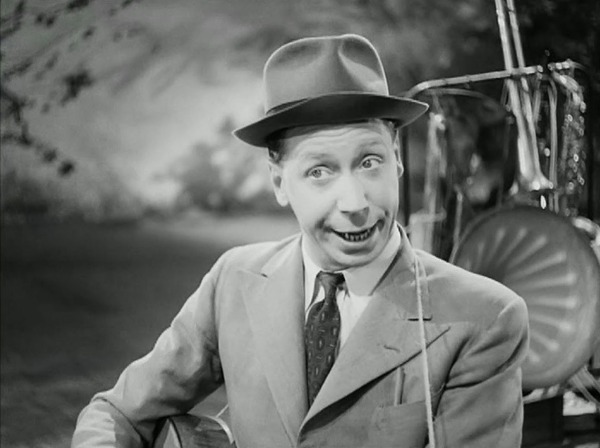
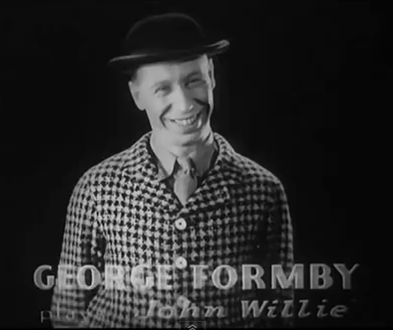
Having now seen all the George Formby movies, I’d say these are my “top 10”, in order of excellence and cohesiveness. I was seeing all but one of them for the first time, since I don’t think they were shown on TV when I was growing up, and it appears it took a long while for them to be released to retail on DVD.

1. Let George Do It! (1940)

The most cohesive film. A wartime spy story, fast-paced and also very funny.

2. He Snoops to Conquer (1945)

The war is over and reconstruction is in the air in a little northern town. Excellent story of a little local man against a corrupt town council, with the aid of a very eccentric local inventor.

3. Come On George! (1939)

A horse-racing stables story, made all the more charming because of George’s knack with horses. He had spent his middle-childhood and early teens as a child jockey in Ireland. Somewhat spoiled by the juvenile supporting actor, but not much — all George’s films were perfectly cast, but not in this one case.

4. Keep Your Seats, Please (1936)

Grandma leaves her money to George in a very unconventional way, to avoid it going to grasping relatives. A bit episodic, due to the nature of the plot, but a fine entertainment.

5. Get Cracking (1943)

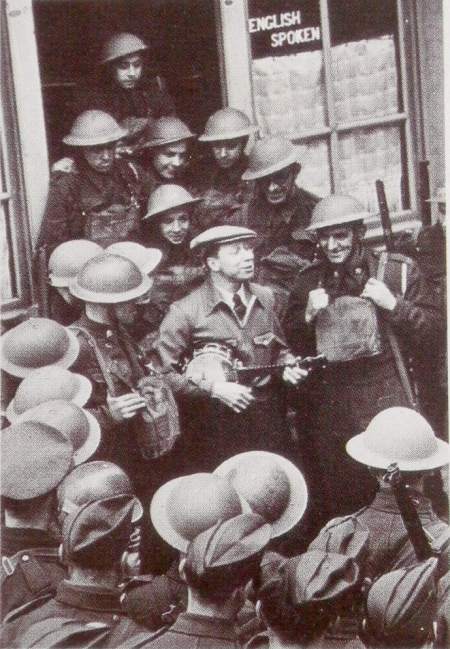
It’s basically Dad’s Army with George and a home-made tank, and this time George has excellent juvenile support. It helps to know the historical context: Princess Elizabeth (later Queen) was then doing war service working as a vehicle mechanic.

6. George in Civvy Street (1946)

George returns from war to find the pub he’s inherited run down and in need of reviving. A bit too ‘slick’ and stage-y, and you can tell it was made partly with an American audience in mind.

7. I Didn’t Do It (1945)

A little bit more of a serious drama, but with plenty of superb supporting comedy-drama actors. A boarding-house murder-mystery, well filmed.

8. It’s in the Air (1938)

George in the Royal Air Force. Often a bit too manic and fast-paced, as was the way in the late 1930s, but good entertainment.

9. Feather Your Nest (1937)

Young love on the hire-purchase, hindered at every step by a gorgon of a mother-in-law. Centers on the classic song “Leaning on a Lamp-post”.

10. No Limit (1935)

His big breakthrough, as a TT racer on the Isle of Man. Often said to be his best, and since my grandfather was a TT racer it has personal appeal for me. But on third viewing it really doesn’t hold up well, compared to the others. Which is why it’s number 10 on my list.

There are plenty of others after that. Possibly also add Spare a Copper (1940), with George mis-cast as a policeman (usually he was physically attacking them) and the film obviously a quota-quickie aimed at the export income from an American audience. But you may think it worth it simply for the hilarious line “Listen Matilta, a weasel!” during a madcap chase scene.

George Formby had his start in Burslem

Here’s an interesting bit of Stoke-on-Trent history. It was in the Potteries that George Formby launched himself as a national film-star. His first feature-film Boots! Boots! (1934) had its premiere in Burslem.

Boots! Boots! was a low-budget film and had been made independently in two weeks, after George had met (in Warrington, Cheshire) the owner of the tiny film studio Mancunian Films. The independent self-funded production meant that no-one from the studio/cinema chains wanted to premiere the finished film, or even to book it.

But Burslem gave George a chance, with a premiere of the film in early July 1934 at the Palladium Cinema (1910-1941) which was on the Waterloo Road, Burslem. According to George, reminiscing about his career on TV in 1960, “I went up there [to Burslem], and it packed them out”. Soon audiences nationwide were queuing around to block to see the new comedy-musical, thus launching him on his career as the biggest and best-loved comedy stars of the 1930s and 40s — and also a tireless entertainer of the front-line troops during wartime.

Apparently the Roxy cinema in Hanley quickly picked it up as well in July 1934, on seeing what a success the film was in nearby Burslem. Then the Regal over in Newcastle-under-Lyme ran it during the early part of the August 1934 school holidays.

Some of the Potteries audiences would have already known him by voice, since his 1932 song “Chinese Laundry Blues” (aka “Chinese Blues”, the ‘Oh Mr Wu’ song) had become a huge hit among the working-class of the Midlands and the North. Despite it only being issued on record as a B-side song on its 10″ disc. And despite George having his songs banned by the prim BBC, for being too saucy in their (implied) lyrics — which no doubt added to their appeal.

Boots! Boots! is not a great film by the standards of his later more polished studio films, but its reputation was marred over the decades by not being seen complete. To the extent that film historians thought it had almost no plot and was just a series of musical-hall skits. This was because the movie was half-lost — available to modern audiences only as a drastically-cut 55 minute version. Until… a complete 80-minute print was discovered by cinema sleuths in the year 2000! So, be warned that the current Amazon streaming version is only 64 minutes, and the two YouTube versions are worse at 50 and 52 minutes respectively. The only Archive.org copy (“George Formby Collection 1”, film 14) is even worse than that, at a paltry 49 minutes! Nearly half the film, missing!

The Palladium cinema appears to have been a relatively small cinema on the southern fringes of Burslem town centre, and according to cinema historians the owners didn’t advertise much in the local Sentinel newspaper. Thus there’s no 1934 newspaper ad in the archives. Possibly the cinema didn’t need to advertise, since (judging by a Staffordshire Past Track glimpse of the frontage) they were not one of those massive 1930s purpose-built ‘palace’ art-deco cinemas. More of a hold-over from the silent era, by the look of it. Presumably the owners had all the trade they wanted by word-of-mouth alone.

Where then is the DVD with the full movie, today? Not on Amazon. So far as I can tell from fairly systematic search, only the small store Loving The Classics has Boots! Boots! with a claimed 80-minutes running time, burned for you on a DVD-R. I guess it’s also possible that one might obtain a copy via membership of The George Formby Society.

But as I said above, it’s not for everyone. But even in its short version it’s a fascinating glimpse of the olde ‘music hall’ Formby, with Formby as an anti-authority figure in Chaplin-style baggy pants, a persona also seen in his next and equally-creaky indie movie Off the Dole. Once he was taken up by a big studio, his anarchic edge was smoothed into more of a hapless cheery-chappy character. Though he still regularly attacks policemen, and pokes fun at pompous officials, he does do as a comical booby. His run of British films have mostly held up very well, with Let George Do It! being generally regarded as one of his best mid-period films, while Come on George has great comedy-charm partly because he was working with the racing horses he loved. Even some of his later Columbia Studios films, obviously half-made with an American audience in mind, are quite acceptable. As well as singing his catchy songs — such as the classic “Leaning on a Lampost” — it’s said he did many of the film stunts himself, being an expert motorcyclist and horse jockey. He had left school at age seven, unable to learn to read and write (he never did, properly), to work as a professional boy racing-jockey until age 16. He went on to become the richest entertainer in Britain, known and loved throughout the British Empire.

And it all started for him in Burslem, on the Waterloo Road.

The science of the Will-o’-the-Wisp

The Smithsonian magazine this week has an article on the ongoing mystery of “What Actually Sparks Will-o’-the-Wisps?”, which follows from a new scientific paper which has discovered that bog-methane bubbles of different sizes can ‘spark’ as they rise and rub against each other. Or “sparked” might be more accurate, since no-one sees Will-o’-the-Wisps today…

“Pavao suggests that will-o’-the-wisps were caused by past reactions between travelers’ lanterns and gas generated by wetlands.”

Our using modern electric torches would then explain why they are no longer seen, even in the many places still wet and boggy. An easy theory to test, I would imagine. Just don olde leather boots (I imagine rubber wellies may prevent some vital electric conductivity or static build-up from happening), and traipse damp and windless moors in a warmish twilight with an olde flame lamp.

On the other hand, the Worcestershire first-hand account which opens the book On the Ignis Fatuus: Or, Will-o’-the-wisp, and the Fairies (1846) has a geologist observing the phenomena scientifically, and at at length, from a house, when there was no such passage of lamps across the spot being observed…


In the year 1835 I gave an account of a great many facts which I collected, and which were published in my pamphlet On the Old Red Sandstone of Worcestershire and Herefordshire, relative to that remarkable and interesting phenomenon called the Ignis fatuus, or Will-o’-the-Wisp, but I never had the pleasure of seeing it myself until the night of the 31st of December, 1839, in two meadows and a stubble field on the south side of Brook House, situated about a mile from Powick Village, near the Upton road. I had for several nights before been on the look out there for it, but was told by the inhabitants of the house that previously to that night it was too cold. I noticed it from one of the upper windows intermittingly for about half an hour, between ten and eleven o’clock, at the distance of from one to two hundred yards off me. Sometimes it was only like a flash in the pan on the ground; at other times it rose up several feet and fell to the earth, and became extinguished; and many times it proceeded horizontally from fifty to one hundred yards with an undulating motion, like the flight of the green woodpecker, and about as rapid; and once or twice it proceeded with considerable rapidity in a straight line upon or close to the ground.

The light of this Ignis fatuus, or rather of these Ignes fatui, was very clear and strong, much bluer than that of a candle, and very like that of an electric spark, and some of them looked larger and as bright as the star Sirius; of course they look dim when seen in ground fogs, but there was not any fog on the night in question; there was, however, a muddy closeness in the atmosphere, and at the same time a considerable breeze from the south-west. Those Will-o’-the-Wisps which shot horizontally, invariably proceeded before the wind towards the south-east.

On the day before, namely, the 30th of December, there was a white frost in the morning; but as the sun rose behind a mantle of very red and beautifully stratified clouds, it rained heavily (as we anticipated) in the evening; and from that circumstance I conjectured that I should see the phenomenon in question on the next night, agreeably to all the evidence I had before collected upon the subject.

On the night of the 1st of January, 1840, I saw only a few flashes on the ground at the same place; but on the next night (the wind still blowing from the south-west) I not only saw several Ignes fatui rise up occasionally in the same locality many feet high, and fall again to the ground, but at about eight o’clock two very beautiful ones rose together a little more than one hundred yards from me, and about fifty yards apart from each other. The one ascended several yards high, and then fell in a curve to the ground and vanished. The other proceeded in an horizontal direction for about fifty yards, towards the north-east, in the same undulating and rapid manner as I have before described. I and others immediately ran to the spot, but did not see any light during our stay there. Both these nights were star-light, with detached clouds, and rather warm, but no fog. On the night of the 3rd of January the atmosphere was occasionally thick, but there was not any wind or fog, nor the slightest appearance of the phenomenon.

There was a very considerable quantity of rain on the 4th of January, but it ceased at five o’clock in the evening; and from about seven till eight the meteors again appeared several times at the spot in question, but as there was not any wind they went in various directions.

On the night of the 5th of January (which was star-lit) I observed a few flashes on the ground at the turn of the evening, but it soon after became cold and frosty, and I saw no more of them either on that or the two succeeding nights. I did not see any lightning during the whole of those observations, which were made by others of the house as well as myself.

The soil of the locality is clay with considerable beds of gravel interspersed thereon.

From all the circumstances stated, it appears probable that these meteors rise in exhalations of electric, and, perhaps, other matter out of the earth, particularly in or near the winter season; and that they generally occur in a day or two after considerable rain, and on a change from a cold to a warmer atmosphere.

[The author witheringly concludes his book, after a long survey of possible fairy and ‘hob’ types which might shed light on the topic, with…]

An opinion has been entertained by some writers that “ Will-o’-the-Wisp is nothing more than a luminous insect; but from all that I have seen and collected upon the subject, the volume of light appears to be much too large to give any countenance to that opinion. The principal circumstance upon which the insect theory rests, is that a person who once upon a time chased a “Will-o’-the-Wisp,” caught a mole cricket in his hat: but the probability is, that in chasing one thing he caught another; and, I believe, we have yet to learn whether mole crickets are luminous or not.
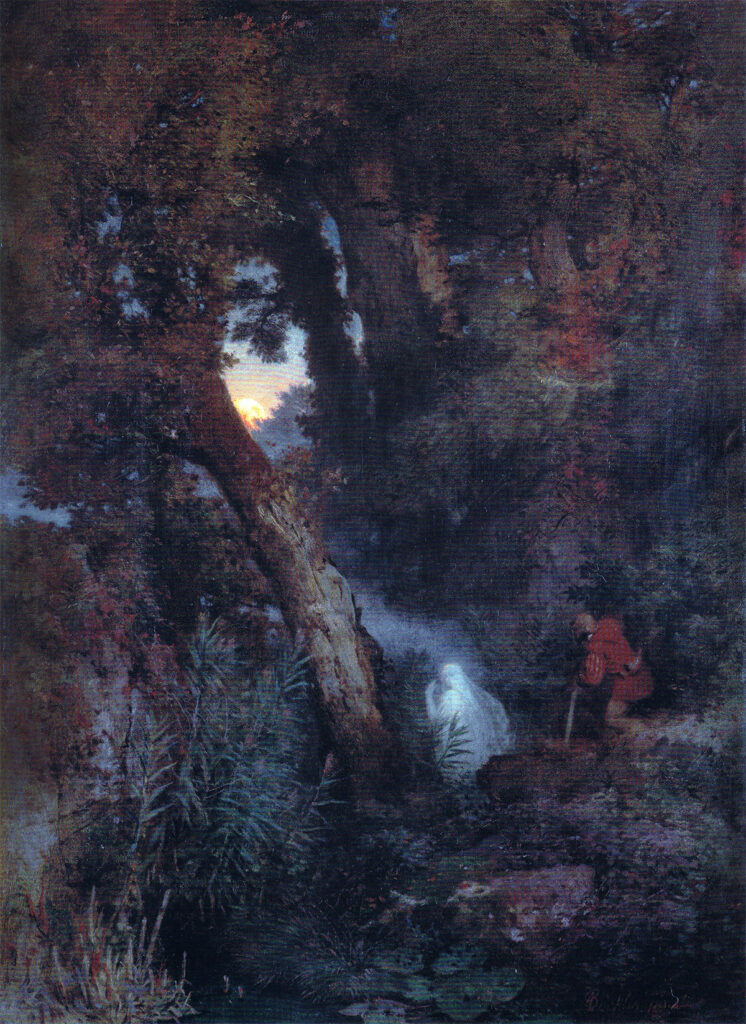

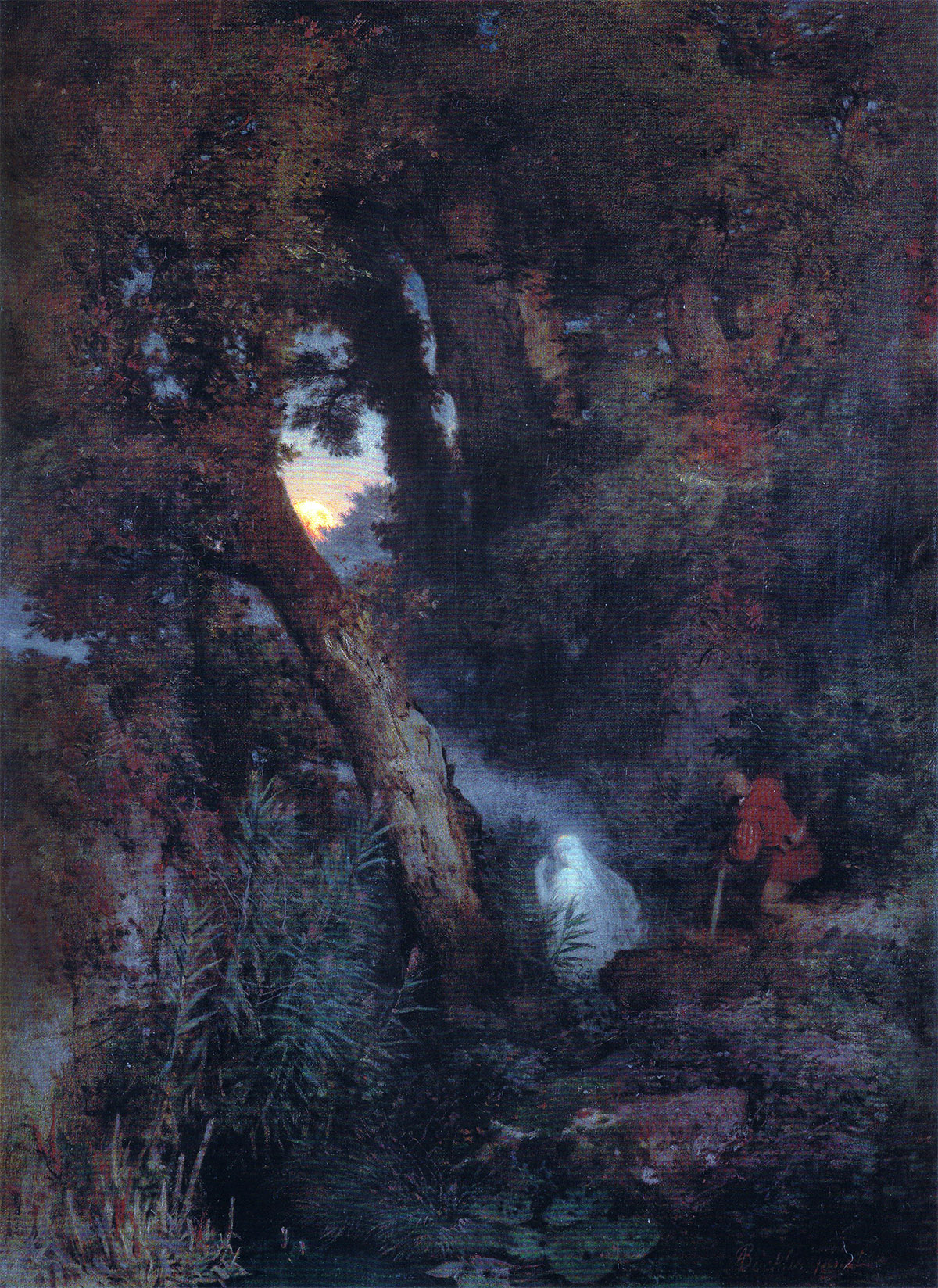
Picture: Arnold Bocklin, “Das_Irrlicht” (The Will-o’-the-Wisp, leading a traveler to his doom) (1882).

Echoes of Etruria

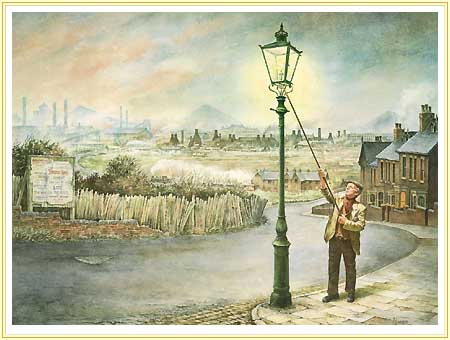
New to me, the website Pictures of the Potteries by artist Anthony Forster, who offers a very attractive picture of a lamplighter. All the more attractive if you know the history of this spot at the foot of the Fowlea Bank, with the new Basford Bank unseen over the scrubby hedge, and Etruria and the Wedgwood factory seen across the Fowlea valley in the distance beyond. On the far left of the picture is the steelworks, then only recently moved over into steel from being an ironworks. He managed to squeeze in a steam-train as well, though it’s not immediately obvious. Obviously a well-researched picture in terms of use of mapping and the pre-A500 topography, and yet the result is still a master-class in composition.

Etruria had only obtained its first street lighting in 1860. A mere seventeen lamps were deemed sufficient.

Judging by an eBay image of the framed print, the colours of this official sample-image have been shifted into an unfortunate greeny-yellow cast. But the scene itself, seen above, is unimpaired.

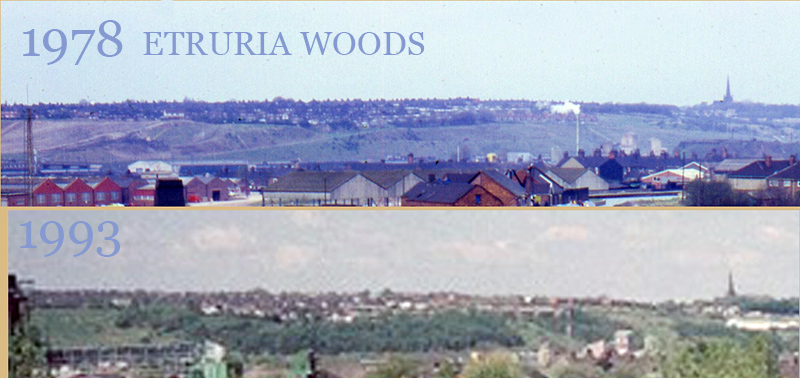
Another two views of the Etruria Woods 1978/1993

I realised that little top-strips on two photos available on eBay from UK Photo Prints showed the Etruria Woods, across time.

1978 — very denuded, barely hanging on amid heathland as isolated bushes, clumps of bushes, and some hedgy trees along the top. A sad fate for what was one the idyllic ‘picnic playground’ woods known to Etruria’s people, and the haunt of H.G. Wells as he dreamed of the tale that would become The Time Machine.

1993 — the woods substantially replanted though only at their former northern end, presumably as part of the landscaping that accompanied the A500 road. But perhaps also further enhanced prior to the 1987 Garden Festival (which happened on the opposite side of the valley)?

Same viewpoint. Wolstanton church tower provides orientation, seen on the far right. You could only make the same photo today with a drone, as nearby trees are in the way.

More new local evidence on local Roman roads

More newly published evidence on local Roman roads, and also an item of possible relevance to the route that the Gawain-poet knew and had his Sir Gawain take into North Staffordshire. In the form of “The Roman Road in East Cheshire: Unfinished Business”, Journal of the British Archaeological Association, 2025. Sadly this academic journal item is paywalled at a ridiculous £56, but there is at least an abstract…

This short notice considers the possibility that a medieval reference of 1405 provides a missing clue to the existence of a Roman road in east Cheshire. This road, which later marked the western boundary of the Macclesfield Forest, continued southwards via the Staffordshire Way on Congleton Edge to the village of Six Ashes near Wolverhampton, and very probably thence to the Malvern hills and the Severn estuary. Northwards it continued as Staley Street west of the Tame valley on the Lancashire-Yorkshire border, and probably further. It is suggested that in the AD 50s and 60s, the Romans connected the Severn and Humber estuaries by a road to facilitate the swift lateral movement of forces across their front. After the conquest of the Midlands the road had no enduring military value but may subsequently have been exploited as a trade route.

“The Staffordshire Way” here is presumably a reference to the modern long-distance footpath. On “the western boundary” of the forest, the History of Macclesfield states…

The Forest of Macclesfield […] western boundary was approximately the present London Road from the Rising Sun Inn to Prestbury, from thence along the Macclesfield township boundary to Gawsworth, where it avoided the precincts of the church and continued south to the Dane.

But it’s then a huge jump by the new article’s author between the Congleton Edge and all the way down to Wolverhampton. Actually not Wolverhampton at all, except by modern postcode. It turns out that Six Ashes is far west of Dudley and near Bridgenorth.

So it’s an interesting claim that touches on local topography. But the paywall means one can’t find out more. One wonders what evidence the author has for claiming the long Congleton Edge -> Six Ashes run, if any? Since the abstract suggests the (new?) “1405” evidence relates only to “a Roman road in east Cheshire”, and not down through Staffordshire. If it also referenced Staffordshire, then surely the abstract would say so?

And if there was once an early road along the Congleton Edge, then where would it go after that?

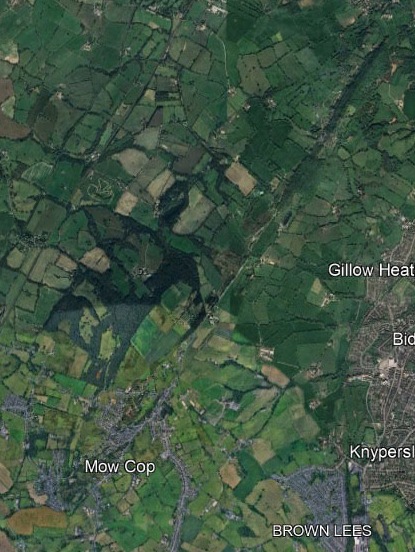
Roman roads were largely straight and the straight Congleton Edge line points directly at Mow Cop. Which was quarrying some of the best millstones in Europe, and thus would logically need sturdy roads to haul the finished millstones out.

One then has to suppose the hypothetical road would go on from Mow Cop, to somewhere around Talke and hook up with our known early Roman road going to Chesterton… and then to what would become Stoke. That said, some of our Roman roads do appear to go nowhere/somewhere and then stop. There’s one which was unearthed for a long length in 1961 at Hanchurch during motorway work, and seemed to go nowhere. Also the Roman road from Buxton towards Leek, which I would guess didn’t need to go further… because it only needed to access the sheep country of the Moorlands rivers via the trackway along the Morridge edge?

On Alderley Edge

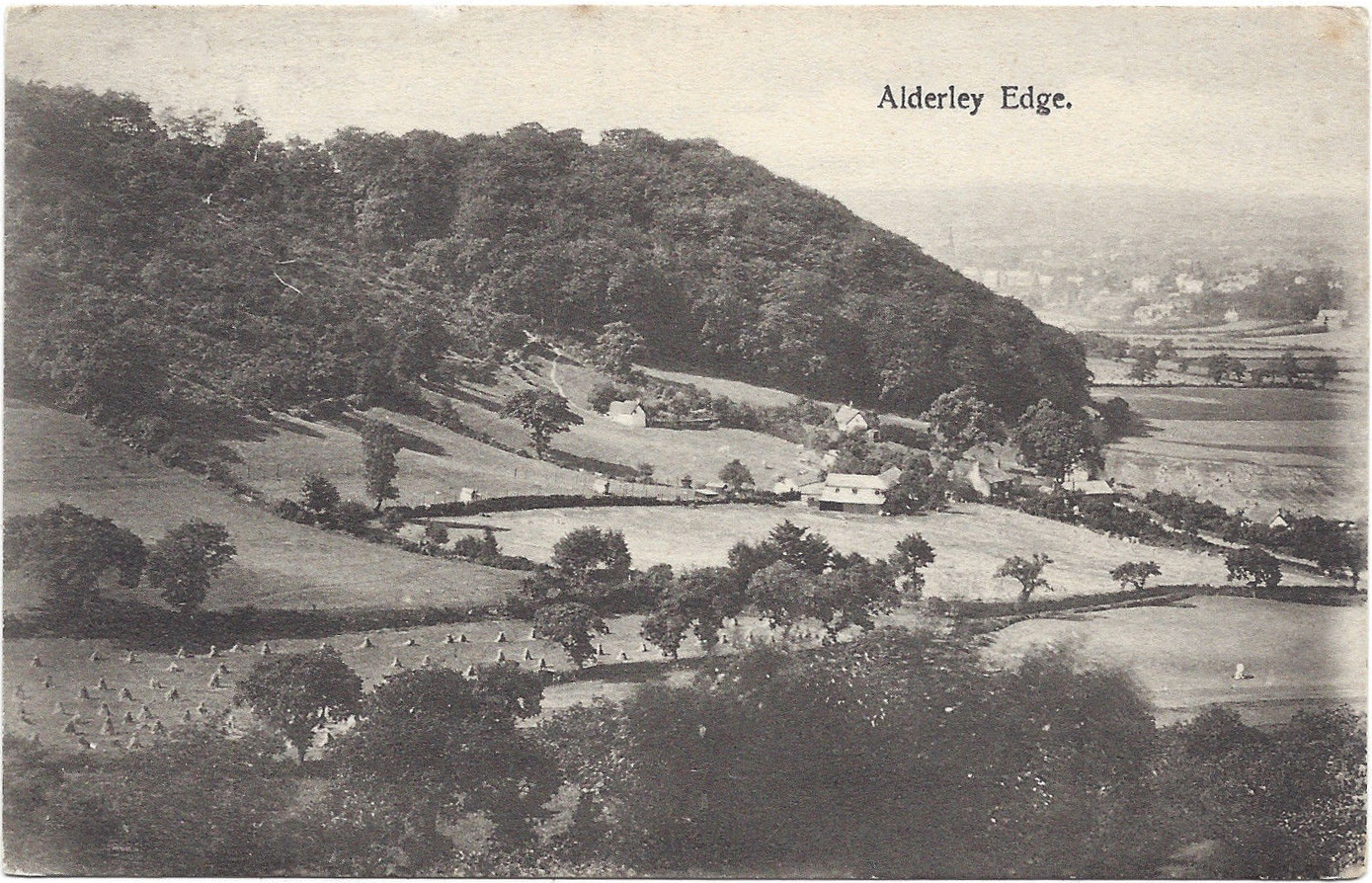
The new £145 academic collection Magical Tourism and Enchanting Geographies: Storytelling, Heritage, Fantasy, and Folklore (2025) has the chapter “Can you hear the knights breathing? Invisible heritage and the magic of Alderley Edge”. For which I can find an abstract at least…

“… home to a legend of which variant versions are found across Europe from antiquity to the present: the legend of the sleeping king or hero and his army, who will awaken when need is greatest. [I explore] the relationship between the legend (as a distinctly medievalist imagining), its medieval precedents, and its new re-imaginings in contemporary literary and oral culture of the NW Midlands [of England], which present a new chapter in a long regional oral and literary culture of storytelling as placemaking.”

Presumably the chapter relates partly to the Invisible Worlds project (2020-23), which created a phone-app AR guide for visitors to Alderley Edge.