Tolkien Gleanings #322

Tolkien Gleanings #322

* Newly listed on Amazon, J.R.R. Tolkien and G.B. Smith: With Wind in our Ears. A book from Palgrave Macmillan, set for release on 9th November 2025.

“The volume explores this relationship from biographical, literary, and philosophical perspectives, focusing on the content and style of Smith’s poetry, Tolkien’s editorial work, their shared intellectual world, and the lasting influence of Smith on Tolkien’s imagination.”

* Somehow escaping notice in Gleanings until now, I find that the new Smith of Wootton Major affordable 224-page paperback edition (March 2025) includes… “a facsimile of the illustrated first edition, a manuscript of Tolkien’s early draft of the story, notes and an alternate ending, and a lengthy essay on the nature of Faery.” This latter essay being, according to a review… “a condensed and more focused presentation of the ideas Tolkien explores in ‘On Fairy Stories’, benefiting from decades of continued thought after that essay was written, revised, revised again, and published.”

* Book trade bean-counter BookScan reports J.R.R. Tolkien’s 2024 book sales via British bookshops at £4.2m ($5.12m). This figure presumably relates to his own works (rather than scholarship etc) and sits within £82m of bookshop sales for science fiction and fantasy books in 2024. Bear in mind that BookScan is apparently only looking at point-of-sale retail data for new print books.

* Concatenation reviews The Letters of J. R. R. Tolkien: Revised and Expanded Edition, with a focus on the development and afterlife of LoTR. The review is freely available online.

* From a Polish Tolkien site, a “Previously unknown letter by Tolkien’s son Michael on his ancestors”. Presumably Michael here conveys the family lore as his father also knew it…

“I will now present a [April 1963] letter from Michael H.R. Tolkien to Charles Woodrow Tolkien from California and his children. Following the letter, which presents the legendary history of the Tolkien family (almost 100 percent untrue), I will briefly reconstruct the family’s history based on documents from archives in Berlin, Gdansk, and London.”

Tolkien Gleanings #321

Tolkien Gleanings #321

* Cardinal Vices in Middle-earth (2025, forthcoming). A monograph as a chunky book, being also Studies in Linguistics, Anglophone Literatures and Cultures, Volume 43 (Peter Lang)…

“a complex comparative analysis of the role of the seven cardinal vices and their opposing virtues as recognised by the Catholic Church” [as found in the vices and virtues of Tolkien’s Middle-earth]

* Red Quills on “What Tolkien Teaches Us About Mapmaking”. One might add “Write the labels more neatly” to the list. Which is what the publisher requested when asking for re-drawn maps for use in The Hobbit.

* Joshse discusses “Poetic Diction by Owen Barfield”. His long commentary after having reading the book…

Poetic Diction by Owen Barfield, was beloved by Tolkien and Lewis. […] C.S. Lewis wrote to Barfield about the influence he had on Tolkien’s philosophy:

“You might like to know that when Tolkien dined with me the other night he said, apropos of something quite different, that your conception of the ancient semantic unity had modified his whole outlook.”

In Poetic Diction, Barfield puts forth the argument that over time language becomes less poetic because, as rational beings, we cannot help but separate all of the different meanings out of rich older words to increase their specificity.

* New from Spain, the PhD “Dishonoured Sun: adaptation, transmission and reception of Sir Gawain in Medieval Europe from 12th to 15th century” (2025). Sadly not yet online, but there is an abstract.

* Also on Gawain and survivals, in a recent paper I noted mention of some recent dialect work… “In a previous study (Markus 2021: 124–135), I investigated the dialectal survival of the specific lexis in the works of the Gawain poet.” This reference can be tracked specifically to Chapter 8.3, “Test Cases for Scholarly Work with EDD Online”, in English Dialect Dictionary Online: A New Departure in English Dialectology (2021, $ paywalled). This ten-page investigation into Gawain is otherwise unheralded by the blurb or contents-list.

* New from Villanova University, the Masters dissertation “”Warm Life, As Now It Coldly Stands”: Figuring Longing, Loss, and Memory Through the Mnemonics of Fantastical Art”. Part three is “”All the land is empty and forgetful”: Memories of Middle-earth”. Partly free online.

* And finally, The Bodleian Library blog has a new post on “The History of the English Faculty Library (1914-2025)” which has some details of the place as the young Tolkien might have known it…

The English Faculty Library was founded in 1914 by an endowment from the English Fund, largely set up by Joseph Wright. It was established in Acland House, 40 Broad Street (part of the land where the Weston Library now stands). […] This was a labyrinthine conglomeration of multiple 17th-century homes which had been renovated and added to over the centuries. Pantin notes that, in the 19th century, two libraries had been added to the property. [… At 1914 the new Library] owned 342 books, many gifted by delegates of the Clarendon Press or Joseph Wright. It had a budget of up to £25 per year. Percy Simpson was appointed as Librarian on a part-time basis. By 1915, the EFL owned 800 books. In 1916, Wright organised an appeal to buy A.S. Napier’s library upon his death for the EFL. This contribution and others meant that by 1917, the EFL owned 4,250 books.

Tolkien Gleanings #320

Tolkien Gleanings #320

* The Tolkien Conference Switzerland, set for March 2026, now has a speakers list and abstracts. Topics include…

   – Tolkien’s depiction of the tools of leadership and command.
   – Leadership and lament in the person of Gandalf.
   – Tolkien as an officer in the Great War.
   – Types of governance in Middle-earth.

* A new long post from Oronzo Cilli on “British Communists: Michael H.R. Tolkien’s letters to the Evening Despatch (1944) and the Catholic Herald (1948)”. This reveals a new discovery, some of Tolkien’s son’s published anti-communist letters to publications. This then leads Cilli to an appendix in which he very plausibly asks if it may have been Michael Tolkien who subscribed to A.K. Chesterton’s ultra right-wing magazine Candour (1953-1973, League of Empire Loyalists), rather than his father. A 24-volume set of Candour allegedly “owned by Tolkien” was sold out of the Tolkien estate in 1973 on the senior Tolkien’s death, or so the current owner of the set would have it. The original ownership then seems fairly easy to prove or disprove: i) do we have the auction catalogue of the senior Tolkien’s house clearance from 1973; ii) are the alleged ‘red biro annotations’ in the set actually made in Tolkien’s very distinctive hand; and iii) does the set have any slips or envelopes relating to the subscription? Subscriber address-lists are not in the Candour papers and archives, now held at the University of Bath, but Bath does have a folder of 1965 letter(s?) from “TOLKIEN, Michael H. R.” to Chesterton. Which I guess may also have remarks which reveal his status as a subscriber or not.

* Sonja Virta is in the early stages of a PhD on… “revisions made to Finnish Tolkien translations after their original publication”.

* A Signum University online thesis defence, of a thesis on “Neutral and Evil Technology in Lewis and Tolkien”… “This thesis challenges the reductionistic narrative that C.S. Lewis and J.R.R. Tolkien were anti-technology and anti-science.” Set for 13th August 2025.

* New in the current rolling issue of the Journal of Tolkien Research, “Romanticism in Tolkien’s The Hobbit”. Considers Tolkien’s uses of nature and domesticity, and suggests these themes parallel the concerns of the Romantic movement.

* The summer 2025 issue of the British Fantasy Society’s BFS Journal is a special on ‘Nature in Fantasy’. No Tolkien.

* And finally, the return of Birmingham Middle-earth Festival in September 2025 appears to have been cancelled. The website says…

“Unfortunately, we have had to cancel this year’s event, everything was all set up, but something has come up, and we sadly decided to cancel. Very sorry to all.”

And this is confirmed on their Facebook page.

Tolkien Gleanings #319

Tolkien Gleanings #319

* The latest edition of the journal Translation Review reviews Reading Tolkien in Chinese: Religion, Fantasy, and Translation (2024) ($ paywall).

* Oronzo Cilli’s new article on “Tolkien, Trains, and Two Discoveries: Meccano and Hornby”. Hornby here refers to the famous brand of British model-railway trains, and their associated track layouts running through home-made miniature landscapes of lovingly crafted chicken-wire, papier-mache and pipe-cleaner trees. There was nothing unusual about this at the time, since ‘model railroading’ (as Americans may know it) was once a hugely popular male hobby in Britain. Even today, the hobby still sustains a regular glossy news-stand magazine.

* Dimitra Fimi on “Tolkien, Landscape Archaeology, and the First Age of Middle-earth”, specifically the great landscape monuments that endured into the Third Age.

* New in the journal The Literary Scientist “What Did She Know About Transformation That We Don’t?” (2025). Freely available online.

“An old woman lingers in Sir Bertilak’s castle, silent and unnoticed. Only at the end of Sir Gawain and the Green Knight is her name revealed […] Far from a mere enchantress, her manipulation of life forms, elemental forces, and bodily change aligns with alchemy’s quest for transmutation, renewal […] In medieval thought, metals were purified into gold through trial, just as Bertilak becomes a vessel of endurance and near-immortality to test Gawain’s virtue. The Green Knight’s seasonal return and survival of decapitation embody alchemical ideals of regeneration and the Elixir of Life.”

* From the University of Birmingham, “‘Stille as the stone, or a stubbe other’: Mineral and Energy Imaginaries in Sir Gawain and the Green Knight” (2025). To appear in Studies in the Age of Chaucer, but already freely available online in Open Access.

“Situating the poem within the context of its geographical allusions to (in sequence [of travel]) regions of coal, lead, and wood/charcoal, it argues that these are components not simply of the poet’s worldbuilding but the text’s narrative logic. It locates Sir Gawain and the Green Knight within the Galfridian tradition – derived from Geoffrey of Monmouth […] engaged with the island’s terranean and subterranean riches.”

A useful focus on gold, silver, lead and charcoal. Though the author regrettably assumes Gawain ceases his journey in the Wirral, and that Hautdesert and its precisely-described topography is somehow a purely imaginary place. Yet the text itself clearly tells us he goes through the Wirral and carries on into very different and obviously real-world upland terrain — which incidentally had medieval lead mining at the time of the authorship of Gawain. re: coal the author might also wish to know that in 1257 Queen Eleanor had protested that Nottingham was too smoky and sulphurous due to sea-coal burning, and therefore uninhabitable for her and her court. Eleanor decamped for the cleaner air at Tutbury Castle in East Staffordshire. Sea-coal was being mined near Tunstall (North Staffordshire) from 1282 onwards, along a ridge only a few miles south of Sir Gawain’s likely route.

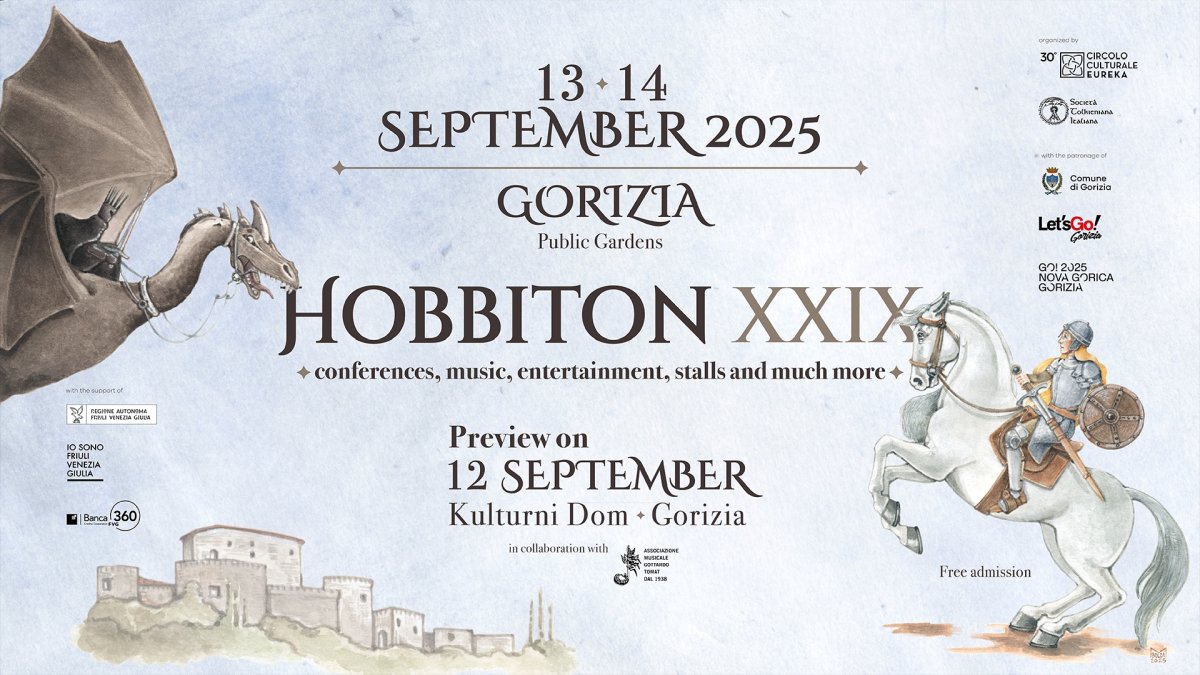
* In Italy at the end of August 2025, a two-day Tolkien Music Festival.

* The Narnia Fans website has an interview with the maker of the new book Painting Wonder: How Pauline Baynes Illustrated the Worlds of C.S. Lewis and J.R.R. Tolkien (2025).

Tolkien Gleanings #318

Tolkien Gleanings #318

* A new Prancing Pony podcast has a long interview with illustrator Ted Nasmith on YouTube. Apparently this is… “his first full-length interview”.

* Next year’s issue (summer 2026) of Forgotten Ground Regained: A Quarterly Journal of Alliterative Verse is to be a Tolkien special, apparently set to feature alliterative verse set in Middle-earth. The Journal appears to be free online, and has articles as well as poetry.

* I came across a 2013 auction page for a Tolkien letter of June 1957, on the speaking aloud (or not) of Sir Gawain and the lost rules of alliterative verse. Fascinating stuff. Surprisingly it’s not in the latest edition of the letters, judging by several searches for distinctive phrases and a look at the relevant 1957 dates…

“In dealing with a dead metrical practice, that has not left a record or tradition of ‘the rules,’ I think that most enquiries, and notably those dealing with the ‘alliterative’ tradition, become confused. They seem to me, to make an allegory, like the work of man attempting to analyse the callisthenics and physical rhythms of two tennis-players, including the differences between them, without bothering to enquire what is the function of the artificial white lines on the grass, or observing the wholly preposterous net. They may, or may not, succeed in saying something interesting about the motions of a man hitting a bouncing object with a racket, or about bodily motions in general, but they will say very little about lawn-tennis, in which human physique and artificial rules are in constant interaction.”

* Miriam Ellis considers the likely architectural and gardening dynamics of “The High Garden and Architecture of Tolkien’s Rivendell”.

* The Fintry Trust is set to host a talk on “Tolkien and the Autumnal Equinox”. Which is 22nd September in 2025, and the same date as Bilbo and Frodo’s birthday.

* At the Virginia Military Institute, the campus news service offers an article on “Ongoing Researches Into Tolkien’s Contribution to Biblical Translation”. Specifically, the Book of Jonah

“Adams plans to present his paper at the VMI Undergraduate Research Symposium during spring [2026] semester, and hopes to get it published in one of several possible academic journals”

The undergraduate is reportedly puzzled as to why Tolkien chose Jonah. Possibly because the Gawain-poet tackled Jonah in his Patience, and for the connections with the German earendel cognate Orendel.

* Can a ‘zine obtain some recognition from the academic system? Perhaps not such a problem in a more fannish world, where fans and scholars and academics all productively mingle. But in more elitist forms of academia, it’s not so easy. Outside the Lines details her attempts at “Publishing a Zine Through Scholarly Channels”, and the details and her routes may be useful for some readers of Gleanings.

* And finally, “Paws on Parchment – New Exhibition Highlights Cats in Medieval Manuscripts”. ‘Paws on Parchment’ is an exhibition open now at the Walters Art Museum in Baltimore, running there until 22nd February 2026. Part of a series of themed animal exhibitions, ‘Paws’ is to be accompanied by ‘Soulful Creatures: Animal Mummies in Ancient Egypt’ opening on 27th September 2025 at the same venue.

Tolkien Gleanings #317

Tolkien Gleanings #317

* A substantial-looking scholarly slate of speakers, set to give talks at the Tolkien Fest 2025 in Malta. The page has details of the talks, and the dates are 22nd-24th August 2025.

* This week Word on Fire taps into Tolkien to find “Hope for the Humanities” in academia.

* Signum University now has listings for its September and October 2025 online short-courses. Including: The Poetic Corpus of J.R.R. Tolkien: The Later Poems 1 (Volume 3: 1931-1967); Creative Quenya Translation; Exploring Tolkien’s “Beowulf: The Monsters and the Critics”; and The Poetry of The Lord of the Rings (Book I), among others.

* New on YouTube from the East Yorkshire tourist-board, “Walking in Tolkien’s footsteps: East Yorkshire’s latest tribute”. Three minutes and well-edited.

* New on CivitAI, a free plugin (LoRA) which guides the SDXL local AI image-generator towards a particular style. The Manuscript Drolleries LoRA allows you to make images from text prompts aimed at generating… “grotesques, drolleries, marginalia and doodles [as if] from illuminated manuscripts”. Note however that CivitAI, the main AI creative models hub, is now effectively banned in the UK. Brits can still reach it if we have a VPN but, given the size of the downloads involved in AI (7Gb is usual for a single SDXL model), a VPN is not ideal. Sadly, very few models or LoRAs are put on torrents.

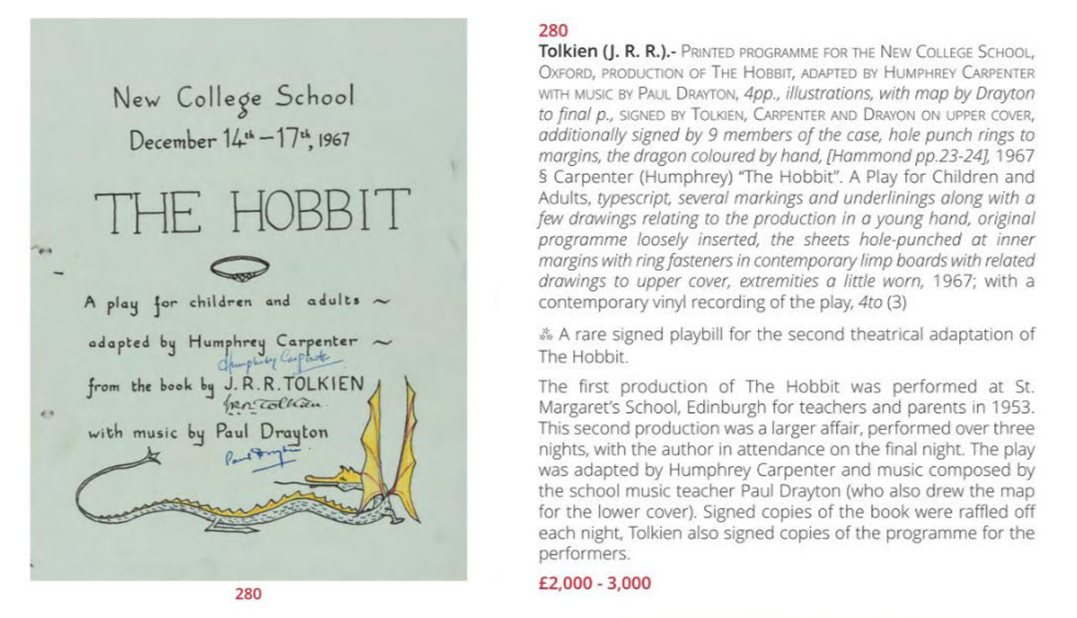
* And finally, that rare edition of The Hobbit which was discovered near Bristol, as mentioned in a previous Gleanings? It has been sold for £43,000. Which is around $57,000 U.S.

Tolkien Gleanings #316

Tolkien Gleanings #316

* The latest rolling Journal of Tolkien Research is nicely “filling up the corners”, and the latest toothsome item is a peer-reviewed article on “The Matter of Time in the Faerie Realms of Tolkien’s The Lord of the Rings”, with specific focus on the Celtic otherworld and… “the complex interplay of time found in Celtic mythology”. Freely available online.

* A Signum University thesis defence is set for 6th August 2025, online on Zoom, titled “A Myth for Mankind: The Lord of the Rings, Modernism, and The Counterculture”. In the thesis … “special attention is given to the novel’s adoption by the American counterculture of the 1960s and 70s”.

* Kalimac’s Corner offers a short Mythcon report

I got to the Tolkien trivia contest [… and there I was the only contestant who] knew that before Tolkien read chunks of The Lord of the Rings into a friend’s tape recorder, what he first recited was the Lord’s Prayer. To exorcise the machine, he said. And, being Tolkien, he recited it in Gothic.

* Mythopoeic Awards winners announced, for books published in 2024. In the ‘Inklings Studies’ category, the winner is The Collected Poems of J.R.R. Tolkien (2024).

* From the Proceedings of Grapholinguistics in the 21st Century (2022), “Fantastic Letters: Writing in a Fictional World”. Discusses Tolkien’s fictional lettering, alongside other key examples. Freely available online.

* The Mythmakers is being translated into Dutch, as The Mythmakers: De wonderlijke vriendschap tussen C.S. Lewis en J.R.R. Tolkien. Set for release on 30th October 2025.

* The Poles are set to enjoy what sounds like a new Polish translation of Tolkien. The title translates as Unfinished stories of Middle-earth and Numenor. The 600-page hardcover is due to thump heavily onto doormats on 12th August 2025, according to Amazon UK.

* A nice new discovery on DeviantArt, Gnome-the-artist, from the Czech Republic. Lots of quality Tolkien artworks, including imaginative portraits of Tolkien himself. Available without watermarks and (for those signed-up to DA) with downloads available at large sizes.

* And finally, The Tolkien Society calls for Tolkien to feature on a new Bank of England bank note. I’m guessing that the shortlist is drawn up a couple of years in advance, and thus the Society is anticipating that a Reform government will be quite amenable to the idea circa 2026/27? Personally I’d change the rather depressive choice of words, though. Perhaps more suitable would be “The road goes ever on and on, down from the door where it began…”

Tolkien Gleanings #315

Tolkien Gleanings #315

Note: Due to growing censorship, I’m now 99% surfing with a VPN. I use Mullvad as the VPN and bounce out to the east coast of the USA. So when I say “freely available online” now, I mean for someone in the USA rather than here in the UK. Of various Tolkien sites, I find that only Walking Tree and the ‘Interactive Middle-earth Map’ sites are unreachable when using a VPN, with the map site giving a very obnoxious message to VPN users.

* A new Amon Hen No. 314 (August 2025) is available, for Tolkien Society members. The Editorial reveals they’ve finally found a new layout and design worker. Some Silmarillion focused lead articles, and among the other items are…

   – Christopher Tolkien’s Lectures at Oxford: Bibliography.
   – An all-too-short article on William, Tom and Bert (the trolls from The Hobbit), leading into a look at what can be known about trolls in general.
   – A DIY article on how to make a hobbit-hole door.

* A new issue of Fafnir: Nordic Journal of Science Fiction and Fantasy Research (July 2025). Freely available online. Has a Finnish article which translates as “Spirituality in the fantasy fiction of J.R.R. Tolkien”, plus a clutch of book reviews…

   – Review of The Romantic Spirit in the Works of J.R.R. Tolkien.
   – Review of J.R.R. Tolkien’s Utopianism and the Classics.
   – Review of Celebrating Tolkien’s Legacy.
   – Review of Mapping Middle-earth.

* The new edition of the Spanish journal Selim: Journal of the Spanish Society for Medieval English Language and Literature has a review of the Spanish translation of Tolkien’s Green Knight. Currently this open-access journal is down, unavailable either with or without a VPN.

* Signum University is to hold a three-day Moot here in the UK, Land of Dragons: How Myth Shapes Our Reality. Set for 3rd-5th October 2025, in Cardiff, South Wales. At present there’s a call for papers and session ideas. It will be possible to attend virtually, online, as well as in person.

* The regional U.S. news radio station TMJ4 has an article deriving from its ‘Milwaukee Tonight’ slot, “11,000 pages of Lord of the Rings drafts are in Marquette University’s archives”, profiling the archivist. Freely available online.

* The J.R.R. Tolkien Lecture on Fantasy Literature 2025 is now… uploaded to Spotify. Rather an unfortunate choice, since Spotify is reportedly set to start deleting UK user accounts en masse. Doubly unfortunate since Zen Cho’s lecture was in part about censorship.

* New in the Protestant Christian magazine American Reformer, “Poetry and Monarchy in Tolkien”. Freely available online.

* New in The American Spectator “The Newest Doctor of the Church’s Influence on Catholic Literature”, focusing on Cardinal Newman’s influence on Tolkien.

* And finally, LOTRSilverCollections, a new Reddit sub-forum for those who collect LoTR merchandise and coins, if made with precious metals. Preciousss…

Tolkien Gleanings #314

Tolkien Gleanings #314

* The new book Crossing borders between countries, scholars, and genres: Commemorating the late Kathleen E. Dubs (2025) is now freely available online. Has several chapters on Tolkien, including…

   – The Corruption of the Best is the Worst: Saruman as an Academic and a Priest.
   – Tolkienesque Elements in Etelka Gorgey’s Mythopoetical Science Fiction.
   – Personal Names in the Irish Gaelic Translation of J.R.R. Tolkien’s The Hobbit.

* Oronzo Cilli has a new article on “The Wilton Diptych: a gift from Tolkien to the Convent of Santa Colette in Assisi”. I also see several others of more unknown date, new to me. Including “Tolkien and Nevbosh: A Tale of limericks, Nonsense, and Literary Echoes”. ‘Nevbosh’ being an early invented language. Freely available online.

* Now available, a slim book from what appears to be a husband and wife team, Tolkien: Roncevaux, Ethandune, and Middle-earth (2025)…

“The influences of works such as Beowulf and the Norse Eddas on Tolkien’s fiction have been widely discussed, but there are other texts that have not received as much attention. This book explores two of these stories, The Song of Roland and Chesterton’s The Ballad of the White Horse, and their influence on Tolkien’s writing.”

* Sadly the forthcoming book The War for Middle-earth: J.R.R. Tolkien and C.S. Lewis Confront the Gathering Storm, 1933–1945 has slipped its publication date. Amazon UK had it set for July 2025, until very recently, and I was looking forward to reading and reviewing it. But now I see that all editions are due in November 2025. Or in the case of the paperback perhaps even later, presumably depending on how badly it collides with Christmas.

* Google Search suggests there is something new about Auden’s ‘copy of Tolkien’ on Instagram. But I can’t get to it because of the growing site-blocking regime — presumably the block is due to the new government regulations here in the UK. I hear these are also blocking Reddit’s RSS access now, as well as CivitAI.

* And finally… for the network-visualisation software tool ManyNet, a free LoTR dataset dated 2025…

“Lord of the Rings. A labelled, complex, undirected network of 36 characters and 66 interaction. The ties are unweighted and concern only interaction. Interaction can be cooperative or conflictual.”

Presumably it wouldn’t be too much trouble for some who knows the book well, to finesse this by colour-coding the interconnection wires by type of interaction?

Tolkien Gleanings #313

Tolkien Gleanings #313

* The recent partial graphic-novel The Mythmakers: The Remarkable Fellowship of C.S. Lewis & J.R.R. Tolkien has sold film-rights for a big screen adaptation…

Independent studio Burns & Co. secured the rights to produce an animated feature-film depicting the longtime friendship of classic Christian authors C.S. Lewis and J.R.R. Tolkien.

Animation magazine reveals a little more. While NarniaWeb cautions against too much rejoicing, noting the many announced-but-failed attempts at bringing a Tolkien/Lewis biopic to the screen.

* In a new book The Wheel of Time and Philosophy (2025), there is a chapter on “Tolkien’s Influence and the World of The Wheel of Time”.

* Yet another review of Tolkien and the Classical World. Put all the reviews together and they’d make their own chunky book, I should think. Mythprint Book Reviews 2025 also has a new review of J.R.R. Tolkien’s Utopianism and the Classics, along with a review of Sub-Creating Arda: World-building in J.R.R. Tolkien’s Work.

* A 40-minute recording from an Italian conference in September 2024 and now newly on YouTube, of a discussion on Tolkien e Lovecraft (‘Tolkien and Lovecraft: origins of the modern fantastic’).

* New from Norway, “Imaginary Realms in Fantasy writing: Alice’s Adventure in Wonderland and The Lord of the Rings” (2025). In English and freely available for download. Described as a final dissertation, but it is very short. Though it’s for a Teacher Education course, so perhaps they’re not expected to write a full 12,000 word dissertation. Explores how landscapes…

are narrated through the perspectives of their characters, who are defined as travelers [whose explorations are crucial to] the reader’s understanding of the worlds they traverse. Their journeys offer deeper insights into the nature of fantastical world-building. Additionally, this article provides content through the lens of Certeau’s philosophy on Spatial Stories, as well as Greimas and Courtes’ terminology of euphoria versus dysphoria.

* In the new issue of the Chesterton Review (Spring/Summer 2025), what appears to be a review of a book apparently titled The Messiah Comes to Middle-Earth: Images of Christ’s Threefold Office in The Lord of the Rings. I didn’t go further, since I was blocked by a captcha roadblock.

* The Mythprint newsletter Vol. 60, No. 2 (No. 405, Summer 2023) is now available for open download, after a two-year members-only embargo.

* Fellowship of Fans offers an account of “J.R.R. Tolkien: Professor of Anglo-Saxon”. Freely available online.

* From Gloucestershire, “An ‘unimaginably rare’ copy of J.R.R. Tolkien’s 1937 The Hobbit has been discovered tucked deep into an old bookcase…

The book had come from the family library of Hubert Priestley, a famous botanist in the 1930s, and brother to Antarctic explorer and geologist Sir Raymond Edward Priestley. Priestley had strong connections to the University of Oxford where Tolkien was the Rawlinson and Bosworth Professor of Anglo-Saxon and a Fellow of Pembroke College, Oxford. […] it’s likely that the homeowner knew Tolkien personally.

Up for online auction by a Bristol auctioneer on 6th August 2025. Yours for a mere 10th of a Bitcoin, by the looks of it.

* And finally… also from Gloucestershire, at the Gloucester History Festival there will be a public talk on “Tolkien’s Gloucestershire: The Real Middle-earth”. Set for 18th September 2025.

Tolkien Gleanings #312

Tolkien Gleanings #312

* The latest issue of Ex Fonte: Journal of Ecumenical Studies in Liturgy, reviews The High Hallow: Tolkien’s Liturgical Imagination (2025). Freely available online.

* In the Polish journal Miedzy Oryginalem a Przekladem, an article in French with English abstract, “Des mots aux mondes: cartographies imaginaires en traduction”. An article on the translation of fantasy literature maps, and the various impacts this can have on the reader. Freely available online.

* There’s a new Oxford University Press history book for those interested in the deep background of Tolkien’s academic battles, Literature and Learning: A History of English Studies in Britain (2025). Said to be… “the first full account of the discipline’s development from its late-eighteenth-century beginnings up to the early 1960s.” I’m not sure if it classes Philology as Eng. Lit. though.

* The Tolkien Library is moving from Belgium to Norway.

* September 2025’s Signum University online short-courses list is offering “The Poetic Corpus of J.R.R. Tolkien: The Later Poems 1 (Volume 3: The Years 1931-1967)”, and the less-certain “Turin’s Bones: The Influences of Sigurd, Oedipus, and Kullervo on J.R.R. Tolkien’s Tale of Turin Turambar”. The latter will only run if enough people sign up for it.

* Artist Miriam Ellis discusses the skill of place-making displayed by Tolkien in his Withywindle valley, in her new blog post “Of Wild Woods, Wild Hobbits, and the Withywindle”. Illustrated as always with her fresh and delightful paintings.

* Not Tolkien related, but I see that Tolkien scholar Kristine Larsen has “The Literal and Literary Impact of Comets in 1870s Science Fiction”, in the latest issue of the Science Fiction Foundation’s journal Foundation.

* What appears to be a sort of Austrian Tolkien Day, Lasse Lanta 2025 is happening in September 2025. Looks more like large cos-play festival than conference. But this year’s theme is “The Return of the King” and so, given such a weighty title, I’m guessing there may also at least be some talks being given.

* A talk at the Malvern Theatre, in the town of Malvern, “The Worlds of J.R.R. Tolkien” with John Garth. 10th August 2025. Booking now.

* A talk on “Tolkien in the Cotswolds”, set for the Cotswolds on 3rd September 2025. Booking now.

* Last week I enjoyed a wonderful British wartime movie that I had no idea existed. If you want to taste the rural Cotswolds that Tolkien knew then The Tawny Pipit (1944) is a delight, a sort of Ealing comedy but a deeply rural one and full of superbly-played characters. I was also reminded of the sublime first series of The Detectorists, at times. Tawny Pipit was filmed on location near Stow-on-the-Wold in the Cotswolds, about 15 miles NW of Oxford. It’s now free on Archive.org and the download is thus on a handy .torrent file. So far as I can tell, the British Film Institute has never restored it, and the Archive.org quality appears to be about as good as it gets for now. Temporally-stable movie restoration AIs are not here yet, more’s the pity, but given the blistering pace of AI such things can’t be too far away. Not that we Brits may know much about that — since visiting the main AI-download hub CivitAI is about to be effectively banned in the UK from next week.

* And finally… YouTube is still available in the UK for now, although our dismal government is no doubt eyeing it nervously. Thus one can enjoy a new 17-hour quality audiobook of The Worm Ouroboros by E.R. Eddison, free on YouTube and from a good reader. There may be ads if you just start playing it on YouTube, but there won’t be if you download it as an .MP3 audio file. I never managed to worm my way past page 90 or so of Ouroboros, reading it as a youth. But perhaps now I’ll try again. Note that if one becomes the audiobook reader’s Patreon patron, one can then suggest future titles to be made into free audiobooks.

Tolkien Gleanings #311

Tolkien Gleanings #311

* A new collection of 17 essays by Tolkien scholar Verlyn Flieger has been published, titled A Real Taste for Fairy-stories. Publisher Walking Tree has the table of contents for the book, though most of the essay titles are rather unrevealing.

* “Tolkien and the changes of times” is the title of a talk to be given by Prof. Giuseppe Pezzini, Fellow and Tutor at Corpus Christi College, University of Oxford. Sounds like it might be about how Tolkien responded to the jarring emergence of modernity during the 1915-1945 period. Happening 28th July 2025 in Southport which is a few miles north of the port city of Liverpool, in northern England. Part of the touring Magic Of Middle-earth exhibition, which runs in this coastal town until 27th September 2025.

* Original hand-drawn maps by Middle-earth map-maker Karen Wynn Fonstad are included in a Fantastic Worlds exhibition at Robinson Map Library, University of Wisconsin, USA. The free show includes other fantasy maps, and will open on 21st July 2025.

* The JIS Symposium 2025 — Lewis & Tolkien: The Promise of Christian Fairytales, to be held online on 18th October 2025.

* A new text interview on “Lewis and Tolkien, Philosophy and Creativity”, with the author of a book on C.S. Lewis and the Art of Writing (2016).

* Details of the planned Tolkien strands at the 2026 International Congress on Medieval Studies are available. These will include, among others, a strand on “The Sea, the Shore, the Sky: Medieval Thresholds in Tolkien’s Legendarium”. This will present papers on… “physical and abstract thresholds, borders, and boundaries within his legendarium”.

* The Tolkien Society has sent an email calling for volunteers for what sounds like a major building project. People familiar with drawing up ground-plans, project fundraising, etc are required. Though one wonders if Birmingham City Council, still bankrupt the last time I looked, might sell them Sarehole Mill and save them the trouble of a new-build?

* Newly freely available on Archive.org, the scanned run of Dragon Magazine, 1976-2007… “one of the two official magazines for source material for the Dungeons & Dragons role-playing game”.

* The lost videotapes of the proceedings of the ‘Lewis Carroll and the Idea of Childhood’ conference (2006) have been found, and the set is now digitized and freely available on YouTube.

* New in the journal History of Education and Children’s Literature, “Lo Hobbit a fumetti: considerazioni su un fantasy illustrato tra il Novecento e gli anni Duemila” discusses the visual depiction of Gollum in the graphic-novel of The Hobbit. Freely available online.

* And finally… science has a new name for an old phenomenon, “The Gollum effect”. Defined as a researcher who refuses to share his ‘precious’ (datasets, computer models, methodologies, study sites, etc) with others, and who actively tries to throttle newcomers.