Mythlore and more

A new edition of the journal Mythlore brings two items of interest…

* “Notes of an Inklings Scholar: Musings on Myth and History, Promises and Secrecy, Ethical Reviewing, and the Limits of Authorial Intent”. A keynote conference speech that melded together several short essays. One of these is an entertaining evaluation of several key denigrators of The Lord of the Rings. Specifically asking: did they actually read it? On the available evidence… no they didn’t, the author concludes. I’d add, as a Lovecraft scholar, that there is also clear evidence that Lovecraft’s most dismissive critics — including a key contemporary editor and anthologist — have not read his key works such as “The Colour Out of Space”.

* Review of Tolkien as a Literary Artist. Usefully notes and details a poetry section in the book…

The analysis of “Poems and Songs”, of which there are more than 60 within The Lord of the Rings, posits that various recitations and performances serve the plot by advancing narrative development as much as to add entertainment. Kullmann notes four types of verse: Mythic, Functional, Bellicose, and Otherworldly. A handy table (pages 230-233) catalogs a breakdown of the types and their schemas. The poems are then elucidated by their textual traditions and genres, mostly related to English folksongs.

Which makes things sound very jolly. However, be warned that this is apparently also a book which lauds contemporary academic literary theory.

Also new and of note, and open-access elsewhere, are:

Light: the diegetic world-builder in J.R.R. Tolkien’s secondary world. A Masters dissertation at Glasgow.

“Ancient Sea Monsters and a Medieval Hero: The Nicoras of Beowulf”. Sees a classical influence. In a special themed issue of the scholarly open-access journal Shima, on sea and water-monsters. I also find that the earlier Vol. 15 No. 2, and Vol. 12 No. 2, were on mermaids.

A new Tom Shippey book and long podcast

News of a new Tom Shippey book, Beowulf and the North before the Vikings, from Amsterdam University Press. Here’s the blurb…

Ever since Tolkien’s famous lecture in 1936, it has been generally accepted that the poem Beowulf is a fantasy, and of no use as a witness to real history. This book challenges that view, and argues that the poem provides a plausible, detailed, and consistent vision of pre-Viking history which is most unlikely to have been the poet’s invention, and which has moreover received strong corroboration from archaeology in recent years. Using the poem as a starting point, historical, archaeological, and legendary sources are combined to form a picture of events in the North in the fifth and sixth centuries: at once a Dark and a Heroic Age, and the time of the formation of nations. Among other things, this helps answer two long-unasked questions: why did the Vikings come as such a shock? And what caused the previous 250 years of security from raiders from the sea?

It was slipped out in August 2022, when many were at the beach. The podcast History of Vikings has a late September podcast interview on the book, and appears to be the only interview. This has an .MP3 download and the excellent long interview starts at 3:10 minutes. Shippey states that he had large amounts of friendly help from Scandinavian archaeologists, eager to bring their little-read recent discoveries to a wider public. Judging from what’s said it seems to have been a very productive engagement, as discovery after discovery slotted into place in the broader framework that Shippey was able to provide.

Amazon notes of the book “New edition”. But I can find no earlier edition, and the podcast interview suggests this is a wholly new book. Shippey does mention that there was a big difficulty in getting copies into warehouses, so perhaps that’s what’s meant — perhaps the first run had to be pulped due to printing problems, and then a new one produced?


Also of note, elsewhere, the new “A Babel of Shadows: The Meaning and Function of Shadows in J.R.R. Tolkien’s The Lord of the Rings. A fine Masters dissertation, dated 2022, from a Dutch student. Written in English.

On Tolkien’s poetry and art

I found what appears to be an offshoot of the January 2022 YouTube Tolkien Day lectures, which I discovered and noted here back in the summer. The offshoot video is an excellent short YouTube lecture on “The Poetry of J.R.R. Tolkien”.

Many good clear points are made in just 11 minutes, but the young speaker makes the especially pithy point that Tolkien — who must surely be the most read poet of the 20th century due to all the poetry and lyrics in his books — is…

“not even mentioned in any general account of 20th century English poetry, so far as I’m aware”

I recently found what appears to be a similar state of affairs in art history bibliography, judging by the massive new unified art history bibliography for 1910-2007. Just six hits for a simple search on “Tolkien”, and one of those spurious…

* Drawings by J.R.R. Tolkien (1976)

* Pictures by J.R.R. Tolkien (1979)

* The invented worlds of J.R.R. Tolkien : drawings and original manuscripts from the Marquette University Collection (44 page exhibition catalogue)

* J.R.R. Tolkien : artiste et illustrateur (1996, French)

* “Elements of myth in J.R.R. Tolkien’s Lord of the Rings and selected paintings of Paul Klee” (1980 microfilm dissertation, probably tangential)

* A collector’s guide to costume jewelry (spurious result, author is also named Tolkien)

… which seems odd. Because some of the many contributing mega-libraries must surely have at least one or two key pre-2007 Tolkien art books in their collections. Although, being charitable, I suppose such books may have proven so popular that they were either stolen, had the best pictures razored out, or simply fell to bits and were discarded.

Perhaps some kind soul could send the relevant publication data to the new openbibart.fr art history bibliography, in the hope that they might add the missing books and articles on Tolkien’s art? Alternatively, perhaps someone might make a comprehensive annotated bibliography on the art, fully up to date?

Tolkien Gleanings #0

More mega-Tolkishness. New Tolkien scholarship items are…


Kristine Larsen’s new “Moons, Maths, and Middle-earth”, which looks at Tolkien’s mathematical abilities. See also her earlier “We hatesses those tricksy numbers” (2011).


A new Journal of Inklings Studies (October 2022) brings a review of A Sense of Tales Untold: Exploring the Edges of Tolkien’s Literary Canvas, and also of the monograph Following the Formula in Beowulf, Orvar-Odds saga, and Tolkien.


Also in the same new issue of Journal of Inklings Studies, a sufficient abstract of the pay-walled An Inspired Alias? J.R.R. Tolkien’s Frodo Baggins ‘Underhill’ and Fr Gerard Albert Plunket ‘Underhill’, O.P. (1744–1814). Argues that a Leeds priest may have been the inspiration for the name. I’d note that the Earendel cognate Urvandill also has a certain similarity in terms of its ‘look on the page’, although the meaning is of course different.


“The Beeches Were their Favourite Trees”: An analysis of peoples’ relationships with trees in J.R.R. Tolkien’s The Hobbit. Takes 50 pages to get to the point, but then there’s quite a bit that’s interesting after that.


“Galloping through the Middle Ages: The Horse in Medieval Life and Middle English Literature”. Horses and ponies are a ubiquitous but somewhat neglected aspect of Middle-earth, so this sort of historical background survey is useful.


“The Symbolic Function of the Cityscape in J.R.R. Tolkien’s The Lord of the Rings.


“”Fairies and Fusiliers”: Warfare and Faerie on the Western Front”. Abstract only, described as a completed “doctoral project”.


“Celtic Things” In Tolkien’s Mythology. Has some musing on Goldberry and Bombadil at the end.


A rather needling review, seemingly the first, of the $105 collection Critical Insights: The Lord of the Rings (2022). The review usefully notes…

John R. Holmes’ article “‘A Dream of Music’: The Eärendil Poem in The Lord of the Rings”. Holmes’ contribution is one of the best pieces

Sounds good. Another essay on Bombadil apparently notes “the character’s Finnish sources”. The reviewer also offers a snippet relating to the chapter “Speak Memory: Some Biographical Sources of The Lord of the Rings“…

While [the chapter’s section] “Inventing Buckland” is its most persuasive portion, Bunting’s comparison between Eärendel and Brandywine proves rather uncompelling.

Interesting. I’ve not seen the book. But it sounds like the author tries to make connections between place-names in Buckland and Old English names? Tolkien certainly put a lot of effort and thought into his place-names. But how would that work, in this case?

Internally to Middle-earth, Brandywine is from Baranduin, i.e. “golden brown”, and the simpler “brown river” is stated early on in Fellowship. “The Etymologies” (Lost Road and other Writings) has the name Baranduin as from baran (brown) and seemingly inspired via the real-world Old Norse barane, the latter meaning a sandy-brown river-sandbank made of sands and shining river-muds. Probably related is Old Norse brunn, which meant either ‘brown’ or ‘shining, polished’ depending on context and modifiers. ‘Amber’ then immediately suggests itself to me as a middle-ground, allowing easy slippage between the two meanings. Something of the latter Old Norse ‘shining’ meaning survives today in English as ‘burnish’.

So the name Brandywine may not relate to the colour of the river-water, but rather to the rich colour of the sandbanks and shifting sandy eyots so beloved of Tolkien (river eyots appear regularly in LoTR). That said, the Baranduin river was once long ago made navigable, and thus one would assume a central deep channel. The river’s source was near the city of Annuminas in the Hills of Evendim, founded by Elendil. This once-great city’s people travelled only by this river, being otherwise hemmed in by high hills. Tolkien once called its waters “Elvish” in explaining why the Black Riders were later reluctant to cross this water in LoTR. This perhaps implies that the Elves had once frequented the river, visiting Elendil in Annuminas. That the Elves named the same city Torfirion suggests they knew it and thus the river-route that was the only approach to it. And, recall here that Legolas says, “Much evil must befall a country before it wholly forgets the Elves, if once they dwelt there”. If they had once used this river, they did not exactly “dwell” there, but it would have been a route well-known to them. Perhaps leaving enough of a legacy to be off-putting to the Black Riders.

[Update: Nature of Middle-earth reveals that the elves “still controlled” Lake Evendim, the source of the river, at the time of Frodo’s departure from the Shire. This is why the Riders will not touch the “elvish” river.]

But that Elvish usage, if such it was, was long past by the time of the founding of Brandy Hall. Either way, if the Brandywine had golden sandbanks or golden-brown water or both, hobbits would have made a natural comparison with the colour of whatever distilled golden-brown hobbit-wine was the equivalent to ‘brandy’. Indeed in early Hobbit-language it was Branda-nîn (possibly ‘border-water’, perhaps also a pun on the brandy colour). Thus we may have a triple semantic weighting, two Hobbit-y and a deeper one that may percolate through and yet live in the memories of the long-lived Elves. Indeed we have evidence of this living-on, since the river is named by Glorfindel in an early manuscript as Branduin — he tells Frodo on the hills above Woodhall of “the Branduin which you turned into Brandywine” — with the line later being cut from the published text. The Elvish name for it is also translatable to ‘golden-brown’.

But “golden brown” is also the colour of a partly charred brand of wood. Recall here Tolkien’s early/sometime use of ‘Burning Briar’ for the well-known star-constellation The Plough and its Middle-earth symbolism as its form of an enduring war-threat to the evil Melkor. Briar = branch = brand (of wood). Perhaps this was partly inspired via the extensive Biblical literature debating the translation of the Hebrew ‘branch’ as ‘dayspring’ (rising light before dawn). Which, if an early inspiration for the name Branduin, would then give one a roundabout earendel connection.

However, if in “The Etymologies” one were to confuse BARAN- with the immediately adjacent BARAD- or BARATH- then either way one could get a quick (but wrong) connection with Varda / Elbereth, and hence with the Middle-earth star-equivalent for the Old English earendel (if the star Venus). Which is not to say that this wasn’t an early conflation once made by Tolkien in his several BARA- words, before later separation. But that would have to be shown by the Middle-earth language specialists and the historians of the evolution of LoTR. By the sound of it, “Bunting’s comparison between Eärendel and Brandywine” — whatever that was — may lack such considerations.

In the real-world the name Brandywine (a river, a real-world folk-etymology) is well known in American history. There it goes back to brandwijn and the earlier brantwijn (Middle Dutch) -> meaning “burnt wine” -> i.e. a ‘fiery spirit distilled from wine’. Then in Old English I suppose one might surmise a hypothetical parallel in biernan (burning) + win (wine, implied dark). Fiery spirit burning, dark, implied wetness, probably good for cheering one through the cold midwinter darkness… yes, I guess you could just about wrangle it into a connection with the Old English earendel in terms of the meaning. But the connection would be more than a bit creaky. Unless… you were to assume another hypothetical original, way back in Old English, as biernan (burning) + windle (turning, winding), with the windle claimed to root back to -wendil. Again, by a roundabout route, there you’d then have an earendel connection via -wendil.

So, those would be my guesses about what might be going on in “Bunting’s comparison between Eärendel and Brandywine”.

Little brother of Mega-Tolk

My last big Mega-Tolk round-up was only a month ago, but there are already more items of interest freely available.

* In Mythlore, “Soup, Bones, and Shakespeare: Literary Authorship and Allusion in Middle-earth”. Includes observations on what are claimed to be Tolkien’s “literary allusions to Shakespeare’s Macbeth” in The Lord of the Rings.

* In Journal of Tolkien Research “Hearing Tolkien in Vaughan Williams?”. Explores the “juxtaposition of their approach and philosophies” re: the much-loved English music (and now apparently adopted as Tolkien-ish) “Fantasia on a Theme by Thomas Tallis (1910), The Lark Ascending (1914), and Fantasia on Greensleeves (1934)”. Excellent. Also notes a Birmingham connection…

Samwise Gamgee in Lord of the Rings sings the tale of the Stone troll “to an old tune” — and Tolkien himself sang this poem in Sayer’s tape recorder with slightly different words in a tune that, according to Sayer, is “an old English folk-tune called ‘The Fox and Hens.’” This tune, as Bratman notes, is a Birmingham variant tune for the folksong “The Fox and the Goose” or “The Fox Went out on a Chilly Night.”

* Mythlore “Review of Musical Scores and the Eternal Present: Theology, Time, and Tolkien (2021).”

* A Kirk Center review of In the House of Tom Bombadil (2021). A slim but apparently perceptive new study of Bombadil by a pastor. Sounds interesting, if rather short.

* A review in Fafnir: Nordic Journal of Science Fiction and Fantasy Research of Middle-earth, or There and Back Again (2020). The review has a misleading comment on the Pearl, re: the casket.

* Review of Eternal Light and Earthly Concerns: Belief and the Shaping of Medieval Society (2021). On the medieval practice of always… “lighting the altars of churches” [at all times. This] “Christian practice of lighting in fact stemmed from ‘pagan’ practices and Old Testament precedents.”

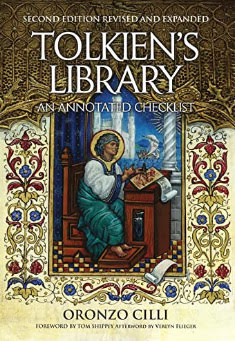
Also noted along the way was a not-free retail book new to me, The Library: A Catalogue of Wonders (2018). Mostly historical (though makes no mention of scriptorium/library cats), and only has one chapter that is a rather scattergun survey of various libraries in fantasy fiction. But this chapter has a substantial section which usefully surveys the range of books and libraries in Middle-earth — this boil down to about six pages once the superfluous publication history of the Hobbit/LoTR is discounted. You do have to wonder if an author who talks of “the elf-city of Rivendell” has actually read The Lord of the Rings, but the survey does appear comprehensive. A passing aside also claims that Tolkien was influenced by Borges, though any glance at the relevant dates would have cast doubt on this. While it’s not impossible that Tolkien saw “The Garden of Forking Paths” in English in Ellery Queen’s Mystery Magazine (Aug 1948), Borges otherwise only arrived in English in 1962. True, Tolkien had learned to read some Spanish in his youth, and perused Father Francis’s library which included books and dictionaries in Spanish. But I doubt he then went to enjoyed Spanish contemporary fiction, or that he would have even encountered Borges in Spanish print form. There was no love the other way, with Borges finding his sampling of Tolkien (probably just the first chapters of Fellowship) “rambling on and on” and tiresome. Elsewhere he calls the tale “pointless”.

New book – “Tree & Star: Tolkien and the quest for Earendel”

I’m pleased to say that my “big Tolkien book” has been finished after many years, and is now available to buy on Gumroad as an ebook or at Lulu.com as a paperback.

The title is Tree & Star: Tolkien and the quest for Earendel

200,000 words. 472 pages. Delivered as a DRM-free printable .PDF file, suitable for reading on a 10″ digital tablet.

CONTENTS:

Introduction: 24th September 1914.

1. J.R.R. Tolkien’s discovery of Cynewulf’s earendel and its key variants.

2. Down the little rivers and bright streams.

3. Earendel variants: of magic horses, flaming arrows and sea-wargs.

4. Earendel and the early Christian north: the solstice chanter-songs.

5. Earendel and the early Christian north: a glitter of eagle wings?

6. Earendel and the early Christian north: an imposition or a recovery?

7. A Christmas interlude: of the curious Earendel of Charles William Stubbs, some poems, and party-trees.

8. Before Cynewulf: ‘dipping a toe’ in ancient star-lore.

9. Earendel’s earthly voyage, ‘there and back again’.

10. In Cornwall: Tolkien’s holiday with Fr. Vincent on The Lizard.

Selected bibliography.

Index.


Note: Yes, I am well aware that modern academics claim Cynewulf was not the author of the earendel lines, but I largely worked with the scholarly assumptions current during Tolkien’s time. Hence Chapter One is titled “.. discovery of Cynewulf’s earendel and its key variants.”


PDF Samples: tolk_earendel_sample.pdf and tree_and_star_index.pdf


I think $36 (around £30) is about the right price for something of this size and scholarly weight, in ebook. I’ve also tried to keep the paperback at Lulu.com at a similar price, and have managed to price it there at around $45.

Not all potential buyers will immediately know how Gumroad works, for the ebook version. You input the price you want to pay and click on “I Want This”. In this case there is a minimum, though I believe the nice thing about Gumroad is that generous people you can input a higher price if they wish. Your purchase is then placed in your Library at Gumroad, and you should also get a link sent by email, from where you can download it. I believe you can also “Send to Kindle” (Amazon’s tablet), if you have that set up at Gumroad, though I’ve not tested the resulting formatting.

Gumroad does not require a sign-up to purchase, and can accept PayPal and cards.

MegaTolk

Time for another “MegaTolk”. Newly appeared interesting items on Tolkien that are open and public, since my last round-up in which was back in May 2022

* Worlds Made of Heroes: a tribute to J.R.R. Tolkien. A complete scholarly ebook in open access, from the University of Porto. Includes, among others…

– The importance of songs in the making of heroes.

– Wounds in the world: the shared symbolism of death-sites in Middle-earth.

– From epic narrative to music : Tolkien’s universe as inspiration for The First Age of Middle-earth: a Symphony.

– Character and perspective: the multi-quest in J.R.R. Tolkien’s The Lord of the Rings.

– Geoffrey of Monmouth and J.R.R. Tolkien: myth-making and national identity in the twelfth and twentieth centuries. (Also a useful survey of Tolkien’s West Midlands patriotisms)

– Mythology and cosmology in J.R.R. Tolkien’s The Lord of the Rings.

* Song Lyrics in The Hobbit: What They Tell Us (Detects in the lyrics the different relationships that each race has with time).

* “Pearls” of Pearl: Medieval Appropriations in Tolkien’s Mythology. (Excellent study of the likely influence of Pearl)

* The image of the tree as the embodiment of cosmological and solar aspects in J.R.R. Tolkien’s works.

* The Joys of Latin and Christmas Feasts: J.R.R. Tolkien’s Farmer Giles of Ham.

* Medieval Animals in Middle-earth. (Found from 2021).

More on Tolkien and Bingo

I’ve found a new and seemingly previously-unrecognised potential source for the name of “Bingo”, Tolkien’s original name-idea for Frodo in The Lord of the Rings. “Bingo Bolger-Baggins” was the initial name. The matter of this initial naming has puzzled many, despite it echoing “Bungo”, who was Bilbo’s father in The Hobbit. I’ve previously casually looked at the name in relation to the advent of the later modern commercial game of “Bingo” (seemingly in the 1950s as a replacement for “Lotto”). As part of another essay I also glanced at the idea that the common exclamation By Jingo! became in some trades the slang contraction of “Bingo!”.

Now a find of the popular book Merrie games in rhyme: from ye olden time (1886, London) reveals that “Bingo” was around in the culture of Tolkien’s childhood. This book of children’s games and songs was published six years before he was born. Its very first song-game is the “Bingo”…

The author the Hon. Emmeline Plunket is now better known among historians of astronomy for her scholarly Ancient Calendars and Constellations (1903, aka Calendars and Constellations of the Ancient World), and she thus appears to have been a scholar of Biblical and related astronomical systems — as well as a collector of the songs of her native land. She thus seems a reliable source, and the song is not a Victorian confabulation.

A publication review of Merrie games in the Saturday Review of Politics, Literature, Science and Art picks out four song-games headed by ‘Bingo’ — “There is ‘Bingo’ and the ‘Muffin Man'” — thus implying that the song-games were then common-knowledge even among parents and nannies and that their mention would ‘hook’ interested readers. Curiously the review disparages the artistic design — it was deemed not sumptuous and ornate enough for late-Victorian tastes! A short welcoming review of the book in The Antiquary also frowned on the ornate design, though for reasons left unstated.

What of scholarly attention in the modern period? Well, the book is cited, but not evaluated for authenticity, in the Opie’s The Singing Game and also in English County Songs: Words and Music. But otherwise it appears to have been totally ignored by later books.

Is there then any other good evidence for the existence of “Bingo” in English play-culture? Yes, two items can be easily found via search.

1) Tales of the Yorkshire Wolds (1894) cites… “the ancient song of ‘Bingo'” being played by the brass band at a churchyard gala at Cragside, while children nearby have gone on to play “a screaming game of kiss-in-the-ring” on the lawns.

2) Cornish Feasts and Folk-lore (1890) records… “Bobby Bingo, game of” as “very common” around Helston in Cornwall. Which links it with my recent book Tolkien & The Lizard: J.R.R. Tolkien in Cornwall, 1914 (2021). I there established that Tolkien’s companion on this seminal holiday was a musician and scholar of chant-song, and someone who had formerly been for many years the curate of Porthleven — which is the coastal port for the adjacent town of Helston and its outlying hamlets such as Godolphin.

3) It was also noted at Stone in mid Staffordshire circa 1900, as a circle/dancing game (Trans. North Staffordshire Field Club, 1901).

Thus the game-song existed as far apart as Yorkshire and Cornwall, and in mid Staffordshire, albeit late in the Victorian period and after the publication of Plunket’s popular Merrie games.

I then searched for pre-1885 occurrences. This led me to Gomme’s A Dictionary of British Folklore (aka Folk-lore). The Dictionary was actually a series, and the book is thus un-findable under that title at places such as Hathi and Archive.org. It is actually to be found online under the title The Traditional Games of England, Scotland and Ireland : with tunes, singing rhymes and methods of playing (1898, 2 Vols. in the Dictionary of British Folklore series). From Vol. 1 tumbles a wealth of detailed lore on “Bingo”…

I’m pleased to find here another Potteries children’s song collected by Miss Keary. Fellow Tolkienians will also note the prominence of ‘Sting’ and a ‘Ring’ here, both items rather well-known to readers of The Lord of the Rings.

Regrettably Gomme omits all dates from correspondents and sources, so one can’t tell if some of these song-games pre-dated the popular publication of “Bingo” in a book aimed at children. However the final note in the article, usefully reprinted from Northamptonshire Notes and Queries, points out that “Byngo” was the name of the dog in the song “The Franklin’s Dogge” aka “Ye Franklin’s Dogge”. On tracking this down, it refers to a footnote in The Ingoldsby Legends as collected and published in the early Victorian period by the Rev. Richard H. Barham. His note gives a “primitive ballad” sung in spelling-out form (the same as the later children’s song-game). The song was had via a “Mr. Simpkinson from Bath” in Somerset and is as follows…

A franklyn’s dogge leped over a style,
And his name was littel Byngo!
B wyth a Y — Y wyth an N,
N wyth a G — G wyth an O–
They call’d him little Byngo!

This Franklyn, Syrs, he brewed goode ayle
And he called it Rare goode Styngo!
S, T, Y, N, G, O!
He called it Rare goode Styngo!

Nowe is not this a prettie song?
I think it is bye Jyngo!
J with a Y– N, G, O–!
I swear it is by Jyngo!

A “franklyn” was a medieval term for a freeman [farmer?] who owned land and property, but was neither a peasant serf nor a noble. My suspicion would be that the word is perhaps a small embellishment to give a more ye olde flavour to an original folk-source, since the phrase “old man” might fit there and sing better. But this text can be found given in The Ingoldsby Legends editions of 1866 and 1852, and thus it clearly pre-dates the later child-song collectors of the 1880s and 90s. In its B-I-N-G-O spelling form it correlates well with the later children’s forms.

Searches suggest that the children’s song-game of “Bingo” appears to have been forgotten by the early 1930s, and earlier meanings would have been swept away by the advent of the bingo gaming halls of the 1950s and 60s. Though interestingly the ‘piecing out’ element could be seen as being kept, but transferred from alphabet letters to what had previously been called “Lotto” numbers. Note also that the mid 20th century bingo-hall balls ‘leap’ in the air like little dogs (numbered ping-pong balls in compressed-air ‘blower’ cages were used to pick random numbers, before the advent of digital methods).

Yet in Tolkien’s early childhood the song-game “Bingo” was evidently a well-known part of children’s play culture in England, especially so circa perhaps from 1880-1905. It was also widespread, being found as far apart as Yorkshire down to the tip of Cornwall, and from Lincolnshire across to Shropshire. There is one early example that appears to be a tavern ale-song from circa the 1840s in Somerset. If the publication of this song is the origin of a game-song’s later spread, or was simply an early random survival of something already widespread in the 1840s, must now remain forever unknown.

As for Tolkien, “Bingo” could well have formed: i) part of Tolkien’s own games in young and middle childhood; ii) been encountered still alive in Porthleven and around Helston in Cornwall in the summer of 1914, or in mid Staffordshire when he was there; iii) and/or been a focus of interest via a 1920s encounter with the publications of the English song and folk-lore collectors of the 1880s and 90s, especially in pursuit of “the little dog leaped…” relic fragments from “Hey Diddle Diddle” — a nursery song we know Tolkien was very interested in and which he incorporated into The Lord of the Rings in the form of Frodo’s tavern-song at Bree.

Of course, I should say that it’s also well known that his young children had toy Australian koala-bears named the Bingos. There was a ‘Bingo Koala’ brand of stuffed toy bear sold circa 1928-30, and which looked much like normal teddy-bears but were grey-white.

More new Tolkien papers, and some recent reviews

* A new Kristine Larsen paper, “Tolkien’s Blue Bee, Pliny, and the Kalevala”. Appears to be unaware of the relevance of bee-lore to Orion.

* Edmund M. Lazzari, “The Cosmic Catastrophe of History: Patristic Angelology and Augustinian Theology of History in Tolkien’s “Long Defeat””.

* “Writing in a Pre-Christian Mode: Boethius, Beowulf, Lord of the Rings, and Till We Have Faces”.

* VII: Journal of the Marion E. Wade Center reviews Worlds of J.R.R. Tolkien.

* VII: Journal of the Marion E. Wade Center reviews Tolkien’s Lost Chaucer.

* VII: Journal of the Marion E. Wade Center reviews Tolkien’s Modern Reading.

* A review of a new accessible book on Old English survivals, The Bone-Locker’s Speech.

* “Tolkien and the Art of Book Reviewing”.

Son of mega-Tolk

Another batch of new writing on Tolkien and around-about. Not quite compiling to form a ‘mega-Tolk’ PDF this time, but still substantial…

* “Subtle Speech and Pronouns in Tolkien and Old English”… “in Old English poetry … dialectal ability is as important as valour, where “the hero has to prove he is a talented speaker in order to be acknowledged”.

Related is the new undergraduate dissertation “The comparative impact of Old English and Classical language on the poetics of modern fantasy”. There are thoughtful and well-sourced central sections on Tolkien… “as a lens through which to view the dissemination of the [poetic] structures of antiquity and to justify” [their re-use in fantasy literature].

* A book review of The Gallant Edith Bratt. This Journal of Tolkien Research review is a different and rather more barbed review than the Inkings journal one already mentioned here a few posts ago. Incidentally, for the sake of American readers, I note that the Inklings journal’s review has Warwick as a “city”. It’s a town, albeit with a substantial castle. As for the new JoTR review, it raises what would appear to be pertinent questions about the young Edith’s supposed status as a wealthy heiress. Her mother’s… “probate document records a healthy value for her estate, [but] we do not know if there were liabilities to set against it, or what fees were charged by its trustees, or what level of income Edith’s investments produced, or what became of them over time.”

* A book review of Switzerland in Tolkien’s Middle-earth.

* A book review of A Wilderness of Dragons: Essays in Honor of Verlyn Flieger. See previous reviews linked here. The new review refers several times to Smith of Wootton Manor, which should of course be Major.

* “Cirdan the Shipwright: Tolkien’s Bodhisattva Who Brings Us to the Other Shore”. Whatever you may think about the Buddhist comparisons used here, a central section has a useful scholarly survey of what can be known about Cirdan.

Also noted is a call for papers (deadline now passed) for the workshop event Tolkien and Antiquity: Antiquities of Middle-earth on 3rd June 2022 in Paris. This seems to want to discover “several Tolkienian antiquities” buried in-world in Middle-earth, periods that are presumably un-named in the texts but which are assumed in-world and have broad formations akin to our ‘antiquity’ and ‘medieval’ periods, since… “We detect in [Tolkien’s fiction] an in-depth knowledge of ancient authors, Virgil … Plutarch … Tacitus … The list is not exhaustive, and Homeric inspiration, in particular, is found”.

“The Magic of Middle-earth” at Worcester, summer 2022

“The Magic of Middle-earth” at Worcester Museum, in the West Midlands of the UK, this summer.

All 200 items are from a local toys specialist / collector, by the sound of it. As such I’d guess that it’s a chance to see, nicely assembled and lit by a regional museum, not only art books and suchlike items but perhaps also a range of the better toys, figures and merchandising items produced for The Hobbit and The Lord of the Rings.