Gog and Magog at Ipstones

Here are pages 185-229 from the weighty survey book General view of the Agriculture of the County of Stafford (1796) by William Pitt. In most of his Appendix Pitt surveys North Staffordshire, as it was on his tour of the county in 1794. While the ‘agricultural improvement’ elements of the book have probably long been superseded, tucked away in the book’s Appendix we have Pitt’s short survey of our terrain and its uses at the end of the 18th century.

Appendix to Agriculture of the County of Stafford (1796) by William Pitt (PDF)

Pitt has a page on the ancient rocks of the district, such as those at the Roaches and Ipstones, and his reactions to them. The religious nature of these reactions, bursting into an agricultural book, seem to have relevance for understanding the Gawain-poem, specifically what Gawain might have felt when first entering this landscape through the Ludchurch cleft in Sir Gawain and the Green Knight

“This part of the country, north-east of Mole Cop [Mow Cop], is the worst part of the Moorlands, and of Staffordshire, the surface of a considerable proportion of this land being too uneven for cultivation. Large tracts of waste land here, though so elevated in point of situation, are mere high moors and peat mosses; and of this sort are a part of Morredge [Morridge], Axe Edge, the Cloud Heath, High Forest, Leek Frith, and Mole Cop, though ranking amongst the highest land in the county.

The summits of some of the hills in this county terminate in huge tremendous cliffs, particularly those called Leek Rocks or Roches, and Ipstones’ sharp Cliffs, which are composed of huge piles of rude arid rugged rocks in very elevated situations, piled rock on rock in a most tremendous manner, astonishing and almost terrifying the passing traveller with their majestic frown. Here single blocks, the size of church steeples, are heaped together; some overhanging the precipice, and threatening destruction to all approachers; and some of prodigious bulk have evidently rolled from the summit; and broke in pieces. These stupendous piles, the work of nature, are a sublime lecture on humility to the human mind; strongly marking the frivolity of all its even greatest exertions, compared with the slightest touches of that Almighty […] The speculative mind, in endeavouring to account for their origin or formation by any known laws, agency, or operation of nature, is lost in amazement, and led to exclaim, with the Egyptian magicians, “this is the finger of God” for the most superficial observer may perceive that it is his work.

Leek Rocks or Roches, are composed of a coarse sandy grit rock; those of Ipstones have for their basis gravel, or sand and small pebbles cemented together.”

The Appendix only has one diagram. Thomas Wedgwood, over at nearby Etruria had not yet invented photography at that point, and an agricultural book couldn’t expect fine engravings. So pictures seem called for here. The Roaches and Wetley Rocks are well photographed, but what of Ipstones? Well, there are some pictures to be had. I found some pictures of the Gog rock which is just west of Ipstones, and one of the rocks had a folly-bridge which enabled visitors to reach the top from the adjacent moorland. Pitt calls the rock type here… “(breccia arenacea) or coarse plum-pudding stone and seems like sand and small pebbles cemented together”. Who built the bridge? Unknown, but one local walk guide talks of the ‘Belmont estate’ and Belmont Hall is nearby and within walking distance.
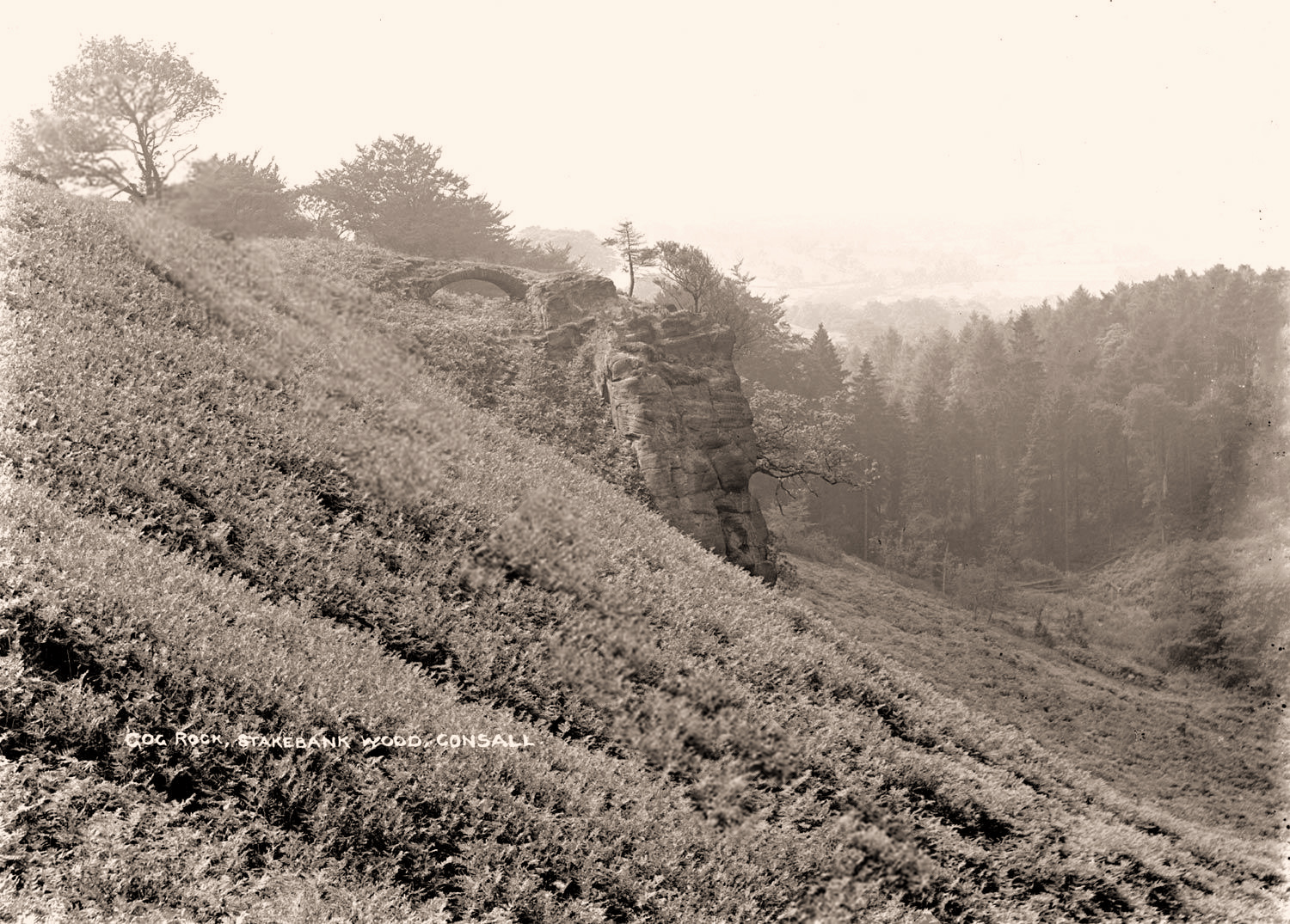
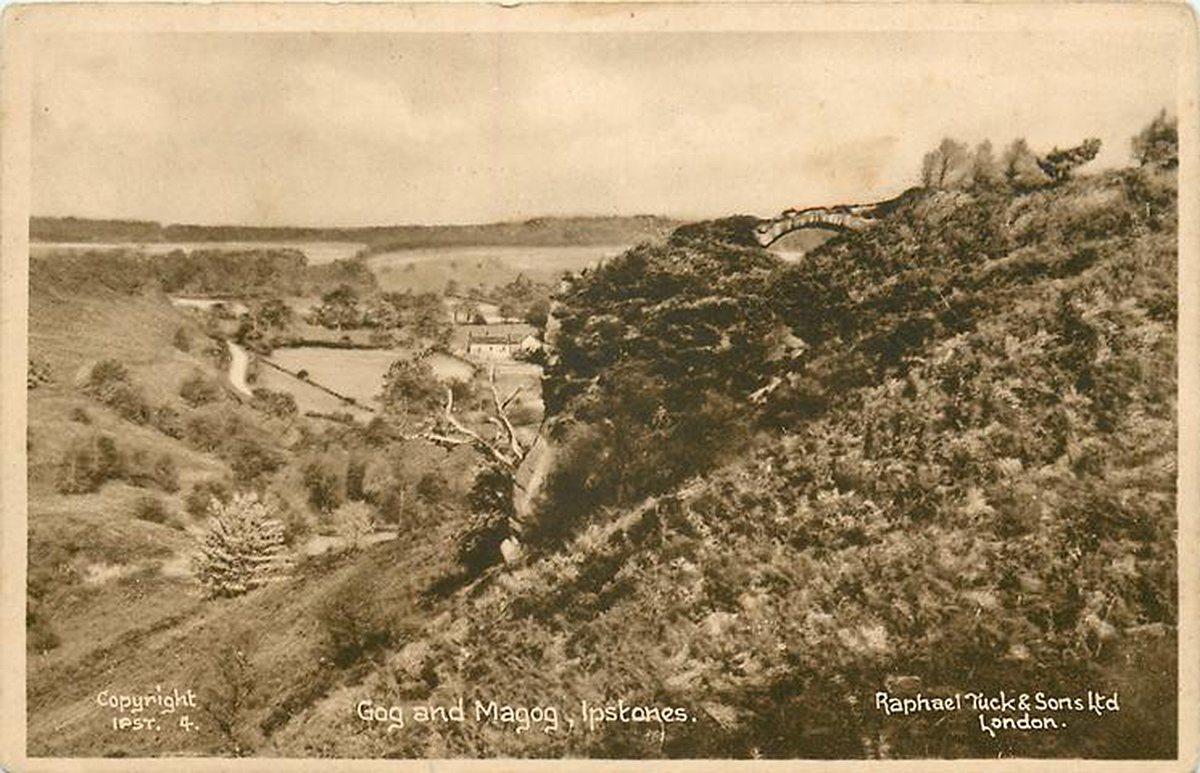
The site appears to have had, and possibly still have, a substantial spring. In 1967 there’s a record of the adjacent Intake Farm being granted a licence to extract “700,000 gallons per year at Stakebank Wood” from a spring there. Presumably this is for agricultural use, as I can find no ‘Gog & Magog Mineral Water’ brand, etc.

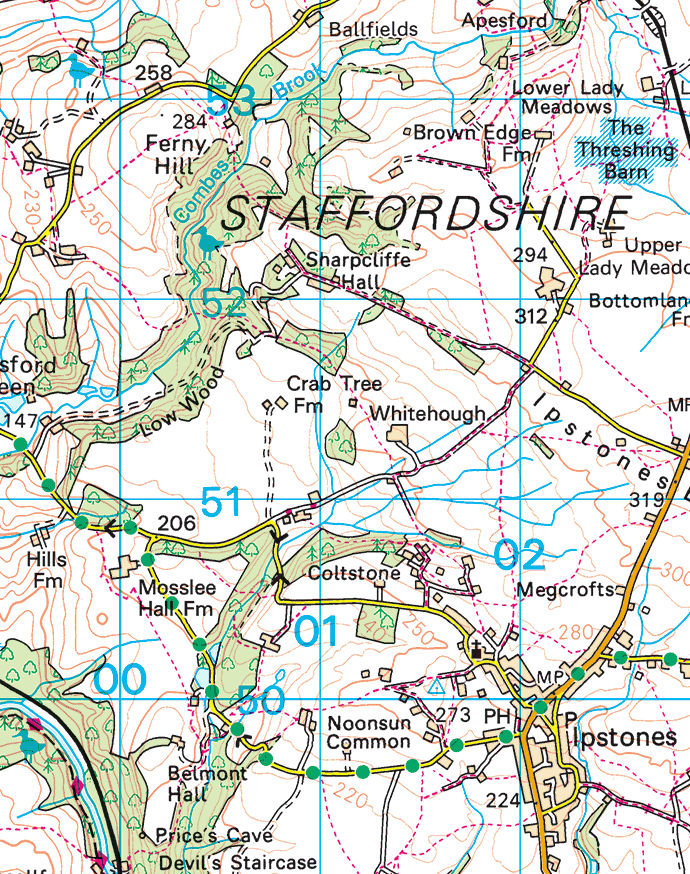
Actually there are two such rocks there, the larger Gog and the smaller Magog. Here are the Gog and Magog rocks marked on the 10:000 OS sheet…
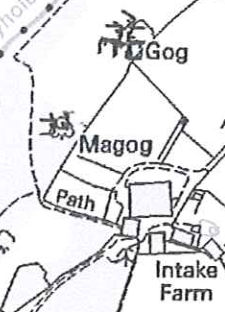
On the larger OS footpath map the two rocks are not marked, but are a short way apart on the slope which sits just slightly west of the map’s big “01” number.
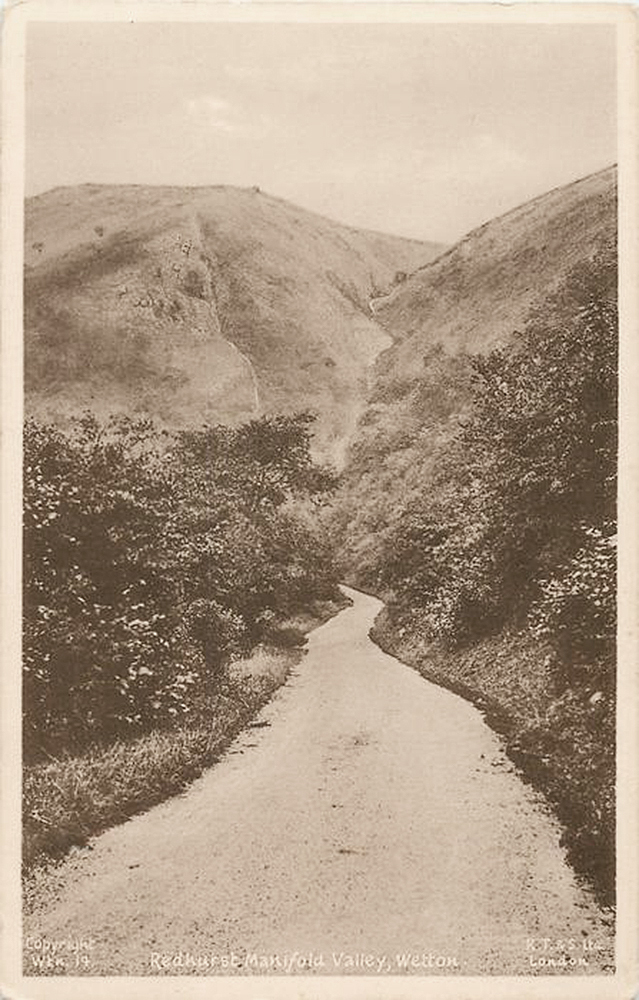
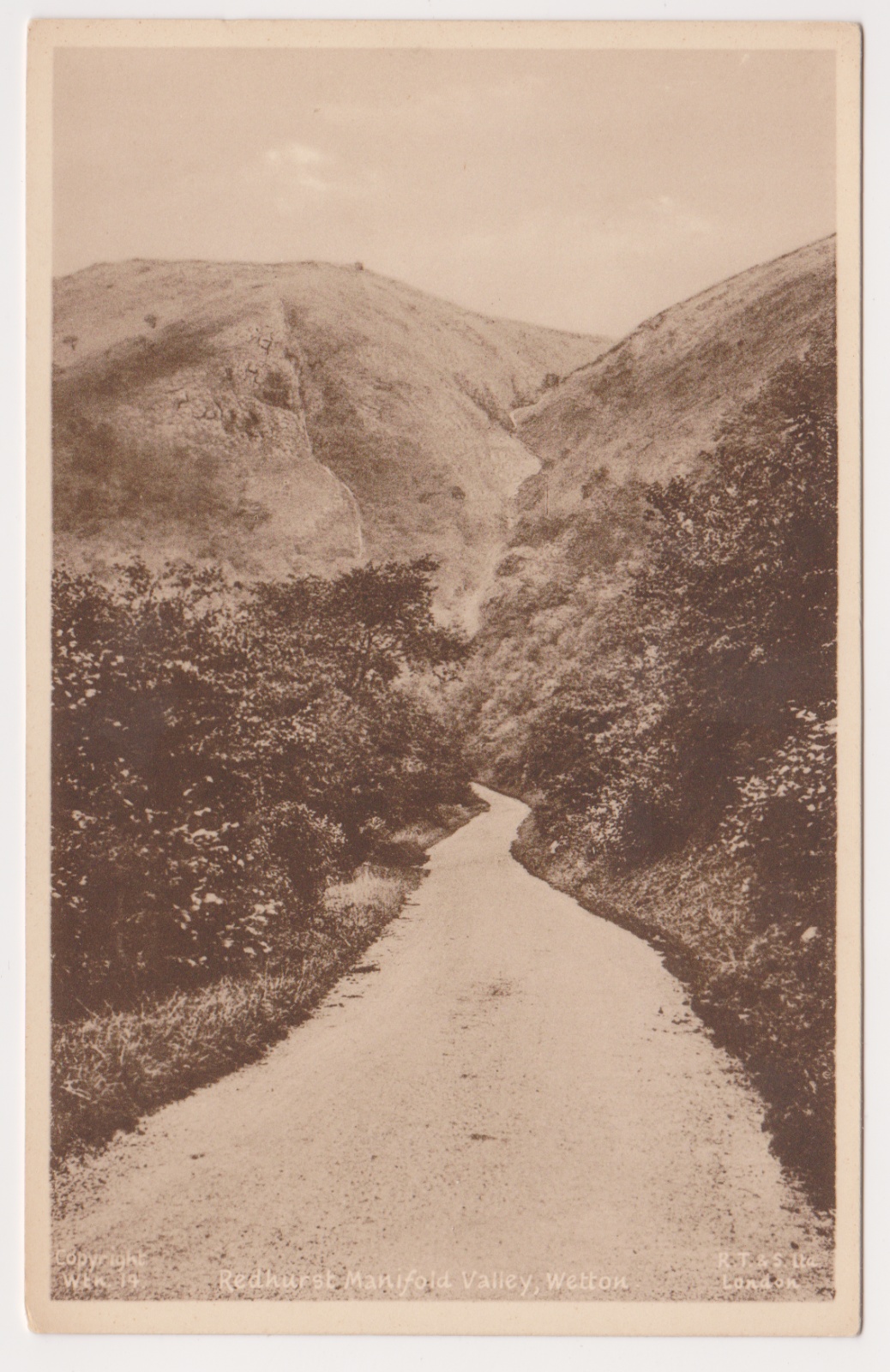
Since the postcards are from perhaps the 1930s, the names must pre-date the ‘ley lines’ era hippies of the late 1960s and 1970s. Pitt (1796) does not use the names, but it would be interesting to know how far back they can be traced.

Since they are on the edge of Ipstones, such stone outcrops may well be the origin of the place-name. Probably meaning simply upland + stones rather than the more romantic notion of imps + stones.


Pitt also has some remarks on the native oatbread (Staffordshire oatcakes)…

“Oat bread is eaten very generally in the Moorlands, and none other kept in country houses; this, however, I cannot consider as any criterion of poverty, or of a backward or unimproved state, as I think it equally wholesome, palatable, and nutritive with [compared with] wheat bread, and little cheaper even here; for upon inquiry at Leek, I found the oatmeal and wheat flour nearly the same price. For several days during my stay in this country, I eat no other bread from choice, preferring it to wheat bread, and rather wonder it is not more general, and kept in London and elsewhere for such palates as prefer it. In the remote country villages it is often baked thick, with sour leaven, and a proportion of oat husks.”

His extended plant-list (at the end of the Appendix) is also annotated with local medicinal and other useful herb-lore. Who knew that English pond-weed could be made into durable writing paper?
More Byron Machin videos on YouTube

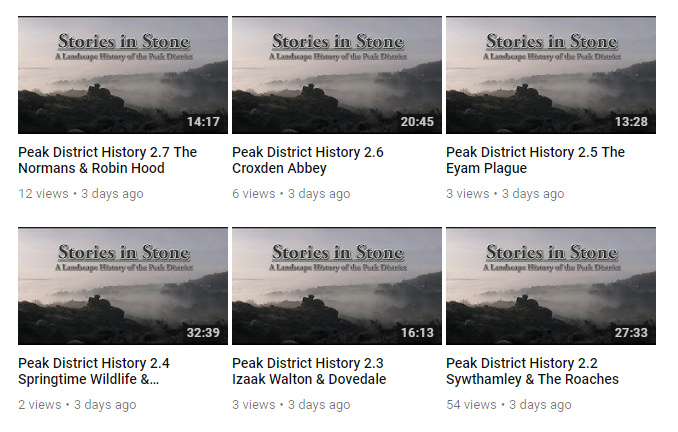
I see there’s another playlist of free videos, kindly released to YouTube by Byron Machin. Peak District History 2 is in addition to the playlist I previously noted on this blog.

The new videos offer another entertaining 120 minutes or so of roving the Staffordshire Moorlands and the Peak. In this case the viewer encounters: Sywthamley & The Roaches; the fisherman Izaak Walton & Dovedale; Springtime Wildlife & Wildflowers; The Eyam Plague; Croxden Abbey; and The Normans & Robin Hood.

In the Sywthamley section Byron gives a spirited full recounting of the plot of Sir Gawain, while standing in Lud’s Church. Definitely worth a listen, but skip this long section if you don’t want plot-spoilers for Gawain. If you do listen to his recounting of the tale, note that he misleadingly implies something that’s not in the original…

19:08: “Gawain heads down into the […] gigantic chasm covered in mosses and lichens and foliage [and] looking towards the very end of the chasm he sees there — taller than life — the [spoiler removed]”.

This tweaking serves to align the tale with popular local notions about Lud’s Church. But to do this Byron’s narration of the tale here conflates, distorts and also slightly invents, compared to the original text.

One also has to be cautious about his occasional sprinklings of seasonal ‘fairy lore’, as it sounds very dubious to me. I wonder where he’s picking it up?

Sir Gawain and the Green Knight to be filmed

Filmmaker David Lowery (Pete’s Dragon, A Ghost Story) is to make a serious film of Sir Gawain and the Green Knight. The movie industry press report he’s signed on with respected film company A24. Some reports speculate the movie will be a revival of a former Terrence Malick (The New World) project, which was quite advanced but had to be abandoned by Malick. A full-on Arthurian Malick Green Knight would have been quite something.

But now Lowery (above) is picking it up, seemingly to make it rather than just to give an old project a brush down. Hopefully he’ll steer clear of a trendy shift into the modern day or to some post-apocalyptic setting. If his take on the movie does get into production, and is authentic, then I’d hope it might even be filmed on location in Wales and the Staffordshire Moorlands.

Hey, I might even sell a few of my new Gawain book to the production team. That’s happened before, actually. I once had an order from del Toro of 12 copies of my book on Lovecraft’s At The Mountains of Madness, back when del Toro had a small team in early pre-production for his planned mega-movie adaptation of Mountains.

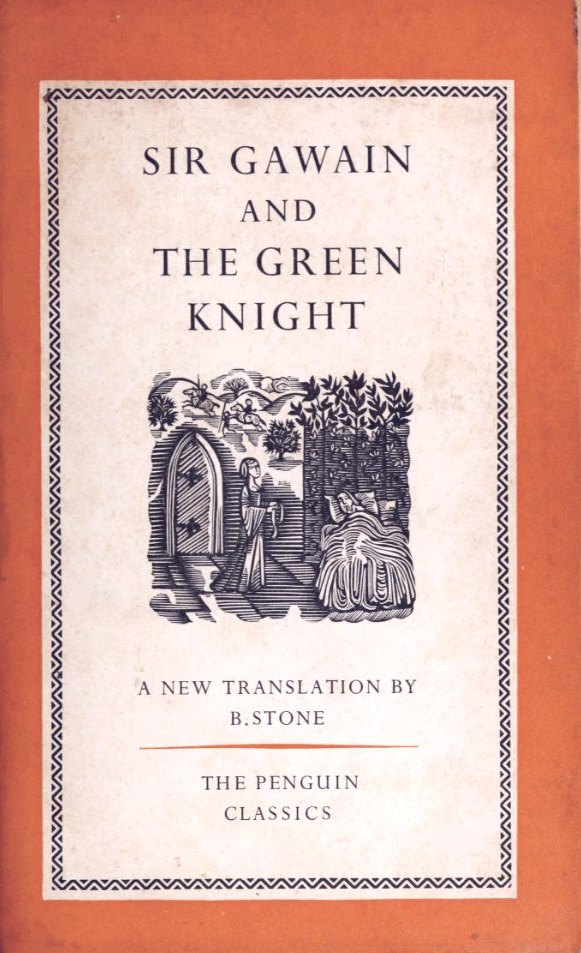
If you want to read Gawain before the movie then steer well clear of anything ‘Armitage’ and his modern hipster slang. Instead, for a readable introductory experience with the story go for the Brian Stone Penguin Classics translation of 1959. This is also available to borrow as an ebook for free, on Archive.org.

R. J. Mitchell for the £50 note

In the Stone Gazette, Campaign for R. J. Mitchell to appear on new £50 note.

Looks great. Though I’ve been a bit dubious about this ‘call to nominate’, as I suspect the final decision will be political. They may even already have someone lined up who ticks all the boxes.

Locally, our scientist can’t be Sir Oliver Lodge, great as he was — because he also wrapped himself up in a whole lot of spiritualist nonsense for decades. To use him would be interpreted by the literal-minded outrage-junkies as an endorsement of spiritualism, and journalists desperate for click-bait would then stir up a unwanted media ‘debate’ and hoo-haa about it.

But R. J. Mitchell is a strong choice. A bit too much of an engineer rather than a scientist, perhaps, in terms of what they seem to want on this £50 note. But he should certainly be put forward strongly, in the hope he might be filed away for use on future notes.

It would also be nice to see Staffordshire’s Erasmus Darwin so honoured, at some point in the future.

Byron Machin’s Peak District History series – now on YouTube

Byron Machin has just posted his Peak District History: A Landscape History of the Peak District series on YouTube for free, and with a playlist. At a rough calculation the total running time is about 120 minutes.

Just keep in mind that a chunk of the stated ‘Spring Customs’ lore is rather dubious, by the sound of it. But he’s fine on the geology, industrial history, botany, railway history and similar.

Five new Tolkien lectures from Oxford

Five new online lectures on Tolkien and his interest in languages, from Oxford, with one per podcast. I have no interest in the intricacies of his invented languages, but in this case it’s real languages such as Old Norse.

Regrettably they’ve only put up the videos, and they’re over a Gb each to download and there’s no plucking torrent so the download speed can’t be throttled back. We don’t all have gigaspeed Internet like Oxford does.

Music in the Five Towns

I’ve never heard of this one before. Music in the Five Towns 1840-1914: a study of the social influence of music in an industrial district. From Oxford University Press, no less, published in 1944. The ‘Five Towns’ being Stoke-on-Trent. Looks like there might be an opening here for someone to write a 1914-2014 sequel to the same standard and format, and then re-publish the original with the new book to form a two-volume ebook set.

See Stoke and Die

New on Archive.org as a free audiobook is H. G. Wells’s book Personal Matters (1897), short essays on various personal topics from Choosing a Wife to House-Hunting to How to Stay at the Seaside.

One of these takes place in Stoke-on-Trent, and recalls his time living at Basford as a young man: “How I Died”.

“Uneducated cavemen”

In response to the “uneducated cavemen” slur on Stokies, heard about in the last few days, I went looking for a suitable image which might perhaps be adapted as a riposte. But, in the end, such leftist ignorance probably only deserves to be ignored.

But along the way I did find a fascinating subset of ‘the imaginative illustration’ type: the prehistoric visualisation of early man’s history. Many appeared more widely, it seems, than just in books. They also appeared on things like collectable cards and stamps…

There are also many such in large-format, in outstanding children’s picture books such as The Story of Man (1960).

If I could afford to be a collector of originals, rather than a curator of digital copies, I’d consider making a collection of the best of such illustrations.

Incidentally, one example shown above is of collectables given away in chocolate wrappers. People of a certain age commonly associated such cards/stickers sets with cigarette packets and Brooke Bond tea packets. But you have to wonder if modern chocolate manufactures are missing a trick, when it comes to what little collectable cards might be placed inside the wrappers of their non-kiddie products. Perhaps they might not be a set of collectables, but rather be communicative — the card could be stamped with a pre-paid postage mark, and thus encourage the good old-fashioned writing and posting of picture postcards. By having the Post Office track where the cards were sent from the company could build of a ‘heat-map’ of England showing where their most dedicated engagers are. And all without pestering their buyers in any way.