Tolkien biopic release date

Ah, at last we have a release date for one of the forthcoming big Tolkien biopic movies. One of them has to be good, we can hope, and respectful to the material.

“Fox Searchlight is releasing Tolkien in cinemas in the UK on 3rd May 2019. Tolkien explores the formative years of the orphaned author as he finds friendship, love and artistic inspiration among a group of fellow outcasts at school. This takes him into the outbreak of the First World War…”

The cast looks good, though the writers have a somewhat worrying leftist slant in their track-record.

The Cracks of Doom: Untold Tales in Middle-earth

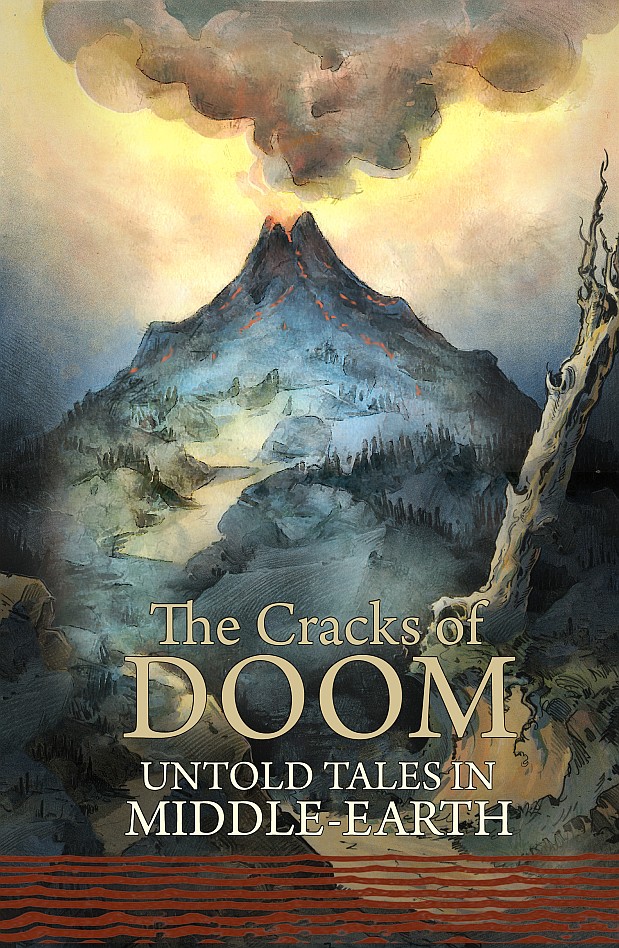
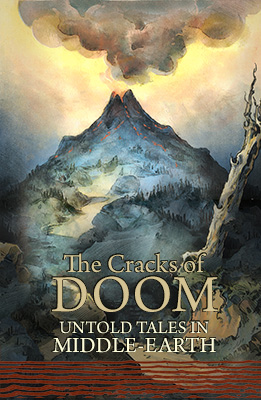
I’m pleased to present The Cracks of Doom: Untold Tales in Middle-earth. My new book is available now, and is a side-project from my larger scholarly Tolkien book. It should be of interest to RPG players, as well as to fan-writers of Tolkien stories.

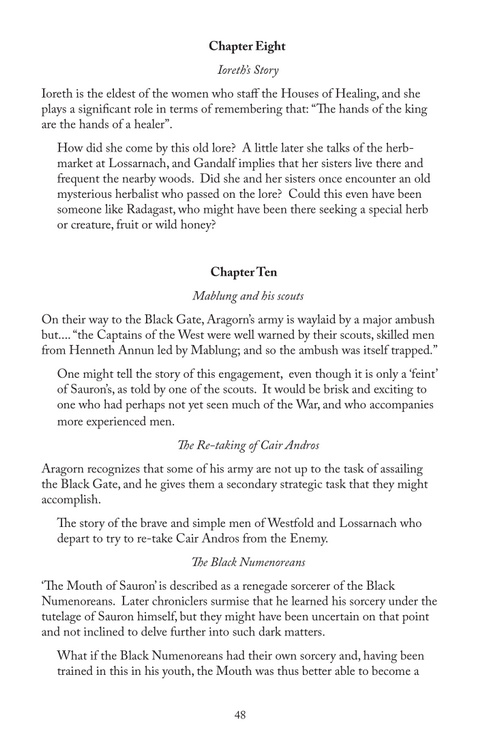
The Cracks of Doom is a fully annotated and indexed list of ‘Untold Tales’ in Middle-earth, pointing out the ‘cracks’ where new fan-fiction might be developed. There are 125 entries and these usually lightly suggest ideas for story development. It will also be useful for scholars seeking to understand what Tolkien “left out” and why, or those interested in ‘transformative works’ and fandom.

Contents:

1. Introduction: “On Untold Tales in Middle-earth”.

2. Writing guidance: “Faith, Duty and Fun: plan and style in Middle-earth fiction”.

3. The list: ‘Openings, Gaps and Cracks’. 125 entries. Note that this is only for LOTR, inc. the Appendices. It also draws on Unfinished Tales, books in the History series, and for one item I also reference the Letters. It does not, of course, cover the vast amount of material in The Simarillion.

PDF sample with index. The full book has 64 pages, about 22,000-words, and a full name and place Index. The book is wholly unofficial, and very respectful of Tolkien’s vision.

There’s also a Kindle ebook version, slightly expanded with some additional entries. Also available now.

I think I’m fairly safe with the title, re: the Estate. Tolkien is not mentioned in the title, and “The crack of doom” was a common colloquial phrase in the Edwardian period, being found in Shakespeare’s Macbeth, Act IV, Sc. 1.

The Word of Teregor

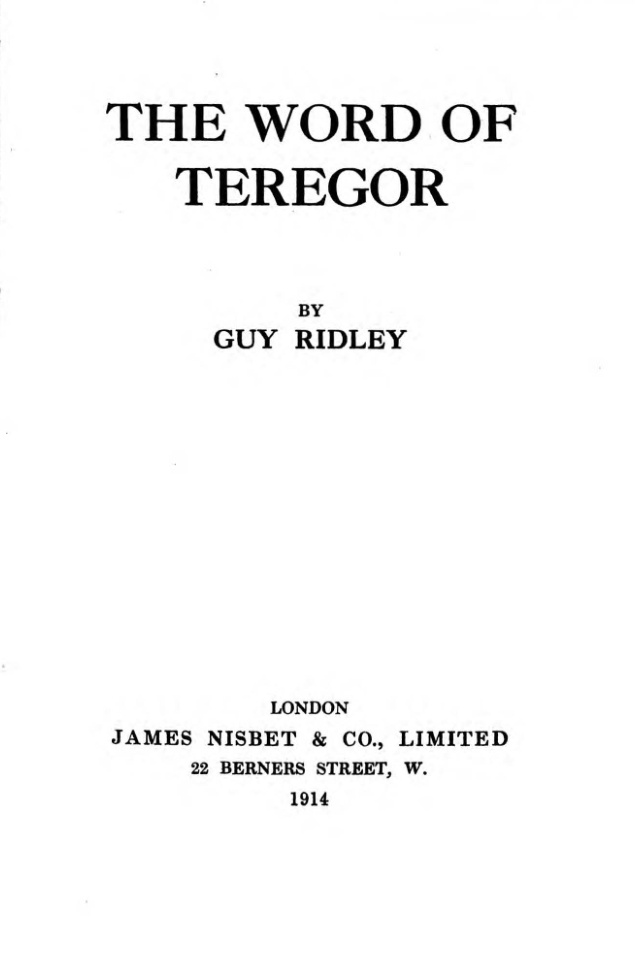
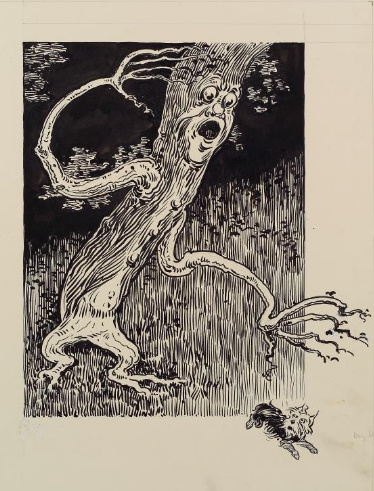
The Word of Teregor (1914) by Guy Ridley (1885-1947) is an early British fantasy novel of sentient trees. The trees converse in moots and are unfriendly to men. One of the trees is called Enteth.

“No one but a real lover of trees could write of them as Mr. Ridley has done.” — review in the Westminster Gazette. “A suggestive and original voice among the babel of modern literature” — review in The Daily Telegraph.

An obvious inspiration for J.R.R. Tolkien’s Ents, circa 1938, you might think. Though I doubt that would be provable now — and anyway there are more obvious and earlier possibilities. Such as an aside in Shakespeare’s Macbeth (“Who can impress the forest, bid the tree | Unfix his earthbound root?” ‘impress’ = to strongarm a man into armed service in an Army). This might perhaps be Shakespeare’s nod to Taliesin’s magnificent poem “The Battle of the Trees” (Cad Goddeu), in which many types of trees are enchanted into a marching army of trees. Tolkien and his circle had surely found time to notice Taliesin by 1938 — though I imagine that Tolkien would have been professionally wary of seeming to endorse the authenticity of the late Welsh ‘bardic’ songs.

There’s also a prime example from Tolkien’s childhood, the “Attack of the trees” from the famous The Wizard of Oz, here depicted in 1900 by Denslow…

Anyway, the full novel is at the link above.

North Staffordshire Field Club Transactions, 1897

Some interesting snippets on local words and lore, found during my listing and summarising of all the contents of the North Staffordshire Field Club’s Annual Report and Transactions, 1897:

* The local name for a polecat was a “Fitchet, the last such being known locally… “about the year 1840, when one was caught in a trap at Wootton Park Farm, near Cheadle.” The fur thus being known as ‘fitch’.

* In Shropshire the word “breaking” alludes to the strange phenomena of the meres, namely that a flood of “minute bright green particles” in Autumn turns a lake or mere bright green. The term is a local one… “It is simply a colloquial expression, best known and used in Shropshire where Meres occur more frequently than in our County, and where the phenomenon is well known to the Mere-dwellers. It is also called “middling,” no doubt from a resemblance to the breaking of milk into curd and whey on the introduction of rennet. But the term “Breaking” is said to be derived from an analogous appearance in brewing, when fermentation takes place. … At certain times in each year, generally in autumn, the Shropshire Meres become turbid with these green particles, the water becomes unfit for domestic purposes, and it defies the powers of filtration”. The cause is the natural late-summer ‘flowering’ of microscopic algae, which live for most of the year down in the muds and sediment. (Nothing to do with artificial fertiliser run-off, since there were no such chemicals in the 1890s and especially not on the mere meadows and high moorland). The article has no mention of children’s ‘Jenny Greenteeth’ lore, though the phenomena shines an interesting sidelight on the lore, especially in relation to the breakdown of very large amounts of algae and the consequent stink — suggesting the possibility of flammable vapours and glowing will-o-the-wisps.

* Among their many outings and excursions a trip was made by the Club to “Ludchurch and Swythamley” near Leek. The short report for this makes no mention of Gawain, then seemingly unknown in connection with the locations. But some late local lore is mentioned in passing, that ‘Robin Hood’ once lived in Back Forest.

New picture of Redhurst Gorge.

Readers of my new book Strange Country: Sir Gawain in the moorlands of North Staffordshire will be interested in a newly-found postcard showing a distant view of Redhurst Gorge near Wetton Mill. Possibly 1920s?

One would have to see the original, which I can’t afford to do, but there appear to be limestone fissures opening in the crag above the cave there. If so then this would confirm the reports of cavers, which I noted in my book and on this blog. One can also more clearly see the potential sexual symbolism, re: Gawain, of the bulge containing Old Hannah’s Cave being shaped rather like a pubic mound and cleft.

Update: got a better scan, June 2019…

Mythlore 1996

There’s a fine Christmas present for Tolkien scholars, the journal Mythlore Vol. 21 | No. 2 (1996) is now newly free and online in public. It’s a very large edition and contains the elusive proceedings of a major 1992 conference. It has per-chapter downloads, so it’s a simple matter to download only the articles you need and compile them to a truncated PDF that suits your needs. Including the editorial, I bagged 10 articles and ended up with a manageable 100-page ebook on my 10″ Kindle HD.

The Jake Whitehouse collection

There is now a dedicated website for the Jake Whitehouse collection of First World War photographs and postcards relating to mid Staffordshire. The tight focus is the First World War and the area around the military camps on Cannock Chase, the camps themselves, and places the soldiers might have visited such as Rugeley, Alton and Stafford.

There are about a dozen pictures of the Haywood villages and a couple of Shugborough, but Tolkien scholars will be most interested in the wealth of camp pictures.

Revivifying the Ur-text

Philip Emery, who was a North Staffordshire -based writer the last time I looked, has just published his 2018 PhD thesis on the Loughborough University open repository. “Revivifying the Ur-text: a reconstruction of sword-&-sorcery as a literary form” asks if, given this literary genre’s relative neglect in recent decades, it is possible to identify the genre’s core characteristics and then use these “to create a work that realizes the form’s potential to exist as literature”. Firstly he explores the structural development of the Ur-genre as it emerged in the stories of R.E. Howard (influenced by H.P. Lovecraft in terms of the horror elements), then surveys de Camp’s later contributions and distortions to the genre, and generally seeks to identify the “pristine elements” at the core of the genre’s once-flourishing form.

Mythical Beasts of Birmingham

A short humourous article surveys a few of The Mythical Beasts of Birmingham, being: the Wump-Tay; Brummies; the “Boss” Tin; The Abominable Snow Hill Man; and The Wrekin.

In the spirit of Ken Reid’s new artbook Creepy Creations, I can think of a few more suggestions, off the top of my head: the Back-a-rack ‘Em (“Back of Rackhams”); the ‘Bumbler 11’ (No 11 bus); the ‘Cad’ Berry (Cadbury); the Certain Coldfeet (Sutton Coldfield); the Suit-on Pork (Sutton Park); the Jolly Cutter; the Bull Wringer (Bull Ring); the Snot Hill (Snow Hill); the Bag-a-Bush (Beggar’s Bush); the Buzz Tin (“Bostin”); the Lickers (The Lickeys); the dreadful monster-pop band the Broomies (“Brummies”) who play strung sweeping-brooms; the dreadful monster-rock band Dark-Hover and d’ Billz Mudders (“It’s dark over Bill’s Mother’s”); the Soul-In-Hell (Solihull) and the distant Doodley Doodler (Dudley).

There’s also the historically recorded Mine Knockers of the South Staffordshire coalfield.

“Tolkien in Love”

While we’re waiting for the slow-as-treacle big-screen Tolkien biopics to arrive (two are said to be due), Radio 4 is to repeat the one-hour “Tolkien in Love” Afternoon Play drama this Sunday, 9th December 2018. Appears to have been first broadcast 2017. It follows a 30-minute mid-morning documentary of the same title, broadcast by Radio 4 in 2012.

The BBC has no Listen Again for this drama, though its Web page promises it will be “available shortly after broadcast”. The earlier Tolkien in Love documentary has long-since been made “unavailable” from the BBC. Surprisingly, neither broadcast appears to have been pirated or sent to Archive.org.

Update: now on Archive.org.