12 ‘lost things’ from Stoke

Twelve ‘lost things’ from Stoke:

1. Aurochs. Giant prehistoric wild cattle which survived to the Roman period, a skull of which was discovered in diggings at Etruria and is in the Potteries Museum.

2. The old Roman Road, through Wolstanton to where the current Stoke train station is. Though some of Rykeneld Street is likely still there, underground.

3. ‘The Lost Painting of Longton’. Robert Bateman’s large major oil painting “Saul and the Witch of Endor” was given to the city and was last heard of in Longton Town Hall in the early 1950s.

4. The vanished railway line from Stoke railway station to Newcastle-under-Lyme, which went through over 700 yards of tunnels to get there and went on the town of Market Drayton. Also the Potteries Loop Line around the city, though much of that now survives as off-road bicycle paths.

5. The old-style ‘very broad’ Potteries Dialect, now almost extinct.

6. The Etruria Woods, of which only remnants and re-growths now remain. One might also include the vast 55-mile long Lyme barrier-forest from the Norman era, which gave its name to Burslem.

7. The vast network of modern deep-mining tunnels. Now flooded, they run mostly from around Forest Park across the valley to Wolstanton.

8. Trentham Hall, offered to the Council as a miners’ hospital but unwanted and thus largely demolished. But the Gardens and Estate are now thriving.

9. Wedgwood’s secret glazes, for making pottery. When H.G. Wells was living in the Potteries, he roomed with a school-fellow who had the job of trying to reconstruct these secrets from the old dried-out glaze-pots in the cellars of Etruria Hall.

10. Folklore and old local tales, of which only fragments remain. Also related customs, such as the annual Hanley Venison Feast.

11. The North Staffordshire Field Club. Once one of the largest and well-patronised in the nation, with amateurs researching everything from local history and geology to local insects and birds. Like a burst seed-pod, it eventually withered away after giving life to a great many individual specialist groups.

12. The Trubshaw Cross at Longport. In the 1620s said to be the terminus of “a great passage out of the north parts unto diverse market towns”, serving the packhorse teams that bore the industries of the Peak (sheep-fleeces, metals etc) to Newcastle-under-Lyme and thence to the good roads that ran north and south. By the 1840s only the stone base of the cross, likely of “Saxon origin”, remained.

Thomas Pape (1872-1970)

Thomas Pape (1872-1970) was a key historian of North Staffordshire. He produced several local history books from 1928-40, and a number of articles can also be found. Sadly the books are not on Archive.org and the publisher — Manchester University Press — has not yet scanned the extensive series of which they are a part and put them online.

His key works are:

1. Medieval Newcastle-under-Lyme, Manchester University Press, 1928. No TOCs online, but his second book for the Press gives a summary of the first…

Ten years ago the Manchester University Press published the first volume, Medieval Newcastle-under-Lyme, a history of the Castle from its foundation in Stephen’s reign until its decay in the late fifteenth century, also a history of the borough from its formation in Henry II’s reign and a history of the Manor — all to the end of the reign of Henry VII. The two most important appendices were the extended Latin transcripts of the minute books of the borough of Newcastle-under-Lyme from 1369 to 1510.

1a.The Ancient Corporation of Cheadle” in the North Staffordshire Field Club Transactions for 1930. This actually turns out to be mostly relevant to the “Mock Mayor” tradition of Newcastle-under-Lyme. He also notes, in passing, the annual Hanley Venison Feast which he found could be traced to the 1780s.

1b.Medieval Glassworkers in North Staffordshire“, in the North Staffordshire Field Club Transactions for 1934.

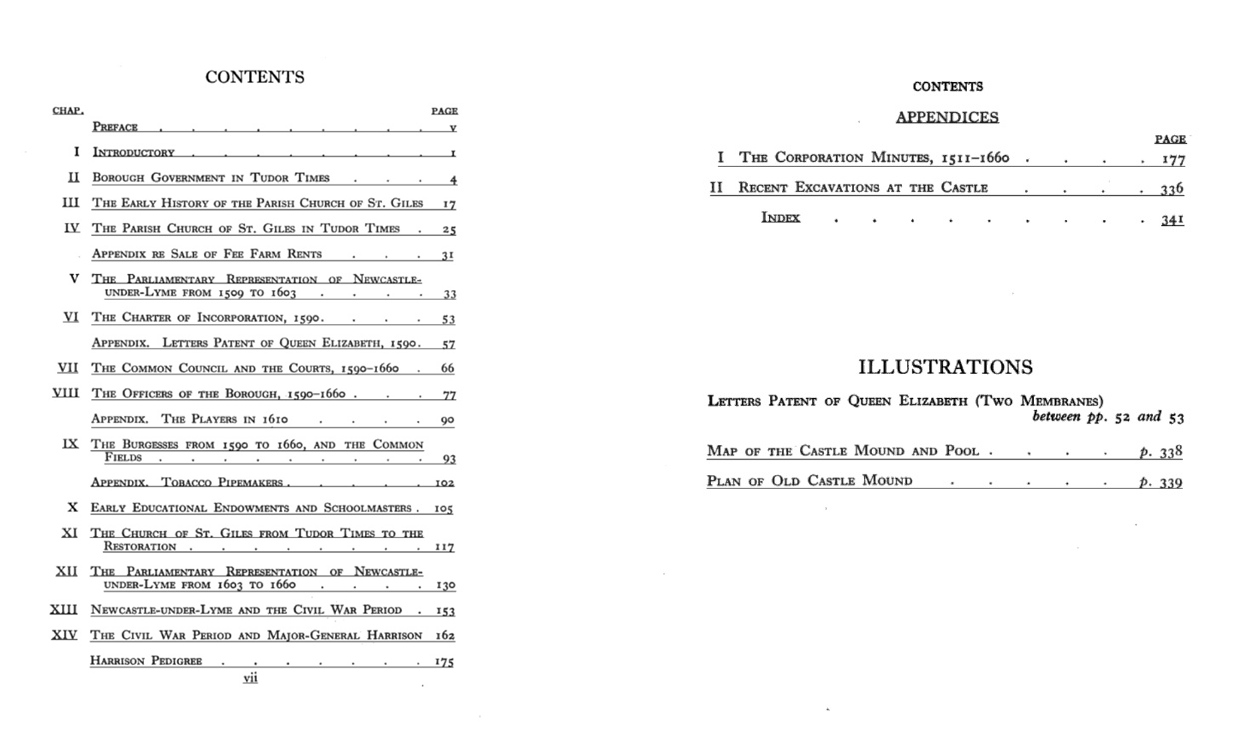
2. Newcastle-under-Lyme in Tudor and early Stuart Times, Manchester University Press, 1938. Substantial, at 350+ pages. It is partly on Google Books, including TOCs. In an appendix are to be found useful castle-location maps that took account of the latest excavations (undertaken by himself and a group of his boys, 1934-1935).
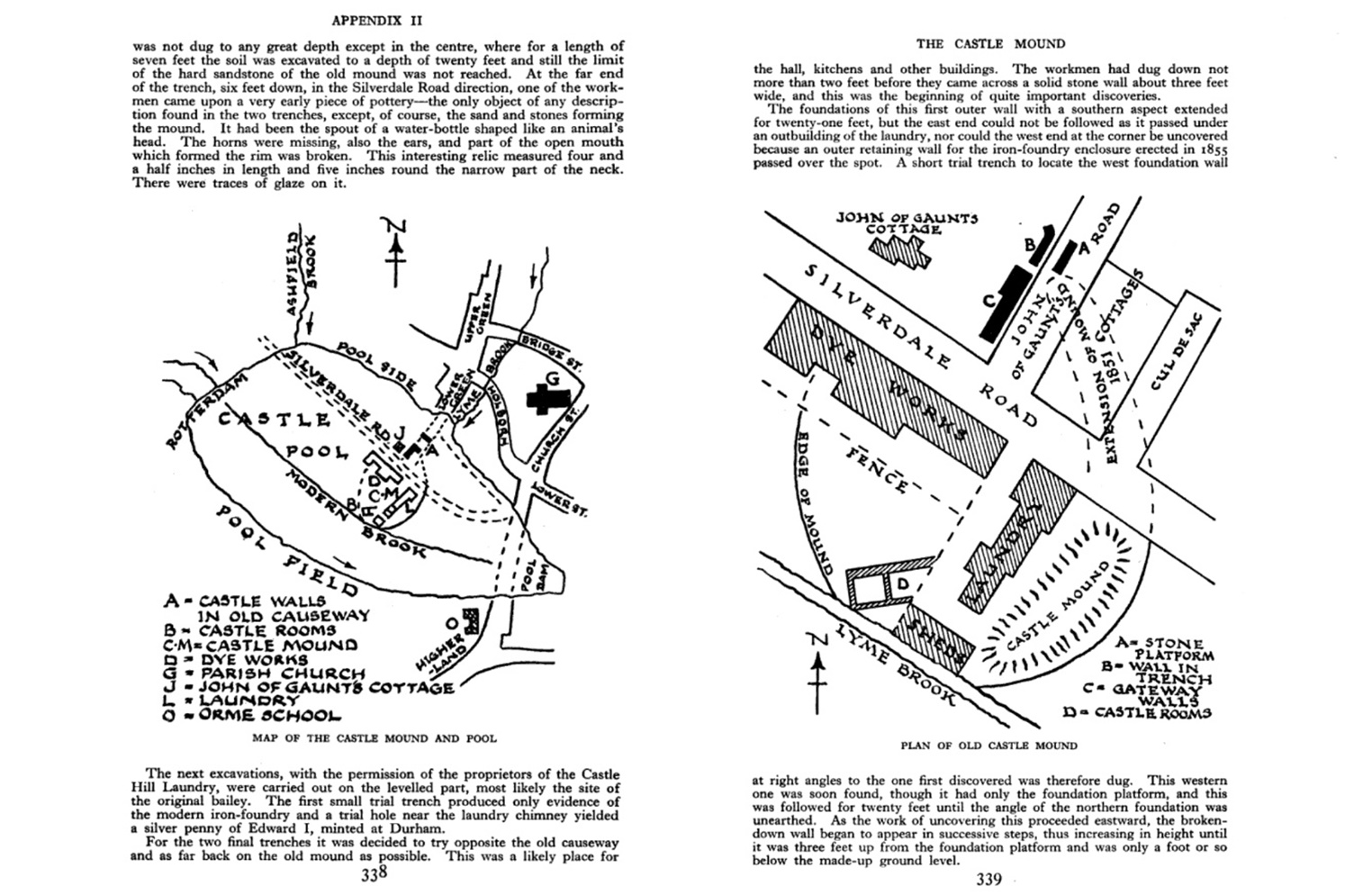
3. The Restoration Government and the Corporation of Newcastle-under-Lyme, Manchester University Press, 1940. At 63 pages this third and final work for Manchester University Press was more of a booklet, perhaps due to wartime paper shortages at a guess. Google Books appears to have no preview, but on one of the versions it offers a simple TOC, and when you click the links for that you do get preview pages

THE INFLUENCE OF THE EARL OF ESSEX
THE CORPORATION ACT
COUNCILLORS DEPOSED
THE CHARTER GRANTED BY CHARLES II
THE LOCAL TRUSTEES
FINANCIAL DIFFICULTIES
A ROYAL MANDATE
THE OLD ORDER AT WORK

It might be useful to get all of the above republished as a single volume, with a new introduction correcting any errors of fact and updating the reader.

He also produce a history of the town’s parish church, St. Giles, seemingly published (re-published?) in 1967.


His papers and photographs are in a special collection archive at Keele University, though a list is only available on request rather than being online in public. The page does however have a basic biography…

Thomas Pape (1872-1970) was a schoolmaster, holding posts at Newcastle-under-Lyme Middle School, the Orme Boys School and Wolstanton Grammar School. Pape devoted a great deal of his time to historical and archaeological research of Newcastle-under-Lyme and surrounding areas, authoring several books and numerous articles. He was elected a member of the North Staffordshire Field Club in 1917 and served as President in 1931.

Elsewhere I also found a picture of him…
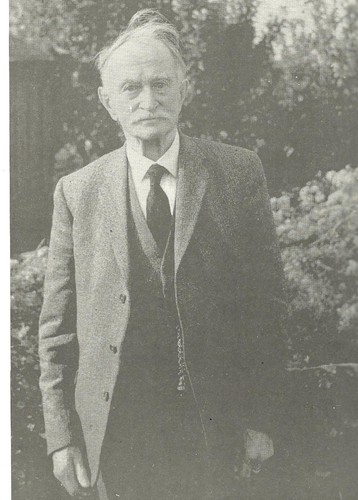
Thomas Pape photographed in old age.

He taught History at Orme (called the ‘Middle School’ before 1914) and in his second book he states that he retired from teaching in 1933. This picture might have been made on that occasion, yet he looks older than 59 and the camera lens and picture-shape looks to be from a later era. My guess is he returned to teaching circa 1942 at age 70, due to the needs of the war, and this might date from that time? He lived to 98 years old, though, so it may even be later. Judging by his hands I’d say he could be in his late 80s here.

Evidently he also published articles in the local newspaper, and one observer remarks on… “Notes by medieval historian Thomas Pape, published in The Evening Sentinel newspaper in 1935″, re: a local pottery excavation.

He and his lads also excavated: The Roman Villa at Hales, Staffordshire; Chesterton Roman Fort; and from memory I’m fairly sure he was the one who did the excavations to find the bed of the Roman Road in the vicinity of Wolstanton (Chesterton fort to Stoke station).


Update: My thanks to David Pitt for a small correction. I had been led to believe, by Staffordshire Past Track, that Pape was serving as headmaster at Orme in 1927 when the Hales Roman Villa was excavated. I am informed that he was a History teacher throughout his career. This fact has been updated.
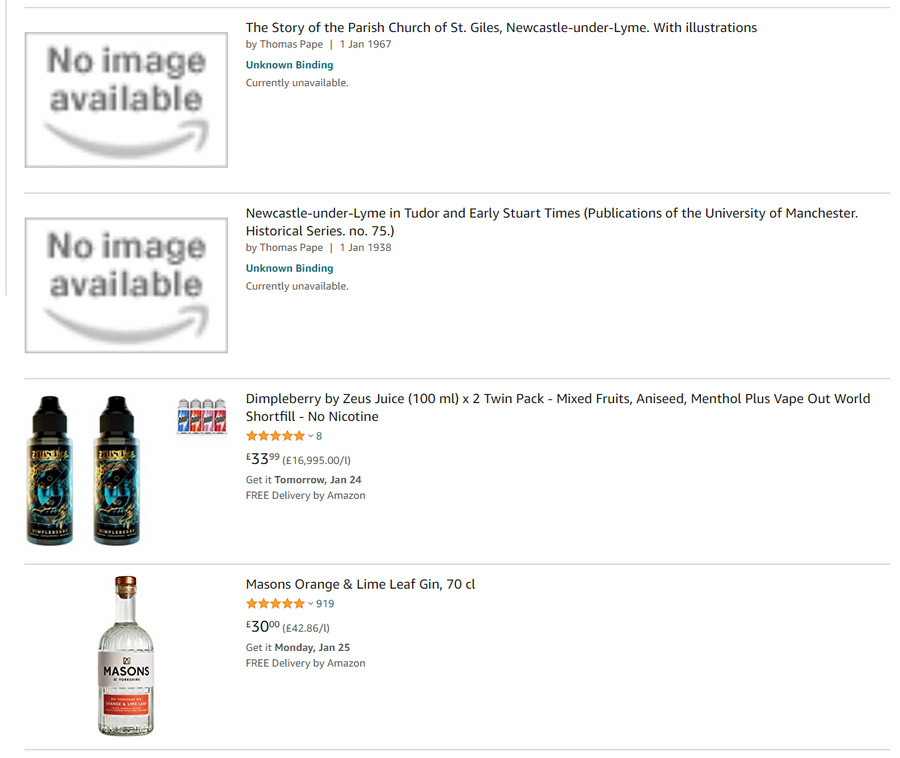
Amazon – from junk to junkie

Since when did Amazon UK become the nation’s pills-and-booze pusher? After the first few results it now show this, and many more like it…

I get the same results on a “clean” alternative Web browser with no addons or scripts, so it’s not my browser. Book searchers had become used to getting junk results, as pages filled with blank “notebooks” and the like. Now it seems Amazon has gone from ‘junk’ to ‘junkie’.

The Spoilt Kill

Yet another local novel of the Potteries, found. Where do they hide? The Spoilt Kill is a ‘police procedural’ crime mystery novel published in 1961 and set in what’s said to be a vividly evoked Potteries of the late 1950s. The obscure title refers to the name for the failed firing of a ceramics kiln.

The novel has recently been republished. By the British Library’s shovelware division, which has nice covers but doesn’t have a very high reputation for textual care. Yet at least the book is available again.

Formerly a mass-market crime mystery in the Penguin Crime paperbacks series. One can currently be had on eBay and the text there will be free of OCR errors.

There’s also an audiobook version.

The Folk-lore of North Staffordshire, version 1.6 (2021)

Here is a new edition of my free booklet The Folk-lore of North Staffordshire, an annotated bibliography. There are a number of newly discovered additions, some quite substantial, and a significant expansion of one item. All told, around seven extra pages are added and one new picture. Several of the new additions relate strongly to the wintry Sir Gawain landscape of the Moorlands, especially as I’ve now finally been able to see Sleigh’s book on Leek. As such the booklet now also forms a shelf-companion to my recent book on Sir Gawain and the Green Knight.

Download.

Please update any local copies you may be keeping. The previous revision was December 2020, when it was 24 pages. It’s now 32 pages and is again feasible to print as a booklet and slip between card covers.

A Moorlands astronomer

Addendum to Richard Sleigh’s A History of the Ancient Parish of Leek, in its 1862 edition:

“At Moorland House, Leek, on Christmas Day, 1888, died Mr. Abraham Kershaw Killmister, a gentleman of retired habits, and of manners indicative of nervousness. The world at large little suspected that in him was to be found an author of repute.

He was the well-known ‘Tom Oakleigh’ of literary sporting celebrity, author of the “Oakleigh Shooting Code”; of the article on Shooting in the “Encyclopaedia Britannica”; of the “Rod and the Gun” by Professor Wilson of Edinburgh, and ‘Tom Oakleigh’ of the “Dalesman”, a five-act play, and of various poems and literary articles, contributed to the “Mirror” and to the “Sportsman’s” and other magazines, principally between the years 1830 and 1845. In the “Mirror” and some other periodicals, he chiefly wrote under the signature of “Cymbeline.” For the article in the “Encyclopaedia” he received from the publishers Mess’rs. Black, one hundred guineas.

After his death a large unfinished work on Angling was found among his papers, and several manuscripts on astronomical subjects, astronomy having of late years occupied much of his attention (as he was indeed in all respects an humble seeker after truth); and he had at considerable expense erected an observatory and furnished it with a powerful refracting telescope, having an object glass, by Dollond, of near eight-inches diameter.

He often mentioned to me that his early sporting knowledge and tendencies had been much derived from the late Mr. Richard Sleigh, of Leek, a thorough sportsman of the old school, whole genial tales, and regular shooting and fishing habits, and favourite dogs, many here remember.”

Staffordshire’s “newt”

The word newt came via Staffordshire…

“The Old English name of the animal was efte, efeta, resulting in the Middle English eft; this word was then transformed in some places to ewt(e). This form, pronounced “newt”, appears to have arisen in Staffordshire as a dialect variant of eft, and had entered Standard English by the Early Modern period.”

Burtons Mineral Waters

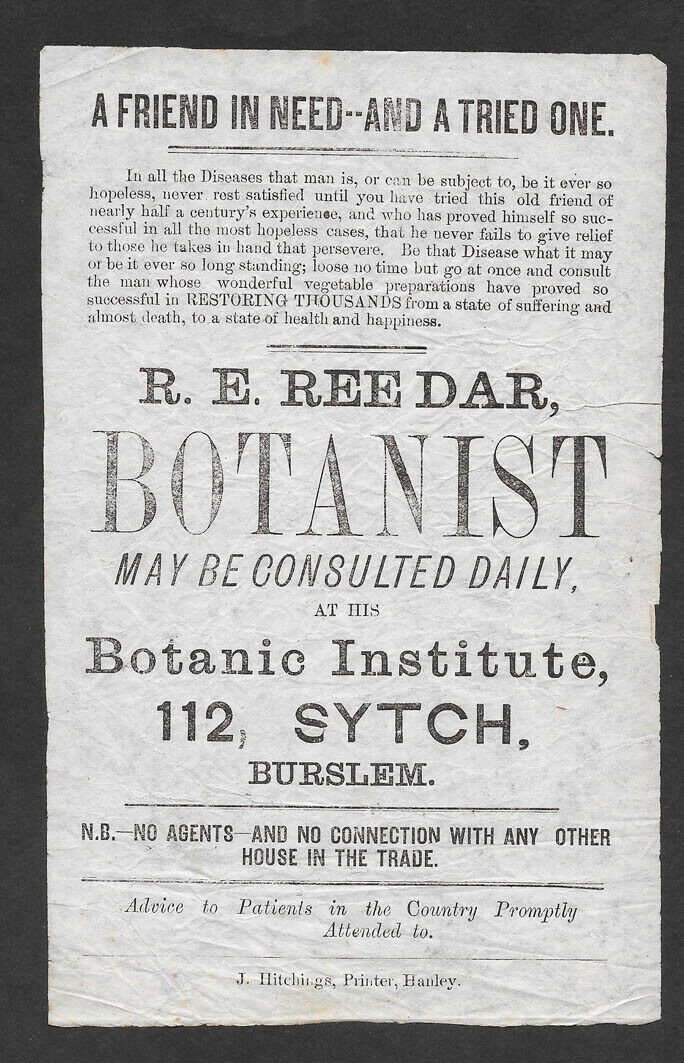
“Burtons Mineral Waters of Hanley”, Stoke-on-Trent. Local makers of Ginger Wine, and a maker who appears to be utterly unknown now except for this beermat on eBay and one mention in a trade magazine. I have a taste for ginger ale, so I’m interested to find a local connection. There seems to have been quite a trade at one time, in mineral and soda water making in the Potteries. But this appears to be a very late example, from the early 1970s given the mention of saccharin.

Assassin’s Creed: England and Ireland in 873 AD

I had assumed the new mega-game Assassin’s Creed: Valhalla was all icy fjords and spicy feasting. But it turns out most of it is set in the British Isles in 873 AD. The latest PC Magazine notes how…

Many environments look like recreations of The Lord of the Rings’ Shire, which itself was inspired by old England … where the bulk of the game occurs. … You can tell the development team spent many years researching the England of old. This is truly one of the finest worlds I’ve seen in a video game.

Nor do non-gamers have to wrestle with fiddly game mechanics and “pillage 10 villages to win a cow” grinding. Because the Assassin’s Creed games get special tourist versions. Eventually. You can already tour Ancient Greece, Egypt etc, from previous games, via a “Discovery Tour” version.

Will there be a Discovery Tour for Anglo-Saxon England? Yes. It was officially announced a month ago that Assassin’s Creed: Valhalla will get a Discovery Tour, along with addon-packs (‘DLC’) to add druids in a wild and apparently supernatural Ireland.

As for the Discovery Tour date, my guess based on the DLC timing would be summer 2021, so that it’s patched and ready for the back-to-school educational market in September. The game appears, from this screenshot, to include the cat-taming from the Ancient Egypt version of the game…

… but sadly it’s Windows 10 only. Also, the PC Magazine review concludes…

“To get the most out of Valhalla, you’ll need a near-godlike gaming PC.”

“‘Your tongue is strangely changed, but the name sounds not unfitting so.”

I’m not sure if this has been suggested before, but I can find no trace of the suggestion. Here is yet another possible solution to the genesis of Tolkien’s word “hobbit”. That it came from his mind musing on, while marking exam-papers, the name of “Coalbiters”.

This being what would become the pet name for a group of his literary fellows some years later, the name arising from the Icelandic Kolbitar which was a euphemism for dull lads who laze by the hearth-fire when there is work to be done…

“youths who were indolent and dull and who lay in the ashes by the fire during the day, the so-called coal-biters.” (Grundriss der Germanischen Philologie).

The name being doubly fitting for Oxford professors because, as masters, they presumably had hands stained with black ink from their daily labours and were also liable to carry smudges of chalk (as if they had been lazing in fire-ashes) gained by labouring at good old-fashioned blackboards. But also fitting for musing on lazy lads who do not trouble to complete their exam-papers.

Anyway, the famous word “hobbit” was jotted down at the end of a long stint of marking school exam-papers, possibly as early as 1926 but likely some years later. Tolkien encountered a blank sheet from the final paper. On this he spontaneously wrote…

“In a hole in the ground there lived a hobbit”.

… and thus began The Hobbit. My suggestion is that line could have arisen, either prior and unbidden in his mind or in a mere moment’s consideration, from musing on coalbiters

“In a hole in the ground there lived a coalbiter … hole-biter … ho..bit … hob-bit.”

Tolkien being presumably aware that hob was also a word from the fireside hearth (see below) and thus connected at least in circumstance with Kolbitar. He would also have known of ‘Lob Lie-By-The-Fire’ from northern England, and the modern German ‘Kobold’ as a common name for a ‘house spirit’.


Even more speculatively, the “hole” might even be inferred if he had then recalled how the word “hob” was used in Cheshire. From a key topography of Sir Gawain and the Green Knight, on which Tolkien was by then the contemporary expert…

“In Cheshire, Hobbity-hoy is an awkward stripling between man and boy” (1823)

This link with a hole could be inferred from “Hobbity-hoy” since it likely derived in Cheshire from the likeness of the lithe and nervously energetic boy to a male ferret, which the Cheshire Glossary has it was called a “hob” in Cheshire and elsewhere.

Ferrets having of course long been used for rabbit hunting in holes, and having an ashy-looking underside of fur. After hunting in a sandy burrow, this pale underside would likely look even more as if the creature had been “lying in the ashes of a fire” — similar to how the coalbiters boys were imagined.

This word is also not incompatible with “hob” used in the olde-time fireside sense. In the era of big broad medieval fireplaces, a “hob” indicated the small shelves set in the corners of the hearth, above hot grates, on which tankards of cider and ale were kept hot. One can then imagine that the lid of a loose-lidded tankard would thus start to “pop” up and down when it became too hot and air needed to escape and the tiny vent-hole was insufficient, much like the action of a weasel or ferret popping his head out of a rabbit-hole and with the same flash of white chest-fur and shining eyes as some bubbling foam spilled up and out. One here also recalls the real tradition of lacing good cider with a dead rodent to help start the yeasting process. Could this be the origin of the phrase “pop goes the weasel”, when it was laughingly observed by the hobbity-hoy boys at the winter fireside that the dead weasel or ferret consigned to the brew on the hob “has cum’ alive again” and “iz tryin’ to pop out”?

Tom Edwards in Burslem

A super bit of signwriting for a disused shop in Burslem, from Tom Edwards.

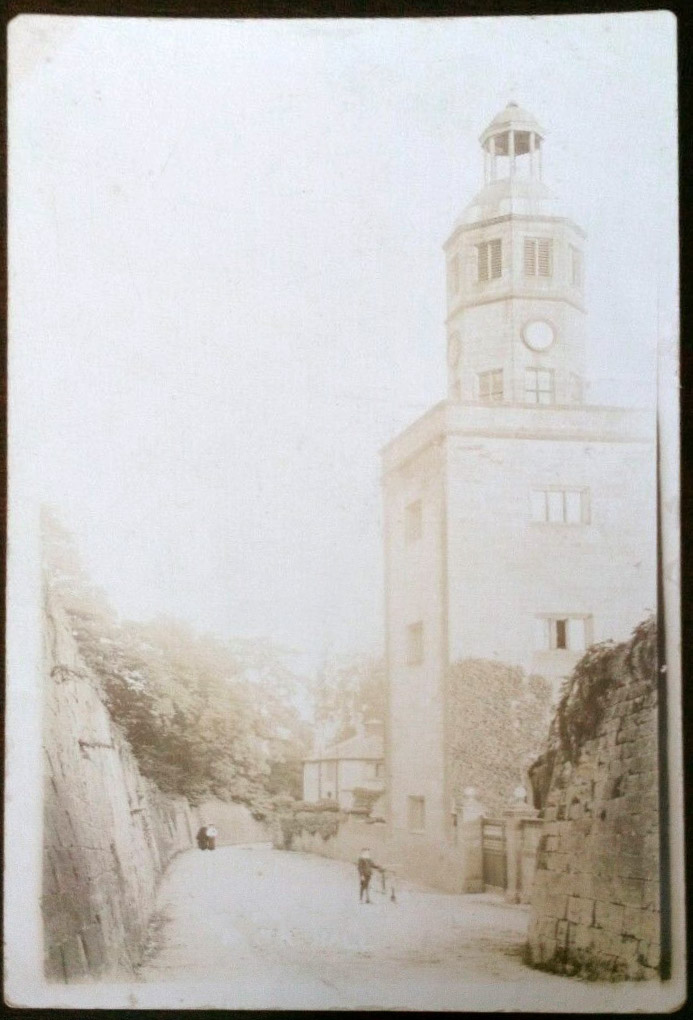
I’m not sure where you might find “Mother Town Marvels” online. Google appears to know almost nothing about them, and the Facebook “Our Burslem” group (seen noted in the corner of the window) is a general one.