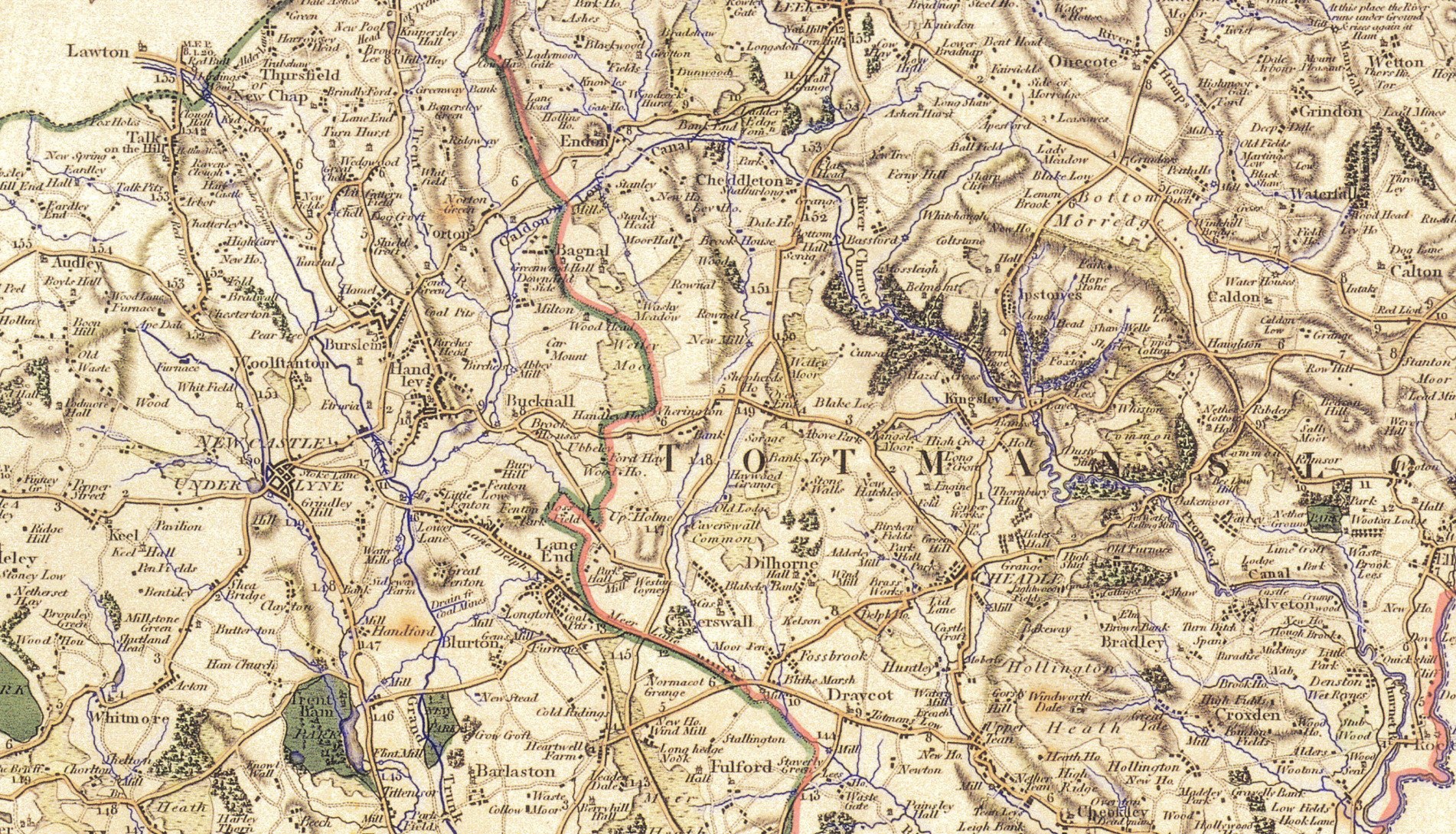
Yates’ 1798 map of Staffordshire

The Yates’ 1798 map of Staffordshire, here the section from Barlaston to Leek. And also the route from Red Street (the old Roman road rising up off the Cheshire Plain) across to the ridge-following ‘Earslway’ that once led to Alton Castle.

For those unfamiliar with the area, the towns “Burslem” and “Handley”, the various hamlets of “Fenton” and the outlying “Lane End” later become Stoke-on-Trent. “Totmanslow” is the Hundred. Alveton (bottom right) is now Alton.

The stink of the Amazon

Gawd, Amazon just gets worse and worse and worse at search results. I’m an expert searcher and it gives me results that are utter rubbish. It’s now almost impossible to get a forward look at what’s coming or what’s been published recently in books. Something is very badly wrong with their algorithms, if it isn’t just down to cynical ‘confusion marketing’.

What’s the alternative? Hive.co.uk, on sorting for books / release dates, gives the searcher a better result, though still not perfect and without dates on the results themselves.

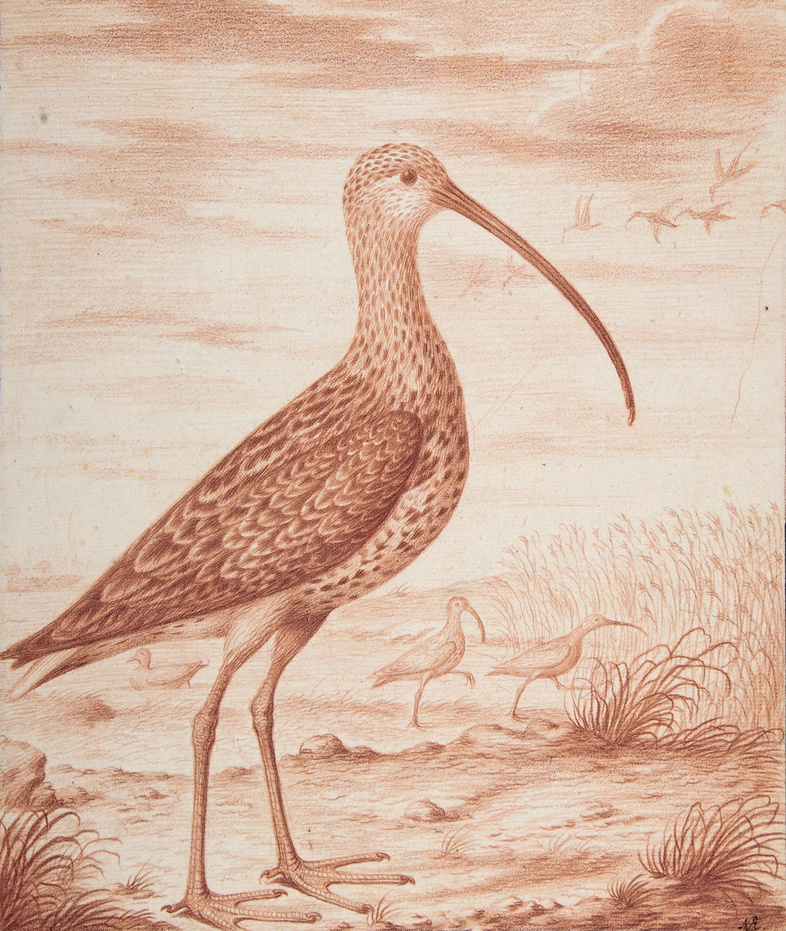
The call of the curlew

There’s a new three-year national and funded curlew survey, ‘Curlew LIFE’, recruiting staff and starting up now. It’s paired with a major new…

“England Curlew Recovery Partnership … set up with government support, which will explore opportunities to embed curlew recovery within Defra’s new Environmental Land Management Scheme (ELMS), which will reward farmers and land managers for environmental work.”

Tolkien’s “league”

The measure of a “league” occurs many times in the speech of those in Middle-earth. What was Tolkien’s “league”, and how many miles did it have in it?

The league used in Ancient Rome was defined as 1½ Roman miles, a Roman mile being 5,000 feet or a thousand paces for a Roman pacer or legion. Thus a league would be 1,500 paces or about 1.4 miles today. A typical day’s journey of six Roman miles on foot would thus be two leagues in the morning, and another two in the afternoon. The traveller would then have covered 5.66 modern miles. It should also be noted that the Roman mile continued in use in England until changed in the year 1593 under Queen Elizabeth I.

However, buried in a deep appendix is the information that the Numenorians effectively used a standard three-mile measure for their league. “5,277 yards, two feet and four inches, not the modern 5,280 yards”, according to Middle-earth Distances Table (2007), with the slight difference making little difference. Thus the modern ‘three modern miles’ measure and Middle-earth measure appear to agree. This can be somewhat tested with reference to “The Riders of Rohan” chapter of LoTR

Aragorn smiled. ‘Keen are the eyes of the Elves,’ he said.

‘Nay! The riders are little more than five leagues distant,’ said Legolas.

[Waiting for the approaching horseman, who are “riding like the wind” when on the firm downland track…] The time passed slowly and heavily.

Eomer and his Eored are thus spied by Legolas when they are some 15 miles distant, and they are not coming on in quite a direct line. They are climbing a rising track from a wide open river valley and then coming on fast across open downland, easy riding country. The horses are male, which go faster at speed and tire less than mares, but they carry heavy gear and large men.

At a fast trot and with a good stride a lone modern horse might take 100 minutes to cover a 10 mile course, or ten minutes per mile.

If we assume the highly-trained Eored with powerful horses is making an average of six minutes per mile, then it takes them about 90 minutes to reach Aragorn, Gimli and Legolas. This seems about right, and feels more right than if the Roman league were assumed, which would put the Eored at seven miles distance when first seen by Legolas and thus arriving in just 40 minutes or less.

The league is a natural and human measure, either way. In pre-modern times a burdened traveller might hope to make six miles a day, and thus a Numenorian league was either a morning or afternoon’s walking and a natural distance to ‘think in’. A day would then involve two leagues of travel, more or less. Similar was the Roman ‘two leagues’, or some 2.8 miles. An army could also cover distance at about the same speed. For instance when Marlborough’s Army of 1704 covered 250 miles from Bedburg to Ulm, they made six miles a day. Compare this to a Roman legion, light-marching efficiently on good Roman straight roads with supply stations along the route. They were expected to be able to make 20 miles a day, for several days at a time.

Thus, when one reads “league” in LoTR perhaps the easiest way to translate it is as “a half day of walking”. If something is “two leagues away”, it could take a day to reach it on foot. If it is “ten leagues” away then one should allow about a week to walk there, assuming reasonable tracks and not getting lost or stopped. The three companions (Aragorn, Legolas, Gimli) are, however, running fast across open unwooded terrain in the wolds of Rohan.

There is another test, one for walking when speed is absolutely essential. When Faramir reports to Denethor, he uses “leagues” as measurement, and Gandalf also comments on the speed and distance…

“I parted with them in the morning two days ago,” said Faramir. “It is fifteen leagues thence to the vale of the Morgulduin, if they went straight south; and then they would be still five leagues westward of the accursed Tower. At swiftest they could not come there before today, and maybe they have not come there yet. [Gandalf then comments] ‘The morning of two days ago, nigh on three days of journey!”

So three long days of journey, on relatively good paths (and some road) through Ithilien to the cross-roads and beyond, going as fast as possible and with a cunning and swift scout, equals twenty leagues or 60 miles. They are being expect by Faramir to make 20 miles a day at the very fastest, in relatively easy country. If he assumes 12 miles is more likely for a day’s average in Ithilien, then the average would be two three-mile leagues in a morning and another two in the afternoon. Really pushing themselves they might actually do three in the morning and three in the evening, which would then be 18 miles, plus another two miles by night. That would give the 20 miles that Faramir offers. They do indeed make that on the first day’s long march (“seven leagues”) at least.

Slightly earlier, on the journey down to Ithilien, Gollum also gives a clear indication of travel times… “By his reckoning it was nearly thirty leagues from the Morannon to the cross-roads above Osgiliath, and he hoped to cover that distance in four journeys.” So that would be seven and a half leagues (just over 22 miles) per night, travelling over country slightly away from the road but parallel to it, fed with sustaining lembas and with an experienced and swift guide to follow.

The Shire, with the Westmarch added, was 50 leagues from end-to-end and north-south, or about the same area as modern England if measured from the Isle of Wight up to the Yorkshire Moors. Or from Norwich on the east coast across to Aberystwyth in the west, adding England to Wales. It would thus take some five weeks to walk across the Shire at medieval speeds, depending on how much time was spent supping in inns and hearing news from travelling dwarves. However, the ‘Ithilien’ speed suggests it might be done fairly pleasantly at three leagues a day by foot travellers in a hurry, which means perhaps a journey of three weeks.

As for fathoms, this is another sensible and human measure. A fathom is about the distance of two arm-lengths for a grown man, or six feet. For many this would also have been about the height of a man, maybe a little less. However for hobbits this would be less, perhaps three feet, since they have small bodies (to the tall and strapping men of well-fed Gondor, Pippin looks like “a lad of nine summers or so”). Thus, when Frodo peers over the edge of the sharp cleft in the Emyn Muil, and estimates the drop at “about eighteen fathoms” he may mean about 50 feet or a bit less. Since hobbits never miss when throwing stones and shooting arrows, we can assume they are also excellent at judging distances by eye. However, when a tall man like Strider estimates a distance in fathoms, he would probably be referencing man-lengths.
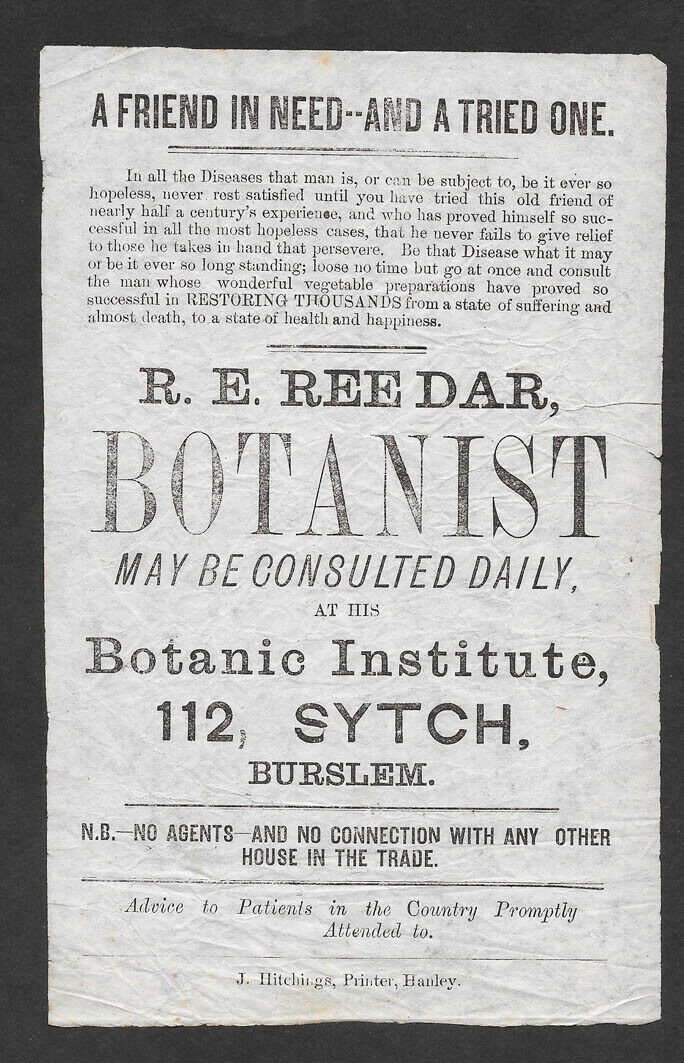
The Botanic Institute, Burslem.

My novel The Spyders of Burslem features the last of the ‘cunning’ men, Jimmy Tunnicliffe, at the end of the 1860s. I’m pleased to discover that there was a real if rather more upmarket equivalent to Jimmy Tunnicliffe in Burslem and, by the looks of it, at more or less about the right time. Evidently there was a ‘Botanic Institute’ herbalist on The Sytch (which also appears in the novel), by the name of Ree Dar or Reedar.

If he could get out to country patients (see the bottom of the flyer) evidently he kept a horse and gig. Which would make sense, since he would also need to have a means of getting out of Stoke to gather herbs in their season. Though such people also had ‘gatherers’ I seem to recall.

More recent Tolkien work

Here are some more picks from the latest public and free Tolkien scholarship, following my last such. That was posted here back in November 2020.

* “The ‘Polish Inkling’: Professor Przemyslaw Mroczkowski as J.R.R. Tolkien’s Friend and Scholar”. May have something relevant, re: exactly when Tolkien first discovered his true ancestry. (Update, no insight re: ancestry, but it does illuminate Tolkien’s publication-history in Poland)

* “The Tale of the Old Forest: The Damaging Effects of Forestry in J.R.R. Tolkien’s Written Works”. “… Finally the essay reconstructs a linear history of the Old Forest through posthumously published materials such as Unfinished Tales of Numenor & Middle-earth to discover the causes of the Old Forest’s villainy”. (Update: lacks the hoped-for focus on deep-history ’causes’, unconvincing on these)

* “Tolkien and the Age of Forgery: Improving Antiquarian Practices in Arda”. “…Drawing on previously unpublished folios from Tolkien’s undergraduate notebooks…”. Nice, anything that gets access to unpublished items from that period is of interest to me. (Update: the “folios” turn out to be just lecture-notes from a first-year lecture he attended)

* “Alcuin and Cynewulf: the Art and Craft of Anglo-Saxon verse”. Text of the Sir Israel Gollancz Memorial Lecture for 2019. A section at the end… “considers the authorship and identity of Cynewulf”. Yes, since 1954 he’s no longer been considered by academics to have penned the actual earendel lines, but interesting all the same. (Update: the Appendix is substantial, and reconsiders the neglected ‘was he the Bishop of Lindisfarne’ suggestion, which was an early suggestion that was overtaken by later findings re: Mercia).

* “‘I Dwelt There Once’: Home, Belonging and Dislocation in J.R.R. Tolkien’s The Lord of the Rings”. (Philosophy dissertation from Finland, and it looks fairly sound). (Update: An excellent piece of work, very illuminating of an important theme running through LOTR).

* “‘Her Enchanted Hair’: Rossetti, ‘Lady Lilith’, and the Victorian Fascination with Hair as Influences on Tolkien. “Gitter may claim that ‘the Victorian vision of magic hair did not survive long into the twentieth century’, but in Tolkien’s early- to mid-twentienth-century writing it is alive and well, and even embellished upon.”

The reading of my previous listing of interesting recent work yielded a variety of interesting items. Some observations: The Zeppelin essay was terrific and definitely informs the flying Nazgul and various forms of ‘far-seeing’ in LOTR. Tolkien was no palaeographer, despite his good ‘hand’ with a pen and his interest in ‘hands’ both in the speech-gestural and scribal meanings of the word. He was likely at work for the OED by Christmas 1918. The terrific new book The Transmission of Beowulf (2017) very strongly supports Tolkien’s early dating of Beowulf. The Rohirrim can be said to have early Mercian names, if one investigates the full names in the notes Tolkien made for the benefit of his translators. An Exeter Book photographic facsimile was produced in the early 1930s. A new earendel variant has been found in an early Gothic sermon. I also note that too many Tolkien items are still hidden away in tiny inaccessible journals such as Orcrist or obscure and expensive ‘academic library’ chapter collections, e.g. Larsen, Goering, and also the final reading of the earendel variant.

More regrettable changes at Facebook

More Facebook changes today. Shortly after the move to the new UI they had it perfect, apart from the annoying and utterly pointless “See more…” click-iness. They had saved themselves, after the Great Exodus.

But now they’re slowing starting to ruin it again, with more changes. They’re also soon to push more work on Group admins through regrettable back-end changes.

The latest change today is to huge ‘blaring’ images. These now overpower the text and links, and make it difficult to concentrate on these. The new ultra-wide central column now also makes it more difficult to read across the text. With this and the very unwelcome Group changes coming, I’m definitely considering taking all my Groups over to an amalgamated WordPress blog. Most likely with a newspaper-like template. By which I mean an old-school news newspaper, not one of the modern hives of clickbait and pop-ups. Though perhaps not quite this old-school.

It’s surprisingly difficult to use search to cut through the ocean of robo-made shovelware templates, but Gabfire’s old $60 WP Newspaper (aka Advanced Newspaper, or Advanced WordPress Newspaper) theme is still a classic and now in v3.6. Here blurred and inverted so you can see the basic structure and how it might look with a Dark Mode on it…