Dr. Fergo’s Last Passion

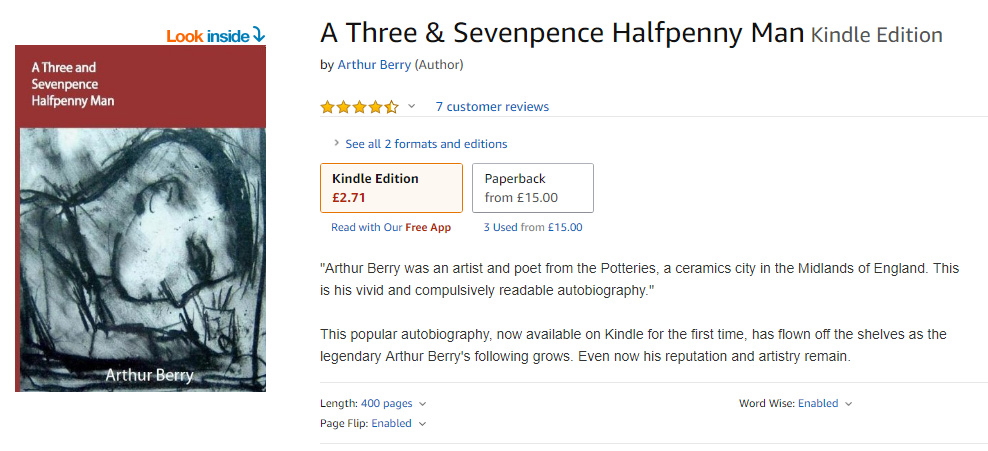
Popping up on eBay, the programme for the Arthur Berry play Dr. Fergo’s Last Passion (aka Doctor Fergo’s Last Passion) from 1979, later followed by Dr. Fergo Rides Again in 1982. New to me. Described as “a rude ballad opera” with comedic songs, by a snippet from one old paywalled newspaper review. It has a local Potteries setting.

Regrettably there never seems to have been a recording or a radio version. Presumably the scripts and staging directions are still available. Might it then be revived? Possibly it would be too bawdy and ‘incorrect’ for our censorious times, but perhaps it could be done as a full-cast audio-only recording?

Another mega-Tolk

Another round up of interesting new Tolkien items, mostly free:

The Journal of Tolkien Research has a new issue. Three new papers from the prolific Kristine Larsen, all of interest.

* Who Maketh Morwinyon, and Menelmacar, and Remmirath, and the Inner Parts of the South (Where the Stars are Strange): Tolkien’s Astronomical Choices and the Books of Job and Amos.

* Smaug’s Hoard, Durin’s Bane, and Agricola’s De Re Metallica: Cautionary Tales Against Mining in Tolkien’s Legendarium and the Classical Tradition.

* “Ore-ganisms”: The Myth and Meaning of ‘Living Rock’ in Middle-earth.

Also three indexes, all apparently new, to key Tolkien journals.

Another bumper Mythlore issue, including…

* All Worthy Things: The Personhood of Nature in J.R.R. Tolkien’s Legendarium.

* The Shape of Water in J.R.R. Tolkien’s The Lord of the Rings. (water symbolism)

* The Enigmatic Loss of Proto-Hobbitic. (the languages of early hobbits)

The latest Fafnir has…

* Book Review: Music in Tolkien’s Work and Beyond.

* Book Review: Utopian and Dystopian Themes in Tolkien’s Legendarium.

Unexpected has…

* Pius Samwise: Roman Heroism in The Lord of the Rings.

A paywalled book chapter, but of mild interest…

* Medieval Animals in Middle-earth. Update: May also be open access (temporary?) here.


Also an event, The Inklings and Horror: Fantasy’s Dark Corners – Online Winter Seminar 2022.

Tolkien Studies 2021

Tolkien Studies 2021 has landed on Project Muse. Including, of interest to me…

* Speculative Mythology: Tolkien’s Adaptation of Winter and the Devil in Old English Poetry.

* A review of Garth’s fine new book The Worlds of J.R.R. Tolkien: The Places That Inspired Middle-earth.

* The Year’s Work in Tolkien Studies 2018.

* Bibliography (in English) for 2019.

A full listing including abstracts is at Tolkienists.

The no-so Radical Potter

The Spectator reviews the new book The Radical Potter: Josiah Wedgwood and the Transformation of Britain. Those worried that the book might be a socialist wokewash of the man need not fear, because…

“there is not much sign of the ‘radical’ of Hunt’s title [except for] his manufacturing of the anti slave-trade medallion featuring a generic African in chains […] Similarly, the casting of a medallion to celebrate the French Revolution seems less of a radical act when we learn that Josiah’s son suggested that the figure of Liberty could easily be modelled on that of Hope in [an existing Wedgwood] medallion celebrating the colonisation of Botany Bay [i.e. the prison colony in Australia].

Yes he was an abolitionist and lent his name to petitions and suchlike, and even served on a committee, yet so did a great many of his class at that time. My feeling is that such a leading businessman would have had to ‘go above and beyond’ the usual in his efforts, in order to be now claimed as a political radical (in the way that modern leftists think of such things). Also, he would not have seen overseas slave-holding in modern terms. Back then it was often presented as a practice incompatible with Christian and British values of personal liberty and freedom of religious-conscience, and thus framed in terms that do not sit at all well with modern authoritarian leftists.

Conversely he also had a passion for Free Trade, the other great cause of the time. This meant he sold globally and to all comers — and thus today’s leftists can find a few early Wedgwood pots in overseas slave plantations if they dig hard enough. But it seems they can go little further in their witch-finding, without dragging out the old false claim… that the slave trade provided the capital for the Industrial Revolution, and thus set up Wedgwood for success. This claim has, in recent decades, been strongly and convincingly debunked.

Take a punt…

I’m pleased to see that Tom Fort’s book Downstream is now on Archive.org to borrow. He follows the course of the Trent in a punt, but first investigates in some detail the river’s moorland source and non-navigable upper reaches. The scan is bad, even by Archive.org standards, but it’s readable.

I gave a hardback copy to Stoke-on-Trent central reference library about a decade ago, but it seems it never made it to the shelves.

George Heiron (1929-2001)

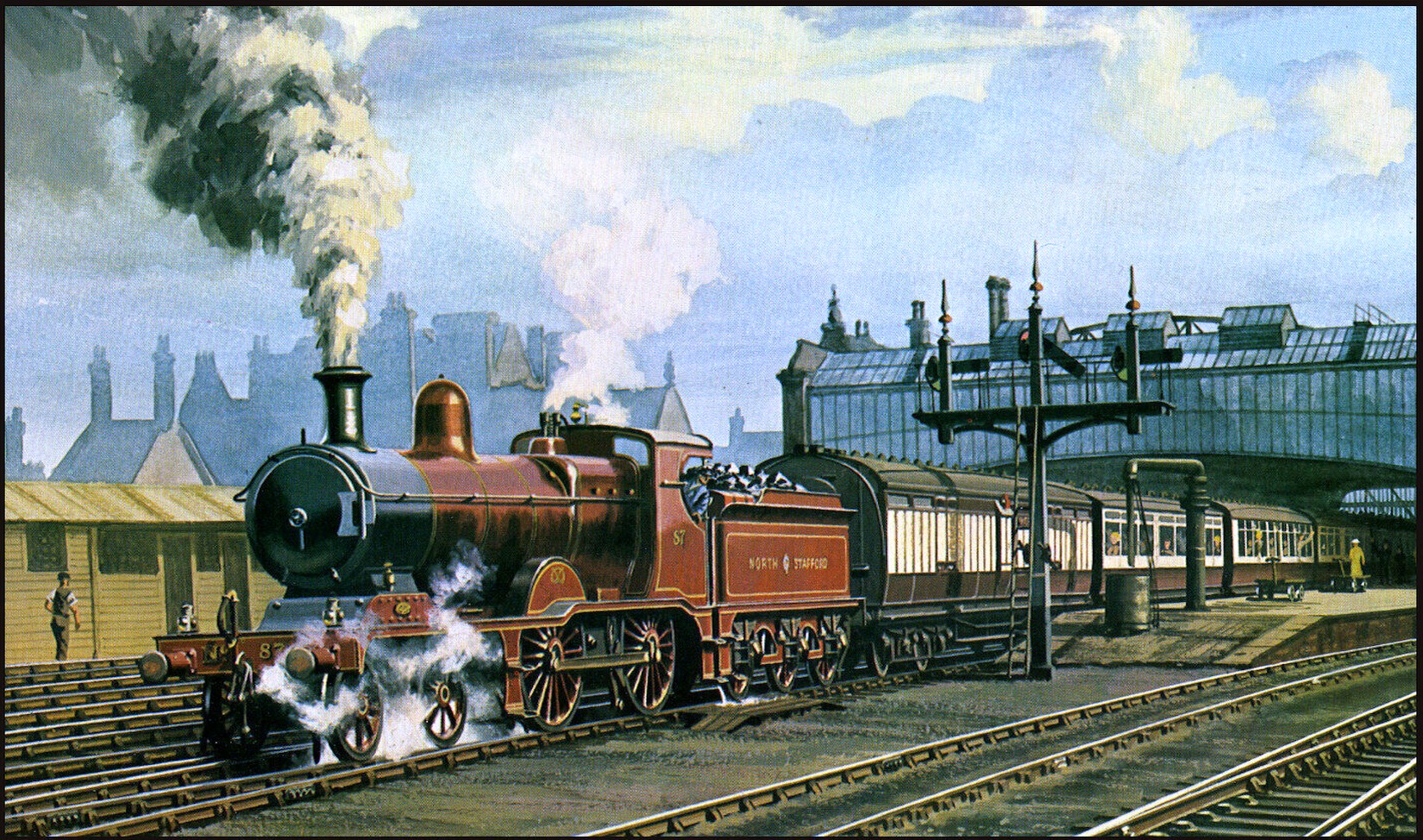
On eBay, a fine painting of Stoke Station by George Heiron (1929-2001) with a local train and the North Staffordshire Hotel in the background. I have no passion for trains steam or otherwise, as machines, but the background and setting are interesting. Still a very recognisable scene today. His 2000 book The Paintings and Photographs of George Heiron can still be had second-hand for a reasonable amount. One wonders if there are more from Stoke & Staffordshire?

A nice Offa

A fine job, relatively nearby…

Offa’s Dyke Projects Officer. Shropshire Council is seeking an enthusiastic and appropriately experienced Project Officer to deliver a programme of conservation works and public engagement for Offa’s Dyke.

Saxon caves found at Burton

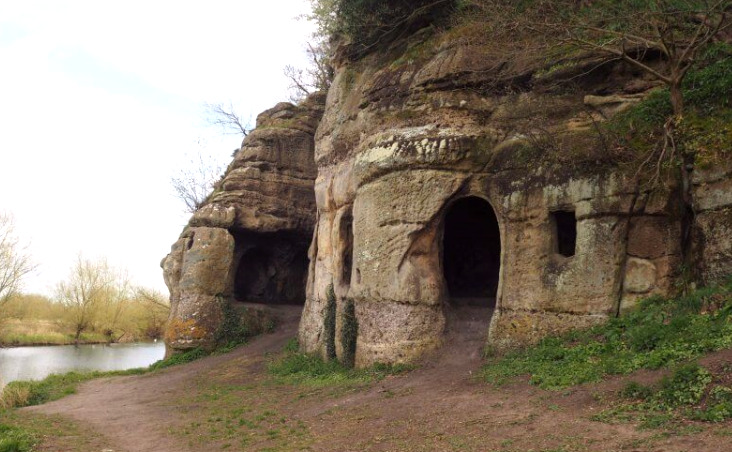
“A near-complete Anglo-Saxon dwelling and oratory has been discovered, believed to date from the early ninth century” and located a few miles from Burton-upon-Trent. “The caves had long been considered to be 18th-century follies”, but a detailed new study by the Royal Agricultural University and Wessex Archaeology shows them to be much earlier.

The PDF is not yet online but the abstract has…

“… Saint Hardulph, a deposed Northumbrian king who seemingly retired as a hermit at this site. The fabric of the cave itself has [long been assumed to be 18th and 19th century, re:] nearby Foremarke Hall. Analysis shows that such a late origin for the structures is very unlikely, and that modifications in the 18th or 19th century were on a small-scale and saw no significant enlargement…”

“… many fair letters of strange and ancient shapes”

Yet more interesting new papers on Tolkien, freely online…

“Tolkien, Manuscripts, and Dialects”.

“Where the Shadows Lie: Tolkien’s Medieval View of Free Will, Temptation, and Evil”.

“Earendel and the Dragon” (compares the three battles against Melkor “to depictions of astronomical events in … medieval annals”).

“Tolkien Beyond the Myth” (Law & Liberty review of the new book Tolkien’s Modern Reading: Middle-earth Beyond the Middle Ages).

“Journey Back Again: Reasons to Revisit Middle-earth” (Mythlore book review, summer 2021).

“The ancestors of J.R.R. Tolkien” (abstract only, paper withdrawn… “his grandfather John Benjamin (1807-96) had a thriving music business at 70 and 87 New Street”, Birmingham).

“Retracing Classical Motifs: Classical Reception of Greek Epic Cycle in Tolkien’s The Silmarillion” (substantial abstract and bibliography only) (if you’re not a member of Academia.edu you can only get the public PDF download via a link from a Google Scholar search).

“Tolkien : essai d’une lecture philosophique” (in French, appears to argue that Tolkien’s major creations can be considered a legitimate “work of philosophy” even though he was not a trained philosopher).

Ford and Bridge at Great Haywood

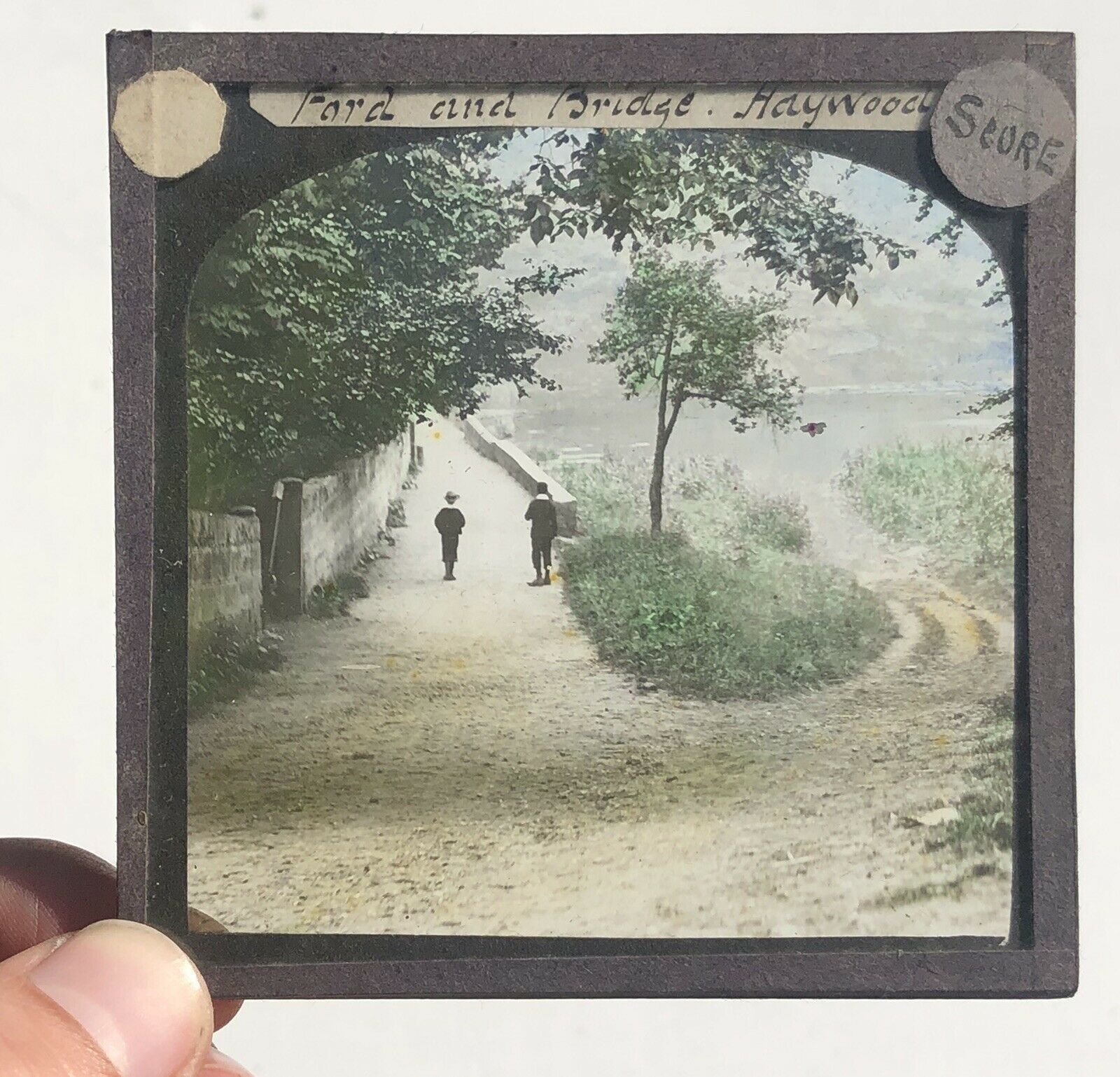
This may interest Tolkien people. A c. 1900s lantern slide of the ford and bridge-end at Great Haywood. Photographed from the village side, as Tolkien would have known it perhaps 10 or so years later. The ramp goes up onto the bridge. The colorising is on the original.

Comparing it to more or less the same view as seen in a wider and winter form in British Isles, depicted by pen and camera (1904), and judging by comparing the growth of the small tree, the date here is perhaps summer 1904 or 1905. Most likely the latter, and possibly even 1906.

The “Score” label presumably means that, when viewing in a sequence, its appearance would have been accompanied by music.