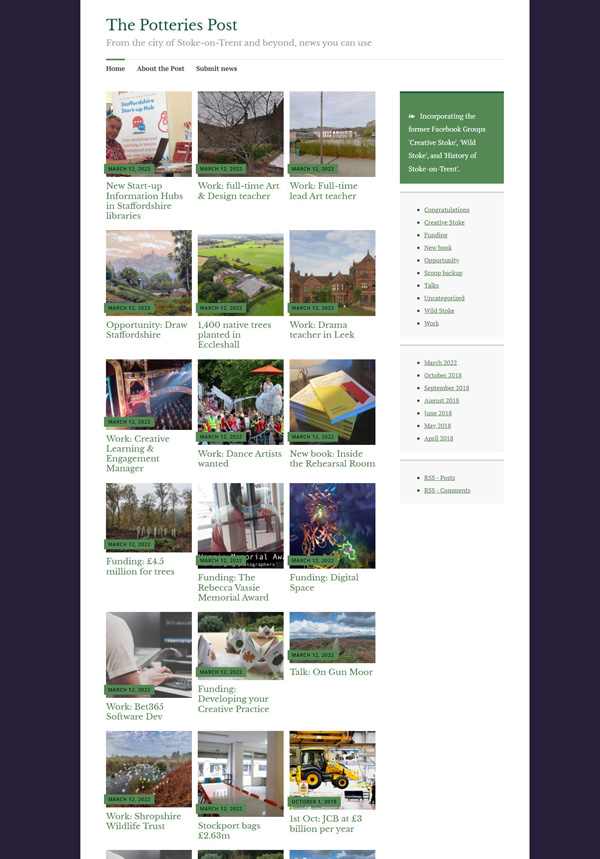
Leaving Facebook

Facebook locked my account last night, and the 11th March 2022 deadline for response has already passed.

Looks like I have no choice but to leave Facebook.

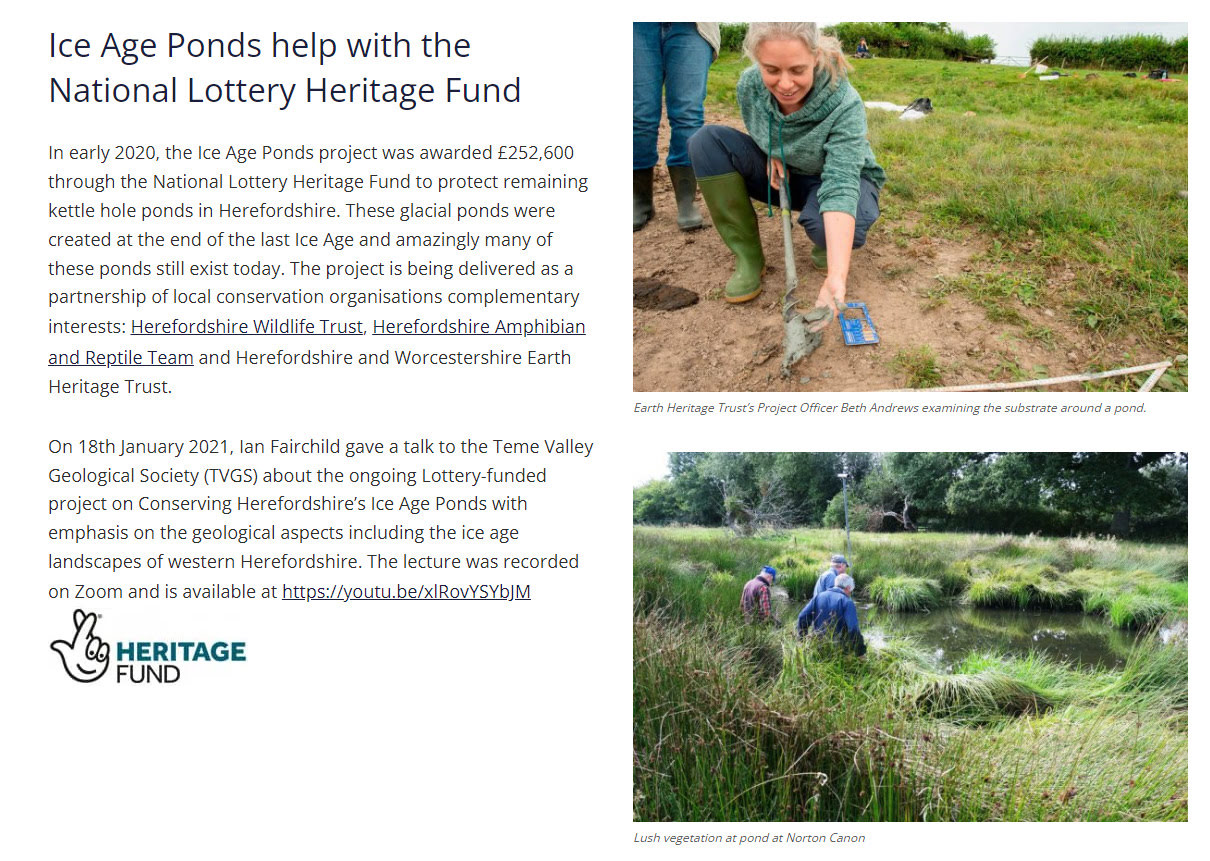
This affects the large Facebook Groups ‘Creative Stoke’, ‘Wild Stoke’, ‘History of Stoke-on-Trent’, and the smaller groups ‘Folklore and Tales of North Staffordshire’, and ‘Pottering Around’.

I’ll be looking at alternative options today.

Meades on Burslem

Jonathan Meades, mentioning Burslem in the latest edition of The Oldie magazine…

“[…] George ‘Metz’ Robinson, whose masterpiece, Burslem Town Hall, is not Gothic. It is not even ‘Modern Gothic’. It is ur-Victorian and belongs to no known school [of architectural design]. [‘Metz’ became a newspaper art critic, but as a journalist in his younger years] he was sent to cover the Franco-Prussian War and was banged up in Metz during the siege – hence his nickname.” [He and his fellow] artists were outsiders – not part of the web of local [municipal architectural] practitioners who, decade after decade, have questionably enjoyed the bulk of municipal and commercial patronage [and who as a class came to be so corrupt both financially and aesthetically in the 1960s and 70s. Robinson can be compared to the men of later 19th-century Birmingham, who in architecture] “developed an idiom that has no peer in England [and who succeeded in making] Birmingham unique in its creation of an arts-and-crafts urbanism” […] “It can hardly be labelled a movement, but there is an undeniable accord between buildings of different types and uses.”

His article is actually on Birmingham but, as usual with such things, south Birmingham relentlessly hogs all the limelight. The article never strays north of the city-centre’s Broad Street. There’s a whole other north Birmingham up there, about which a young Meades admirer might make a Meades-like video series.

Bernard Hollowood

Add one to the ‘famous people from Burslem’ lists.

Bernard Hollowood (1910-1981), born in Burslem, became a cartoonist and then the editor of Punch magazine from 1957 through 1968. The magazine is forgotten now except among the over-70s, but Punch was then the leading British humour and spot-cartoon magazine of the post-war period.
Where is ‘The Forest of Mercia’ – the map

I had to search long and hard for this. An actual map of the area covered by the ‘Forest of Mercia’. The area starts below the ‘Chase’ bit of Cannock Chase, and runs down to just north of the urban rim of Wolverhampton, and then also runs south a bit around the city.

They’re currently one of the partners in DEFRA’s new £12.1m national tree-planting boost, and as part of that are locally delivering planting into early 2022… “a mixture of small-scale planting, some on school grounds and others on larger scale public open space. Native trees and shrubs will be planted … Some sites have also been identified for the planting of orchards”.

The Potteries in the year of the Great Exhibition – extract

From “The Potteries in the year of the Great Exhibition”, issued as a 28 page booklet by the Festival Committee of the Council of the City of Stoke-on-Trent, to mark the Festival of Britain in 1952.

The paragraph below was part of a short extract published at the back of the Festival brochure. Here edited for clarity, sense and errors.


“The traveller [when walking from Stoke to Hanley in the year 1851], once off the main thoroughfare [in Stoke town], was almost immediately in open country. After passing the railway bridge [at the top of] Liverpool Road, Stoke, he would walk towards Hanley along a main road with green fields on either side, flanked by trees and hedgerows with cattle and sheep grazing right [down the hill] to the point where the Station Road ‘bus stop stands now. Directly opposite stood the isolated house known as Winton Villa (still visible from the railway bridge [to those travelling on a train, but] now built around by N.C.B. [National Coal Board] offices). [This Villa was] then the abode of Robert Garner1 one of the early surgeons attached to what is now the Royal Infirmary (but which was then situated [nearby] in Etruria Vale). The fields later consecrated as the [Hanley] Cemetery rose above the hollow lane which became Stoke Road. Blackberry bushes grew at its side. The [road to Hanley rose to cross the line of the Cauldon canal (1779) which] flowed by tall trees in which magpies nested (which gave the name to [nearby] Pynest Street). [As the traveller crested the final rise into Hanley he looked back west and saw] The valley [spread out below. This was] watered by the Fowlea [Brook] and was very pretty — the waters clear, sweet and full of fish. In the meadows along its banks, even beside the new railway, the shepherd still guarded his flocks.”

1. As well as a leading local medical man, Robert Garner was one of the founders of what became the North Staffordshire Field Club. In old age he became ‘The Father of the Club’.


A trip into the Peak by rail

The Rev. James S. Stone takes a railway journey to the Peak from Derby through Staffordshire, in the early 1890s. He usefully notes a country-folk saying at Uttoxeter… “smiling like a basket of chips”, presumably referring to the ways that long thin chips each curl into a ‘broad smile’ when fried. He also usefully refers to a long 1723 poem “attributed to Ambrose Phillips” which vividly described the bull-running and folk festivities there.


[Travelling on the train from Derby] We behold the hill on which stand the ruins of Tutbury Castle rising abruptly and commandingly from the plain. Some ingenuity has been expended upon the etymology of the name of this place; and possibly they may be right who contend that the name comes from the god Tiw, whose immortality is more ensured in the nomenclature of the week [i.e. the day-name of Tues-day] than in memories of his celestial and military glory. Indeed, except by scholars, forgotten is the wolf-bitten deity who went to the battle sure of victory, and by the ravens and wolves was followed to the fields of the slain. He sent pale fear to the hearts of the foe and out of forest shades burst upon the unwary, and from their throats forced the death-cry. Worthy of his all-golden mother and of Odin was Tiw thought to be, but whether Tutbury was one of his shrines or was even named after him, I am not careful to inquire. […] Few places are more picturesque [seen from a train]. The broken walls are partly hidden among the heavily-foliaged trees, and, seen from the valley, suggest the romance of the days that can never come again. […] nature has given a glory that enhances and makes more than ever delightful this fortressed height. The ivy winds along the crumbled battlements; the elms bend their green boughs as though to hinder the gaze of the over-curious. As I look up to the towers, again the sunlight breaks upon them — the same dear, merry sun that Mary, Queen of Scots, and Charles the First beheld, when so long ago they for a brief while dwelt there.

While the train moves slowly on, I can tell you that in bygone days this Tutbury was a gamesome place. […] The gleemen [jesters and minstrels] were apt to dispute and even to quarrel among themselves, to prevent which John of Gaunt ordained that one of their number should be appointed governor and arbitrator over the rest, and styled ”King of the Fiddlers”. […] Nobody living has seen such fun as was provided for the singing men. On the feast of the Assumption of the Blessed Virgin — the August Lady Day, as it was sometimes called — a bull was turned out of a barn [for bull-running]. The uproar occasioned by [the minstrel’s annual bull-running] is described in a ballad which may be found in the first volume of a collection published in 1723, and attributed to Ambrose Phillips; the said ballad being entitled, “The Pedigree, Education and Marriage of Robin Hood with Clorinda, Queen of Titbury Feast.” I do not know that the editor of the book referred to is right in describing this song as ”the most beautiful and one of the oldest extant, written on the subject”, but from it we learn of the strange shoutings, the mad looks, the fighting and the fiddling while the “bagpipes baited the bull.” […]

It is not altogether the mingled light and shade which make the country look more beautiful the farther we go. Yet broken clouds are helpful, and the sunshine which falls through the rents and rifts gives a peculiar and winning charm to field and hillside, blending colours and softening lines, deep and rich as in a vignette of finest workmanship. For these bits of loveliness we may well be thankful; also for the leisurely progress of the train which enables us to mark the sinuosities of the river and the approaches of the forest. Sudbury is on the edge of the great tract of woodland known as Needham, and through the trees one catches a glimpse of the fine red mansion built in the seventeenth century, and set in a park of more than half a thousand acres. Other halls come into sight further on; also church spires, and before we reach Uttoxeter we distinguish the Weaver Hills, a bleak and dreary range which here marks the beginning of the Peak country.

At Uttoxeter we change trains for Ashbourne. There is no need of hurry: this is another of those happy places where people take time to live. Therefore we can possess our soul in patience, and while the shower which now has broken upon us lasts, wait under shelter. Moreover, the guard is not ready. Judging from the high words that are passing between Him and that rustic clad old man by the booking office, he has trouble on his hands. “Ducks”, I hear him say. The old man sold him a pair and did not remember how long a time had elapsed since they were killed. Poulterers are often forgetful of such matters.

No, I cannot say whether that extraordinary-looking lady, with the curls and the sharp nose, is the wife of the clergyman who is holding over her two-thirds of his gingham. He is gray: she has reached that age in which a woman stays the number of her years [i.e. fibs about her age], not being willing to say one thing one day and another thing a twelvemonth later. Her packages are numerous and heavy: the good man carries them for her and listens as she talks to him, now about her little nephew’s whooping cough, and now about somebody’s girls she saw at Cheadle fair. Was ever face so funny as hers? She is not his wife. Perpetual virginity is marked in every expression of her countenance and voice. She has no more chance of getting a husband than an English curate after five and thirty years of service has of getting a benefice [i.e. a promotion in the Church]. And [yet] she, the maid I mean, is happy — smiling, as the country people say, like a basket of chips — though for the life of me I do not know how chips can be supposed to smile. Now he is telling her a story, the dear soul; but he will spoil it, unless he looks graver and gets along a little faster. As he laughs, she laughs. I suspect she already sees the point of the story, for these maidens of uncertain years are very knowing. And then the rain pours down, as though Staffordshire had fallen into the region of the Doldrums. […]

Again we move. The rain has ceased, and we lose sight of Uttoxeter spire as we wind along the strath of the Dove. Now the sun comes out. Rocester reminds me that we are not far from Alton Towers. […] Here is the last station next to our journey’s end. Now is the parson leaving the train; also his female friend. A trap [horse and cart] is waiting for him and his hamper [large square wicker basket] of hens and guinea fowl. He must farm his glebe or, at all events, grow his own poultry. That stalwart lad in knickerbockers will surely wring the old man’s hand off: he has a heartier and more natural grip than the London tip-over. Even the wrinkled and happy maid likes his grasp, though she winces slightly as her hand writhes in the vice.

“Tickets,” says the collector at the door. “Any chance of getting to Ashbourne before night?” “There directly, sir.” Bang goes the door. “Get in,” cries the guard; “going.” Blessed prospect! We have been going for the last two hours, and yet number only twenty-seven miles from Derby.

Down pours the rain again: surely the gods have tipped over the bowls of water. The woodpeckers will now have enough to drink [as] the showers fall in sheets. [He refers to the belief that the birds could only drink from rain-drops]. And there is Ashbourne, nestling between the green hills, with its beautiful church, the Pride of the Peak!

The railway ends here, and the man who would venture to carry it further should be sent to Terra del Fuego [the bleak tip of South America] without delay or pity. There is one omnibus at the station capable of carrying four persons, provided they are not children of Anak [i.e. Biblical allusion, ‘very fat’]. Should another Dr. Johnson come [to the Peak from Lichfield] there would be an effort, I imagine, to [carry his big frame in such a bus]. I suppose this plain, little, mudsplashed vehicle goes to the “Green Man,” but nobody seems either to care or to know. However, we get in and patiently abide the will of the gaunt chap who has charge of the Rozinante [Don Quixote’s sorry horse] between the shafts. After attending to his business he prepares to start. To us he is indifferent: slams the door to, pitches a flat and two or three bundles on the roof, passes a joke with one of the porters, and finally mounts the box, jerks the reins and cracks his whip. In two minutes we cross the stone bridge over the Schoo or Henmore, a tiny tributary of the Dove, and from which the town derives its name.

[…] We drive on through the rain till we reach the sign of the Green Man and the Black’s Head Hotel swinging on a beam stretched across the street. Here is our inn. From overhead in the low archway leading into the yard hang a brace of birds, a roast of beef and a leg of mutton. On either side of this passage are stone doorsteps, white and clean. Here a door leads to that part of the house in which are the tap [room] and the large dining-room; there a door opens into the more private quarters, where are to be found, as later we learned, a snug sitting-room and a parlour. At first sight we are satisfied that here is one of those pleasant and comfortable hostelries associated with the stage-coach days of England. The driver lets us out, and at the door we are met by a bright and sprightly maid [who we later learn is] one of half a dozen equally bright and sprightly damsels — a comforting fact, for even a Dove trout tastes better served by a nice-looking, clean waitress. And, indeed, some of these inn-girls are perfect Niobes [classical goddess, destined to bear many children], with lips as dainty and fingers as pink as any the novelists used to give to their heroines.

In Darkness and in Light: Rethinking Joseph Wright of Derby

An online and in-person talk, 16th February 2022, In Darkness and in Light: Rethinking Joseph Wright of Derby.

“Rethinking” is not here a weasel-word for the usual scabrous political axe-grinding. Rather it’s apparently about…

the extent to which Wright, rather than being a spokesman for scientific progress, was actually a melancholic and sceptical outsider, who increasingly retreated into a solitary, rural world of philosophical and poetic reflection, and whose artistic vision was correspondingly dark and meditative.

A full Catalogue Raisonne is also reported to be in preparation for the famous painter.