Dinah Mulock’s ‘Olive’ and the Potteries

The United Methodist, 12th August 1929 had a summary of a paper by local historian Thomas Pape, of a paper on local Potteries novelist Dinah Mulock (daughter of Bryon’s notorious ‘Muley Moloch’)…
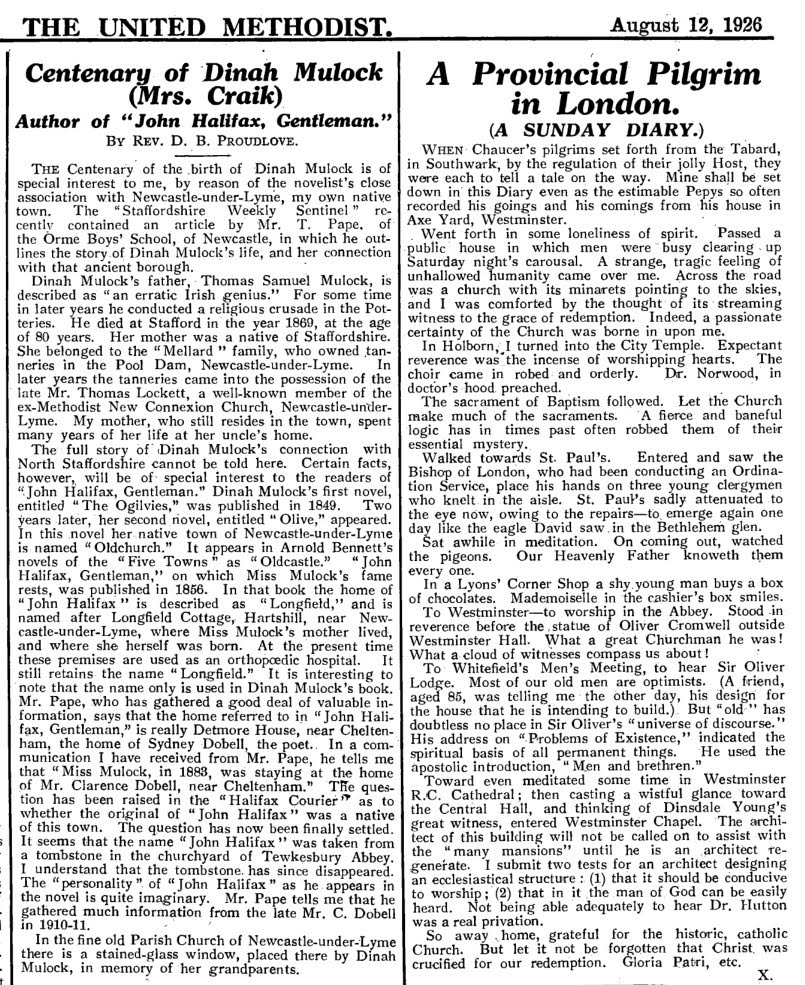
This reveals another Potteries novel new to me. Her second novel, Olive (1850) was one of those sweeping sentimental mid-Victorian three-volume melodramas that in this case, as the article alerts, depicted Newcastle-under-Lyme as ‘Oldchurch’. It has a baby girl born in a gloomy Scotland with a “shoulder deformity” and “curvature of the spine”, “not pretty” and she is rather hidden-away as “a pale, deformed child”. But her father dies and as a young child she moves to England and to the brighter ‘Oldchurch’, where she gradually becomes aware that she is unlike other girls…

[Her new home in the Potteries is] The old hall, seated on a rising ground, and commanding views which were really beautiful in their way, considering that Merivale [Hall, Oldchurch] was on the verge of a manufacturing district, bounded by pastoral and moorland country. Those strange furnace-fires, which rose up at dusk from the earth, and gleamed all around the horizon, like red fiery eyes open all night long, how mysteriously did they haunt the imaginative child! Then the town, Oldchurch, how in her after-life it grew distinct from all other towns, like a place seen in a dream, so real and yet so unreal! There was its castle-hill, a little island within a large pool, which had once been a real fortress and moat. […] there was a curious fascination about Oldchurch. In the cloudy memories of her childhood it rose up, as she used to go there with Elspie [her nurse], at far distant intervals. The two great wide streets, High-street and Broad-street, intersecting one another in the form of a cross: the two churches — the Old Church, gloomy, and Norman, with its ghostly graveyard; and the New Church, shining white amidst a pleasant garden-cemetery, beneath one of whose flower-beds her baby-brother lay. The two shops, the only ones she ever visited, the confectioner’s, where she stood to watch the yearly fair, and the bookseller’s, whither she dragged her nurse on any excuse, that she might pore over its incalculable treasures. [She dwelt there for] “those seven years of childhood, in a little Eden of her own.

Later she is old enough to attend a town ball, and this event starts to reveal her future situation if she were to stay in “prying, gossiping Oldchurch”…

Olive had never in her life before been at an orthodox ‘private ball’, with chalked floors, rout seats, and a regular band. She was quite dazzled by the transformation thus effected in the Derwents’ large, rarely-used dining-room, where [as a child] she had had many a merry game with little Eobert and Lyle. It was perfect fairy-land. The young damsels of Oldchurch — haughty boarding-school belles — whom she had always rather feared, when [her friend] Sara’s hospitality brought her in contact with them — were now grown into perfect court beauties. She was quite alarmed by their dignity, and they scarce noticed poor little Olive at all.

But she strives to overcome her disability and becomes an artist, moving to London.

I also discover that Dinah Mulock had four early fantasy tales for young children, “Little Lizzie and the Fairies”; “Sunny Hair’s Dream”; “The Young Ship-Carver”; “Arndt’s Night Underground”. All placed and published just after she had herself moved from the Potteries to London. Her “Arndt’s Night Underground” can be found in good form in Tales of wonder; a fourth fairy book (1909). It seems unlikely that they have any dashes of Potteries background, judging by the generic setting of “Arndt’s Night Underground”. Still, they’re in the public domain and they might be written or re-told so as to include local colour and placenames.

‘Sunny days are here again…’

A fascinating Met Office report. After about 1972 the cumulative effects of the UK’s Clean Air Acts and central-heating installations probably had a nice side-effect… they gave the Midlands significantly more sunlight in winter and on sunny autumn days. The sun became able to cut through what had before been man-made fug and smoke and haze…

Since 1929… “significant changes [in total sunlight hours] occurred in the winter season, when there has been an increase in sunshine of about 20% for central and northern England. Sunshine has also increased in these areas by about 10% in autumn.”

“These increases could be a result of the Clean Air Acts of 1956 onwards, which has led to a decrease in air pollution.”

The effect was especially marked after about 1970. So… 20% more sunlight reaching the ground in winter by 2004, largely because the winter coal-fires were no longer burning in millions of homes. And it may well have ticked up by a further 5% in 2005-2020, though that’s my guess rather than the Met Office’s figures.

The upward inflection point in sunniness starts around 1972 for the Midlands, according to an accompanying graph. That’s about right, 1970-72 being the point when many middle-class people had central-heating installed and turned the old coal-shed into an outside loo for the garden. The trend would have been amplified by the Oil Crisis which affected industry and began in 1974, alongside wave after wave of nationwide industrial strikes from 1974-79 (factories standing idle etc). Then there was another burst of central-heating installation when Mrs Thatcher gave people the right-to-buy their rented homes in the mid 1980s. The Thatcher revolution of the 1980s also meant that many of the inefficient old ‘smoke stack’ industries were swept away by circa 1986.

Average surface temperatures also then nudged up slightly, in tandem with the increased sunlight. It got a bit warmer because smog, mist and haze had been artificially cooling the land, by blocking warming sunlight. I imagine that the effects were especially pronounced in somewhere like Stoke-on-Trent. The city being said to have often been smoky, especially at times when the pot-banks were firing their wares. It might then be an interesting historical exercise to see if the change can be tracked on the ground, in the data at the city-region level in the Potteries, and if the sunniness effect was actually greater in Stoke-on-Trent. That assumes, however, that the data still exists somewhere in its original un-tampered state. There will also be natural variation to accommodate, for instance the city’s 1986 Garden Festival had a terrible summer of near constant rain, wind and cloud. Not much sun was seen during that entire spring/summer, by all accounts.

Source: National Climate Information Centre Climate Memorandum No. 21, 2006, UK Met Office. Using a data-set that ran to 2004.

Rabbits vs. magpies

Rabbits chasing magpies, seen today. Evidently rabbits are not scared in the slightest of magpies, but magpies are scared of rabbits (when moving at speed, at least). Even when the birds flew off, on being subject to a fast ‘charge’, the rabbits continued to chase the birds half-way across a field.

New book: Treacle Walker by Alan Garner

I’m pleased to see from Wyrd Britain that Alan Garner is still writing, up on the Alderley Edge…

“I had kind of assumed that Garner had retired from writing but this little 152-page novella [Treacle Walker, October 2021] shows him to be a writer still right at the top of his idiosyncratic game.”

“Told in a delightful, poetic lilt we find Joe trapped in a fairy tale adventure as a folkloric cavalcade of fantastic phenomena both vex and aid him as he tries to quietly reads his comic. […] a darkly funny tale of another world, a mythic world filled with old lore, a world of deep, dark woods and the mischievous creatures that live within them”.

Sounds great, and more-or-less local too. Though, on my arriving at Amazon, my excitement was immediately deflated by gushing praise from the leftist Guardian and far-left New Statesman. But thankfully that’s probably just the skew from the publisher, who seems to have had it reviewed in remarkably few places. If you’re not a leftist or a subscriber to the nominally-conservative Telegraph (one glowing review there, paywalled) you wouldn’t know it existed. I certain didn’t. Searches suggest that America is utterly oblivious, too, other than a blog post by Murray Ewing (not linked here, due to massive spoilers). Though perhaps all you need these days is a tweet from Neil Gaiman and some TikTok, and I’m behind the times in expecting to find lots of proper reviews in magazines and newspapers — and for what may be the last book of a great writer. Well… it’ll definitely be in the next Digital Art Live, anyway.

More new Tolkien papers, and some recent reviews

* A new Kristine Larsen paper, “Tolkien’s Blue Bee, Pliny, and the Kalevala”. Appears to be unaware of the relevance of bee-lore to Orion.

* Edmund M. Lazzari, “The Cosmic Catastrophe of History: Patristic Angelology and Augustinian Theology of History in Tolkien’s “Long Defeat””.

* “Writing in a Pre-Christian Mode: Boethius, Beowulf, Lord of the Rings, and Till We Have Faces”.

* VII: Journal of the Marion E. Wade Center reviews Worlds of J.R.R. Tolkien.

* VII: Journal of the Marion E. Wade Center reviews Tolkien’s Lost Chaucer.

* VII: Journal of the Marion E. Wade Center reviews Tolkien’s Modern Reading.

* A review of a new accessible book on Old English survivals, The Bone-Locker’s Speech.

* “Tolkien and the Art of Book Reviewing”.

Oh lordy, the Lords in Stoke?

An interesting suggestion, currently being mooted, is The House of Lords moving to Stoke-on-Trent while their London chamber and offices are being refurbished. It seems to be one of three main possible destinations in the Midlands and the North.

But where would they go, if it was Stoke? It would have to be ready-built, since there’s presumably neither time nor money nor political inclination to build them and their staff a new luxury mega-palace.

There’s the Queens Theatre in Burslem, together with the Indoor Market for the staff offices. And if they came, The Leopard would no doubt be resurrected from the ashes in all its glory. There are a number of other unused buildings around Burslem. Though admittedly, the town is probably very unlikely. Just too insecure, and too much heavy traffic.

Somewhat more likely would be Stoke. Down in Stoke there’s the Civic Centre and the King’s Hall, and Spode next door for staff offices. All of which have had lavish amounts of money spent on them, and are ready for such a thing. Good inter-city rail access and the inner chambers would have something of the atmosphere they’re used to. But such a move would of course mean the City Council offices would have to relocate somewhere else. Or else the City Council would have to hot-desk and try to all cram into the modern bit of the complex, while also running a home-working rota. I’m not sure of the relative sizes of the Lords / Council these days, but it doesn’t seem impossible at first glance.

As for Hanley, I doubt that anyone would be so cruel as to send them there, especially given its dangerous ‘Wild West’ nature these days. But what about the former Central Library there, together with renting out all the upper floors of the Potteries Shopping Centre? Which, last I heard, was drastically underused. The large police presence would theoretically scare all the druggies and drunks out of Hanley, although perhaps not… as these days the police don’t seem to want to tackle such things.

Etruria? I suppose a very boring new shed on the former Shelton Bar rolling-mill site, currently being rapidly developed by St. Modwen adjacent to the Festival Park site? A bit dull and isolated from ordinary people, and very modern. But no doubt secure, given the restricted access points.

Longton? There’s the beautifully refurbished CoRE complex at the back end of Longton. Very suitable but also a long trek up from the unappealing and wind-swept railway station. Half of the Lords would be keeling over, by the time they got to the top of the hill. Is the more central Longton Town Hall available as an intact old-school council chamber, these days? I understand it was quite palatial at one time. But again, probably not big enough and the town is probably as unlikely as Burslem, due to heavy traffic through the centre.

I suppose they could go outside the city. Alton Castle might at first seem unlikely, as the church run it as a ‘troubled youth’ respite centre. Still… consider that the churches are said to be hard up, and thus they might just be open to a generous ten-year offer that would also fix the vast roofs. Alton Towers (not be confused with the Castle) would be difficult, due to the difficult summer traffic situation. You wouldn’t want to be calling a crucial vote, only to find that your vital voter is stuck behind a caravan in Lower Threapwood or even off having some fun on the big roller-coaster. I guess the same traffic problem would be had by the adjacent Alton Castle, suitably palatial though it is.

Update: I just thought of Caverswall Castle, in Stoke-on-Trent. Though I’m not sure if it has the required central debating chamber.

The swifts have arrived

The swifts have arrived. I saw three coming in from the south and diving and darting high up in the Etruria Valley, 9:10 this morning. They’re on time, according to Mr. Robert Garner’s Natural Kalendar for North Staffordshire…

May:

The swift in the 2nd week.

His Kalendar for the Potteries was based on observations made over many years from 1838 to 1864, and for the birds “much longer”.

Update: Definitely here now: a big flock of about 20+ of them, re-enacting the Battle of Britain high over the Etruria Valley, 6th June 2022.