Tolkien Gleanings #14

Tolkien Gleanings #14

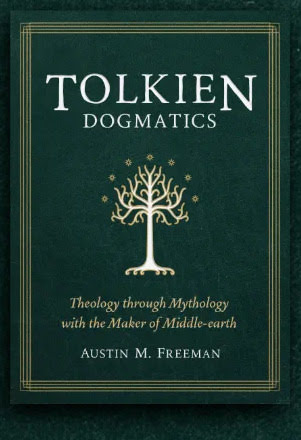
* Newly available via Amazon in dead-tree and e-book formats, the book Tolkien Dogmatics: Theology through Mythology with the Maker of Middle-earth (November 2022). Weighing in at 432 pages, it is billed as…

“a comprehensive manual of Tolkien’s theological thought. […] Austin M. Freeman [who teaches Apologetics at university level] inspects Tolkien’s entire corpus — The Hobbit, The Lord of the Rings and beyond — as a window into his theology”.

There’s no mention of use of the Letters here, which is slightly worrying. Though the book has an encouraging recommendation from Tolkien scholar Thomas Honegger…

Tolkien Dogmatics is likely to become a standard text for interested laypeople and literary critics as well as professional theologians when discussing the theology of the maker of Middle-earth.”

The book is a self-described “manual”. In that regard I noted a short buyer-review, stating that… “the theology is nicely organised”. Another source admired the wealth of footnotes. But it’s probably not the A-Z cross-referenced encyclopedia that a non-theologian Tolkien scholar might hope for. I see the author is also editor of the recent Theology and H.P. Lovecraft, in which he had a chapter comparing the world-building approaches of Lovecraft and Tolkien.

If you can’t afford Tolkien Dogmatics yet, apparently the publisher Lexham Press is sending out review copies. As yet, Google Books knows nothing about it while Amazon’s “Look Inside” only offers the front cover.

There’s a podcast interview with the author, scheduled for 21st December 2022.

* The next volume of the Journal of Tolkien Research is now underway, the first two items having been posted. One is an article which takes a rather over-complicated dive into “The Enigma of Goldberry”, the River-woman’s daughter who becomes the beloved of Tom Bombadil. The author usefully suggests that Bombadil’s reluctance to stray too far from Goldberry may be because he must be always on hand and attentive, to prevent her being drawn back to the river and to her former life as a nixie. The author also notes a connection of water-lilies with nix… (“[of] water-lilies both yellow and white, Grimm [1883] remarks that in modern German they are called ‘nixblumen‘ which translates as ‘nixie-flowers'”). This is not a late confabulation arising from 1870s scholarly interest in nix, as I can find the word in a 1740 German dictionary.

* The Journal of Tolkien Research also now has Kristine Larsen’s 2019 conference paper ““I am Primarily a Scientific Philologist”: J.R.R. Tolkien and the Science/Technology Divide”.

* A very long new article in First Things offers an in-depth review of the recent essay “A Prophecy of Evil: Tolkien, Lewis, and Technocratic Nihilism”. I had previously noticed the essay in question, but had backed off within microseconds — because the pictures were so cringingly naff and because it was evidently mostly about C.S. Lewis. But apparently it is worth a read.

* And finally, new to me is the stage play Lewis & Tolkien, of Wardrobes and Rings, which my searches suggest first appeared under spotlights circa 2018. The play is said to be a “mature and insightful” two-hander which portrays the close friendship of Tolkien and C.S. Lewis. It was brought to my attention by a listing for a March 2023 performance in America, and at a guess it may have further U.S. dates in 2023. The play…

“is set in Oxford’s Eagle and Child pub, where British authors C.S. Lewis and J.R.R. Tolkien meet for what turns out to be their final conversation.”

Potteries Post updates

A small update for my The Potteries Post. That’s it for 2022. I’ll be back with more local ‘news you can use’ in early 2023.

A sampling of recent posts at the Post, which has replaced my Facebook groups ‘Creative Stoke’ and ‘Wild Stoke’…

Opportunity: Staffs University has a day and evening Apprenticeship Fair on 4th Feb 2023.

Opportunity: Deutsche Bank Awards for Creative Entrepreneurs are now open for 2023.

Work: Staffs University (Stoke campus) requires a Senior Lecturer in Immersive Technology.

Good news: Staffs Wildlife Trust is taking on eleven open-space sites in the Moorlands.

Work: Newcastle-under-Lyme’s Appetite requires a part-time Community Co-ordinator.

Funding: Small businesses can bag £5,000 government vouchers for new software.

Work: The new ‘Great Northern Bog’ seeks part-time artists, £20-£25k commissions.

Good News: Peak District National Park bags £1 million for restoration of ‘bare peat’ bog areas.

New book: Staffs Uni Pro Vice-Chancellor co-authors an important new book on Visual Pollution.

Funding: Community Project Funding is now available from Music for All.

Opportunity: Connects Network event – hear from Alton’s Rural Brewing Co.

Opportunity / good news: Staffordshire will support new entrants into farming.

Opportunity: Could your business use a Keele graduate, to work on a digital project?

Training: Cheshire Wildlife Trust – Beaver Ecology and Reintroduction Training Day.

Work: The Forest of Mercia requires a Community Woodlands Officer.

Report: The UK Local Government Association’s new ‘Cornerstones of Culture’.

Work: Keele University requires a video producer, to boost student recruitment.

Work: Newcastle-under-Lyme’s CEDARS Short Stay School requires a Teacher of Art.

Good News: Newcastle-under-Lyme to plant a new “Lyme Forest” of 850 lime trees.

Work: Stoke Town High Street Heritage Action Zone seeks an artist – £8k commission.

Work: A full-time Art Teacher is required at Stoke’s Peak Education.

Work: Buxton Museum & Art Gallery seeks day-rate workshop artists for 2023.

Work: Stoke City Council is now advertising its new Tree Officer vacancy externally.

Report: Can a R&D tax policy help support the creative industries? Staffs Uni has the answers.

Work: The Buxton Opera House requires a full-time Head of Marketing & Comms.

Work: Artists invited to submit proposals for “What Does Staffordshire Mean to You?” workshops.

Work: A part-time arts Project Officer is required for ‘Outside’ in the Moorlands.

Work: Staffs Uni’s Media & Communications Hub requires a Technical Assistant.

Event: Stoke and North Staffordshire CEP Partnership Networking Meeting.

Opportunity: Staffs Uni has a Staffs Startup Community Launch evening event.

Opportunity: The Stoke Creates Exchange Forum has the December event date.

Work: Stoke’s 6th Form College needs a Teacher of Creative Arts – also has news of new T-level Ceramics.

Funding: Universal Music UK Sound Foundation grants, for teachers and instruments.

Talk: North Staffordshire RSPB, “in-depth talk” on Peak raptors in January 2023.

Good news: Stoke-on-Trent has a new Grade II Listed Building.

Work: Nottingham Uni has a paid PhD in Creative Arts Youth Work.

Work: Newcastle-under-Lyme’s Brampton requires a part-time Education Officer.

Opportunities: Dance with Frontline.

Work: Full-time Assistant Curator at World of Wedgwood in Barlaston.

Tolkien Gleanings #13

Tolkien Gleanings #13

* “Addenda: One Middle English Manuscript and Four Editions of Medieval Works Known to J.R.R. Tolkien and What They Reveal” (2021). This offers several new additions to the recent ‘Tolkien read this’ book Tolkien’s Library: An Annotated Checklist (which is to have a new edition on early 2023). The free PDF for the article can be had via searching Google Scholar for the title placed “in quote marks”. Last time I looked, academia.edu only allows public downloads in that way (for non-members).

* The author of The Annotated Hobbit has a new post on “The Hobyahs: A Reconsideration”. “Hobyahs” became known via printed books as a Scotch household bogey creature, akin to the common Midlands / Northern English ‘Hob’ and ‘Lob’ — but made rather more scary to children due to their vivid picture-book illustrations. As the article explains, Tolkien was interested in the word’s resemblance to his own word and he publically asked about its dissemination… although that interest came after The Hobbit.

* “Un souvenir brumeux de Dante dans The Lord of the Rings de Tolkien” (2021). In French with English abstract. Sees a possible influence of Dante’s Commedia on the Dead Marshes chapter in The Lord of the Rings

“Dante could have been a model for Tolkien. Despite the specificity of each text, the marsh appears as a space with a paradoxical nature, between life and death, between water, earth and fire. A space dominated by the indistinct and the deceptive, in which the presence of a guide is indispensable”.

Regrettably they appear to refuse and “404” all links, except to the home page or if found by internal search. You’ll have to search for “Tolkien”.

* The Imaginative Conservative has a new ‘short but informative’ post on “The Inklings and the Outbreak of World War II”. The Inklings…

“worried that England would be next on the invasion list, and they began to enumerate the innumerable times they had publicly condemned the Nazis.”

* “One Graph to Rule them All: Using NLP and Graph Neural Networks to analyse Tolkien’s Legendarium” is an open-access paper for a December 2022 conference. The researchers use new computational methods to… “study character networks extracted from a text corpus of J.R.R. Tolkien’s Legendarium.” An early version is available on Arxiv. Note that NLP = ‘Natural Language Processing’ computer-science, not the pseudoscience of ‘Neuro-linguistic Programming’.

* And finally, new to me is Introducing the Medieval Dragon (2020) by Tolkien scholar Thomas Honegger. A University of Wales book of 144 pages. The contents are…

   Preface.
   The Dragon and Medieval Religion.
   The Medieval Dragon and Folklore.
   The Dragon and Medieval Literature.
   Outlook and Conclusion.
   Endnotes.
   Further reading.

Tolkien Gleanings #12

Tolkien Gleanings #12

* Open-access in the Italian journal Mantichora, ““Like Flowers Beneath The Ancient Song”: Language And Myth In Owen Barfield and J.R.R. Tolkien” (2021). The journal wrongly states the article is in Italian. It’s actually in English.

“at the basis of language there is first and foremost an ancient pleasure — purely expressive and performative — of articulating sounds [that are] pleasantly conformed to the objects they designate (“phonetic fitness”) [… with these being often originally] strongly linked to the natural environment.”

* Open-access in LURe: Literary Undergraduate Research, “Christopher: The Editors and the Critics” (2022). A deft appreciation of Christopher Tolkien, by a talented undergraduate.

* A new library blog-post from Special Collections at Washington University, “The Medieval Mind of Tolkien”, which offers a peep at a few of their treasured books.

* The Dominican publication Dominicana offers a new meditation on “Christmas in Middle-Earth”

“His stories about Middle-earth […] also reveal the marvel of the Incarnation in ways that are explicit, surprising, overlooked, and ‘peculiar’ — to use the author’s own word.”

* An extract from an old conference paper, now newly posted online as a blog post by Dimitra Fimi, as “Goblins in Dickens’s Pickwick Papers and Tolkien’s The Hobbit.

* Open access, “Palimpsestos Liricos em Tolkien” (2022). The full title translates as: ‘Lyrical Palimpsests in Tolkien: on the poetic interpolations and vestiges of Nordic and Anglo-Saxon literary traditions in the works of J.R.R. Tolkien’. A Masters dissertation for the University of Sao Paulo, in Portuguese. In the English abstract, the author sees a…

“derivative relationship with Beowulf in Old English and the Elder Edda in Old Norse [and detects] traces left by such a process and its connection with the Germanic poetic tradition [and] compositional procedures from that tradition. [Something which, for Tolkien, may have] begun in an effort of translation”.

Someone in a podcast — possibly Tom Shippey — recently recalled how translation of several pages of text was given as an exercise by the better British schools, in Tolkien’s day. It was a swift dash-it-off individual daily exercise. Tolkien, of course, went a step further. At least for Greek. To help him learn to translate Greek, he invented his own purified ‘Pure Greek’.

* And finally, news of a new richly illustrated translation of “The Wanderer”….

“Cole decided to write her own translation of ‘The Wanderer’, one that would pay homage to Tolkien by using his language and themes […] she also illustrated her text with beautiful watercolor paintings.”.

On Mow Cop by train

Platform 2c has a handy new 8-mile circular tour of Congleton and Mow Cop on foot, recently undertaken and photographed (summer 2022). The walk starts at Congleton Station, which is reachable from Stoke-on-Trent by train. I think I looked at it some years ago, and had thought that it wasn’t accessible via a direct service. Or perhaps it was then costly to cross the border from the West Midlands into the North West. But there’s a quick direct hourly service now, and you can apparently get up there and back for a fiver if you book ahead. Brilliant.

If you want to also visit Congleton itself, note that the station is a good mile and a half from the start of the core of the town centre’s main shopping areas. I can’t immediately see any fabulous off-road direct walking-route from the station into the town centre. The Local Cycling and Walking Infrastructure Plan: Congleton (2021) suggests that those arriving by rail trudge alongside a main road, albeit on a mostly segregated path, while dodging cyclists…

The red line is the current station-centre walk.

Not ideal. Though it looks like you might instead be able to go west along the canal towpath, and then on rural footpaths to reach Howey Lane and Moody Street and thus into the town centre. That would be a longer two-and-a-half mile dog’s-leg, though, and with an uncertain level of muddiness. This is just a theoretical suggestion to explore, so don’t blame me if it lands you in a quagmire lane heavily trafficked by tractors and scrambler-bikes from the local council estate.

You might also be able to thread your way through to the top of the town centre, as a walker, via the Station – then a short stretch of Canal – then the road seen above Bollin Drive? Here seen as another hypothetical route marked in blue.

Canal Street / Canal Road looks like a nice short-cut here, but isn’t — it is noted on the Local Cycling and Walking Infrastructure Plan as a busy road with ‘heavy traffic’.

The unspecified “future routes” marked on the council map suggest things may improve in future.

Tolkien Gleanings #11

Tolkien Gleanings #11

* Many intelligent reading youngsters graduate themselves from The Hobbit straight into The Lord of the Rings, often at the early age of 11-13. I recall one lad I knew who read it avidly in the bike-sheds at school, when aged barely 11. I think I read it a few years later than red-haired Nigel, and can recall some of my first responses (such as being rather annoyed that Tolkien was suddenly introducing a new character, Dernhelm, more than half-way through). But more generally what does one think, at such an age, of the challenging larger work? There’s now a public PhD thesis on the topic, ‘Small Hands Do Them Because They Must’: examining the reception of The Lord of the Rings among young readers (2020, Glasgow University).

* The Melborne Catholic this week, on “How Tolkien nearly lost his faith — and what drew him back”… “Out of wickedness and sloth I almost ceased to practise my religion […] I regret those days bitterly” (Tolkien).

* The Tolkien Experience podcast has a new interview with Brian Sibley, whose “newest project The Fall of Numenor is a book that pulls together Tolkien’s writings” on the topic, and makes a coherent book from them.

* The Adherent Apologetics podcast has a new interview, “Holly Ordway: The Christian World of J.R.R. Tolkien and The Lord of the Rings”.

* Scholars and Storytellers has a new blog post titled “Reconstructionary Tales”, on Tolkien and Guy Davenport. Who, as it turns out, was once one of Tolkien’s university students. I can add that Davenport also rather amusingly pranked the first wave of eager LoTR language-delvers. He claimed that all the names that Tolkien gave to various hobbits could actually be found in his local telephone book for Lexington, Kentucky (later shown to be untrue, sadly). More seriously he also detected the influence of a “von Essenbach” in The Lord of the Rings. Definitely not a household name in the Anglosphere, but von Essenbach (1170 – c. 1220) was a poet of the mystical Arthurian epic Parzival in medieval German. On which one Richard Wagner later based his 1882 opera, and the rest is history.

* The Parma Rumillion blog has a new post on “Tolkien and Stonyhurst College” in Lancashire. Tolkien made a delightful pen-sketch of the “New Lodge at Stonyhurst College”, which is shown in the post and which I had not seen before. But the blog post finds that… “the school and the area’s connection to Tolkien and The Lord of the Rings is wildly exaggerated”. There are questions about… “the Tolkien Trail promoted by [local tourist-board] Visit Lancashire and local businesses, although the leaflet does have a picture of New Lodge. The trail is a bit of a wild goose chase quite frankly, not using the public right-of-way to get a good view of the school and visiting places without meaningful Tolkien connections.” But Parma Rumillion kindly offers readers an alternative route, with maps. And a warning about a strange local Jobsworth who drives a little white van.

* And finally, as we head toward Christmas, a short meditation on “The Importance of Being Jolly”…. “J.R.R. Tolkien’s hobbits provide an example from fiction; their response to the goods of everyday life, such as food, drink, and tobacco, is one of gratitude and exultation.”

Piccadilly (1929)

Local lad Arnold Bennett’s movie Piccadilly (1929), now on YouTube. I missed hearing about a recent big-screen screening in Stoke-on-Trent. If you did too, you can still catch it on YouTube. At least, you can until the copyright cops come for it. Only ‘1927 and before’ material is technically in the public domain in the U.S., as of 1st January 2023.

Tolkien Gleanings #10

Tolkien Gleanings #10

* I was sorry to hear of the passing of Professor J. S. Ryan, one of the few scholarly writers on Tolkien who had also studied under Professor Tolkien. I still have his books Tolkien’s View and In the Nameless Wood on my shelves, and a number of their otherwise-scarce essays proved useful in writing my own recent book. Douglas A. Anderson has assembled a biography of Ryan, and he has a Web link to a fuller obituary.

* Newly online in open-access in 2021, the final published version of “Middle America meets Middle-earth: American discussion and readership of J.R.R. Tolkien’s Lord of The Rings, 1965-1969″ (2005). The first half being an very in-depth history of the copyright problems with the book in America. Then we eventually get to a section on the first brief ‘craze’ for Tolkien among the more discerning elements of American’s youth, and the response to it…

[even when critics actually looked at the book] “… criticisms very frequently have had less to do with The Lord of the Rings itself than with their aversion to the type of book they think it to be, and equally to the type of reader attracted to such books.”

* The venerable U.S. magazine The National Review this week reviews the new Tolkien book The Fall of Numenor. Mostly gushy praise + a long potted summary, but it’s useful to have such a summary.

* Forthcoming, a “revised and expanded edition” of The Silmarillion Primer. Amazon knows nothing about a first edition. But a little digging reveals it actually first appeared as a publisher’s bi-weekly blog-post series, at Tor.com back in 2017-18.

* And finally, ominous news re: Tolkien Estate’s licensing deals for 2023. “LEGO BrickHeadz, The Lord of the Rings versions” are coming soon to toy stores. This hideous-looking line of plastic tat, specifically designed to look squat and monstrous, even has a pair that defiles “Aragorn & Arwen”. Ugh. I’ll spare you the pictures.

Regrettably I also see that the Tolkien Society is seeming to endorse such orc-work, through allowing Lego items into their “Best Artwork” annual category.

Tolkien Gleanings #9

Tolkien Gleanings #9

* An Exploration of Tolkien’s Changing Visions of Faerie Through His Non-Middle-Earth Poetry (2021). A PhD thesis for the University of Glasgow, UK. The .PDF is online and public. Sees Bombadil as having one possible source in the 17th century Tom O’Bedlam.

“… analyses the themes, language, and folklore of Tolkien’s non-Middle-earth poetry, arguing that it is possible to see three sometimes overlapping phases […] an initial phase when he explored who and what the fairies were; a second divergent phase where Tolkien at once studied the worlds and poetic styles of the medieval works he taught at Oxford yet also used his Faerie poems to protest the excesses of modern living; and a third phase where he increasingly merged his Christian beliefs with his concept of Faerie”. Concludes by showing how these approaches might have been woven into the late tale “Smith of Wootton Major”.

* Free online, a blog article for a medical humanities site, “Fangorn, the Shire, and Beleriand: Tolkien’s Disabled Landscapes” (2022)…

“… we do not abandon lands after they are changed, or when their value is diminished in our eyes. The Ents reclaim Isen. The Hobbits remain in the Shire [and restore it, even though] neither goes back to the way they were before they were impaired.”

* From Kent State University Press, the book Inkling, Historian, Soldier, and Brother: A Life of Warren Hamilton Lewis (December 2022)…

“examines Warren Lewis’s role as an original member of the Oxford Inklings [and C.S. Lewis’s brother, drawing on] unpublished diaries, his letters, the memoir he wrote about his family, and other primary materials, this biography is an engaging story of a fascinating life, and period of history”.

* Free online, a long scholarly blog post on “The Medieval in Middle-earth: Anglo-Saxon Elephants and Tolkien’s Oliphaunts” (2020).

* And finally, to Tolkien’s cherished town of Warwick in the West Midlands of England. A giant Lord of the Rings style ‘trebuchet’ siege-engine is to be built there. The 22-ton wooden machine will be the world’s biggest, and by 2023 it should be ready for flinging oliphaunt-sized loads around the grounds of Warwick Castle. Seen here is their earlier smaller engine, which is being retired.

Garth states (Worlds, p. 191) that it is “not unlikely” that the young Tolkien brothers took the train from Birmingham to the annual Warwick Pageant in the castle grounds. Though in those days there may not have been reconstructed siege-engines, it seems vaguely-possible that the castle could offer displays of scale models set in battle dioramas.