Tolkien Gleanings #22

Tolkien Gleanings #22

* New today, a long article on “Eucatastrophe and Evangelium: Tolkien’s Devotion to St. John the Evangelist”. At the end of this the reader learns that…

“This article is adapted from material in Holly Ordway’s forthcoming book, Tolkien’s Faith: A Spiritual Biography (Word on Fire Academic, 2023).”

Good to hear of a new book, and from a writer who knows the theology and church history. This forthcoming title is currently listed on Amazon UK, set for a hardback release on “2nd September 2023”.

* I’m not going to be tracking articles or books on Tolkien’s invented languages for Tolkien Gleanings. But they will be noticed if they reflect on the young Tolkien and his influences. Such is a new article in the Italian open-access journal RiCOGNIZIONI, “Tolkien and Comparative Historical Linguistics” (2022, in English, with English abstract). This looks at the influence of the young Tolkien’s academic training on his earliest Elvish languages. Finds some influence on his… “meticulousness [and] symmetry and systematicity”, among other things. But also the age itself was somewhat encouraging him to take a “creative and free approach to his sources”, though in this he was steered by his already highly-developed “phonoaesthetic taste”. But what were his sources? The author suggests, as a glottopoeia source for the young Tolkien…

“a source not listed in Cilli’s catalogue and, to the best of my knowledge, nowhere mentioned” [which could well have been the] “Rev. George Bayldon’s
An Elementary Grammar of the Old Norse or Icelandic Language.”

* In the same issue of the RiCOGNIZIONI journal, “Linguistics and Classical Tradition as Sources for Tolkien’s Glottopoiesis”. The author focusses on picking up what are said to be many similarities to Latin, but his abstract usefully explains what the first author meant by the technical word glottopoeia (glottopoiesis)…

“[to create his constructed languages] Quenya and Sindarin [Tolkien picked] from the templates represented by natural languages, such as Finnish, Germanic languages, Welsh and also Classical languages.”

* I encountered a bit more on the local claims for the ‘Tolkien Trail’ in Lancashire. A 2022 local press report on the walk claims…

“it is clear that Tolkien did get inspiration to call the fictional region of Middle-earth, ‘The Shire’, from Hurst Green. Shire Lane can be found in the village, along with the River Shireburn and the Shireburn Arms”

There is an intertwingling in the above sentence between Hurst Green in Sussex and Hurst Green in Lancashire, which few will notice. The Tolkien Reader’s Guide and Chronology both have this place in Sussex and not in Lancashire…

“At that time the Brookes-Smiths lived at The Lodge, Hurst Green, in Sussex” and “then living in Sussex, in a country house at Hurst Green.”

The confusion among Lancastrians is probably genuine, and it appears to root back to Paul Edwards’ “In the Valley of the Hobbits” article describing much the same walk, which was then picked up and enshrined by the 2008 Tolkien’s Inspirations PDF assemblage. The confusion appears to have arisen locally via the following reasoning: “Tolkien is known to have stayed several times at Stonyhurst and sketched it (true, though many years too late to have influenced the early landscape of LoTR); and the lovely rural stone village of Hurst Green is near Stonyhurst (true); therefore this ‘Hurst Green’ mentioned by Tolkien sources must be the Stonyhurst one (false); and thus… the whole area must therefore have been his inspiration for Hobbiton and the Shire!”.

The landscape does however appear to be very lovely and well worth a stroll, and is about 17 miles north of Manchester and on the southern edge of the Bowland Forest. Some of the pictures of fir-trees and small streams even remind one of Rivendell. But as for “The Shire” claim in the more recent 2022 press article… I suspect that Worcestershire and Warwickshire and Staffordshire may yet have something to say on the matter of Tolkien’s coining of ‘the Shire’.

* And finally, on GitHub I find the very comprehensive javascript-driven “Shire Reckoning: A visualization of the calendars described in J.R.R. Tolkien’s The Lord of the Rings Appendix D”. The GitHub shows it was last updated in September 2022. Impressive work.

Tolkien Gleanings #21

Tolkien Gleanings #21

* As posted here yesterday, my new musings on the question “Could Tolkien have seen the pre-Raphaelite collection at Birmingham?” along with my newly colorised picture of the interior in 1911.

* I came across a 2017 paper I’d not heard of before, from Tolkien scholar and astronomy specialist Kristine Larsen. The Harvard aggregator for astronomy papers has it as “Oxford Astronomer John Knight Fotheringham (1874-1936) as Unwitting Godfather of J.R.R. Tolkien’s Fictional Luni-solar Holiday “Durin’s Day””, with a substantial abstract but no PDF link. My guess is this paper was later partly folded into her Journal of Tolkien Research article on Durin’s Day. The latter is freely available as a full-text .PDF file. But some researchers may also want the original abstract re: some details on Fotheringham.

* The two Mallorn issues produced in 2020 have now popped their locks, these being issues 60 (Summer 2020) and 61 (Winter 2020). They appear to be the latest. Despite still being labelled on their landing pages as “not open-access as it was published within the previous two years”, on a hunch I found I could download the full PDF downloads. I assume some auto-bot has popped the locks for 2023 without any human intervention. Included and of interest to me are…

# 61:

———— “Tolkien on Holiday” surveys Tolkien’s uses of holidays, and his personal thoughts on the real thing. Doesn’t note that a chunk of the early part of Fellowship was written while on holiday.

———— “In the Moon Gleaming” on Tolkien’s uses of ‘Man in the Moon’. Unaware of the Shropshire and Hereford links, which would have been well known to Tolkien as a West Midlands medievalist.

———— “The Tolkien Art Index”, giving a history of building “an online catalogue raisonne of all published Arda-related artwork created by J.R.R. Tolkien” and a short guide to the structure and usage.

———— “There and Back Again? Tolkien’s Brief Visit to Sussex in 1904”. He went for a long extended stay, and most likely also took day-trips out. The article discovers a likely address in Hove (of ‘Brighton & Hove’). With a rider in the form of “Tolkien in King’s Heath” in the following issue, which picks up a misinterpretation of the 1901 census (though relating to King’s Heath in Birmingham, rather than Hove).

———— A good review of Tolkien’s Library: An Annotated Checklist and yet another short review of Tolkien and the Classics (it must have had 20 or more by now).

———— A long letter of reply to the earlier “Checking the Facts” article, which had been critical of certain aspects of Tolkien studies.

# 62:

———— “Tolkien’s Fantasy Landscape”, a fine lead article which examines a Tolkien “1915?” dated painting in detail, and with painstaking topographic and astronomical cross-referencing. Also has much to say about Tolkien’s brother Hilary.

———— A joint review of the recent Oxford, New York City and Paris Tolkien exhibitions. Notes the great popular successes, each in a different way but alike in terms of vast visitors numbers and red-hot catalogue / book sales. Has nothing to say about any serious notice given to the shows, if any, by weighty art-world critics. I had to laugh at the glowing description of the ticket system at Oxford… “a cleverly designed ticket booking system guaranteed that every visitor had the impression of entering a shrine of peace and quiet with enough space and time to take it in”. When I was there the ushering in/out was abandoned and the place was rammed. I managed to stay in for well over two hours.

———— Reviews of the books Something Has Gone Crack, Tolkien’s Cosmology, and a rather pickily critical one for Garth’s The Worlds of J.R.R. Tolkien.

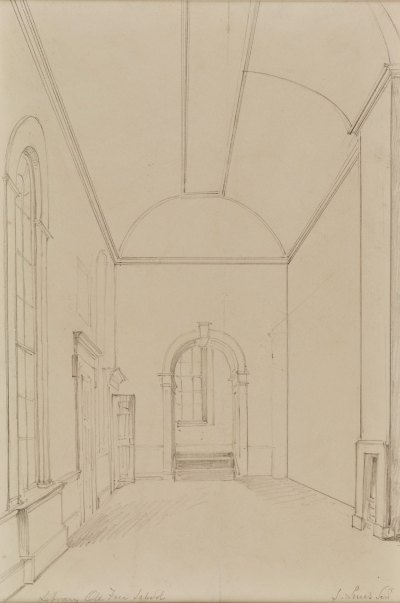
* Birmingham Museums now have their long-awaited CC0 collections online. It’s been around in various forms since 2018, but now at last it has good-sized downloads freely available without sign-up. My searches suggest there’s not a great deal of Tolkien interest in there, but there is a pleasing old pencil sketch of what appears to be the Library entrance corridor in Tolkien’s school on New Street. Possibly an unfinished drawing, or meant to evoke the original appearance of the interior… as I see lines hinting at a tall bookcase on the right-hand wall.

* And finally, one for the book-sniffers. Dr. Joe Schwarcz on the smell of old and new books at YouTube (2021).

Get ‘appy on Alderley…

“New app to bring Legend of Alderley Edge to life”

Launched on 21st December 2022, the Invisible Worlds app will enhance the visitor experience at Alderley Edge. Through their smartphones or tablets, visitors and users will be able to explore Alderley Edge with Augmented Reality wizards, knights, and white horses appearing throughout the landscape, as well as specially commissioned soundscapes providing an atmospheric background.

I think I’d just rather hear the slosh of wellies and the howling of warg-winds. But for kids and those who can’t go anywhere without a mobile phone, it may be just what the wizard ordered.

Could Tolkien have seen the pre-Raphaelite collection at Birmingham?

Could the young J.R.R. Tolkien have seen the now well-known pre-Raphaelite collection at the Birmingham Museum, circa 1903-1911? In those years he was at school in Birmingham city centre, and was aged 11-19.

Perhaps. But he appears never to have recalled them in either letter or interview, so far as I can discover. Which in itself is quite remarkable. Nor does he ever appear to have been asked about them, even for the official biography, which is even more remarkable. What were the Birmingham Tourist Board of the 1960s and 70s thinking of, not to pin him down on the topic and get a few quotes for future marketing purposes? Well, they probably weren’t even considering such things. In those days Birmingham wasn’t exactly on the tourist map of England, except as a big void to avoid.

But what of the Edwardian era, before the planners and the car-culture ruined the city centre? Were unaccompanied youngsters not allowed into the Museum at that time, perhaps? Were there no ‘school visits’ back then? Tolkien’s school was at the opposite end of New Street, so they wouldn’t even have needed to hire a charabanc to visit the place. Just troop the lads up the gentle hill.

Yet all that can be found in the scholarship is Garth remarking that “Tolkien once likened the TCBS to the Pre-Raphaelites”, stated in passing and with no reference given. Tolkien’s official biographer mentions the same, in a similarly fleeting and un-referenced manner. But perhaps Garth was remarking on unpublished letters, which he was allowed to see at the Bodleian when writing his Great War book?

We do know that the leading pre-Raphaelite Edward Burne-Jones (d. 1898) was a Birmingham lad from Bennett’s Hill, and a romantic artist whose early life and student fellowships (with William Morris and fellow Brummies) Tolkien knew about. He admired and read Morris, and would have seen Burne-Jones works and designs in print. Had he fully read up on Burne-Jones’ biography it would have offered him something of a life-template. Indeed, a little later Tolkien would follow in Burne-Jones’ footsteps and become an undergraduate at Exeter College. Again it’s then very difficult to imagine that the young Tolkien wasn’t popping into the local Museum on rainy afternoons after school, admiring works by Burne-Jones in the company of members of the TCBS or Edith. Or perhaps moving solemnly around St. Phillip’s Cathedral, which was located a stone’s throw from both Barrow’s Stores tea-rooms and Cornish’s bookshop, to admire the building’s fine Burne-Jones stained-glass windows (fully installed there by 1898).

But were pre-Raphaelite works on general public show in the Museum at that time? It’s very difficult to discover what was on show back when, either permanently or in time-limited exhibitions. Surprisingly no-one ever seems to have put together a comprehensive history of the early pre-Raphaelite exhibitions in Birmingham, between the death of Burne-Jones and the First World War. Possibly there were none, simply a gradual growth of the collection. Though I can find hints which suggest Birmingham Museum’s collecting began relatively early. For instance I can discover that in 1891… “an exhibition of examples of the English pre-Raphaelites was held in the Birmingham Museum in October [1891]” (The British Architect trade journal, 1892). “The Star of Bethlehem” was the star attraction. “The Last of England” was also on show. These remained at Birmingham, and both works spoke to themes that would become important to Tolkien. A wealth of drawings had been added to the collection by 1906, and one might assume the best of these were exhibited in a temporary show within a few years. Some of the remarkable Burne-Jones series of giant Holy Grail Tapestries were… “presented to the Museum in 1907” (Journal for Weavers, Spinners & Dyers), and presumably these were suitably hung for the public before a few more years had passed. Visual depictions include Sir Gawain and a magnificent medieval ship in tapestry-stitch. Though it’s possible “The Ship” was not then at Birmingham.
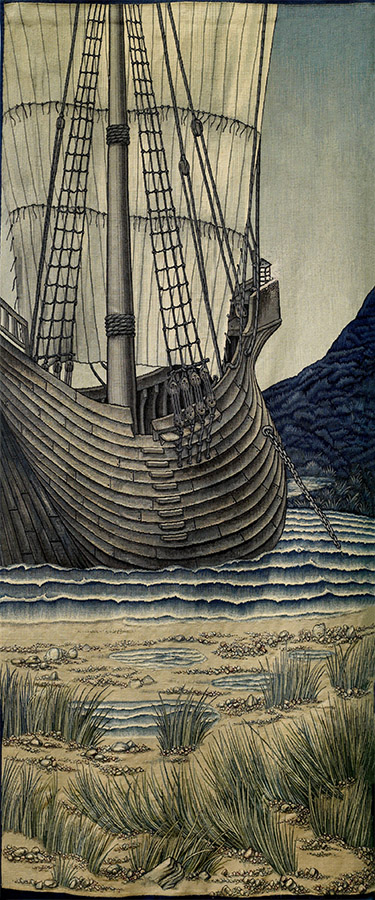
Thus it sounds to me like a core collection of pre-Raphaelite paintings, tapestries and drawings was present in Birmingham by circa 1908-11, and probably were on at least some sort of permanent public display there by 1911 — however limited due to the chances of fading etc. A glass-plate photo appears to confirm for 1911, at least.
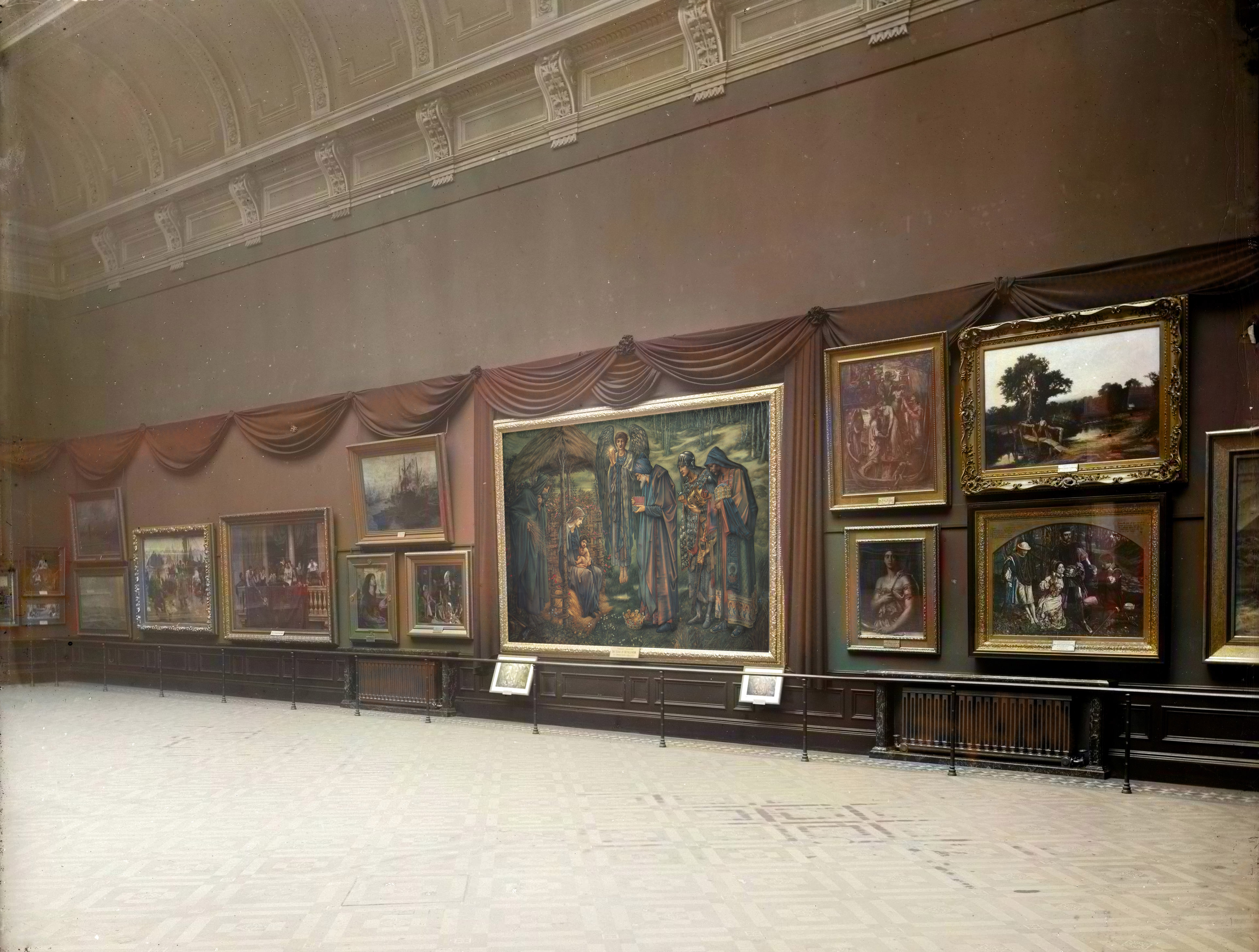
A pre-Raphaelite Gallery at Birmingham in 1911, suggesting a permanent public display by that date. “The Star of Bethlehem” in the centre.

But we still don’t know for sure that Tolkien saw them, and we probably never will now — unless perhaps some new youthful letters are eventually released for publication.
Tolkien Gleanings #20

Tolkien Gleanings #20

* A long and detailed November 2022 guest-post on John Garth’s website goes “In search of T.W. Earp”, a fellow-student during Tolkien’s undergraduate years at Oxford. Earp was also a guardian of the records, minutes and traditions of the various college societies during the disruptive war years. Includes portraits and pictures that I had not seen before.

* “Community Greening in The Lord of the Rings: Samwise Gamgee and the Power of Local Care”. A revised December 2022 essay version of a presentation given at the Texas Literature and Language Symposium 2021…

In the character of Samwise Gamgee, Tolkien champions a “love of the land” which Patrick Curry describes as “a fierce attachment to highly specific and local places and things”. Sam is a gardener — an excellent gardener with great knowledge and skill. He is also a curator of local ecological knowledge — he knows the landscape of the Shire, and he knows how the flora and fauna of the Shire are distributed.

* British Fairies has another post in a long series. This New Year’s Day post notes some of the uses that writers have made of lore of ‘long-barrow sleepers’ in the British landscape. A tradition which readers will recall informed the events on the Barrow Downs in The Lord of the Rings.

* In South Carolina, USA, a 2023 Regional Convivium (great word) on the theme of “The Inklings and the Great Conversation: Friendship through Literature”. On 24th-25th February 2023…

we explore ways that literature brings old friends together, helps us make new friends and continues the long friendship of minds from ancient times into the present and for the future.

* News of the annual Inklings Symposium 2023 in Germany. Papers can be in either German or English, and the deadline is 31st January 2023, for…

the annual symposium of the Inklings Society for Literature and Aesthetics [from] 29th April to 1st May at Otto-von-Guericke-University Magdeburg, [with] the theme ‘Defying Death: Immortality and Rebirth in the Fantastic’.

* News of a conference panel on the theme of “the functions of relics and ruins in Middle-earth”. Part of a conference to be held at Niagara Falls on the U.S./Canada border, from 23rd-26th March 2023.

* A forthcoming book has been mentioned, to be titled Cities and Strongholds of Middle-earth: Essays on the Habitations of Tolkien’s Legendarium.

Tolkien Gleanings #19

Tolkien Gleanings #19

* The first issue of my Tolkien Gleanings PDF omnibus edition can now also be had as a download on Gumroad. A few silly typos have been corrected.

* “Tolkien’s Animals” will be the theme of a future special-issue of the Journal of Tolkien Research. There’s still time to send something in. The deadline is 23rd January 2023 via kris.swank@signumu.org — for draft papers on Tolkien and your choice of…

a wide range of animals, and not necessarily connected with medieval conceptions. PLEASE use “Tolkien’s Animals” as your email’s subject-line.

* New to me, a Norman Stone movie featuring a relatively brief portrayal of Tolkien. Who knew? The Most Reluctant Convert slipped out in November 2021 to a piffling box-office take, before landing on the main streaming services in June 2022. Though it is now hitting some “Best of 2022” lists, and also some of the Christian streaming services. It’s from the maker of the fine Shadowlands (1985) movie about C.S. Lewis. The new film portrays Lewis’s journey…

from vigorous debunker of Christianity to become, as he said, ‘the most reluctant convert in all England’.

I found it very well filmed and polished, but for a non-Christian Lewis might as well be speaking in Swahili for half the movie. This is the problem I’ve always had with Lewis, half the time I just can’t fathom what the heck he’s talking about or why he’s finding it all so important. For someone supposedly trained to think clearly, he has a most convoluted way of putting things. Still… for those who can instantly grasp each religious turmoil as he goes through it, and parse the specialist language and doubts that each turmoil seems to entail, I daresay Reluctant Convert will be found to be a fine and intelligent movie. Many Christian reviewers like it a lot. Non-Christians may come away feeling rather baffled.

* The French magazine Livr’ Arbitres has what might be a Tolkien special-issue(?) for December 2022.

* Also in France (Google Translate not permitted on the source Web link, ‘French only’), news of two 2023 exhibitions dedicated to Tolkien. One exhibition title translates as “In the Footsteps of Tolkien and the Medieval Imagination” and is described as “major”. While another will “focus on other modern or digital artistic evocations of Tolkien’s work. Like digital art, comics, animation, videogames.” Doubtless more will be heard about these in due course.

Tolkien Gleanings #18

Tolkien Gleanings #18

* New in the journal Critereon, “Genre in Translations of Sir Gawain and the Green Knight. Identifies differences between the Tolkien and Simon Armitage translations of Gawain.

* The second edition of the book Journey Back Again: Reasons to Revisit Middle-earth (2022). Each chapter explores a reason why people re-read The Lord of the Rings. According to the editor’s home-page the book was launched with an event in the late summer of 2022. This second edition (seemingly not expanded or revised) was announced for “November 2022”, and is now on Amazon UK as a £9 Kindle ebook. Which means Kindle owners can yet the first 10% free as a sample.

Judging by the one review, the book doesn’t appear to have a chapter on the pleasure of discovering small interconnections, un-noticed in many previous readings. For me the LoTR deepens like a coastal shelf, when partly read with an eye to such things. For instance in the Fellowship Aragorn left “the hill of Cerin Amroth and came there never again as living man.” Why the emphasis on “living”? Does this imply his body was later transferred to Lorien from Gondor, after death? No, it seems not. But in the Fourth Age his beloved Arwen was buried on Cerin Amroth. One can then glimpse a later tradition, between these small cracks in the text. A tradition among the increasingly “rustic” remnant of the elves who remained in Lorien, that Aragorn’s spirit was sometimes to be seen (or felt) at the grave of Arwen.

* A new essay at the online Catholic magazine Fellowship & Fairydust gives an overview of “Tolkien the Religious Man”. Appears to be a useful introduction on the topic, and probably helpful — along with other materials — for non-religious people seeking to correctly grasp the outlines of Tolkien’s belief. The author also introduces a few new possibilities for influence, including pre-1914 influence of Cardinal Newman’s lectures on “Tolkien’s opinion on the matter of pagans’ knowledge of God”.

There are a couple of question marks on the above essay. It’s stated “the Oratory priests were all learned men”, yet Father Francis was definitely not a learned intellectual nor remembered as such. “Educated” might have been the better choice of word here. In Birmingham Father Francis is said to have been “paying a portion of his tuition fees with his own money when he was under no obligation to do so”, but so far as I am aware a kind uncle was initially paying the full school fees. The reference given in the essay is to Letters — and is thus almost certainly to the letter stating “Fr. Francis obtained permission for me to retain my scholarship at K[ing] E[dward’s] S[chool] and continue there”, which is not the same thing as paying fees. This statement by Tolkien may refer to his winning a foundation scholarship in 1902 (during which year he briefly attended the nearby St. Philip’s School). His foundation scholarship meant that “no fees will have to be paid for his education” to continue at King Edward’s (Chronology). The alternative explanation would be that Tolkien was referring to an extension granted for the extra year he spent at King Edward’s, at the end of his time there, while was trying for a place at Oxford. The matter is important in relation to the pressure Father Francis could have placed on the young Tolkien not to see Edith. Obviously, if he was even partly paying the boy’s school fees, then his leverage would have been much greater than otherwise. But the date of the forbidding was in the late Autumn of 1909, so the fees would not have been a factor either way.

* A new Journal of Tolkien Research review of the new Tolkien fix-up book The Fall of Numenor (2022). As well as problems of narrative arrangement, apparently it lacks something in terms of the expected scholarly apparatus.

* And finally, a special website at blackberry.signumuniversity.org lists a wealth of Short Courses at Signum University for January and also February 2023. Eight hours each, complete them in a month. Several on Tolkien or thereabouts. Who knew?

Tolkien Gleanings #17

Tolkien Gleanings #17

* Tolkien Gleanings is now available as a handy 96-page PDF magazine, free on Archive.org and also on Gumroad. All my previous blog Gleanings and MegaTolks are here neatly collected and presented, back to 2019. Plus additional scholarly articles, a review and an interview. Easily searchable, and the Web links have also been checked for obvious breakage.

Drop me a comment on this blog, if you have something to contribute to the next PDF issue. Such as a scholarly review of a little-reviewed book. Unlike the academic journals, I’m not averse to reviews of self-published scholarly books. No poetry or fiction please, unless you’re Pauline Stainer or Alan Garner. Each issue will collect my Tolkien Gleanings blog posts into a bundle, and add some additional texts and pictures of interest. Expect perhaps two issues per year, produced when I feel the urge.

* ““The Ring in Your Voice Tells It”: Voice and the Essential Self in J.R.R. Tolkien’s Legendarium” (2021). A free preview of a Masters dissertation, though it has a lengthy abstract.

* “Theology and Fairy-Stories: A Theological Reading of Tolkien’s Shorter Works”, seemingly newly in open-access at a university repository. This was a chapter in the book Tolkien’s Shorter Works (2008). From the same author as the above, and again seemingly new in open-access, is his “Freedom and Providence as Anti-Modern Elements”. This examines… “the depiction of freedom and providence in Tolkien’s fictional works”.

* The Times newspaper ($ paywall) has a Priscilla Tolkien obituary.

* News of the forthcoming book The History of the Hobbit by John D. Rateliff. Being… “a re-issue of the revised 2011 edition”. Pre-ordering now and due to ship on 16th March 2023. The book… “presents the complete unpublished text of the original manuscript of J.R.R. Tolkien’s The Hobbit, accompanied by John Rateliff’s lively and informative account of how the book came to be written and published.” Also has the revised “rewrite” version of The Hobbit, supposed to make it more adult like The Lord of the Rings. Thankfully that was never finished. The 2023 book appears to only have a new cover, to make it uniform with other such volumes? Harper Collins also lists a “Deluxe edition” in slipcase, shipping on the same date.

* And finally, Shropshire Tourist Board on The Wrekin… “It has been suggested that it may have been the inspiration for J R R Tolkien’s Middle Earth in The Lord of the Rings”. What kind of tourist actually believes such airy marketing piffle? The ones who ‘spend big’ at the Gift Shoppe, I guess.

The wording is a verbatim filch from the Amberley book 50 Gems of Shropshire (2018), including the mangling of Middle-earth as “Middle Earth”. In this 2018 book the claim is given in passing and is un-referenced. The only likely source I can find, in print, is William Cash’s book Restoration Heart: A Memoir in which he recalls his “Uncle Jonathan” from his childhood, his Uncle being a local amateur archaeologist and hill-walker in the mid/late 1980s… “Jonathan explained that Tolkien used to walk up the Wrekin and used the famous defensive hill as a model for the shire in The Hobbit.” So it sounds like that claim could have seeded a small cloud of local oral confabulation.

Tolkien Gleanings #16

Tolkien Gleanings #16

* New on Archive.org to borrow, Roger C. Schlobin’s collection Phantasmagoria: Collected Essays on the Nature of Fantasy. This includes the essay “The Monsters are Talismans and Transgressions: Tolkien and Sir Gawain and the Green Knight”, which discusses how Tolkien might have subtly woven certain tones and shades from Gawain into The Lord of the Rings. Such as having a mostly “absentee villain”. The author briefly examines Boromir as a flawed character, but curiously overlooks Sir Gawain as the obvious template for Boromir’s lone and questing journey to find the mysterious Rivendell. Though I’ll admit that this quest is easy to overlook, deeply interwoven as it is across a dozen or more points in LoTR.

* Tea with Tolkien has a useful new Concise Outline of the Waldman Letter (Letter 131). This being a very long letter/pitch by Tolkien to an editor, written and sent in 1951. The Tolkien Gateway also has an existing summary online, but that is more verbose and slab-like.

* Douglas A. Anderson’s new scholarly Tom Shippey on Tolkien: A Checklist through 2022. Free as a .PDF file, though regrettably only for those with an Academia.edu account.

* New this week at The European Conservative, the article “When Middle Earth Came to Vienna”… “The renewed obsession with the minutiae of Tolkien’s work gives me an excuse to revisit […] the inspiration for Tolkien’s Battle of the Pelennor Fields.”

* A talk on “The Pagan Tolkien” is set for 16th February 2023, snow-gods permitting… “Professor Ronald Hutton shares insights on the pagan influences evident in the work of J.R.R. Tolkien”. A heavyweight speaker, though at a small Shire-like village-hall on the edge of Gloucester, England. Booking now.

Jael’s Nail (1950)

Currently on eBay, and possibly of interest to some locally. The magnetic tape soundtrack for a local comedy movie called “Jael’s Nail” (1950). Evidently it was a locally-made 16mm comedy of some quality…

The Daily Mail Challenge Trophy, for the most outstanding film entered, went to Jael’s Nail, a black and white comedy by the Stoke-on-Trent Amateur Cine Society.

It also won The Wallace Heaton Cup for Best Photography, 1950. Of unknown ‘local colour’ and length. I’m not sure if the visual part of the movie survives, and can’t immediately find details for it online.


Update: Movie Maker reel listing from 1977: “A comedy about a man who claims to have the original nail with which Jael killed Sisera as told in the Old Testament”. So possibly Biblical and not of much local Stoke interest, re: local scenes and settings. Although I guess it might just have a contemporary 1950 Stoke setting? I’m imagining a sort of strange Stokie hybrid of Railway Cuttings, East Cheam, and Waiting for Godot, with a dash of The Life of Brian.

Tolkien Gleanings #15

Tolkien Gleanings #15

* John Ahern has a short but stimulating new article musing on “The Forest and the Descendants of Saruman”

It is easy to sentimentalize Tolkien’s trees. […] But there is another side to the story. […] Saruman may use the forests of Fangorn to fuel his machines, but for much longer than that Sauron used Mirkwood to gather his strength. On the whole, there are four forests in The Lord of the Rings and only one is unambiguously good.

* News of a talk at the 2023 Oxford Literary Festival, “The Great Tales Never End: in Memory of Christopher Tolkien”

“The Bodleian’s Tolkien archivist Catherine McIlwaine, writer John Garth and academic Stuart Lee discuss the role of J.R.R. Tolkien’s son, Christopher, in promoting the works of his father and furthering understanding about them.”

* Worcester’s The Magic of Middle-earth exhibition closed in the late summer, but was then quietly trucked up to Lichfield in Staffordshire. Who knew? Not many, unless perhaps you were on Instagram or perusing the local newspaper. The Lichfield publicity seems to have not gone much further than that. I find the exhibition closed on 11th December 2022.

* A new interview, “For The Love of Tolkien and Lewis”. This has news of a forthcoming screen documentary…

“Joseph Loconte, PhD., is an author, Senior Fellow in Christianity and Culture at The King’s College, and the Director of the B. Kenneth Simon Center for American Studies at the Heritage Foundation. […] His most recent project is a documentary on Lewis and Tolkien, with an emphasis on the way that war shaped their friendship and writings. Tri-State Voice writer Blake Whitmer recently sat down to interview him about his work.”

* And finally, I see that in Spring 2022 Malvern claimed Tolkien with a rather poorly proof-read leaflet (e.g. “C.s lewis”) containing a mapped walking route along the top of the Malverns…

An article in Mallorn in 1998, “A Fiftieth Anniversary Walk (or There and Back Again, an academics day out)” discussed and re-traced the walk in question…

“the [walk in the] Malvern Hills in 1947 was the last they [Tolkien and Lewis] went on together.”

Garth (Tolkien’s Worlds) is less sure, and offers that it was “perhaps” their last walk together. But they were definitely there. The new leaflet also makes an un-referenced claim that the Malvern Hills inspired the…

“Ered Nimrais mountain range, known colloquially as the White Mountains” and that “In a rare admission, Tolkien acknowledged that these White Mountains were, indeed, based on The Malvern Hills.”

This seems unlikely, given the greatly differing elevation and reach. Again one consults Garth (Tolkien’s Worlds) to find that the source was a recollection of a verbal conversation. On this Garth suggests a mis-remembering… “perhaps based on a mis-hearing”. This seems quite likely to me. Tolkien spoke rapidly and also mumbled, and it was difficult to catch everything he said even if you were right next to him. But a mis-hearing of what? Well, The Weather Hills would be a far more apt comparison. That comparison has already been made in Mallorn in 1992 in the article “The Geology of the Northern Kingdom”. This also offers some clear geological parallels. Weathertop is at the southern end of the Weather Hills, and thus the Hereford Beacon and its hill-fort remains would have partly inspired Weathertop. Again, quite a plausible surmise. We also know that they could be seen from Tolkien’s brother’s farm in Evesham, across the (relatively flat) Worcestershire countryside.