Tolkien Gleanings #376

Tolkien Gleanings #376

* The Oxford Tolkien Network’s 2026 seminar talks are underway. On 10th February 2026 there will be a talk on “Tolkien’s ‘Luxuriant Animism’: Unseen Beings and the Animacy of Arda”.

* From the Philippines, “Hobbits, Ents, and Pope Francis’ ‘Laudato Si’: Environmental Echoes and Religious Resonances from J.R.R. Tolkien’s The Lord of the Rings” (2025) ($ paywall). See also the earlier article “Tolkien, Middle-earth and ‘Laudato Si'”, which is open-access.

* A newly-found open-access journal, in French. Feeries: Etudes sur le conte merveilleux, XVIIe-XIXe siecle. “Feeries is dedicated to tales of the marvelous, mainly in French, from the 17th to the 19th century”. The journal currently runs from 2004-2025, and includes many book reviews. Publication in HTML format means the articles and reviews are easily auto-translated.

* At the University of Malta, “Tolkien’s Elvish Mirror: Language, Myth, and Europe’s Search for Self”, set for 24th-25th April 2026. Intended as… “a focused discussion among scholars and experts on the role of J.R.R. Tolkien’s approach to language in the cohesion of European identity.” Thomas Honegger will give the keynote talk.

* The Wall Street Journal reviews the new book The War for Middle-earth ($ paywall).

* The Tolkneity blog reviews the book Tolkien’s Faith, in Polish.

* Chesterton and Friends blog notes the dogged continuation of an effort to have the church recognise Tolkien as a modern saint.

* Today in the U.S. there was a “Documentary Sneak Peek and Q&A” event for The Forge of Friendship: J.R.R. Tolkien & C.S. Lewis

“Through almost ten years of production, built on interviews with over forty of the top Lewis and Tolkien experts, with beautifully shot reenactment scenes in the historic locations of Oxford and Europe, The Forge of Friendship promises to capture the world’s attention.”

* And finally, an article on “Tolkien and The Desk That Built Middle-earth“…

“It tells us something uncomfortably unfashionable about how creativity actually happens: slowly, physically, somewhere specific. Brown furniture, long written off as dull, irrelevant and unwanted, turns out to have been quietly winning all along. It doesn’t chase relevance. It doesn’t need reinvention. It waits.”

“The Cone” – a Stoke-set tale as a free audiobook

A local tale as a new audiobook. “The Cone” by H.G. Wells is a macabre revenge tale set in Basford, Basford Bank, and Etruria, in Stoke-on-Trent. You can also find an annotated version of “The Cone” at the back of my recent book on H.G. Wells in the Potteries.

The new 28-minute audiobook is read for Gates of Imagination, a YouTube channel which also has an excellent set of free readings of R.E. Howard’s Solomon Kane tales.

If you have problems with ads in YouTube, download your audiobooks as local .MP3 files with MediaHuman’s free Youtube to MP3 downloader.

Tolkien Gleanings #375

Tolkien Gleanings #375

* “The Pen of Middle-earth, Part II: The Instruments of Creation – Tolkien’s Pens, Nibs, and Inkwells”. Which reminds me of the lovely Birmingham Pen Museum in Tolkien’s home city. I wonder if this museum has a small Tolkien-related display (I don’t recall seeing one there, on a visit some years ago), and if not perhaps they should have one?

* New in the current rolling issue of the Journal of Tolkien Research, a review of Tolkien’s Glee: A Reading of the Songs in The Hobbit and The Lord of the Rings. Freely available online.

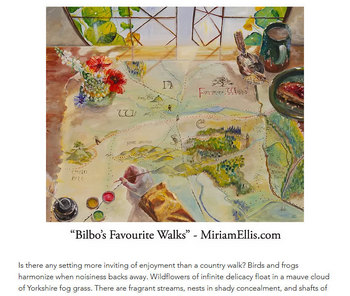
* Readers will recall that, on his Kingship, Aragorn told the hobbits… “my realm lies also in the North, and I shall come there one day”. Artist Miriam Ellis this week depicts some glimpses of the Days of the King on the Shores of Lake Evendim, after the events of The Lord of the Rings.

* An initial work-in-progress, now online as the Tolkien Books Database.

* A new accessible biography, The Brothers Grimm: A Biography (2025), from Yale University Press.

* Karen Wynn Fonstad’s acclaimed Middle-earth atlas is now in Polish as Atlas Srodziemia, and in Spanish as Atlas de la Tierra Media. Amazon UK has it that these translations were both published in November 2025.

* The Finnish national epic and ‘young Tolkien fave’ the Kalevala is now a big-screen movie. Titled as Kalevala – Kullervon tarina the feature-length movie is in cinemas in Finland. The Nordic Film & TV Fund has an English interview with Director Antti J. Jokinen and lead actor Elias Salonen, accompanied by stills.

* And finally, nominations open for Tolkien Society Awards 2026. First-round deadline: Sunday 1st February 2026. Also inviting nominations is The Mythopoeic Society’s Mythopoeic Awards 2026, with a 15th February 2026 deadline.

Tolkien Gleanings #374

Tolkien Gleanings #374

* All of Phil Dragash’s original recordings (2026), on a 9Gb .torrent. This new ‘complete collection’ including all outtakes, versions and extras, now issued in a bundle via the Internet Archive for…

“…the sake of completeness and preservation. […] all versions of each chapter, original and re-recorded, preserved in their unedited form. […] All files provided here are encoded in MP3 at 192 kbps.”

This treasure-trove potentially now gives the opportunity for an audiophile to ‘patch to perfection’ Dragash’s full-cast Lord of the Rings unabridged soundscape. Perhaps with the aid of the voice-cloning AI called Chatterbox to replace a few mispronunciations or skips, plus the AI prompt-to-SFX generator Stable Audio Open.

* New in the book Transformations of Oral and Written Narratives: The Interdisciplinary Approach (2025), the chapter “Tolkien’s refashioning of the Volsung material in The Legend of Sigurd and Gudrun and the depiction of the titular hero as a world-saving typos Christi”. Freely available online, in open-access and Creative Commons Sharealike.

* A new podcast discussion on “Middle-earth and Modern Meaning: Tolkien, Barfield, and the Soul of Story”

“In this conversation, philosopher Robert Rowland Smith is joined by psychotherapist and writer Dr Mark Vernon to explore the imaginative world of J.R.R. Tolkien and the often-overlooked influence of Owen Barfield.”

* The French Festival of Classical Languages (February 2026) will have a short session on ‘Tolkien and the Memory of Antiquity’.

* Possibly of interest to some readers of Gleanings, the new biography The Buried Man: A Life of H. Rider Haggard (2025).

* Now booking in Oxford, Magdalen College’s Lord of the Rings Marathon Screening, a one-day screening of the extended movie trilogy. Tickets likely to vanish in a twinkling, as it’s only £20 inc. food.

* Oxfam charity-shop volunteers in Scotland have turned up a 1968 edition of Tolkien’s The Hobbit among the donations. It turned out to be a rare schools edition of which only around 50 copies have survived. Now sold for £3,000.

* And finally… some of the Google Earth (desktop version) overhead imagery for the UK now has a “1945” toggle. Thus one can see Barnt Green and its train station as it was at the end of the war. Including a quiet back-lane that would have led from the back of the station to the north corner of the village. The alignment of modern roads (yellow) on old roads seems slightly mis-registered, presumably so one can actually see the old roads.

At the top of this back-lane, which still bears the evocative name of ‘Fiery Hill’, one would have turned immediately right into the village, through this unusual tall railway archway…

The arch recalls the shape of the entrance to Moria in LoTR. One can imagine that if an imaginative boy encountered it in 1900s rural darkness, on the way to the train station and back to Birmingham, it might have for a moment seemed a sort of forbidding door to a dark underworld. Though one would have to get a modern straight-on photo to compare the dimensions exactly with those of the Moria entrance, to see how precisely they match.

Tolkien Gleanings #373

Tolkien Gleanings #373

* This weekend University of Chicago professor Rachel Fulton Brown asked “Why was life-long Catholic J.R.R. Tolkien so obsessed with magic?”, in which she considered Tolkien’s own understanding of magic and story. This YouTube talk is accompanied by her equally-long talk on “Tolkien’s Magic Tree”, which considers the ‘tree’ of Tolkien’s historical spiritual influences, in terms of their stances towards claims of magic. Freely available online.

* At the Diocese of Grand Rapids in March 2026, a talk on “Tolkien and Technology”… “Dr. Bradley Birzer, professor of history at Hillsdale College and fellow of the Ronald Reagan Presidential Library, to speak on technological themes in the work of J.R.R. Tolkien”.

* The latest Heightscast podcast considers the place of Tolkien in Middle School classrooms in the USA. An educational term which there indicates schooling for pupils aged 12-14.

* Dr Lynn Forest-Hill’s blog has a new January post which anticipates for 2026 putting… “together all the research I have done over the last 10 years into a book tracing the history of the story of the Bevis romance from its 10th century background to the twentieth century”. She also notes a forthcoming “study day on Sir Bevis” in Southampton in August 2026.

* Spanish Tolkien site Elfenomeno has posted a new English complete screenplay for Tolkien’s “Smith of Wootton Major”. Freely available online.

* The movie magazine Empire will have a special March 2026 issue for the 25th anniversary of the cinema release of The Fellowship of the Ring, the first movie in the LoTR adaptation. On the news-stands any day now.

* And finally… New on YouTube, a compilation of all the appearances of the character ‘J.R.R. Tolkien The Writer’ in Fackham Hall (2025). A movie which passed me by, not being an Empire reader, but which appears to be a sort of spoof/parody of the famous British TV series Downton Abbey.

Tolkien Gleanings #372

Tolkien Gleanings #372

* The Spanish Tolkien Society has posted its 2025 Aelfwine Essay Contest winners. In Spanish, and freely available online. Among other essays, titles include (given here in English translation) …

– “Tolkien’s Aesthetics Versus Critical Theory: harmony and dissonance”.
– “Older Than The Elves, Wilder Than The men: Treebeard, the Celtic guardian of the spirit of Fangorn”.
– “The Voices of Elvish Linguists” (detects subtle differences between the way different elves speak).
– “Tolkien at the End of the World: Journey to Cornwall”.

The latter is very much the ‘fictional recreation’ it claims to be. The author invents for Tolkien and Fr. Reade’s walking holiday: tootling all the way down to Cornwall in a car rather than going by train from Birmingham New St.; staying with a landlady at a picture-book Cadgwith cottage rather than with Fr. Reade’s mother in humdrum Lizard Town; driving from their lodgings all the way to Land’s End and taking in major stone-circles and barrow burials on the way; driving to Tintagel and exploring ‘Merlin’s Cave’ below it.

* Talking of fictional Tolkien, I’ve rather enjoyed reading the novel Tolkien and the Dangerous Truth (Book 2 of ‘The People Under The Hill’ series). It’s been sitting in the Kindle ereader for a year, but I finally got around to reading it. The tight writing, vivid characters and intricate plotting are all very close to what one might read in one of Neal Stephenson’s tighter novels (e.g. Anathem), which is high praise but is well deserved. The book is self-published however, and like so many such books is ill-served by an off-putting cover. Had I not read the first book in the series, I might have passed it over. Tolkien is here imagined as having accepted a place on a late summer 1919 German ethnographic expedition to the Sunda Islands (home of the komodo dragons, lush volcanic forest, Catholic population, some 20 days from London by ship), to record an unknown language thought to exist there on a remote high plateau. In the first third of the book his lost-in-the-Oxford-archives expedition notebook is sought by a curious cast of characters. Tolkien the-young-man is treated very fairly, I thought, provided one accepts that real writers of a certain vintage can be depicted as fictional characters. If you’re interested, be warned that the book’s blurb is rather a plot-spoiler.

* Oxford Libraries Graduate Trainees

“We also were also shown three examples of individual books being conserved by the Assistant Book Conservator, Alice Evans. One of these examples was Tolkien’s copy of Sir Gawain and the Green Knight. Tolkien thoroughly annotated it and repaired it with tape – something we hope no reader will do to our books! In this case, despite the tape degrading over time and staining the book, the tape will not be removed or replaced with acid-free archive-safe tape. That’s because the value of this object for researchers comes from Tolkien’s interaction with it and the signs of use – including all the tape fragments. […] The 2026/27 trainee scheme is now open for applications”.

* The Italian Tolkien journal Quaderni di Arda has issued a Call for Papers 2026, for a future issue exploring Tolkien related games and how they to try to cleave to canon or how the makers justify departing from canon. With a specific focus on how this influences role-playing games and thus player identity / choices. The editors will also consider proposals related to… “mods, expansions, scenario designs, and component ecologies” of game-worlds such as spin-off “board and card games”.

* The new academic book Literary Game Adaptations: A Systems Approach (2026) has the chapter “A Game of Riddles: Knowledge, Experience, and Fidelity in The Hobbit” ($ paywall).

* A Collection of Unmitigated Pedantry has posted “Tolkien and Eowyn Between Two Wars”, this being his text of his keynote talk given at Prancing Pony Podcast Moot in 2025, on… “the grounding of Tolkien’s perception of war, anchored in both his deep erudition and his own experiences.”

* The latest Russell Moore Show podcast interviews Joseph Loconte on his new book The War for Middle-earth.

* Dimitra Fimi’s blog considers the reactions of four later fantasy writers to Tolkien’s “On Fairy Stories”.

* And finally, Tolkien’s friend C.S. Lewis seems set for a bump in book sales. Due to the publicity for a big-budget British movie version of The Magician’s Nephew (the sixth book in the Narnia series), a movie now fairly firmly set for a U.S. cinema release on 26th November 2026. Apparently the tale has been moved to the 1950s, and it’s said to have been fairly freely adapted. Releasing around the same time is a Welsh horror movie titled Werwulf, apparently a 13th-century English werewolf tale re-told with Old English (Old Welsh?) dialogue and English subtitles. Tolkien would surely have nodded in approval.

Tolkien Gleanings #371

Tolkien Gleanings #371

* As the winter temperature plummets below freezing here in England, a timely article from the University of Leicester journal Physics Special Topics, “Thermal Insulation of Hobbit Holes: Comfort in the Shire”. Freely available online.

“[Bag End’s] long hallway contributes significantly to heat-loss, but burial depth and material selection enable sustainable heating with ∼18kg [40lbs] of wood daily.”

Bag End therefore must have had a winter log-pile some 4 feet high and 8 feet long, called a ‘cord’ in the trade, perhaps averaging 4,000 pounds of wood. At Bilbo’s consumption rate this pile would need to be fully renewed three times each year, with each new ‘cord’ lasting him around 100 days and with a two-month gap for the high summer. Deliveries likely in late August, mid December, and early March, probably with an extra cost for carting it all up the hill. Assuming easy-burning pine logs, Bilbo is therefore consuming about two mature pine trees a year, in order to comfortably heat a large hole with a great many rooms. If on his country walks he occasionally plants a pine-cone in a likely spot, he is more than heating his home in a sustainable manner.

* New in The Explicator, a note-article on “The Origins of J.R.R. Tolkien’s Mirkwood Revisited” (first page and footnotes are free, the rest is $ paywalled).

* The Geeks of Doom blog reviews the new pocket-book Pocket Portraits: J.R.R. Tolkien (2025)…

Organized into 100 brief vignettes, this mini-hardcover spans 240 pages filled with biographical insight into the British writer and illustrator’s life […] But where this beautifully designed biography really excels, however, is in its exploration of Tolkien’s writings that were never published during his lifetime, particularly those set in Middle-earth”.

* A 2026 reprint of the £75 ‘making of’ book Middle-earth: From Script to Screen: Building the World of The Lord of the Rings and The Hobbit (Weta/HarperCollins). A table-trembling hardcover of over 500 pages, with the reprint due on 26th March 2026. It doesn’t appear to have been updated or expanded for this new printing.

* Italy’s Paulo Nardi on Homer and Tolkien: What It Means to Come Home.

* In Polish in the latest edition of journal Rozprawy Spoleczne, “(Po)wolnosc” (‘Slow and free’), on slowness and slow-living in Tolkien. The Ents are considered as a metaphor for the value of slow and considered living in freedom. Being so deeply rooted in the land, this slowness can yet at times turn to a fast and efficient defense of the homeland — as in the scouring and transformation of Isengard.

* And finally, talking of slow and rooted… Tolkneity this week blogs on “Tolkien Pines in Poland”

“Before the Tolkien Pine [aka the ‘Black Pine’] in Oxford declined […] Polish Tolkien fans brought its cones back from England in 2008. [Intending to plant its] true descendants, grown from seed — a new generation of the very tree Tolkien himself knew. A decisive moment came when the Skierniewice Forest District became involved in the project. It was there that the seeds were professionally sown, the young trees were raised under expert care, and proper forestry conditions were provided for their survival.”

Tolkien Gleanings #370

Tolkien Gleanings #370

Happy New Year!

* Alas, Not Me on “The Digital Tolkien Project – How it Helps My Work”.

* A repository collection of 101 very early Tolkien fanzines, all scanned and online. Freely available. Lighthouse 13 (August 1965)…

* Literary Hub has an official free excerpt-article from Michael Drout’s new book, “Michael D.C. Drout Remembers the Impact of The Lord of the Rings and The Hobbit on His Childhood”.

* In the latest Forum Auctions catalogue (November 2025), a proof for the cover of the 1961 British children’s paperback of The Hobbit

* A curious self-published pamphlet in Italian, newly published on Amazon, Tolkien vs Lovecraft: Confronto sul concetto di Morte (‘Tolkien vs Lovecraft: A comparison of their concepts of death’) (2025).

* Clas Merdin looks back on the year in his “Matters Arthurian in 2025”. He notes that the 40th volume (XL) of the journal Arthurian Literature had an article on “fairies and cosmic providence in Sir Gawain and the Green Knight”.

* And finally, Wormwoodiana’s Second-Hand Bookshops in Britain: 2025 Report. Includes the interesting detail that…

“… another development is the spread of a small selection of second-hand books in a variety of places. For example, almost every historic church visited on a book-hunting holiday this year had second-hand books for sale, usually several hundred each.”

A little more on local Roman roads

A little more on local Ancient Roman roads in North Staffordshire, following my previous posts on the topic. Below is an extract from the final part of: Rev. T.W. Daltry, “Chesterton” [Roman Camp], Journal of the British Archaeological Association, 1896.

One [final] word as to certain place-names in the neighbourhood of Chesterton. We have, one and a half miles to the north, a small village called Red Street, which is distinctly visible from the [Chesterton] Camp. This Red Street is evidently the Roman Road that went northwards by Windy Harbour and the village of Talk [Talke], and probably on to Condate and Mancunium [Manchester].

To the south-west, about two and a half miles from Chesterton, there is a short length of Roman road called Pepper Street, which now terminates at its junction with the Newcastle and Nantwich road, close to what was Keele Toll Gate. Originally it must have gone straight on. About half a mile further there are two farmhouses, called respectively ‘Honey wall’ and the ‘Highway’, and these names seem to indicate the proximity of a Roman road; and a little further on we have two farmhouses close together, which are called ‘Stonylow’, and this may perhaps be another indication of the same road. Then, still in a straight line, the pavement of an ancient road has been found beneath the soil in a field on Nethersethay Farm, not far from the London and North-Western Railway, about one and a quarter miles south of Madeley Station.

According to Mr. Watkin, in his ‘Roman Cheshire’, another road came from Condate or Kinderton to a little south of Betley, and this must have continued by or near to another Windy Harbour, half a mile to the north of Madeley Village, and to have joined the above-mentioned road from Chesterton somewhere about the spot where the ancient pavement was disturbed by the plough. The united roads must have led to Bury Walls near Hawkstone, which is said to have been the Rutunium of the Second Iter, and thence to Uriconium.

About midway between these two lines, about three miles from Chesterton, and one and a half miles north of Madeley, in a field near to the colliery at Leycett, two earthen jars filled with Roman copper coins were ploughed up in the year 1817. The jars were broken, and I have seen one or two fragments. The coins were about two thousand in number, and were chiefly of the reigns of Constantine the Great, and his son Crispus. Mr. Ward [the local Stoke historian] says there were also “many coins of Licinius and of the associate Emperors Diocletian and Maximian, and some of the usurpers Posthumus, Tetricus and Victorinus.”

Tolkien Gleanings #369

Tolkien Gleanings #369

* The Tolkien Society appears to have set the dates for its big gathering in 2027. The TolkienGuide’s Events page has ‘Tolkien 2027’ as set for 18th – 22nd August 2027 at the Hilton Birmingham Metropole, the hotel for the UK’s National Exhibition Centre (NEC). The NEC is far out in the countryside between Birmingham and Coventry, conveniently adjacent to Birmingham International Airport and also well-served by inter-city trains.

* A new article has been added to the new rolling edition of Journal of Tolkien Research, “Belliphonic Tolkien: Listening to the Wars in Middle-earth”. Freely available online. The article focuses on the described soundscape of war and battle in Middle-earth, and draws on a recent cluster of wider research on ‘belliphonics’. Freely available online.

“Tolkien’s immersion in classical, Anglo-Saxon, and Norse literature, combined with his experience of World War I, enabled him to create richly layered battle sounds in which horns, cries, silence, and environmental acoustics carry narrative and psychological weight.”

* Zackery Arbela’s blog muses on Tolkien and Nostalgia and Robert E. Howard and Nostalgia. R.E. Howard’s…

“heroes do not embark on great adventures to save the world, there are no humble hobbits or noble rangers in [his] Hyborian Age. Conan and Kull are men out for themselves. [This was likely a natural outgrowth of the author growing up in Texas towns] at a time when the Frontier had only just closed, in] cowtowns and boomtowns steeped in tales of gunfights, outlaws and Indian raids. The Texas oil boom of the early 20th century was at its height [and Howard was in the thick of it in his early manhood], bringing with it a massive increase in crime, vice and bare-knuckle violence. Indeed, it is this fatalistic view of human existence that differentiates Howard’s nostalgia from Tolkien’s. The Lord of the Rings saw the restoration of an older, civilized order to its rightful place, leaving the darkness behind to live in the light. But to Howard such an order was unnatural and could not last. Civilizations were doomed to fail; no matter how high they climbed”.

A starting comparison for a basic understanding, but he might want to delve into the complexity of Tolkien’s position on ‘the long defeat’ and the place of hopeful struggle and restoration within it. Howard’s position is also equally complex (e.g. see the two volumes of his 1930s letters to H.P. Lovecraft, where the barbarism vs. civilisation position is argued out with subtlety and at great length). Had the authors not had such complex and well thought-out positions on such things, it’s arguable that their works would have had far less long-term impact.

* The new academic book The Exceptional North: Past and Present Perspectives on Nordicness (2025) has a chapter on “Danish Literature in British Nineteenth-Century Periodicals”.

* The latest edition of the open-access journal Ethnologia Fennica (December 2025) has a review in English of the Finnish-language book Pyhat Puut (2025), as “Sacred Trees of the Finns in the Past and Today”.

* And finally, Tolkien and cats. An obscure little topic, but one I’m casually interested in. Perhaps it will eventually amount to a small counter to the “Tolkien hated…” brigade. He knew cats as a boy, since he and his brother would play with them in the corridors at the Birmingham Oratory. But he also knew cats later in his family life. Since his children evidently had a white kitten for Christmas, as his Father Christmas letters show…