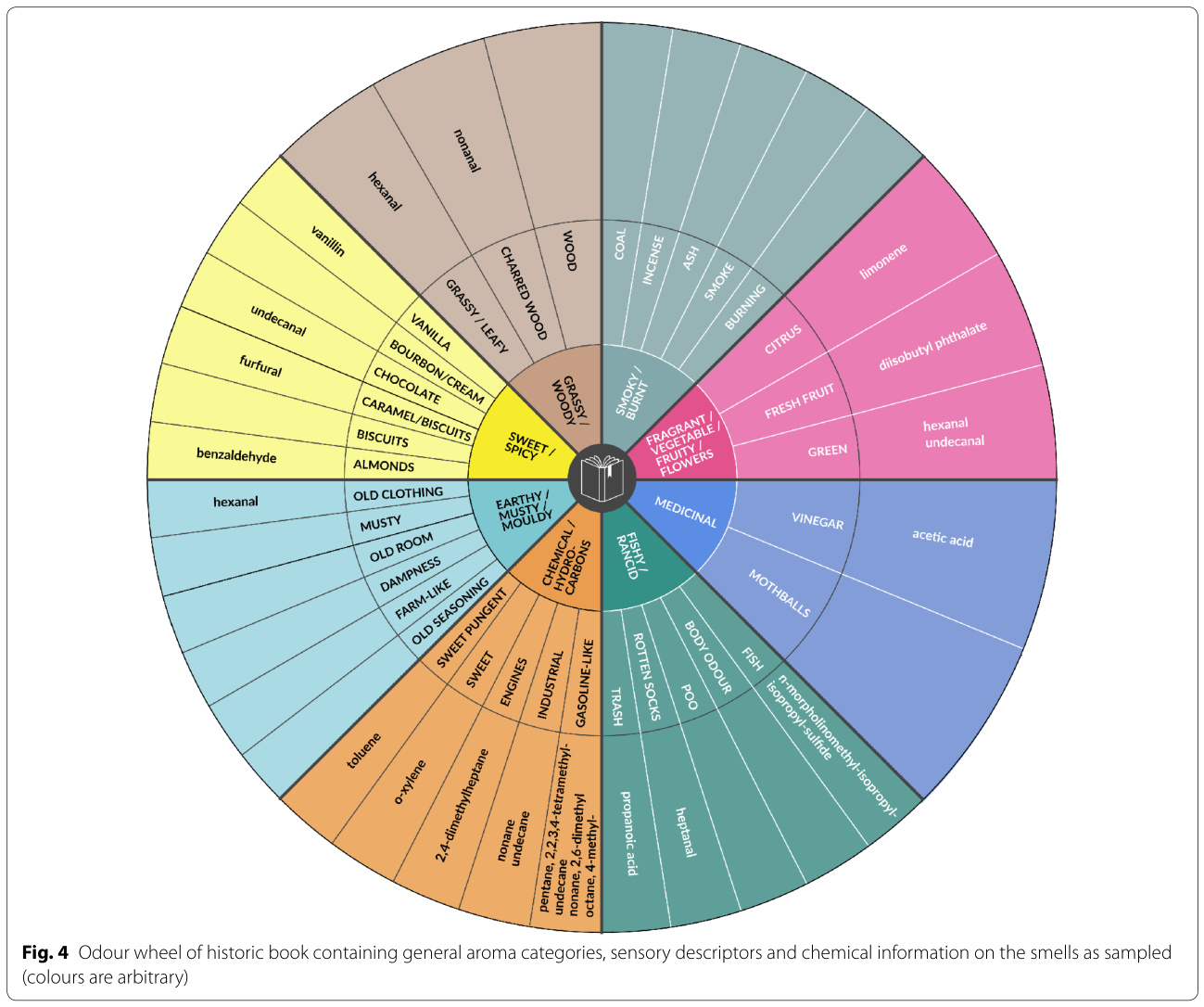
Wheely smelly

Smell of heritage: a framework for the identification, analysis and archival of historic odours, Heritage Science Vol. 5 No. 2, 2017…

We… “create[d] the Historic Book Odour Wheel, a novel documentation tool representing the first step towards documenting and archiving historic smells.”

Also rather a useful quick ‘smell lookup-tool’ for fantasy writers with characters who frequent ancient archives and suchlike, I’d suggest.

Out to the Oratory

New on the National Catholic Register: “J.R.R. Tolkien and the Birmingham Oratory”.

“Arriving in Birmingham, England’s second city — population in its metropolitan area in excess of 3 million people — I was dismayed to find that the city did not possess a Tourist Information Centre. Not a formal one, at any rate — there is an informal one in the City Library though. It was there I asked for information on the “Tolkien Trail.” The answer I received only increased my dismay: “Is that in Birmingham?”

Yup, that’s Brum city centre and the local council apparatchiks, alright. Apparently it’s been like that for years, with the default position (before the current utter unknowing) being: get the Tolkien freaks on the bus to south Birmingham

“…when I sent media graduate Alma Sanz Fazio in there recently as a test, she was told to catch a bus to either Sarehole Mill (even though it doesn’t reopen until the spring) or Hall Green Library. What a welcome for a first time visitor from Madrid.”

Difficult to avoid the feeling that some of this attitude from the Council is snidely political. Anyway, the lesson is: do your research before you arrive at a place, including virtually ‘walking the route’ by using Google StreetView.

What are ‘the Tolkien basics’ of the West Midlands, then, if you don’t have much time? This is how I’d do what’s still there and is worth seeing. Given that so much has been swept away, there are some ‘maybe’-places and substituted ‘equivalents’.

1. Early morning train from London to Birmingham. Walk from Birmingham New St. station to the Birmingham Museum & Art gallery for the Pre-Raphaelite and Burne Jones collections, Birmingham city centre. (There’s no proof that he and the TCBS were influenced by this world-class collection, as schoolboys. But the long-gone school was at the other end of the street from the gallery, and how could a group plotting a resurrection of the English spirit never have seen this collection?)

I’d skip Moseley in the south of Birmingham entirely, especially if you have to struggle to get there by a bus grinding down the main road (very bad idea). Though the Moseley Bog can ‘have its moments’, if visited in a sunny springtime on a quiet weekday.

2. Uber from the city centre out to the Birmingham Oratory and perhaps a peep at the nearby 4 Highfield Road site. (I have found one mention, as aside in a blog post, that as a boy the young “Tolkien served Fr. Morgan’s Mass daily”, but I’ve never seen any scholarly reference to that apparent fact or its source). The devout may also want to then go on to the Catholic Cathedral. Again, no proof I know of that he was ever actually at the Cathedral, but how could he not have ever been there?

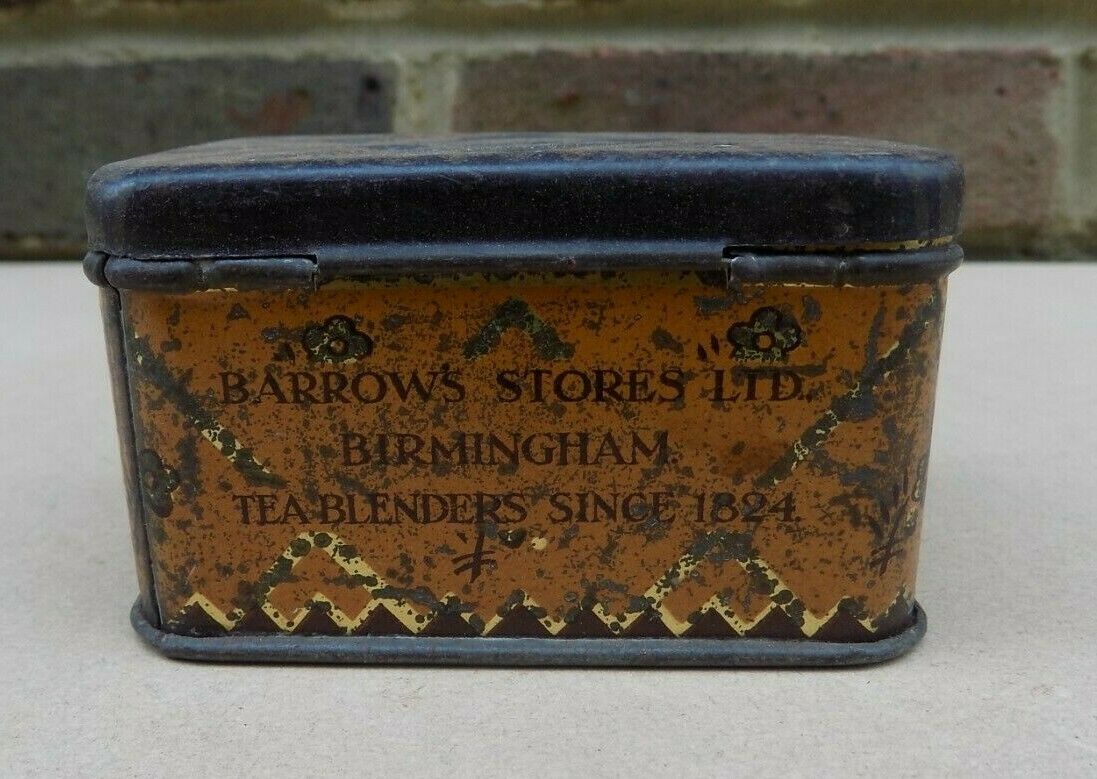
3. Train from Birmingham New St. to Stafford. Once beyond Wolverhampton, you’ll get a flavour of the mid Staffordshire lowland countyside from the windows. Then at Stafford you’d walk away from what has to be ugliest train station in England (sorry!), and through the pretty and safe adjacent river-park, for lunch at The Soup Kitchen. This is on the principle that the Soup Kitchen is about as close as you’ll get, in wood-panelling / atmosphere / uniformed waitress service, to the long-gone Barrow’s Stores tea-rooms in Birmingham in which the TCBS would meet. Then an Uber from Stafford out to the nearby Great Haywood in mid-Staffordshire.

4. The sites of his First World War camps on Cannock Chase, near to Great Haywood. The Essex Bridge, though trees now mean that Shugborough Hall can no longer be seen from the bridge approach.

5. Uber back to Stafford train station then on north to Stoke-on-Trent train station. An Uber for a quick look at 104 Hartshill Road in Stoke and perhaps the pleasant back part of the Butts where he learned to shoot live rounds with his rifle. Then hop back in the Uber and out of Stoke and up into ‘The Gawain country’ around Wetton Mill and up onto Cauldon Low for a sunset look at the barrow-downs in the west of the Peak District (don’t get trapped by the fog!). Again, there’s no proof he was ever there. But it seems difficult to imagine that (if he thought the North Staffordshire claims for Gawain worth considering) he didn’t venture up there during his holidays in Stoke, to see the landscape of the Gawain text he’d spent much of his life working on.

6. Back to Stoke-on-Trent in the dusk and catch the direct two-hour inter-city train to Oxford. Do Oxford the next day (perhaps two days), then back to London.
Lake of Thor

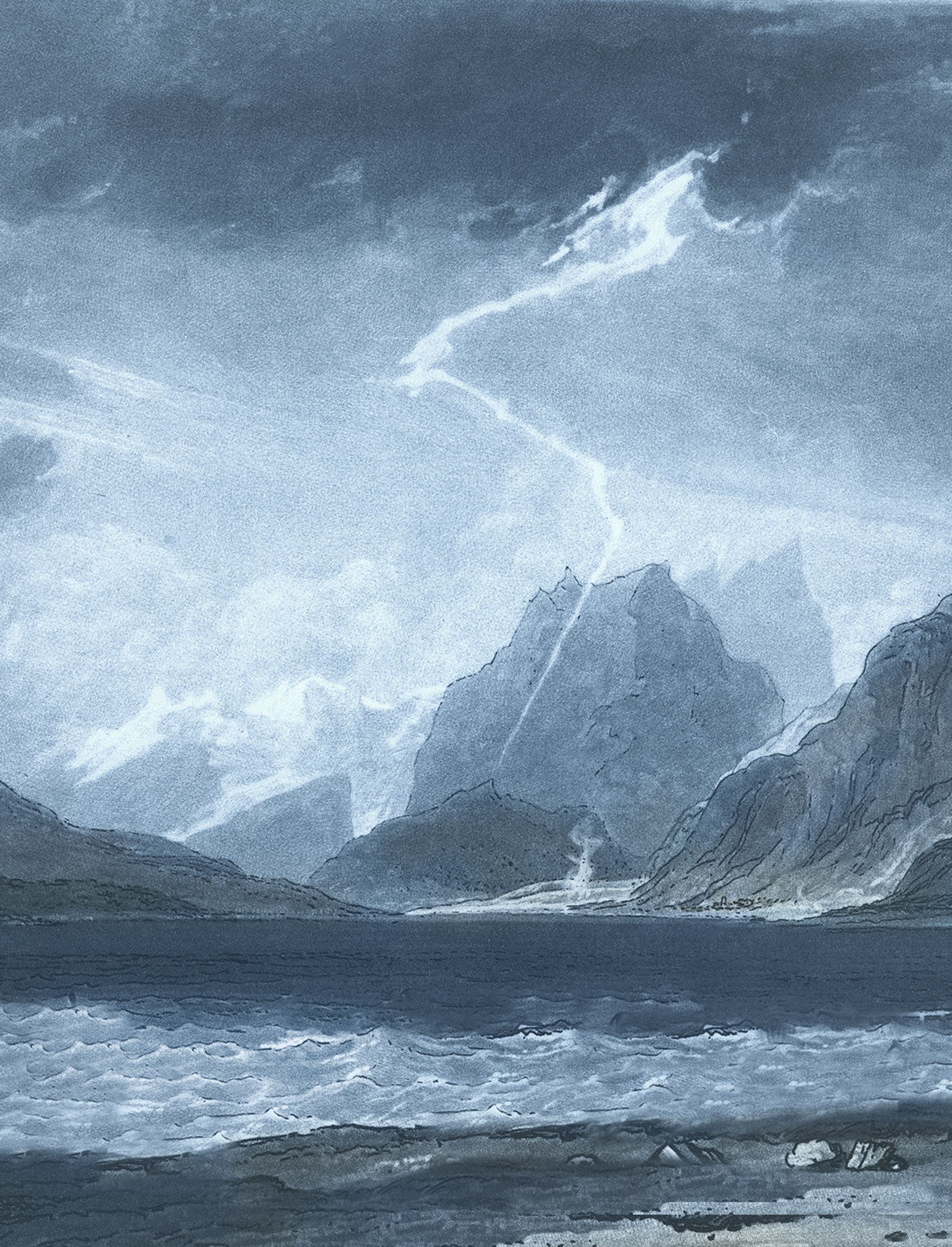
A detail of Turner’s engraving “Lake of Thun”, Photoshopped to remove figures and re-colour etc, and thus turned into a potential book cover for a book on thunderous Northern topics. Feel free to use, I’m placing this version under Public Domain. Original at embedded link.

http://www.metmuseum.org/art/collection/search/359776

Gardening in ‘hell’

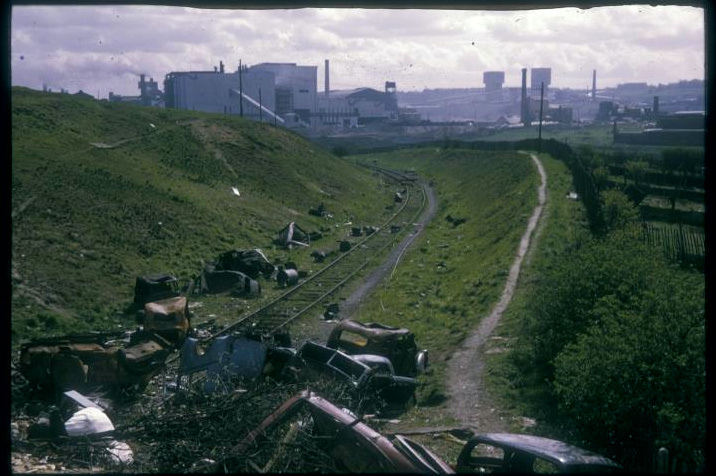
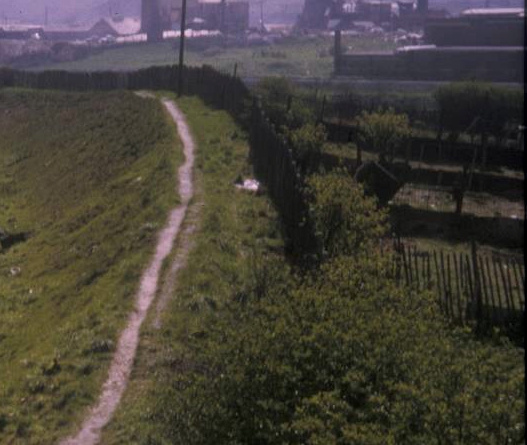
New on PastTrack: May 1964 on The Grange, Burslem, looking toward part of Shelton Bar.

What’s remarkable is the three strip-gardens seen on the right, possibly the top grassy bit of allotments, with what might even be small fruit trees. One of the most industrial and polluted sites in western Europe, and there are gardens in it that wouldn’t look out of place in a rural medieval monastery.

It’s another example that illustrates the way that the rural and the industrial co-existed in Stoke-on-Trent.

From slab to tablet

New Addenda and Corrigenda for the “now so big, it’s square-shaped!” new edition of the J.R.R. Tolkien Companion and Guide.

If your letter box and/or wrists can’t quite cope with such hefty slabs, I see there are now Kindle ebook tablet editions of the 2017 edition. Although these don’t show up as links from Amazon’s hardback/boxed-set page. Here are the links to the ebooks:

* Volume 1: Chronology (£24)

* Volume 2: Reader’s Guide – PART 1 (£5)

* Volume 3: Reader’s Guide – PART 2 (£24)

So £53 for the lot. Not bad, and on the Kindle these are also keyword-searchable to boot (albeit individually, rather than all three at once — I know of no tool that will index across multiple .mobi files, even they were to be DRM free).

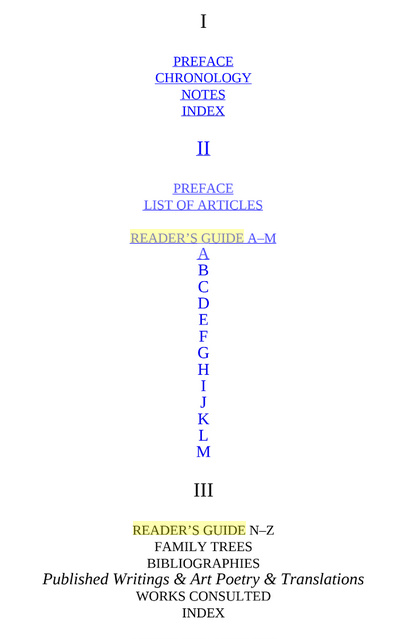
What is the difference between Reader’s Guide – PART 1 and PART 2? The publisher’s description is useless on that point. But thankfully there’s a view of the Contents page on Google Books:

Apparently the Index in Vol. 1 and Vol. 3 are both duplicates of each other, and presumably they refer to the pages of the print version.

Bombadil as guardian-spirit for LoTR

Ah, Bombadil. Whatever else he may be, he’s an excellent ‘door-guard’ guardian-spirit for The Lord of the Rings, preventing unworthy readers from entering the rest of the book — the readers who just can’t get their dull heads past the idea of what they see as merely a ‘jolly annoying singing garden-gnome, with a fish for a wife’. For the more perceptive reader, he more or less works the opposite way, as an enticing enigma and riddle. Partly shaped by Tolkien’s memories of his father-figure guardian Father Francis, obviously, and a dash of St. Francis… but far more than that and an enduring riddle for most.

Palmer’s shipwreck

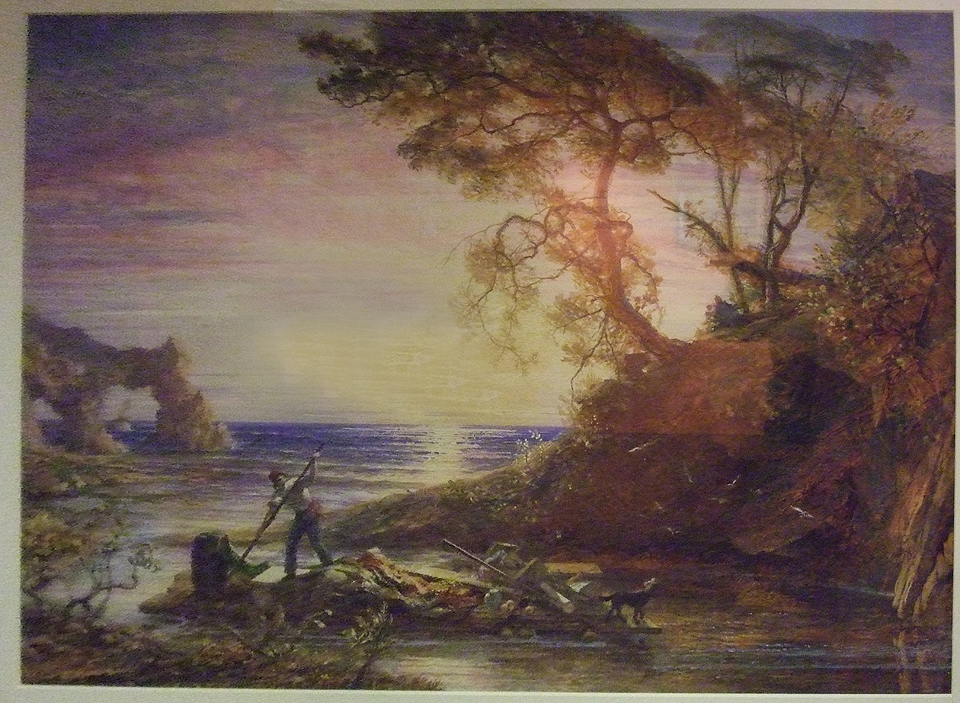
Interesting. The Samuel Palmer painting “Robinson Crusoe …”, owned by and occasionally on display in the city museum at Stoke-on-Trent, is (like its subject-matter) a survivor of what was once a large and now-lost part of Palmer’s work…

   “Samuel Palmer is not usually thought of as a painter of the sea. However, his son A.H. Palmer included five coastal scenes amongst the 22 illustrations of his Life and Letters, and described one work, ‘Storm and Wreck on the North Coast of Cornwall’, as ‘one of the best of [his] sketches from nature’. The coast features in a number of the elaborate exhibition watercolours of the mid-century, such as ‘Robinson Crusoe guiding his Raft into the Creek’ (1850, City Museum and Art Gallery, Stoke on Trent) and ‘Farewell to Calypso’ (1848—49, Whitworth Art Gallery, University of Manchester). In addition to these, exhibition records show that in the 1850s and 1860s Palmer exhibited a considerable number of paintings which focus on the contemporary life of the British coast [mostly Cornwall and Devon]. In many cases we know these works only from their titles, because they sold very well, and disappeared into private collections straight after the exhibitions. Palmer evidently shared the preoccupations of other artists of the time: he made detailed studies of wave movements, and explored narrative subjects drawing on the life of the British fisherfolk, with all its anxieties and dangers. These works are from the middle period of Palmer’s life, which has been unduly neglected by art historians. The standard account of Palmer focuses on the visionary Shoreham years, which came to an end in the early 1830s, and the ‘vision recaptured’ in the Milton and Virgil illustrations of his last years, starting in 1865.”

— from Christiana Payne, “”Dreaming of the marriage of the land and sea”: Samuel Palmer and the coast” in Samuel Palmer Revisited, 2010.

I never knew that, despite having several books on Palmer on my shelves.

Stoke’s “Robinson Crusoe …” is not especially inspiring at first glance. I remember a girl I was looking at it with in the Museum, some years ago… she could obviously see nothing in it. ‘Just another example of pretty-pretty patriarchal/imperialist art’, seemed to be her implied political stance. But there are multiple resonances to be seen in it, for those who can discern the deeper cultural and literary contexts.

I see that the Ashmolean also has a fine Palmer painting of the Arthurian site of Tintagel in Cornwall. Since much of his sea work still seems to be in the Midlands/North West, I wonder if his surviving sea works might be brought together to make the nucleus of a cheery summer exhibition circa 2020, at the Potteries Museum & Art Gallery. Accompanied and bulked out by similar British sea paintings featuring or alluding to myth and legend?

There might also be a side-room that explains the spiritual concerns of the Staffordshire Hoard makers with the sea, and the symbolic resonances they gave it in their art and poetry. Perhaps paired with the other great English sea-poetry written written in North Staffordshire, later, by the Gawain-poet in poems such as Patience and Purity. That would link through to Tolkien (a Gawain-poet expert), who had formative experiences in Staffordshire while he was nurturing the foundational centre of his legendarium – the mythic mariner Earendel.

Perhaps such an exhibition could be co-organised with some large gallery in Cornwall, to share the costs.