“The custom of ‘lifting’ and ‘heaving’ is referenced in several sources in the University of Leicester’s Special Collections as being an Easter tradition in the 18th and early 19th centuries. Common in Lancashire, Staffordshire and Warwickshire and other parts of England, the practice involved groups of people gathering together in the street and physically lifting those they came across into the air … in all cases the ceremony is considered incomplete without three distinct elevations made.
Also in Bakewell in the nearby Peak…
“It persisted in some areas for a little longer, for example at Bakewell in Derbyshire where young men lifted and kissed the girls on Easter Monday as late as the 1890s.”
It seems the rumbustious and boisterous ‘street heaving’ had a parallel in a more restrained and respectable ‘chair lifting’. I’ve found that it was also done in Buxton, as stated in British calendar customs: England, 1936. Volume 97, page 109…
On Easter Monday and Tuesday an ancient custom prevails at Buxton consisting in lifting a person, in a chair, three times from the ground. … Until about the middle of the nineteenth century the heaving custom at Easter was regularly observed in South Staffordshire.
The same University of Leicester source also has a first-hand account nearby Shrewsbury…
A more detailed account of heaving was first printed in Henry Ellis’s edition of John Brand‘s Observations on Popular Antiquities Vol. 1 (London, 1813). The description was from Thomas Loggan, a ‘correspondent of great respectability’, who encountered the practice while minding his own business eating breakfast at the Talbot Inn, Shrewsbury. A group of female servants entered, carrying a chair lined in white decorated with multi-coloured ribbons. When asked what they wanted, they replied that they came to “heave” him, according to custom:
“It was impossible not to comply with a request very modestly made, and to a set of nymphs in their best apparel, and several of them under twenty. I wished to see all the ceremony, and seated myself accordingly. The groupe then lifted me from the ground, turned the chair about, and I had the felicity of a salute from each. I told them, I supposed there was a fee due upon the occasion, and was answered in the affirmative; and having satisfied the damsels in this respect, they withdrew to heave others. (SCM 09950, pages 155-56)
I can add that in North Staffordshire it has a late parallel, in a May Queen chair-carrying celebration near Leek (which is near Buxton, see mention above)…
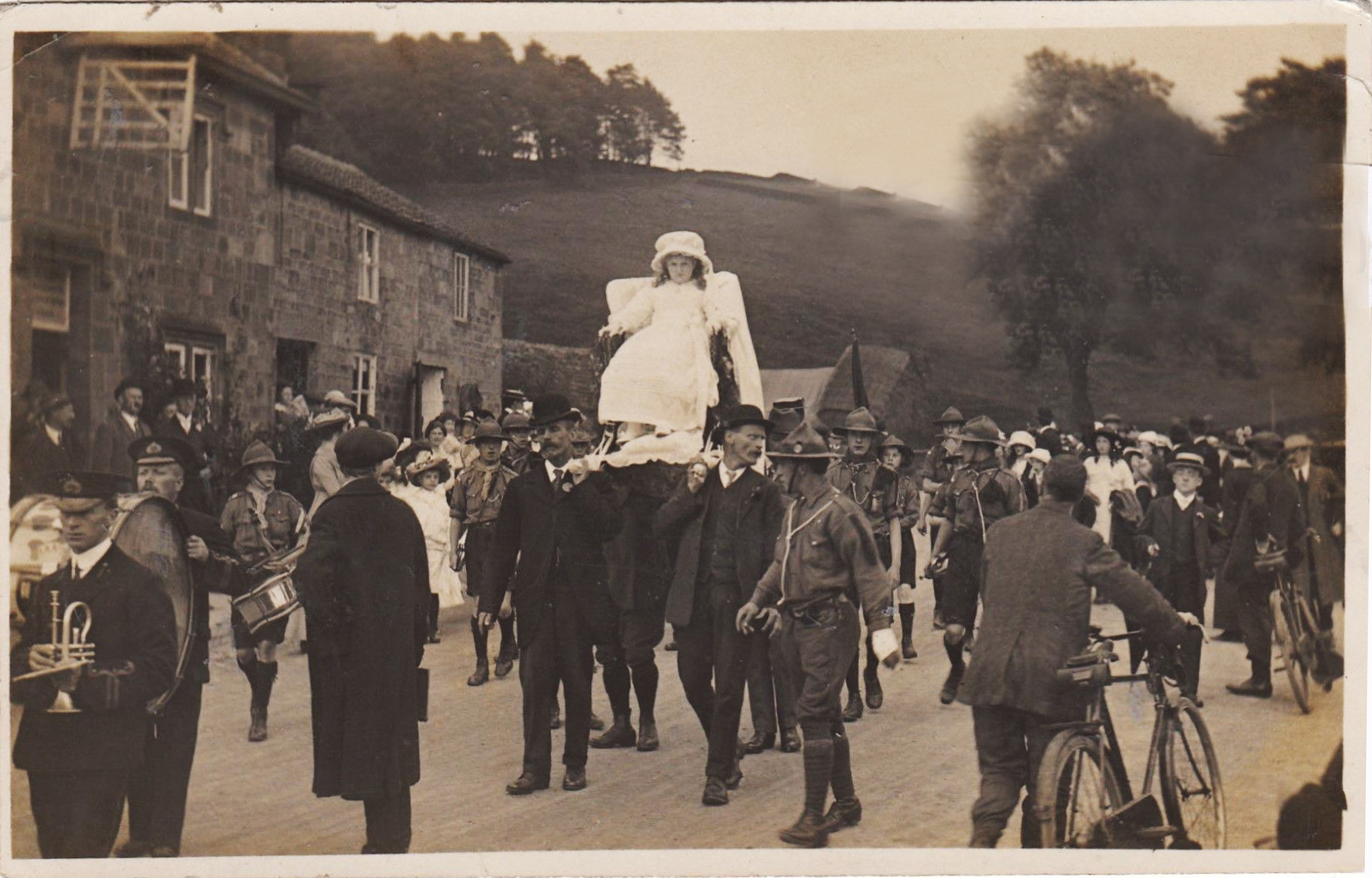
The May Queen aloft, at Rushton Spencer, near Leek in the Staffordshire Moorlands. Flanked by boy-scouts, so possibly early 1910s?