The seven-year oak wood project in mid Staffordshire has reported its findings, in the journal Nature. The wood being studied is the 46-acre Mill Haft, full of mature English oaks, around six miles west of the county town of Stafford. In this wood, various plots of 32 yards diameter were studied, these being pumped with CO2 over seven years.
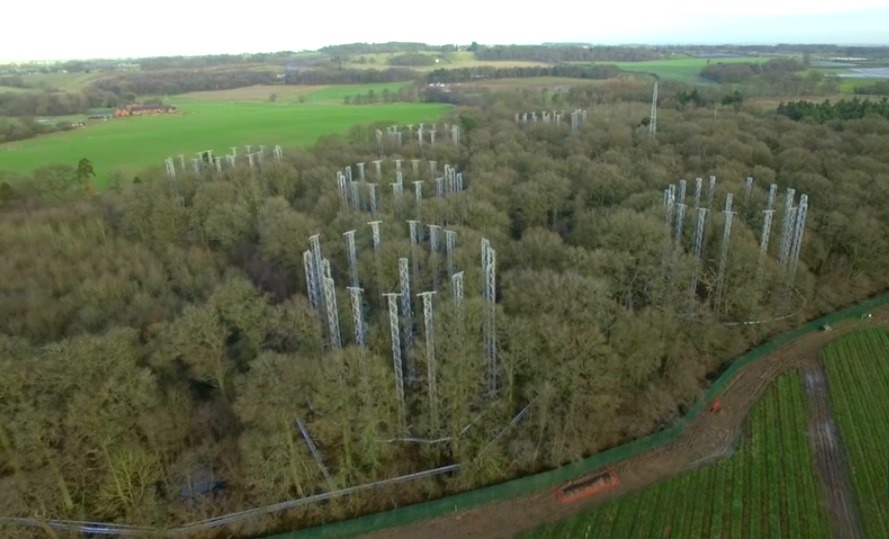
The results, now in, show that…
“over the seven years of treatment, tree growth was 9.8% greater […] Most of the observed increase was attributable to wood production; there was no difference in fine-root or leaf mass production”.
Also note that…
“Exudation of organic carbon from roots is rarely included in estimates [by others. But here, our repeated] analysis indicated a significant overall effect [stated as between 43% and 64% more exudation, depending on year].
Which means (in layman’s terms) that not only is elevated CO2 being used by the tree to make a bit more wood (hardly noticeable to the eye, for most people), but the tree is also rather usefully pumping a lot more of it underground than before. As the report suggests, this then benefits the microbes living in the soil below the tree…
[the exudation is] “disproportionately important to ecosystem biogeochemistry [since it primes] the microbial community and associated nitrogen and phosphorus cycling” [in the soil].
All of this is to be expected, as CO2 is ‘plant food’. But it has not before been proven in temperate mature woodland. Overall, the project’s results clearly contradict earlier assumptions that…
“older, mature forest systems have no capacity for response to [elevated atmospheric] C02”.
The project plans to continue for another seven years.
[…] A major seven-year Staffordshire oak wood project reports on the influence of elevated CO2 on mature temperate woodland. No worries found, according to the […]