Tolkien Gleanings #178.
* Forthcoming at Signum University, “Tolkien & Tradition” is a 12-week online course which starts on 29th April 2024. Booking now.
* More recordings from the Tolkien lecture series at Oxford, now freely available on YouTube, “‘Never Trust a Philologist’: Lewis, Tolkien and the Place of Philology in English Studies” and “Tolkien’s Modern Readings: Past Perspectives, Present Insights, Future Study”.
* A new article itemising and detailing at great length “The Sauronic Empire”…
“The Sauronic Empire was the largest single dominion in recorded history, stretching sixteen hundred leagues from the Sundering Seas in the west to the foothills of the Orocarni Mountains in the east, and more than four thousand and eight hundred leagues from Forodwaith in the north to Far Harad in the south. It was larger than any of the Eleven realms of the First Age, or the Kingdoms of Gondor and Arnor at their height, or the domains of Morgoth during his rule from Angband, representing an unprecedented consolidation of power and territory under a single ruler.”
* A 2023 thesis from Brazil, O Fim da Demanda: a Terra-madia de J.R.R. Tolkien entre a vontade de poder e o escape da morte (‘At the end of the quest: J.R.R. Tolkien’s Middle-earth between the will to power and the escape from death’). Freely online, and while not in English it has a substantial English abstract. Trying to boil down this rather choppy abstract, I take from it that… Tolkien’s protagonists go on “audacious quests” partly due to their inner “yearning for happiness”, in the sense of Aristotle’s eudaimonia (‘happiness in a life well-lived, in persuit of excellence and virtue’), or the similar Christian beatitude (here understood in the religious sense, but which in the secular sense might mean ‘great happiness, achieved by using one’s own natural powers to strive for the better world that is to come’). The author links these ideas with Tolkien’s wider idea of “the hope of a happy ending beyond the catastrophe of tragedy — and even of death”.
* A 2022 thesis from Finland, Supernatural Knowledge: Literary and Philosophical Approaches to Epistemology in J.R.R. Tolkien’s Legendarium. Freely available and in English. Examines how and where… “Tolkien’s complex fantasy universe partakes in philosophical conversation about the questions of knowledge”, with special reference to aspects of “Plato’s philosophical theory”. The abstract leaves the latter unspecified, but the body text reveals it to be the Theory of Forms.
* The lead article in the latest edition of the journal Greece & Rome is “Tolkien’s Unique Reception Of Pythagorean ‘Dissonance’ in the Ainulindale of The Silmarillion” ($ paywall). The author suggests that… “Tolkien has deliberately chosen a somewhat esoteric element of Pythagorean musical theory, albeit highly relevant to his own historical context”.
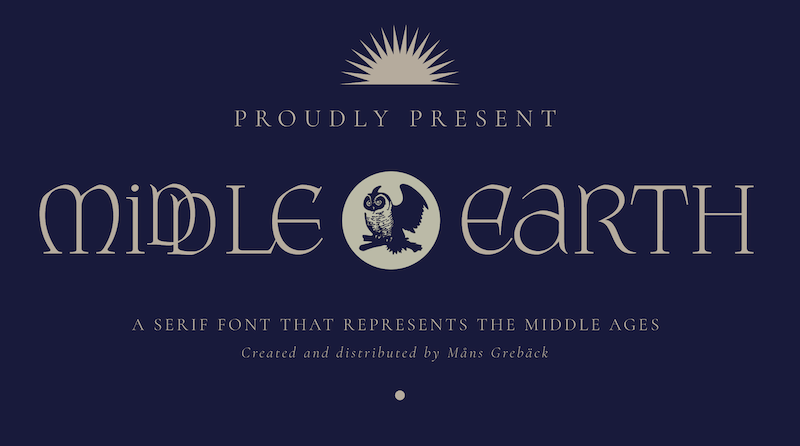
* And finally, a new Middle Earth Font (late 2023), as freeware for personal use. A paid commercial version is also available on request and appears to have the addition of a set of numbers. Presumably the maker knows it should be Middle-earth not Middle Earth, but he probably fears a trademark.