Tolkien Gleanings #84.
* Following on from my idle musing about elvish handicraft in Gleanings #82, “Medievalism, the Lost Book, and Handicraft in The Lord of the Rings” (2022), a Masters dissertation for Laurentian University in Canada. Freely available online. Suggests, among other things, that Tolkien’s eventual mass-market success helped to keep alive the connection in the thinking public’s mind between fine handicrafts and the medieval…
Clearly the association of handicraft and the Middle Ages exists before and beyond The Lord of the Rings, as evidenced by the Arts and Crafts movement, but the continued popularity of The Lord of the Rings and subsequent medievalisms have only heightened the association between handicraft and the Middle Ages.
* Somewhat related, a Masters disseration for the Dept. of History and Archaeology, Macquarie University, Australia. “Harmony and folklore: the function of the forest in Middle-earth” (2022). Freely available online. Offers, via Tolkien…
“a close reading of the texts to track how forests function within the medievalism of Victorian England, and the changing medievalism of the [early] twentieth century.”
* A Masters dissertation for Leiden University “J.R.R. Tolkien and the Modern Philosophies of Death and Immortality” (2022). Freely available online. Looks rather interesting, in that I would never have thought to use both Existentialism and Posthumanism to address Tolkien’s concerns on these topics.
* A page for the new Amon Hen #301, with a full table-of-contents. A new addition to the gappy coverage of the title at Tolkien Gateway wiki.
* In Gleanings #83 I admired the new cover for a forthcoming 2024 book. Why the in-filling on the letters marking “Gondor” I wondered? To get around an Estate trademark, presumably.
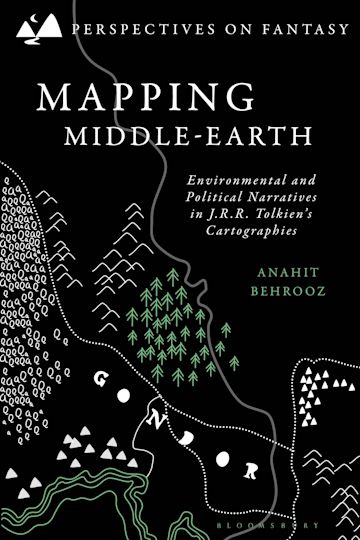
This led me to note some clear ‘prior art’ in the word “Gondor”. For instance it’s trivial to find…
– “At Gondor is the residence of the king, Elias by name, Ate or Nogoos, called by the Abyssinians” (Missionary Journal and Memoir of the Rev. Joseph Wolff, 1829).
– “the most important prince was the party called by Europeans an Emperor, but known to Abyssinians as the Athie or Negus, whose capital was Gondor, in Amaraha, or the south-western division of the kingdom [of what is now Ethiopia]” (Transactions of the Ethnological Society of London, 1868).
Page scans show these are not OCR errors. The use of the word in English has continued to the present day, though it is now sometimes also called Gonder or Gondar by aid/development agencies. Capital, seat of the king (an ancient Christian ruler, indeed), in the south… it all sounds rather familiar. Much later, in 1971, Tolkien mused that the 1935-37 Italy-Abyssinia war may have brought it frequently to his eye in the newspapers, but he also recalled that it had entered the legendarium early and related to ond = ‘stone’.
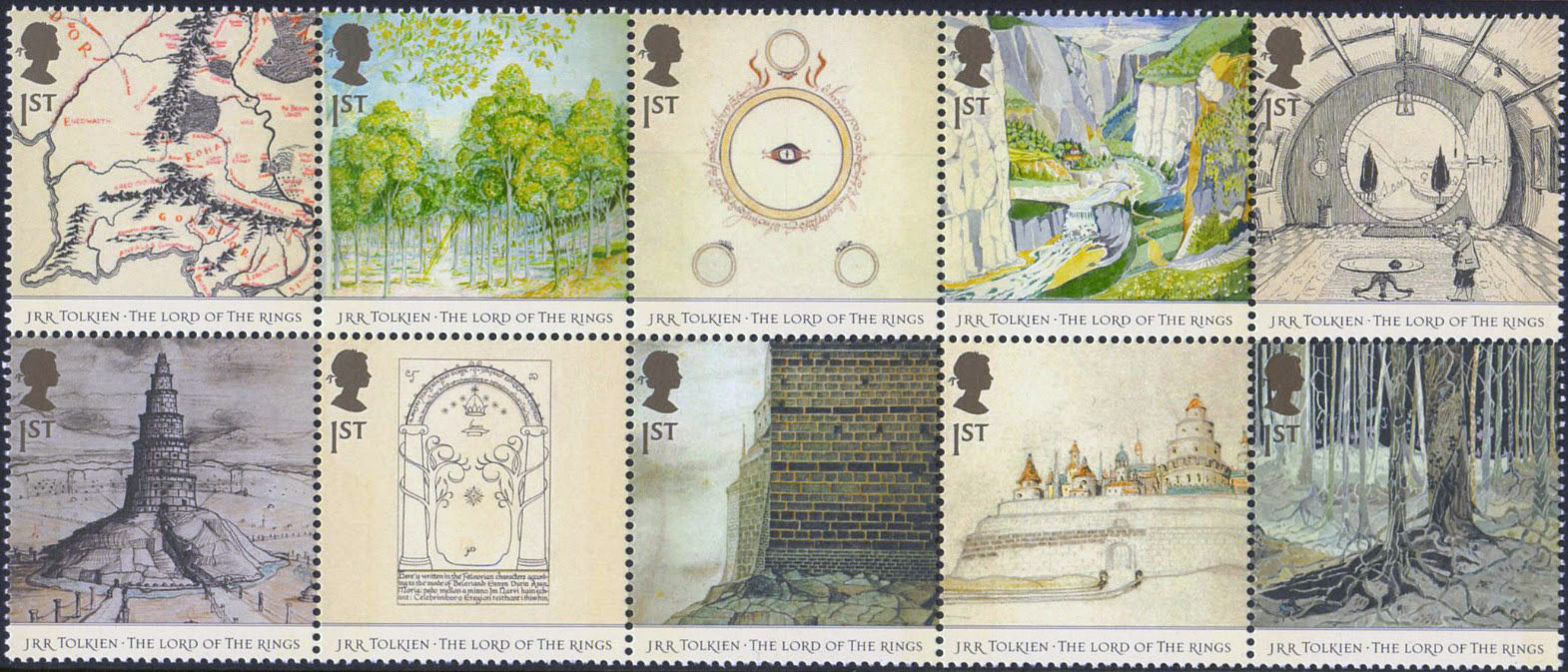
* And finally, Lord of the Rings Stamps for Postage – 10 x Royal Mail 1st Class (2004). I’m faintly amazed to see these still available at summer 2023, on Amazon and at non-collector prices. £15 for ten, at present, not much more than it might cost to buy 10 x regular 1st’s these days. The Christmas and themed picture-stamps are said to be still valid, while the plain ones are defunct unless they have a bar-code on the side.