* A 2021 interview in English with Italian scholar Claudio A. Testi, on “Tolkien on War and Intelligence”. ‘Intelligence’ is used here in the wartime sense of ‘information likely to be advantageous in war’. Tolkien was a battlefield signals expert, and later involved in combating the Zeppelin menace. As such he was on the receiving end of intelligence activity, such as it was in the First World War. Testi’s interview observes that the over-reliance on intelligence in war can be un-wise, as shown by The Lord of the Rings. Such as the…
“… Palantir’s use, these mysterious stones that allow seeing almost everywhere. Saruman and Denethor use them, see Sauron’s army, and mistakenly lose hope. Sauron himself uses it, sees the face of a hobbit (Pippin), and mistakenly believes that the Ring is going to Minas Tirith, towards which he concentrates the greatest war effort, and so on.” […] In my opinion, The Lord of the Rings warns of the danger of transforming intelligence from a means to an end in itself. Today, with big data, this risk looks real. […] Tolkien tells us that when [such] power is too great, it becomes too dangerous.” [It] “cannot be governed, but it governs us”. […] The true leader is not the one who has the most information but the one who is most aware of the dangers of power” and especially the danger of mass intelligence gathering in terms of its potential to mislead. There is also the further and wider danger in the Ring, that having “utmost intelligence completely destroys freedom” among people, or it would if used by one who knew how to wield it.
There is a small misinterpretation of a point in LoTR, given early in the interview. It’s claimed that… “Theoden arrests him [Eomer] because he did not strictly apply the law” in the case of meeting Strider when riding out on the wold. But it’s stated in the book that Eomer was arrested and imprisoned because he had openly and actively … “threatened death to Grima” [the king’s counsellor] while in his lord’s hall. He had also gone riding north with his household men… “without the king’s leave, for in my absence his house is left with little guard.”
* The new open-access journal Leeds Medieval Studies now has two issues online, for 2021 and 2022. I’ve added it to my JURN. These opening issues include “The Animality of Work and Craft in Early Medieval English Literature” (animals working alongside humans), and also a review of the book The Natural World in the Exeter Book Riddles. Good preparation for the forthcoming “Tolkien’s Animals” special issue of Journal of Tolkien Research by the sound of it. The Leeds Medieval Studies editors are also interested in “the study of modern medievalisms”, by which they presumably mean 19th and 20th century medievalisms rather than ‘early modern’. Their new journal is…
“the successor to and continuation of Leeds Studies in English (founded 1932)”
Since Tolkien was at Leeds, it would be natural to imagine that they might be open to a possible ‘Tolkien special-issue’ at some point.
* There’s a new Nick Groom repository citation for his forthcoming article ““The Ghostly Language of the Ancient Earth”: Tolkien and Romantic Lithology”. This effectively brings news of a new Walking Tree book for 2023, The Romantic Spirit in the Works of J.R.R. Tolkien. There was a call for papers for this book a couple of years ago, with a deadline at the end of 2020. Possible topics then included, among others…
– The pre-Raphaelites, Birmingham and the T.C.B.S.
– The fairy-tale tradition (Brothers Grimm and others).
– The Romantic spirit in […] Tolkien’s predecessors and contemporaries.
– Romanticism in other art forms (music, visual art etc.) and its connections to Tolkien.
Sounds good, and I now assume it’s likely to appear in 2023. The “Lithology” in Groom’s title refers to the understanding and classification of rocks and their physical formations.
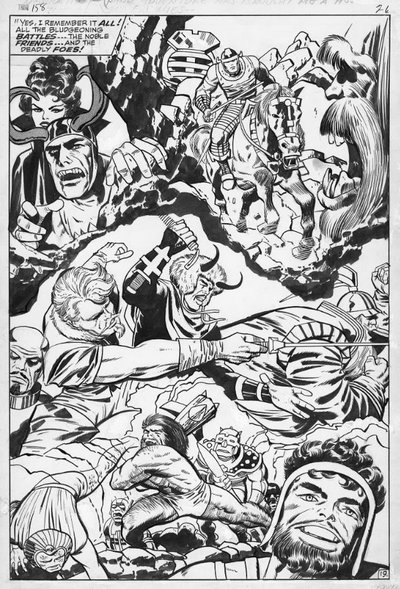
* And finally, Jack Kirby and Tolkien. What a Kirby-krackle of a combination. The open Creative Commons 2018 article “Darkseid’s Ring: Images of Anti-Life in Kirby and Tolkien” explores the parallels.