* New today, a long article on “Eucatastrophe and Evangelium: Tolkien’s Devotion to St. John the Evangelist”. At the end of this the reader learns that…
“This article is adapted from material in Holly Ordway’s forthcoming book, Tolkien’s Faith: A Spiritual Biography (Word on Fire Academic, 2023).”
Good to hear of a new book, and from a writer who knows the theology and church history. This forthcoming title is currently listed on Amazon UK, set for a hardback release on “2nd September 2023”.
* I’m not going to be tracking articles or books on Tolkien’s invented languages for Tolkien Gleanings. But they will be noticed if they reflect on the young Tolkien and his influences. Such is a new article in the Italian open-access journal RiCOGNIZIONI, “Tolkien and Comparative Historical Linguistics” (2022, in English, with English abstract). This looks at the influence of the young Tolkien’s academic training on his earliest Elvish languages. Finds some influence on his… “meticulousness [and] symmetry and systematicity”, among other things. But also the age itself was somewhat encouraging him to take a “creative and free approach to his sources”, though in this he was steered by his already highly-developed “phonoaesthetic taste”. But what were his sources? The author suggests, as a glottopoeia source for the young Tolkien…
“a source not listed in Cilli’s catalogue and, to the best of my knowledge, nowhere mentioned” [which could well have been the] “Rev. George Bayldon’s
An Elementary Grammar of the Old Norse or Icelandic Language.”
* In the same issue of the RiCOGNIZIONI journal, “Linguistics and Classical Tradition as Sources for Tolkien’s Glottopoiesis”. The author focusses on picking up what are said to be many similarities to Latin, but his abstract usefully explains what the first author meant by the technical word glottopoeia (glottopoiesis)…
“[to create his constructed languages] Quenya and Sindarin [Tolkien picked] from the templates represented by natural languages, such as Finnish, Germanic languages, Welsh and also Classical languages.”
* I encountered a bit more on the local claims for the ‘Tolkien Trail’ in Lancashire. A 2022 local press report on the walk claims…
“it is clear that Tolkien did get inspiration to call the fictional region of Middle-earth, ‘The Shire’, from Hurst Green. Shire Lane can be found in the village, along with the River Shireburn and the Shireburn Arms”
There is an intertwingling in the above sentence between Hurst Green in Sussex and Hurst Green in Lancashire, which few will notice. The Tolkien Reader’s Guide and Chronology both have this place in Sussex and not in Lancashire…
“At that time the Brookes-Smiths lived at The Lodge, Hurst Green, in Sussex” and “then living in Sussex, in a country house at Hurst Green.”
The confusion among Lancastrians is probably genuine, and it appears to root back to Paul Edwards’ “In the Valley of the Hobbits” article describing much the same walk, which was then picked up and enshrined by the 2008 Tolkien’s Inspirations PDF assemblage. The confusion appears to have arisen locally via the following reasoning: “Tolkien is known to have stayed several times at Stonyhurst and sketched it (true, though many years too late to have influenced the early landscape of LoTR); and the lovely rural stone village of Hurst Green is near Stonyhurst (true); therefore this ‘Hurst Green’ mentioned by Tolkien sources must be the Stonyhurst one (false); and thus… the whole area must therefore have been his inspiration for Hobbiton and the Shire!”.
The landscape does however appear to be very lovely and well worth a stroll, and is about 17 miles north of Manchester and on the southern edge of the Bowland Forest. Some of the pictures of fir-trees and small streams even remind one of Rivendell. But as for “The Shire” claim in the more recent 2022 press article… I suspect that Worcestershire and Warwickshire and Staffordshire may yet have something to say on the matter of Tolkien’s coining of ‘the Shire’.
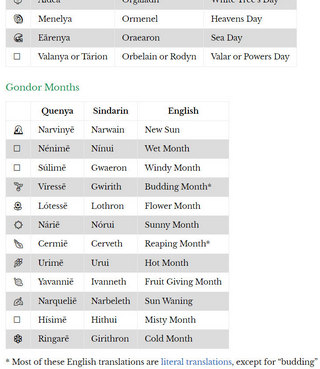
* And finally, on GitHub I find the very comprehensive javascript-driven “Shire Reckoning: A visualization of the calendars described in J.R.R. Tolkien’s The Lord of the Rings Appendix D”. The GitHub shows it was last updated in September 2022. Impressive work.