Tolkien Gleanings #385
* A new book from Oxford University Press, Science and Religion in the Imagination of C.S. Lewis: The Quest for the Best Mental Model of the Universe. Due for publication in print on 14th March 2026, and available now as a Kindle ebook, the book is…
“the first comprehensive examination of C.S. Lewis’s views on the relationship between science and religion, authored by an internationally acclaimed writer recognized as an authority on both Lewis and the field of science and religion. […] While some continue to characterize Lewis as an anti-scientific Luddite entrenched in medieval fantasies, this analysis makes it clear that Lewis was well-acquainted with both the cultural perceptions of science and religion during the medieval and Renaissance eras, as well as the major philosophical and cultural debates concerning their relationship during the middle of the twentieth century.”
* On YouTube, Paolo Nardi usefully summarises and discusses Fulvio Ferrari’s recent Italian-language book Gli altri mondi dell’eroe: Beowulf e la letteratura fantasy, which has a chapter that… “explores the profound connection between the Anglo-Saxon poem and the work of Tolkien”. He also links to a review of the book from the Italian Tolkien Studies Association…
“Fulvio Ferrari is a retired professor of Germanic philology at the University of Trento [and his new book has] an entire chapter dedicated to Tolkien, or rather to the influence that the Anglo-Saxon poem in question has had on both the Oxford professor’s work as a scholar and as a storyteller.”
* In the new ANQ: A Quarterly Journal of Short Articles, Notes and Reviews, “Of Him the Harpers Sadly Sing”: Fragmentary Ballad Diction and Transmission in The Lord of the Rings” ($ paywall).
* Elfenomeno begins a new series of blog articles on adaptation by considering From Middle-earth to the Cinema (I): Beren and Luthien…
“This article explores the possibilities — and the dangers — of adapting the story of Beren and Luthien to film, one of the Great Tales of the First Age.”
* A new essay on “J.R.R. Tolkien’s Vision of Just War”, being an expanded free chapter from the book The Hobbit Party (2014) which explored aspects of Tolkien’s politics.
* John Garth has a new article on “‘Going west’: How war in 1914 resurrected an ancient image for dying”. Freely available online.
“War changes language. In Tolkien and the Great War I put it this way: “English received an enormous jolt of electricity from the new technologies and experiences of the Great War. Old words received new meanings; new words were coined; foreign phrases were bastardized.””
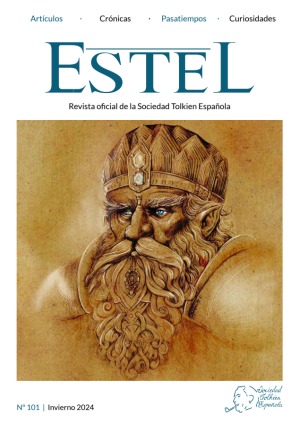
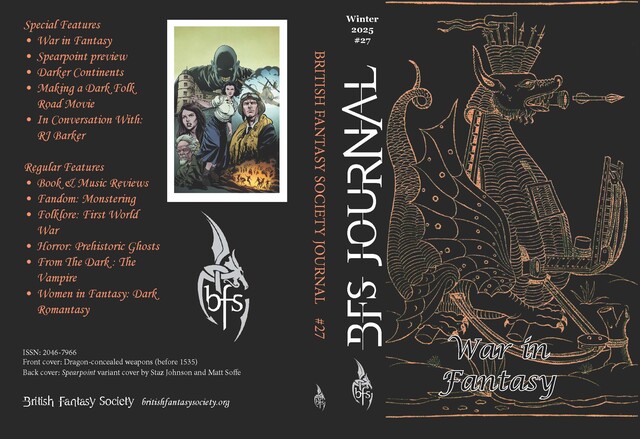
* The latest British Fantasy Society Journal is a special on ‘War in Fantasy’, or perhaps just with a long lead article on the topic. Members only and no contents-list online, it seems, but there is an indicative cover available…
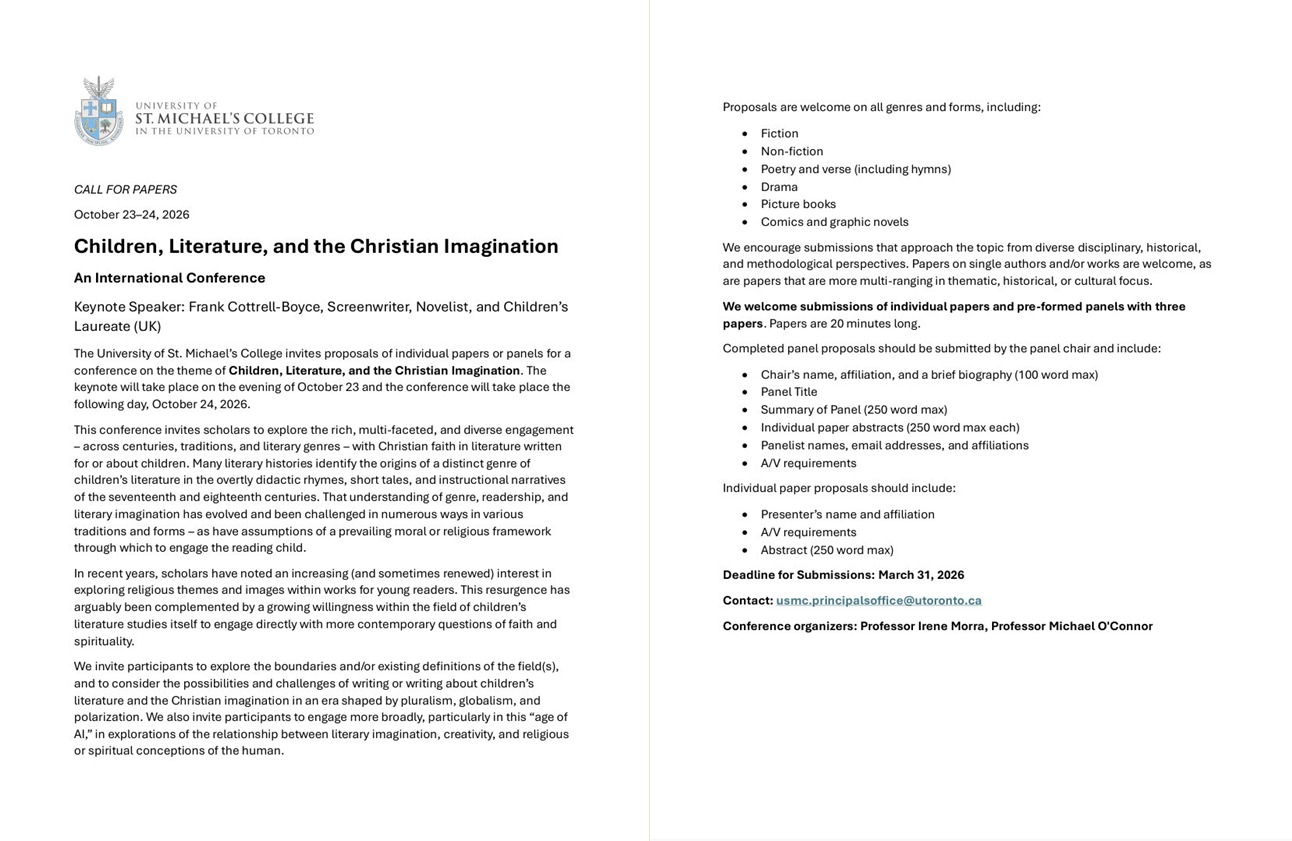
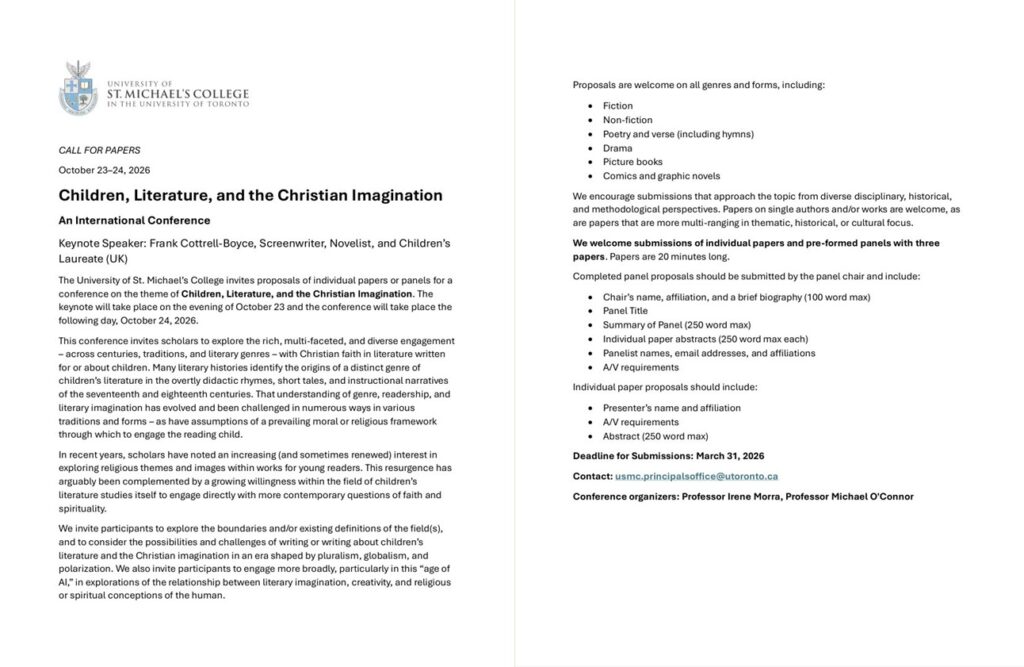
* A call for papers for a conference on ‘Children, Literature, and the Christian Imagination’, 23rd-24th October 2026 at the University of Toronto, Canada. Submission deadline: 31st March 2026.
* The latest Weird Studies podcast considers Tolkien’s The Fellowship of the Ring as a work of weird fiction, re: the Old Forest and evil sentient trees, the cosmic ancientness of Bombadil, ring-wraiths, barrow wights, strange elves, warg attack (Gandalf: “these were no ordinary wolves”), the Watcher in the Water, and the eerie darkness of Moria.
* The Salon Futura (February 2026) online fanzine is a special issue on Welsh Fantasy. Freely available online.
* ‘Technologies of the Fantastic’ is an online conference set for 13th-15th May 2026. The title appears to be somewhat misleading, as the organisers state they intend to focus on… “the technologies of fantasy” in particular, such as… “carefully constructed runes and magical glyphs that operate as locks and keys; in the textile metaphors of spell weaving; in the taxonomy of the naming [of natural elemental forces]”. I’d hazard a guess that one might also consider magical maps, the forging of enchanted weapons, and even magical herb lore? Registration for the conference is required (not yet open) and will be via Eventbrite.
* And finally, Hammond and Scull’s latest Book Notes post draws my attention to The Salisbury Museum and Art Gallery’s heavily illustrated catalogue for their substantial show ‘British Art: Ancient Landscapes’ (2016). Being… “the first significant publication to range over the entire field” of artistic works depicting the very ancient sites of the British Isles such as stone circles, hill-figures, barrows and the like. Paperbacks appear to still be available, if the badly-scanned full preview interests, though Amazon UK suggests there are only five copies remaining.
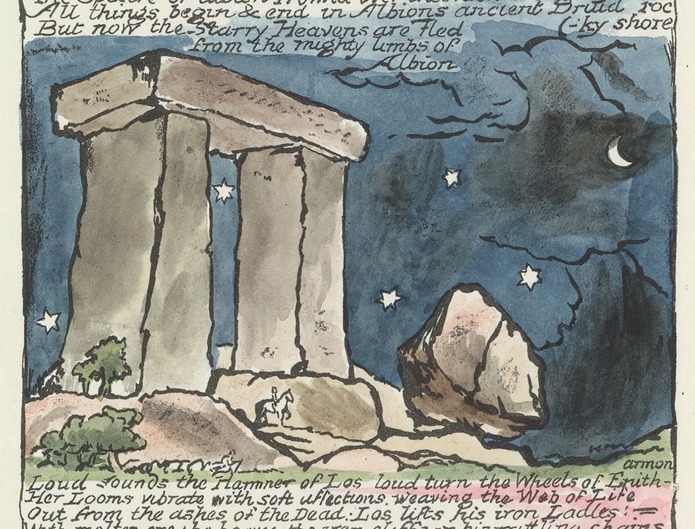
From Blake’s Milton a Poem in 2 books, detail from plate 4. The subject on the right of the painting is a balanced rock, but at first glance could also very easily be read as a ship having just descended from sailing among the stars. Tolkien read Blake’s prophetic books in February 1919.