Tolkien Gleanings #342

Tolkien Gleanings #342

* New on YouTube, an interview about the forthcoming Tolkien book The Bovadium Fragments, with the director of the Bodleian Library’s ‘Centre for the Study of the Book’.

* Newly added to the current rolling issue of Journal of Tolkien Research, a long 19-page review of the new book Proceedings of the Tolkien 2019 Conference (2025). Freely available online.

* “Ex Occidente Lux: Tolkien’s New Mythology for the Western World”, a Web page giving some details of a forthcoming lecture to be given at the University of Norway on 29th October 2025, by… “Visiting scholar Jan Kozak from Charles University in Prague.”

* Airyyn is making Middle-earth maps and infographics about maps, on Deviantart. Including an infographic which offers a tree of the Middle-earth cartographers

Her latest, published to Deviantart a few days ago, is The Maps of The Silmarillion… “This infographic shows the publishing history of the maps of The Silmarillion, from the first Silmarillion map in the 1930’s to the map in The Children of Hurin.”

* Australia’s OzMoot 2026 will discuss the themes of ‘Celebration, Ceremony, and Courtship’ in Tolkien. Canberra and online, from 24th-26th January 2026.

* “War, Fellowship, and Survival in the Lives and Works of C.S. Lewis and Kindred Spirits”, a three-day conference set for 11th-13th June 2026 in Amiens, France.

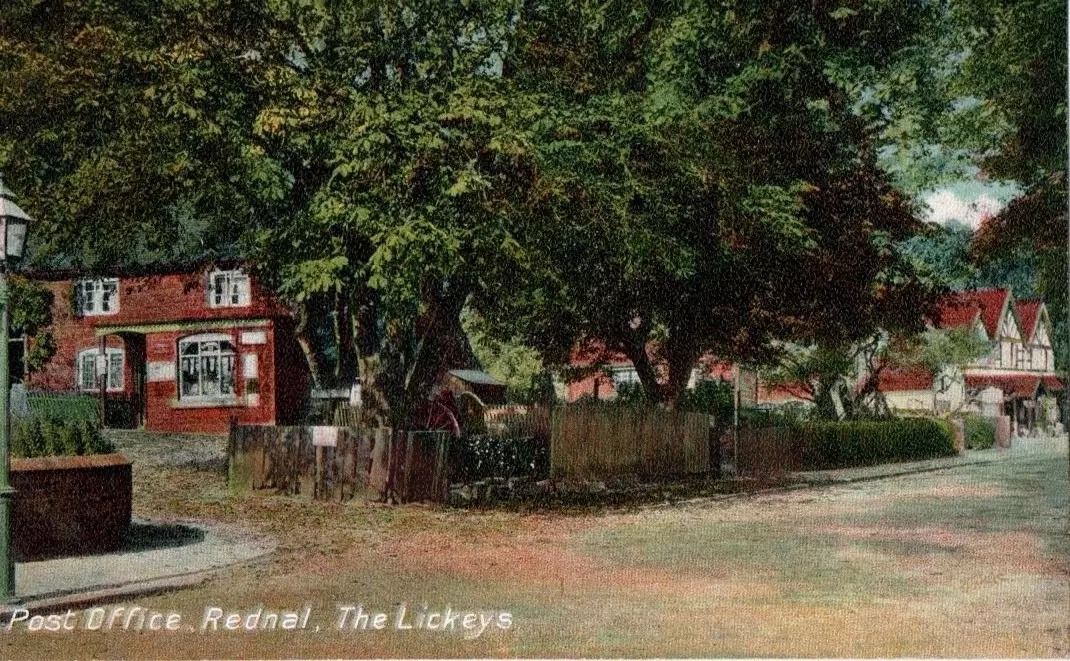
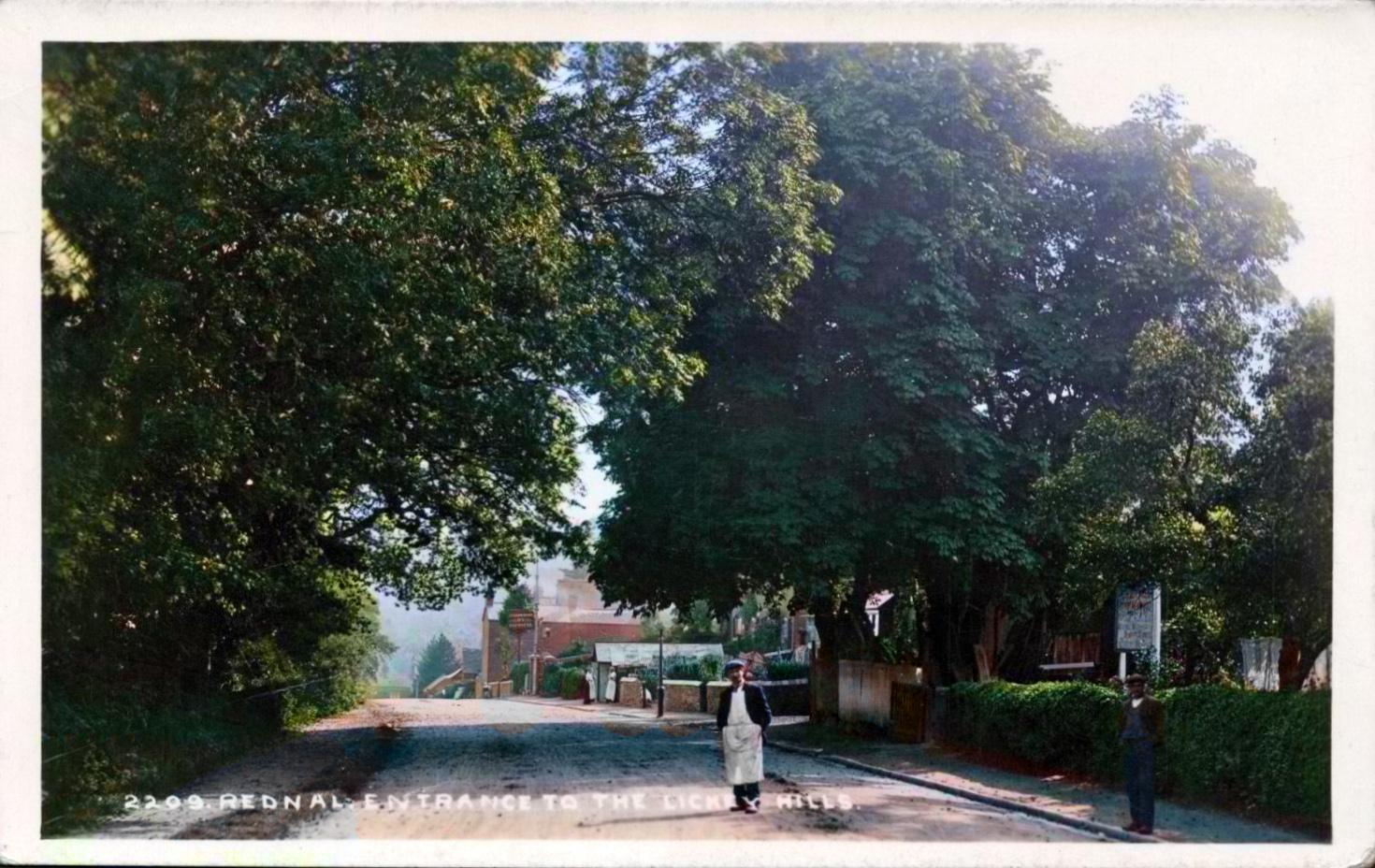
* And finally, I spotted an alternative view of the entrance to The Post Office, Rednal, which has popped up on eBay. Here I’ve newly enhanced and colorised the eBay scan. One can determine the location by comparing it with another postcard which named the Post Office, re: the same fence-sequence and sign-board. The new card looks in the opposite direction.

It’s not impossible that we see the Postmaster, in the man wearing the shopkeeper’s apron.

In 1904 the Tolkiens were staying with the postman and his wife very nearby at ‘Woodside Cottage’. Rednal Post Office was then only a stone’s throw from the start of the Oratory retreat’s driveway (a yard or two out of sight on the newly found view, at the end of the hedge on the right). The same driveway also led to the cottage. The lads had perfect weather in summer 1904 and went roaming, sketching, tree climbing, kite-flying and bilberry-picking. And presumably they visited the Post Office for fizzy-pop and crisps (U.S.: soda and potato-chips).

Tolkien Gleanings #341

Tolkien Gleanings #341

* The recently auctioned “signed by Tolkien in Elvish” LoTR set has sold for £24,000. The news also reveals some additional Tolkien biography…

“The book was originally gifted to one of three Oxford University students who befriended Tolkien in the 1950s. Alan Egerton Parker, then an undergraduate at University College Oxford in 1957, read The Lord of the Rings trilogy and decided – along with two pals – to track down the retired author, who was living nearby. Tolkien welcomed the students into his home, invited them for tea, and the group went on to enjoy a series of friendly meetings. Before the students graduated, Tolkien presented each of them with a personally signed set of The Lord of the Rings as a farewell gift.”

* TolkienGuide reviews The Bovadium Fragments, and gives the complete table-of-contents including the illustrations list. We also have a poem unpublished until now…

“One might think that we had been treated to so much poetry recently, with The Collected Poems […] that no more substantial poems would remain to be published. […] The poem [newly published here], with its mention of “Iffley” makes one look back to the poem bearing that same name, ‘From Iffley’, written from 1911 to c. ?1915″ [to be found in Poems, pages 54-6].

* Oronzo Cilli reports his findings on “Printing Tolkien: Investigating the 1925 Oxford Professorship Application”. Freely available online.

* The Soundscape of Ea by Jordan Rannells is apparently about to release, this week. Though the Web page is still offering a pre-order. For $70, an entire musical score for the Silmarillion mixed with suitable field records of the natural world. The recording is said to be precisely… “timed to match the Andy Serkis audiobook”.

* A new paper on “Cold Words, Heartless and Miserable: Tolkien’s Approach to Supernatural Horror” (2025). Freely available online. Tolkien’s LoTR chapter…

“”Fog on the Barrow-downs” is basically a tale of supernatural horror [and] demonstrates that Tolkien, as a horror writer, could innovate and improve on his materials”

* The tireless British Fairies blog has a new post on “Forever fading: the ever-present, ever-leaving faery”, arising from a recent conference talk…

“our perennial conviction [is] that the faeries have ‘just [now]’ disappeared — that they were something our grandparents believed in, but which can only be regarded as naive nonsense by ‘modern’ society. The irony is that people have been saying things like this at least since the time of Geoffrey Chaucer in the late fourteenth century.”

* And finally, talking of disappearances, a new scientific discovery in The Science of the Will-o’-the-Wisp. But the scientists must not only explain why the “tricksy lights” appear(ed), but also why they seem to have disappeared.

The science of the Will-o’-the-Wisp

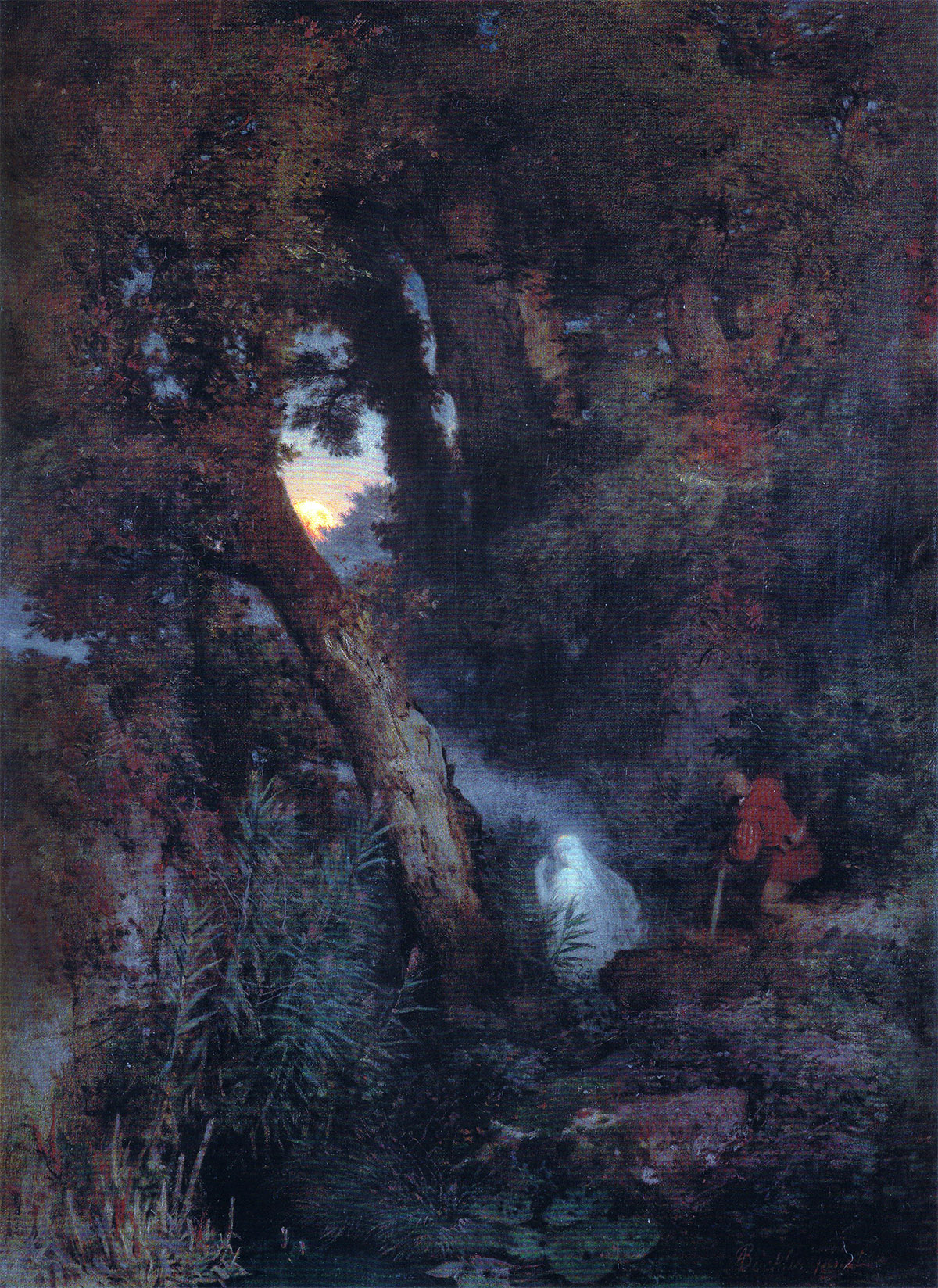
The Smithsonian magazine this week has an article on the ongoing mystery of “What Actually Sparks Will-o’-the-Wisps?”, which follows from a new scientific paper which has discovered that bog-methane bubbles of different sizes can ‘spark’ as they rise and rub against each other. Or “sparked” might be more accurate, since no-one sees Will-o’-the-Wisps today…

“Pavao suggests that will-o’-the-wisps were caused by past reactions between travelers’ lanterns and gas generated by wetlands.”

Our using modern electric torches would then explain why they are no longer seen, even in the many places still wet and boggy. An easy theory to test, I would imagine. Just don olde leather boots (I imagine rubber wellies may prevent some vital electric conductivity or static build-up from happening), and traipse damp and windless moors in a warmish twilight with an olde flame lamp.

On the other hand, the Worcestershire first-hand account which opens the book On the Ignis Fatuus: Or, Will-o’-the-wisp, and the Fairies (1846) has a geologist observing the phenomena scientifically, and at at length, from a house, when there was no such passage of lamps across the spot being observed…


In the year 1835 I gave an account of a great many facts which I collected, and which were published in my pamphlet On the Old Red Sandstone of Worcestershire and Herefordshire, relative to that remarkable and interesting phenomenon called the Ignis fatuus, or Will-o’-the-Wisp, but I never had the pleasure of seeing it myself until the night of the 31st of December, 1839, in two meadows and a stubble field on the south side of Brook House, situated about a mile from Powick Village, near the Upton road. I had for several nights before been on the look out there for it, but was told by the inhabitants of the house that previously to that night it was too cold. I noticed it from one of the upper windows intermittingly for about half an hour, between ten and eleven o’clock, at the distance of from one to two hundred yards off me. Sometimes it was only like a flash in the pan on the ground; at other times it rose up several feet and fell to the earth, and became extinguished; and many times it proceeded horizontally from fifty to one hundred yards with an undulating motion, like the flight of the green woodpecker, and about as rapid; and once or twice it proceeded with considerable rapidity in a straight line upon or close to the ground.

The light of this Ignis fatuus, or rather of these Ignes fatui, was very clear and strong, much bluer than that of a candle, and very like that of an electric spark, and some of them looked larger and as bright as the star Sirius; of course they look dim when seen in ground fogs, but there was not any fog on the night in question; there was, however, a muddy closeness in the atmosphere, and at the same time a considerable breeze from the south-west. Those Will-o’-the-Wisps which shot horizontally, invariably proceeded before the wind towards the south-east.

On the day before, namely, the 30th of December, there was a white frost in the morning; but as the sun rose behind a mantle of very red and beautifully stratified clouds, it rained heavily (as we anticipated) in the evening; and from that circumstance I conjectured that I should see the phenomenon in question on the next night, agreeably to all the evidence I had before collected upon the subject.

On the night of the 1st of January, 1840, I saw only a few flashes on the ground at the same place; but on the next night (the wind still blowing from the south-west) I not only saw several Ignes fatui rise up occasionally in the same locality many feet high, and fall again to the ground, but at about eight o’clock two very beautiful ones rose together a little more than one hundred yards from me, and about fifty yards apart from each other. The one ascended several yards high, and then fell in a curve to the ground and vanished. The other proceeded in an horizontal direction for about fifty yards, towards the north-east, in the same undulating and rapid manner as I have before described. I and others immediately ran to the spot, but did not see any light during our stay there. Both these nights were star-light, with detached clouds, and rather warm, but no fog. On the night of the 3rd of January the atmosphere was occasionally thick, but there was not any wind or fog, nor the slightest appearance of the phenomenon.

There was a very considerable quantity of rain on the 4th of January, but it ceased at five o’clock in the evening; and from about seven till eight the meteors again appeared several times at the spot in question, but as there was not any wind they went in various directions.

On the night of the 5th of January (which was star-lit) I observed a few flashes on the ground at the turn of the evening, but it soon after became cold and frosty, and I saw no more of them either on that or the two succeeding nights. I did not see any lightning during the whole of those observations, which were made by others of the house as well as myself.

The soil of the locality is clay with considerable beds of gravel interspersed thereon.

From all the circumstances stated, it appears probable that these meteors rise in exhalations of electric, and, perhaps, other matter out of the earth, particularly in or near the winter season; and that they generally occur in a day or two after considerable rain, and on a change from a cold to a warmer atmosphere.

[The author witheringly concludes his book, after a long survey of possible fairy and ‘hob’ types which might shed light on the topic, with…]

An opinion has been entertained by some writers that “ Will-o’-the-Wisp is nothing more than a luminous insect; but from all that I have seen and collected upon the subject, the volume of light appears to be much too large to give any countenance to that opinion. The principal circumstance upon which the insect theory rests, is that a person who once upon a time chased a “Will-o’-the-Wisp,” caught a mole cricket in his hat: but the probability is, that in chasing one thing he caught another; and, I believe, we have yet to learn whether mole crickets are luminous or not.
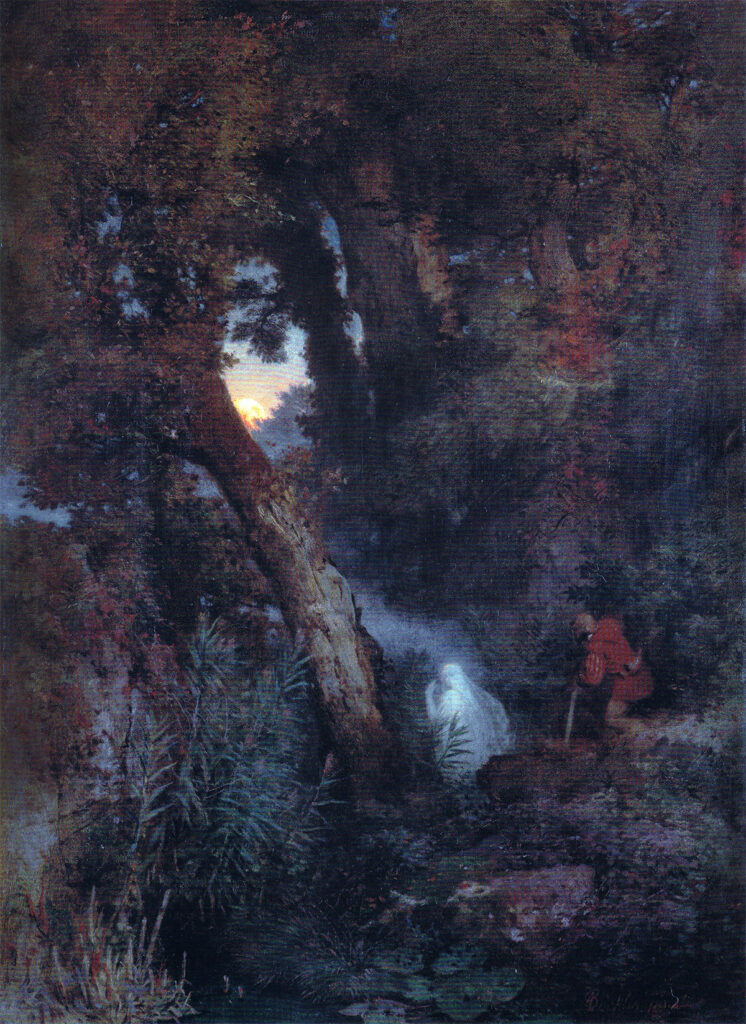

Picture: Arnold Bocklin, “Das_Irrlicht” (The Will-o’-the-Wisp, leading a traveler to his doom) (1882).

Tolkien Gleanings #340

Tolkien Gleanings #340

* In the latest Antigone magazine, an article on two possible “Homeric Allusions in J.R.R. Tolkien’s Hobbit”. Freely available online.

* From the Heart of Europe blog considers why Tolkien disliked the work of Dorothy L. Sayers, and along the way squishes the other wild notion that they had a ill-fated youthful affair (on the slim basis that they graduated from Oxford in the same year). The author might have added how immensely difficult it was for male and female undergraduates to be together in Oxford in those days. They even had to browse the libraries at different set times, so they wouldn’t meet. When they did meet, chaperones had to be present. The Tolkien movie scene of Tolkien and chums getting wildly drunk on a bus at night, in the company of bluestocking female first-years, could never have happened.

* December 2025 online courses at Signum University include Tolkien’s Letters from Father Christmas; and The Inklings: Lewis, Tolkien, Barfield, and Williams; and the timely The Bovadium Fragments: Tolkien and Satire. These online short-courses require enough student sign-ups to run.

* John Garth in The Times on Tolkien’s forthcoming Bovadium Fragments book (to be published 9th October in the UK), “Lord of the ring road — J.R.R. Tolkien’s war against the motor car” ($ possible paywall). I see elsewhere that there is to be an audiobook version.

* The Telegraph has also had an advance copy of Bovadium Fragments and is rather less positive. Indeed, rather grumpy. “The endless ‘unearthing’ of Tolkien’s archive needs to stop”. ($ paywall). Oh dear.

“Of the 50-odd pages that are Tolkien’s writing, a good bit is in Latin. […] Tolkien himself would, I suspect, have been mystified to see this piece of ephemera so portentously published in hardback.”

* Omentielva Minquea, the 11th International Conference on Tolkien’s Invented Languages. Set for 30th July – 2nd August 2026 at Marquette University in the USA.

* Of use to historians and biographers, Whereisthisphoto.com. This uses a specially trained AI model to try to identify the spot on which a landscape picture was made. Free, no sign-up, and no blocking of VPN users or even any ‘captcha hassle’. I’ve read test-reviews of such AI models, and they have remarkable accuracy if enough landscape is visible.

* And finally, talking of landscapes… this week’s Malvern Gazette has “Malvern historian says neither The Lord of the Rings or The Chronicles of Narnia has anything to do with the town.” Oh dear.

Echoes of Etruria

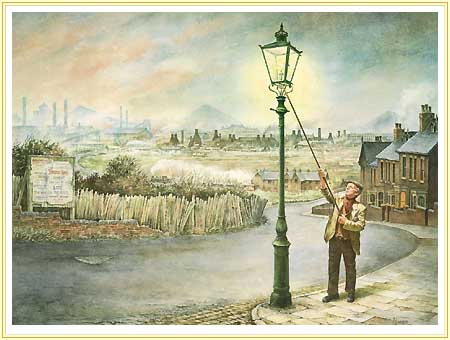
New to me, the website Pictures of the Potteries by artist Anthony Forster, who offers a very attractive picture of a lamplighter. All the more attractive if you know the history of this spot at the foot of the Fowlea Bank, with the new Basford Bank unseen over the scrubby hedge, and Etruria and the Wedgwood factory seen across the Fowlea valley in the distance beyond. On the far left of the picture is the steelworks, then only recently moved over into steel from being an ironworks. He managed to squeeze in a steam-train as well, though it’s not immediately obvious. Obviously a well-researched picture in terms of use of mapping and the pre-A500 topography, and yet the result is still a master-class in composition.

Etruria had only obtained its first street lighting in 1860. A mere seventeen lamps were deemed sufficient.

Judging by an eBay image of the framed print, the colours of this official sample-image have been shifted into an unfortunate greeny-yellow cast. But the scene itself, seen above, is unimpaired.

Tolkien Gleanings #339

Tolkien Gleanings #339

* The latest Eric Metaxas Show ad-filled podcast is “Could England Fall?”, being an interview with Joseph Loconte about his forthcoming book on Tolkien, Lewis, and the Second World War. Which reassures that the much-delayed book does actually exist. Or will do soon — Amazon UK currently pegs the release-date at 18th November 2025.

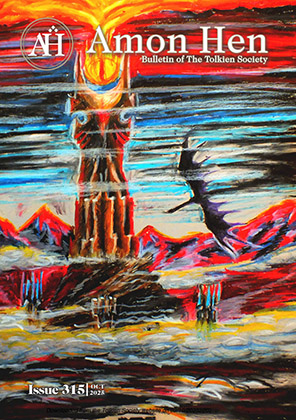
* Now available to Tolkien Society members, the October 2025 issue of Amon Hen. Issue 315 has, among other contents: a short article on the sea-longing, Legolas and the Old English poem “The Seafarer”, paired with a fine full-page artwork; three pages on the new Tolkien carvings in Roos; an article on Ungoliant the spider; and a book review of J.R.R. Tolkien’s Women of Middle-earth. There is also a production note that the forthcoming 2025 issue of Mallorn… “looks to be in a good place for publication this Christmas”.


Cover art: detail from “Barad-dur” by Miruna Lavinia.

* The Oxford Tolkien Network has details of two new public talks in Oxford. “Tolkien’s Heterotextuality” in mid October, and “Eden, Fall, Exile and Beyond in the History of Middle-earth” in early December 2025.

* From St. Petersburg in English, an abstract for a Masters dissertation “Transformation of Plots and Images from J.R.R. Tolkien’s Works in Russian-Language Music of the 1970s–2010s” (2025). Discusses fan-songs and also musical interpretations of Tolkien’s words in Russia. Not available online in full-text.

* From Sweden in English, an undergraduate’s final dissertation for a Secondary School Teaching Programme, “Using the Literature of J.R.R. Tolkien to Teach about Death in the Upper Secondary English Classroom”. Freely available online.

* Newly uploaded at Archive.org, Tolkien and Gordon’s first edition of Sir Gawain & the Green Knight (1925). This one is usefully downloadable, when Archive.org’s other scans are not. Bear in mind there was also a 1930 “corrected” reprint, which over the decades is said to have become… “the most widely used text of the poem for forty years” in classrooms and among scholars. That version is not on Archive.org.

Note the curious leap in the book’s “Notes” (by Gordon) regarding the journey. These leap from the Wirral to the castle, and a curious reader interested in the text’s detailing of the final parts of the journey must be satisfied with… “it is clear that a journey of some distance is here described, after Gawain has landed in Wirral.” Indeed, since there was surely much to be said about it. One wonders if Tolkien was supposed to provide notes for that part, but didn’t manage it?

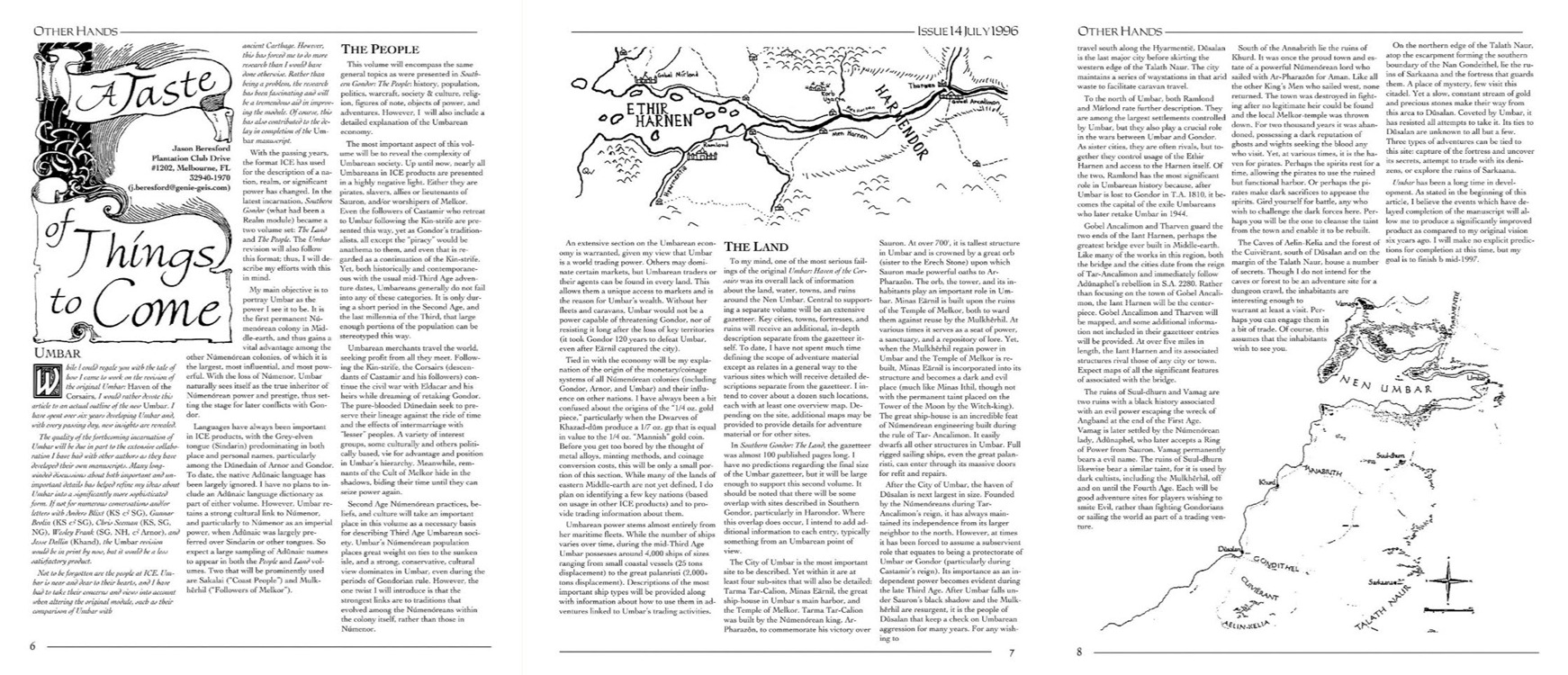
* Also new on Archive.org, a run of the ‘zine Other Hands 1993-2001, devoted to fantasy role-playing set in Middle-earth. Even if one doesn’t care for RPGs, there are articles and maps of interest. For instance, a 1993 article on Umbar with maps, from someone who spent six years studying and developing an RPG for the region. The earlier RPG handbook referred to in the article is Umbar: Haven of the Corsairs (1982).

Other Hands is today continued by the free Other Minds magazine, which also maintains an archive of the old Other Hands. However, their archive is not keyword searchable as the new Archive.org run now is. One can also now download all the PDFs from Archive.org via a single time-saving .torrent file, and then index locally with freeware such as AnyTXT Searcher.

* Also new at Archive.org, a saved backup copy of Tuckborough.net, which was a large books-only Tolkien wiki…

“This was a Tolkien wiki from between 2003-2011. It got hit with a trojan [virus], then it it was revived as The Thain’s Book, and I decided to save a copy of it in 2016 … before it went back offline. I believe this is the latest copy of the site.”

* And finally, The Magic of Middle-earth touring exhibition has its first confirmed 2026 date. In the new year it will move to the Museum in the town of Banbury, Oxfordshire. Set to then run in Banbury from 31st January – 28th June 2026, with an entrance fee. No details yet of any extra activities around the show. Though, since the location is Oxfordshire, one might expect accompanying fringe talks on ‘Tolkien in rural Oxfordshire’ or suchlike.


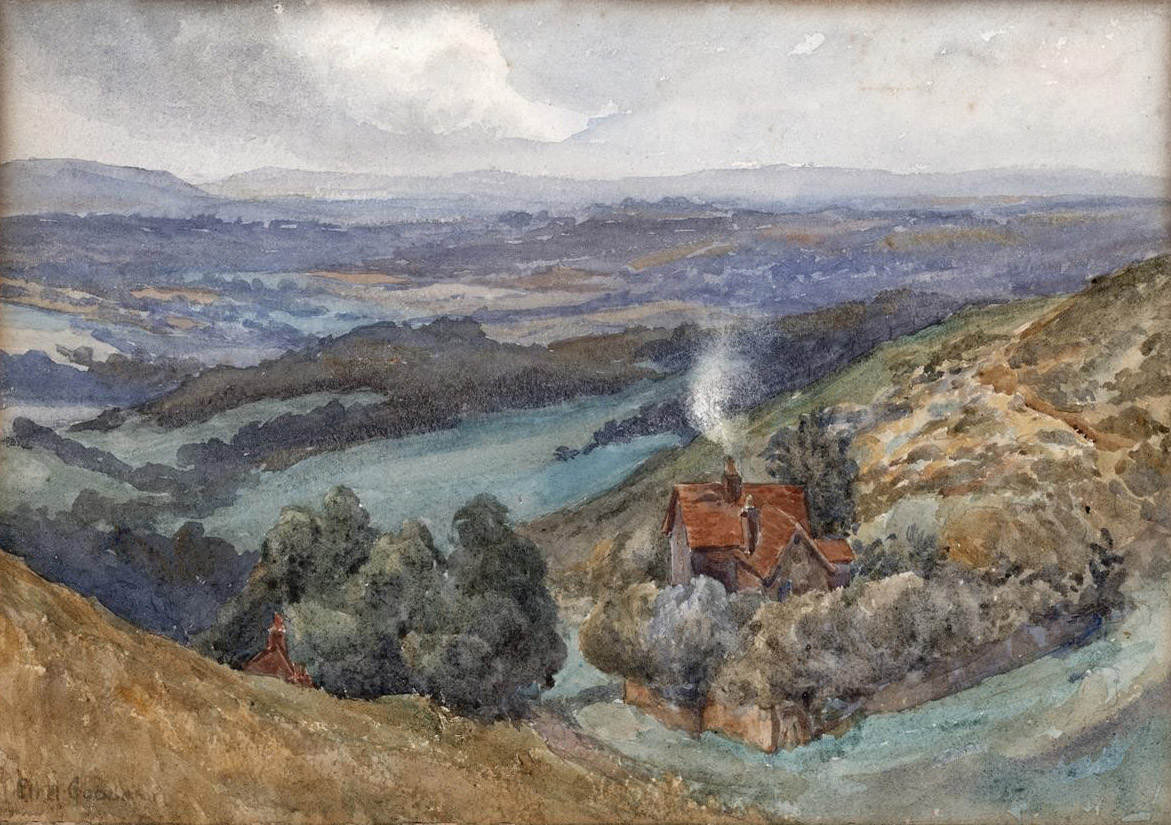
Unknown artist: Ethel Go[…?]. Possibly the South Downs (Sussex), but equally the hills look very like the landscape seen in wide views of Rollright village, near the Rollright Stones.

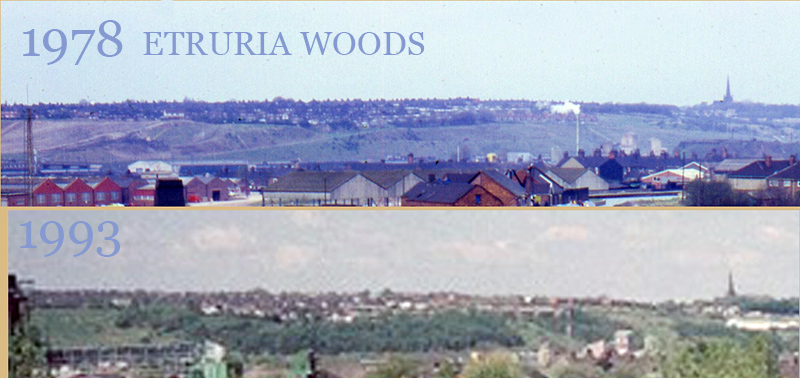
Another two views of the Etruria Woods 1978/1993

I realised that little top-strips on two photos available on eBay from UK Photo Prints showed the Etruria Woods, across time.

1978 — very denuded, barely hanging on amid heathland as isolated bushes, clumps of bushes, and some hedgy trees along the top. A sad fate for what was one the idyllic ‘picnic playground’ woods known to Etruria’s people, and the haunt of H.G. Wells as he dreamed of the tale that would become The Time Machine.

1993 — the woods substantially replanted though only at their former northern end, presumably as part of the landscaping that accompanied the A500 road. But perhaps also further enhanced prior to the 1987 Garden Festival (which happened on the opposite side of the valley)?

Same viewpoint. Wolstanton church tower provides orientation, seen on the far right. You could only make the same photo today with a drone, as nearby trees are in the way.