Tolkien Gleanings #351
* The new journal Fantasy Art and Studies 18 (Summer 2025) takes as its theme ‘Non-violence en Fantasy / Non-Violence in Fantasy’. Inside one can find the French-language Tolkien article “Corps epargnes, esprits traumatises: de la violence necessaire a la non-violence chez Tolkien” (‘Bodies Spared, Minds Traumatized: From necessary violence to non-violence in Tolkien’). The journal can be read online for free in your Web browser as a flipbook (pages cannot be bookmarked as Web links, but see page 100). The flipbook format makes auto-translation rather difficult, but not impossible with capture tools suitable for fine text + accents such as ABBYY Screenshot Reader and then Google Translate.
* In Italian in the journal Studi sulla Formazione, the article “Il tema della mostruosite in J.R.R. Tolkien” (2025) (‘The theme of monstrosity in J.R.R. Tolkien: Reflections on the ethics and pedagogy of fantastic narrative’). Freely available in open-access and also under Creative Commons Attribution.
* In English, in the French Reviews in Science, Religion & Theology (2025), “Eschatological Expectations and Ecology in J.R.R. Tolkien”. The article is also posted on Academia.edu, but only freely available without Academia.edu membership via searching for the title on Google Scholar. Scholar has a special arrangement with Academia.edu for open downloads via their search-results.
* This week in The Imaginative Conservative, “Reliving the Life of Chesterton”. In which a Chesterton biographer (2015) reviews the new I Also Had My Hour: An Alternative Autobiography of G.K. Chesterton (2025), a book which is… “the labour of love of Dale Ahlquist, that Chestertonian extraordinaire, who has made it his life’s work”. Usefully the reviewer also notes, in passing, something of possible relevance to Tolkien’s thinking on fairy tales…
“I had forgotten what Chesterton had written about fairy stories; I’d forgotten “The Ethics of Elfland”.”
The essay “The Ethics of Elfland” was widely available in Tolkien’s youth, in Chesterton’s book Orthodoxy (1908). Although admittedly 1908 was long before Chesterton became a Catholic in 1922. The book was however continually reprinted, including after the conversion. On the possible influence of the Orthodoxy essay on Tolkien, Hammond & Scull (Reader’s Guide) have…
“… apart from references in his published letters, it is clear from his lecture “On Fairy-Stories” that Tolkien was closely familiar with Chesterton’s writings. He quotes Chesterton or mentions him approvingly several times in the lecture, and seems to have drawn at least from Chesterton’s ‘Ethics of Elfland’ in Orthodoxy [among a few other titles by Chesterton]”
Incidentally, I find that Chesterton also reviewed at length Lang’s The Violet Fairy Book (1901) under the same title of “The Ethics of Elfland”, in The Speaker magazine for October 1901.
* On YouTube this week, a new flip-through video of the large-format Dover artbook edition of Arthur Rackham’s Color Illustrations for Wagner’s Ring (1979).
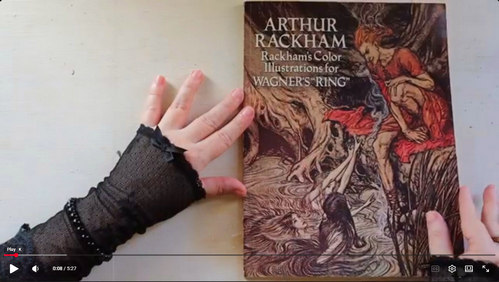
I looked up the publication details, found in the front of the book, and as I had thought they were published at a formative time for Tolkien. As such the dates and title may interest some Tolkien researchers…
The color illustrations, here reproduced in their entirety, and the black-and-white vignettes and tailpieces, here reproduced in a selection, appeared in two volumes, both published by William Heinemann, London, and Doubleday, Page & Co., New York: Siegfried & the Twilight of the Gods (1911) and The Rhinegold & the Valkyrie (1912).”
Both books are now public-domain and free on Archive.org as reasonably good scans. They’re linked above. The scans are slightly light in their contrast, presumably so as not to crush the blacks.
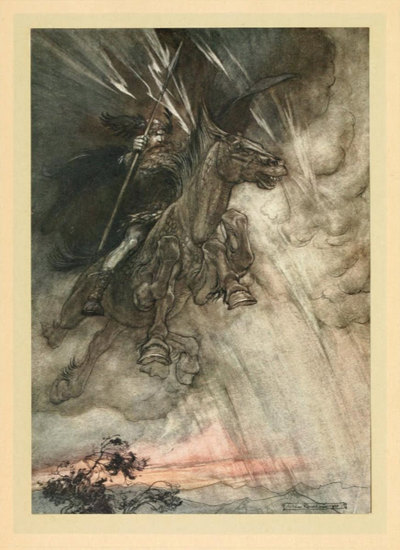
* And finally, a bit more art that might have been encountered in magazines and books during Tolkien’s Edwardian boyhood. Chicago has a substantial art exhibition titled Strange Realities: The Symbolist Imagination. The show is on now at the venerable Art Institute of Chicago, and runs until 5th January 2026.