Here’s an interesting bit of Stoke-on-Trent history. It was in the Potteries that George Formby launched himself as a national film-star. His first feature-film Boots! Boots! (1934) had its premiere in Burslem.
Boots! Boots! was a low-budget film and had been made independently in two weeks, after George had met (in Warrington, Cheshire) the owner of the tiny film studio Mancunian Films. The independent self-funded production meant that no-one from the studio/cinema chains wanted to premiere the finished film, or even to book it.
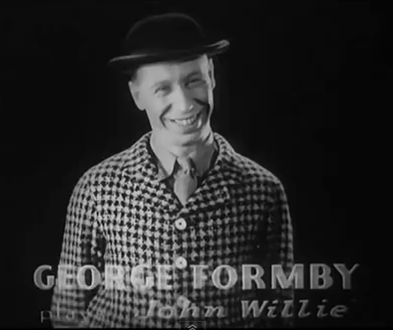
But Burslem gave George a chance, with a premiere of the film in early July 1934 at the Palladium Cinema (1910-1941) which was on the Waterloo Road, Burslem. According to George, reminiscing about his career on TV in 1960, “I went up there [to Burslem], and it packed them out”. Soon audiences nationwide were queuing around to block to see the new comedy-musical, thus launching him on his career as the biggest and best-loved comedy stars of the 1930s and 40s — and also a tireless entertainer of the front-line troops during wartime.
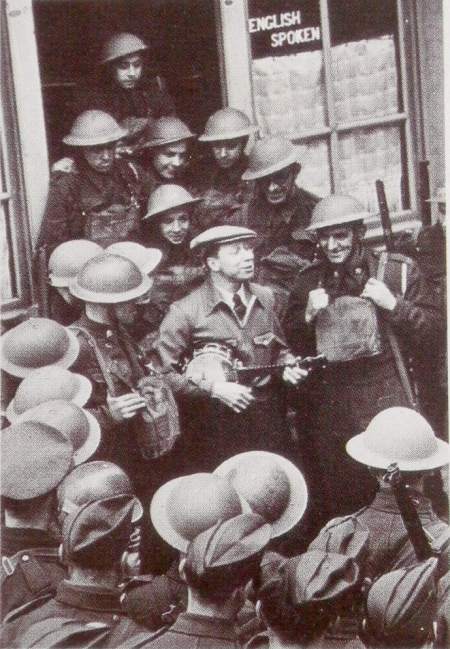
Apparently the Roxy cinema in Hanley quickly picked it up as well in July 1934, on seeing what a success the film was in nearby Burslem. Then the Regal over in Newcastle-under-Lyme ran it during the early part of the August 1934 school holidays.
Some of the Potteries audiences would have already known him by voice, since his 1932 song “Chinese Laundry Blues” (aka “Chinese Blues”, the ‘Oh Mr Wu’ song) had become a huge hit among the working-class of the Midlands and the North. Despite it only being issued on record as a B-side song on its 10″ disc. And despite George having his songs banned by the prim BBC, for being too saucy in their (implied) lyrics — which no doubt added to their appeal.

Boots! Boots! is not a great film by the standards of his later more polished studio films, but its reputation was marred over the decades by not being seen complete. To the extent that film historians thought it had almost no plot and was just a series of musical-hall skits. This was because the movie was half-lost — available to modern audiences only as a drastically-cut 55 minute version. Until… a complete 80-minute print was discovered by cinema sleuths in the year 2000! So, be warned that the current Amazon streaming version is only 64 minutes, and the two YouTube versions are worse at 50 and 52 minutes respectively. The only Archive.org copy (“George Formby Collection 1”, film 14) is even worse than that, at a paltry 49 minutes! Nearly half the film, missing!
The Palladium cinema appears to have been a relatively small cinema on the southern fringes of Burslem town centre, and according to cinema historians the owners didn’t advertise much in the local Sentinel newspaper. Thus there’s no 1934 newspaper ad in the archives. Possibly the cinema didn’t need to advertise, since (judging by a Staffordshire Past Track glimpse of the frontage) they were not one of those massive 1930s purpose-built ‘palace’ art-deco cinemas. More of a hold-over from the silent era, by the look of it. Presumably the owners had all the trade they wanted by word-of-mouth alone.
Where then is the DVD with the full movie, today? Not on Amazon. So far as I can tell from fairly systematic search, only the small store Loving The Classics has Boots! Boots! with a claimed 80-minutes running time, burned for you on a DVD-R. I guess it’s also possible that one might obtain a copy via membership of The George Formby Society.
But as I said above, it’s not for everyone. But even in its short version it’s a fascinating glimpse of the olde ‘music hall’ Formby, with Formby as an anti-authority figure in Chaplin-style baggy pants, a persona also seen in his next and equally-creaky indie movie Off the Dole. Once he was taken up by a big studio, his anarchic edge was smoothed into more of a hapless cheery-chappy character. Though he still regularly attacks policemen, and pokes fun at pompous officials, he does do as a comical booby. His run of British films have mostly held up very well, with Let George Do It! being generally regarded as one of his best mid-period films, while Come on George has great comedy-charm partly because he was working with the racing horses he loved. Even some of his later Columbia Studios films, obviously half-made with an American audience in mind, are quite acceptable. As well as singing his catchy songs — such as the classic “Leaning on a Lampost” — it’s said he did many of the film stunts himself, being an expert motorcyclist and horse jockey. He had left school at age seven, unable to learn to read and write (he never did, properly), to work as a professional boy racing-jockey until age 16. He went on to become the richest entertainer in Britain, known and loved throughout the British Empire.
And it all started for him in Burslem, on the Waterloo Road.