I’ve found a local item I missed in 2019, an article going by the unpromising name of “Investigation leading to the Scheduling of RR181”, in the Roman Roads Association Newsletter, Summer 2019. Titled differently on the newsletter’s contents-page as “RR181, from realisation to Scheduling”.
Stoke-on-Trent’s Roman road (the ‘Ryknield Street’) from Chester to Derby had, as the article details, been missing knowledge of “its first four miles as far as Langley Common [west of Derby], where no confirmed evidence of the road had ever been identified.” The newletter’s article is mostly about the discovery of this lost Langley Common route and the consequent scheduling.
However, page 7 of the same article also usefully details the route back to Stoke-on-Trent and the fort at Chesterton in Newcastle-under-Lyme. This reveals a vital new bit of lidar evidence for Stoke…
Where the Roman line crosses Queensway close to its junction with the A53, lidar [i.e. ground-penetrating radar] reveals a substantial road cutting, now appearing artificially filled. It is conceivable that the Roman road survives well within the cutting.
This is of course only a trace, but it adds good evidence to my suggestions that the Basford Bank was more-or-less the place the road came down off the ridge and crossed the marshy Fowlea valley. The valley would have been just too waterlogged further down, as it approached the Trent. If the road sloped slowly down the valley side from Wolstanton Marsh towards the bottom of the Basford Bank, or if it came down steeply at the old Basford Bank (now the quiet lane behind the modern road) must remain unknown for now. However, the possible need for a deep cutting suggests it came down a steep slope as it approached the Fowlea.
After crossing the Fowlea and the valley-bottom, then much wider and marshier than today, the road must have got up onto somewhat higher ground east of the Fowlea. Before then proceeded on through Cliffe Vale towards its known route past what is now Stoke Station, and then across the Trent (roughly where the University nature reserve is now) and out through Fenton and along part of King Street.
Here is what the article means by the “line”, which I’ve marked approximately here…
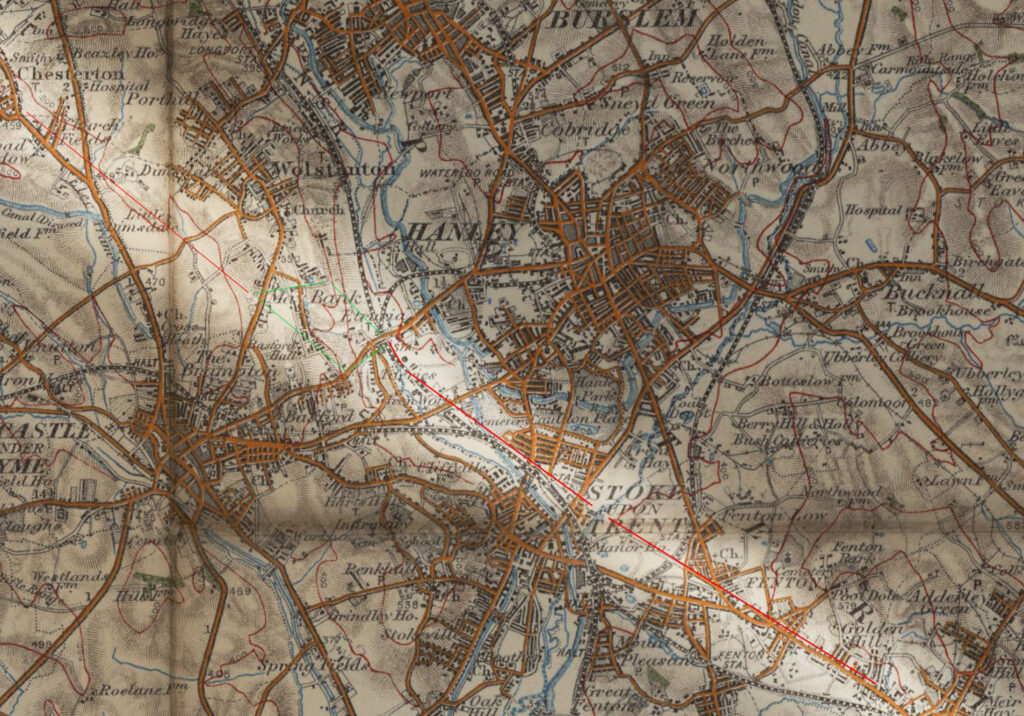
Green indicates the two possible approaches to the Fowlea, either across the top of Etruria Woods and gently down the valley slope, or dropping off the valley side steeply at the old Basford Bank lane.
One might thus whimsically imagine a footsore Roman legion rocking up at the Holy Inadequate pub, had it been there back then, thirsty and in need of reviving drafts of ale! Unfortunately there’s no precise location for the lidar discovery of the buried cutting at the Queensway / A53 junction, and that item in the Roman Roads Association Newsletter article is unreferenced. Possibly it can be seen on recent lidar maps, but I can’t immediately find where those are online. Archiuk.com has a lidar map for Stoke, but it fails to respond and is anyway possibly not up-to-date.
There has also been another key recent lidar development, that I also missed. This discovery was made at the Chesterton end of our Roman road, as detailed at the Roman Roads in Cheshire website…
The route of the [Roman] road is well documented in the north of the county [of Cheshire], but the nearer it got to Chesterton the more its course was lost, with several alternative suggestions. The biggest clue to tracing it south is that the road direction just south of Sandbach appears to be in alignment on the high ground near Bignall Hill / Wedgwood’s Monument. This represents a logical direct alignment, but until lidar [i.e. ground penetrating radar] the evidence was not forthcoming. [But] we can now be confident that the route took a very direct course and went over Bignall Hill / Wedgwood’s Monument, as the lidar evidence is convincing there.
The direct route approached Chesterton fort along the ridge of high ground around [the east side of] Wedgwood’s Monument. The latter would have been a very logical position with excellent view ahead to set out the alignment to Middlewich — assuming it was set out south to north. With the release of Series 2 lidar we now have the [exact] route across Bignall Hill/Wedgwood Monument. [Nearby] Red Street would appear to be a clue [to the presence of an ancient road, due to its name]. It is [however now revealed to be] slightly off line, but must have been named after the [nearby] road.
Or after its purloined stones, perhaps? The routes are very close, and it would have been relatively easy to cart the stones over.
This discovery adds another local node to the route. It came up off the Cheshire Plain and slipped around what is now Wedgwood’s Monument and into North Staffordshire. Which also makes it, in mediaeval times, Sir Gawain’s likely route into North Staffordshire. I had suggested the nearby Red Street for this entry-point in my recent book on Gawain, but now there’s an even more precise mapping. But that’s another story.
So it’s good to learn that the old road isn’t totally forgotten today, and that the lidar boffins still occasionally probe the likely route and make solid discoveries.