The Historic and Botanic Garden Training Programme, now open for 2025 at the Trentham Estate in Stoke-on-Trent. ‘Estate’ is different from the ‘Gardens’, but it is a Garden Training programme. So I guess you’d also spend time in the garden parts. Application details for trainees are here. Selection appears to be based on merit and ability, rather than political criteria.
Monthly Archives: January 2025
Tolkien Gleanings #274
Tolkien Gleanings #274
* Free on YouTube, the complete playlist for videos from Tolkien Society 2024 Hybrid Seminar: on ‘Tolkien as Heritage’. Includes, among others, “Libraries and Middle-earth: fanworks, archives, and communities as heritage”. Translating the Serbian titles reveals, among others, “Tolkien’s eco-philosophy as the cultural heritage of the modern age”.
* Forthcoming in French in mid-March 2025, the short book Le Dieu de Tolkien (‘Tolkien’s god’). The author is curator of the tapestry exhibition ‘Aubusson weaves Tolkien’ and has contributed to The Tolkien Society’s Mallorn. In translation, part of the summary…
Tolkien wrote a work in which the Christian message appears as “an invisible lamp”. This is what this work proposes to study, which also calls on the knowledge that we have on the life of Tolkien.
* A new open-access journal. Imagining the Impossible: International Journal for the Fantastic in Contemporary Media hails from Denmark, and is published in English under a full Creative Commons Attribution licence. No Tolkien as yet, but the latest and third issue has a review of The Dragon in the West: from ancient myth to modern legend (2021).
* A new review of the book In The House of Tom Bombadil (2021)…
“Tom Bombadil saved Frodo twice — first from a tree, and the second time from a tomb — an interesting typology and parallel to Christ, who was crucified on a tree (wood) and rose again from the tomb.”
* In Seattle, the stage show “Lewis and Tolkien” at the Taproot Theatre, now extended through to 8th March 2025 due to popular demand.
* The Oxford Mail local newspaper reports that hands-on work is now underway to repair and restore the Eagle and Child pub, a key haunt of Lewis and Tolkien. The hoardings are up, and the workmen are in. The newspaper has pictures.
* Posted online circa 2020 but new to me, a set of Peter Klucik’s illustrations for an unpublished version of The Hobbit (1990). Not jarring and quite charming in a way, sort of vintage ‘Tenniel meets Peake’ via mediaeval paintings. Possibly quite useful to accompany a reading-aloud of the book with youngsters in middle-childhood, I’d imagine, since the pictures would be unlike anything they had ever seen and yet would be instantly understandable.

* Also new to me, from 2023/24, “The Voices of Ents in Tolkien” and “Harps in Tolkien: What Would They Sound Like?”.
* A black metal “monumental symphony” of the Second Age of Middle-earth is due as an album in spring 2025, announced in the press-release “Anfauglir ink deal with Debemur Morti Productions”. The band Anfauglir’s second album will apparently offer…
“a cinematic journey spanning over 3,000 years of J.R.R. Tolkien’s Second Age, following the downfall of the island of Numenor [across] four epic tracks”
* And finally, I found a picture of the Y.M.C.A. Writing Room hut at Whittington (‘Lichfield’) Barracks. Undated but almost certainly a temporary hut built for the First World War (a Japanese flag would not have been hung for the Second World War). Which could mean that this room would have been where Tolkien wrote some of his letters and perhaps even (if writing other than letters was allowed) poems, while doing his initial Army training under canvas tents on Whittington Heath. I’ve given the picture a new subtle colorising.


Update: Postcard World confirms the First World War date, listing the same card but postally used in 1915. “An interesting old card features the concert and writing room at the Y.M.C.A. hut at Lichfield barracks. The card was postally used and is in a very good condition. 1915.” This is the same year Tolkien was at Whittington (August to November 1915). There was as officer’s Y.M.C.A. hut at Brocton, but that was later and at a different camp. It seems unlikely that there would have been two separate such huts at a basic camp such as Whittington, one for officers and one for men.
Tolkien Gleanings #273
Tolkien Gleanings #273
* Amazon UK lists a forthcoming book from eminent scholar Michael Drout The Tower and the Ruin: J.R.R. Tolkien’s Creation. Due from publisher W.W. Norton before Christmas 2025. No details at Amazon beyond that the book will be a hardcover with a chunky page-count. But an interview of some years ago revealed more…
“My forthcoming book, The Tower and the Ruin, tries to approach Tolkien alternately reading like a philologist and reading as an individual”
I’m guessing it will include a version of “The Tower and the Ruin: The Past in Tolkien’s Works”, a chapter first published in the £110 conference-papers collection Tolkien: The Forest and the City (2013).
* Amazon UK also lists the forthcoming book Illustrating The Lord of the Rings in the Soviet Bloc: Iconographies of Difference. Due in mid September 2025 and set to offer…
A comprehensive history and analysis of the Soviet illustrated editions of The Lord of the Rings published between 1981 and 1993, this book explores the production and reception of these works against a backdrop of oppressive state censorship, restrictive publishing practices and the logistical struggles of translating such long texts.
* Tolkien and his Medieval Sources, a six-week online short course. Starting 6th February 2025 and booking now.
* The Tolkienists.org blog brings news of a new “modern back-end for LR Citations“.
* At Bibliotecanatalie, “Democracy of the Dead”. This being a new guest-post which looks at Tolkien and modernity. The post makes the interesting historical point that…
“Tolkien grew up under a then-conservative Catholic Church hostile to modernity. […] Pope Pius X [Pope from 1903 – August 1914] commanded “all clergy, pastors, confessors, preachers, religious superiors, and professors in philosophical-theological seminaries” to take an “oath against modernism.””
This was the The Oath Against Modernism of 1910, which followed the Pascendi (September 1907) and Lamentabili (July 1907) encyclicals against modernism. However, these addressed a theological ‘modernism’ within Catholicism. It is thus not to be confused with i) the birth of ‘modernism’ as a cultural moment/movement (then hardly born), or ii) with being wholly against the modern world as it existed in the mid 1900s — meaning the mass ‘machine modernity’ which had emerged strongly in many nations from the 1870s onwards. This new world was evidently here-to-stay by the mid 1900s in England, but was only then hitting Italy like a sledgehammer. Italy industrialised late and with extreme and jarring speed, whereas England had a far more gradual introduction over generations.
As far as I can gather from various long summaries — the book Tolkien’s Faith being silent on this ‘point of inflection’ in 1907-10 — this particular form of Catholic modernism was a truculent movement within the Catholic Church, and in summary sought to…
– embrace a spirit of constant movement and change, always wanting to ‘do away with’ tradition and established ways
– push the notion that the Catholic Church must always be radically remodelling, so as to follow and accord with the new ideas of the 20th century
– would allow and encourage 20th century science to investigate everything, regardless of possible religious disapproval
– would allow historians to dispassionately set aside faith, the better to investigate the historicity of sacred tradition
– totally separate the church from the nation-state
– engage in continual activity for interfaith ‘understanding’, reaching across different types of Christianity and perhaps beyond
– (and, for good measure) allow a certain amount of freedom of personal conscience and morality to exist, alongside the strict and overarching decrees of the church
Thus the point made in the Bibliotecanatalie post about the “oath against modernism” of 1910 does not really tally with the idea of being against the modern world per se. The Pope, at a very formative time in Tolkien’s young life (just before he went to Oxford), was not saying ‘swear to be wholly against mass machine-modernity’. He did not intend his followers to stop buying railway-tickets or to cast their then new-fangled bicycles into the canals, nor to disdain the new flush-toilets or to forgo modern dentistry.
* And finally, what appears to be a large festival for Tolkien miniatures and scale-model making in Spain. With special emphasis this year on exploring Tolkien’s depiction of characters.
Tolkien Gleanings #272
Tolkien Gleanings #272
* From the Birmingham Oratory, the full text of the October 2024 Tolkien talk “Of the One Ring and the Nature of Good and Evil: The Moral Power of the Lord of the Rings“.
* A new post from Tolkien scholar John Garth, on “Tolkien’s ‘second father’, Francis Morgan” of the Birmingham Oratory. As the UK recovers from a recent storm, Garth also topically muses on “Storm Eowyn and the ghost gale in Tolkien’s ‘Notion Club Papers’”.
* From The Cambridge Companion to William Morris (2024), the short chapter “Morris’s prose romances and the origins of fantasy”. Now freely available for download from a university repository. Has some discussion of Tolkien, pointing out that their different politics didn’t prevent the fateful encounter. Adding dates might have rather finessed this point, I’d add. The young Tolkien enjoyed the man’s fantasy work more than 30 years after the revolutionary politics of London in the 1880s.
* Unexpectedly, the open-access Fafnir: Nordic Journal of Science Fiction and Fantasy Research has sprung to life at the new URL of fafnir.journal.fi. The journal’s archives appear to have vanished if one only visits the new URL, but they are still available at the old journal.finfar.org site. A site which at present knows nothing about the new issue. Anyway… the new issue, just published has an article exploring “Ant Similes in J.R.R. Tolkien’s The Lord of the Rings” and reviews the book Tolkien, Enchantment, and Loss, among other items.
* Details of the 2025 Staffordshire Moorlands Walking Festival here in the West Midlands of the UK, this year to run from 25th April to 5th May 2025. Includes a 2nd May ‘Gawain Country’ walk from Gradbach to-and-through Lud’s Church & then around The Roaches. A “leisurely” five miles, though reaching the starting-point without a car will be very difficult.
* In Belgium, the Athus Library is… “organizing an exhibition and a series of animations on Tolkien and Middle-earth”, plus movie screenings. 25th January to 15th March 2025. Athus appears to be a local city library rather than a national one.
* In the academic open-access journal Well Played, a detailed examination of “The Lord Of The Rings: The Card Game – A Machine That Generates Possible Worlds”…
“The literary inspiration governs the whole system of the game. Even the basic design choices are deeply influenced by the ideas presented in The Lord of the Rings books. […] The adventuring in The Lord of the Rings: The Card Game is not only intellectual, but also a tactile experience.”
Sounds enticing. Though for a view of encountering the game as a first-time player, see
the tepid review at Board Game Quest. For a wider view of the expanding world of Tabletoppy Tolk®, see this week’s podcast Lore of the Rings #197: Tolkien & Tabletop Role Playing Games. Yet another big-budget expensive RPG LoTR boardgame is due in 2025.
* And finally, the French city of Lyon is staging a real-world game in February 2025. The city is organising a treasure-hunt for an authorised Lord of the Rings movie-facsimile £8k gold ring. Plus a Grand Costume Parade, to encourage the hunters to dash around the city in Middle-earth costumes. Nice idea.
Tolkien Gleanings #271
Tolkien Gleanings #271
* The Tolkien Society has announced Carl Phelpstead as the Annual Guest Speaker. A scholar best known for his book Tolkien and Wales (2011).
* Lingwe has posted the new article “J.A.W. Bennett on Tolkien”… “Jack Arthur Walter Bennett (1911–1981) was a younger and lesser-known member of the Inklings.”
* The OST Continuing Education podcast has a new interview with Dr. Austin Freeman on Tolkien’s imaginative apologetics. Freely available on YouTube.
* Omnes magazine briefly notes that Holly Ordway’s spiritual biography of Tolkien is now available in Spanish translation.
* The Oxford Mail local newspaper reports that the city council’s planning committee has finally approved the renovation and re-use of The Eagle and Child in Oxford. The pub will re-open as a pub after the extensive work, but will add a new restaurant and a new “study space” linked with a new science campus in Oxford.
* An Inklings Fellowship gathering in July 2025, An Inklings Week in Oxford, to be themed ‘Of Other Worlds: 75 Years of Narnia’.
* In the last Gleanings I mentioned the apparent lack of a repository of sewing-patterns for Middle-earth costumes. I’ve now found the Material Middle-Earth website. While I don’t immediately see a pattern repository there, it’s current and obviously the central hub for all things material. Their postings and blogroll may lead those interested in such things as printable pattern-sheets.
* And finally, in this week’s Country Life magazine, an unintended but magnificent evocation of The Shire. In the form of Samuel Palmer’s painting “The Weald” (c. 1833-34).
£50k Lemmy statue for Burslem
A statue of the singer Lemmy, of the band Motörhead, is to be erected in Burslem in May 2025. The statue is by Andy Edwards, who I recall has done a lot of Stoke-on-Trent’s new statues in the past 20 years. He’s sculpting it in local clay, and it will be on a tall sandstone plinth. On the east side of the old Town Hall, just over the road from the Queens Theatre with its back to the main road, apparently. £11k has so far been raised by crowd-funding of the £50k cost.
Tolkien Gleanings #270
Tolkien Gleanings #270
* A new short post from The Catholic University of America, on “Robert T. Meyer: ‘Bespectacled Linguist’ and Friend of J.R.R. Tolkien”. Includes a link to the 22-box Robert T. Meyer Collection, which has the text of a past lecture reminiscing about Tolkien…
* The Tolkien Society has posted the contents-list for the forthcoming book Proceedings of the Tolkien 2019 Conference in Birmingham. Due to be published as an affordable £9 ebook on 28th February 2025. I spotted, among many others…
— Tolkien’s Birmingham.
— J.R.R. Tolkien and R.S.S. Baden-Powell.
— On the Trail of the young Tolkien in Sussex.
— The Dim Echo of the Catcher [presumably about Nuada?].
— Knife, Sting, and Tooth: The Lasting Effects of Frodo’s Wounds.
— Clothing in Tolkien’s World and What Can Be Seen through its Analysis.
* The Tolkien Society has released another batch of videos, free on YouTube. Among others, these include “Collecting, Reading and Studying Tolkien’s Letters” and “Where Tolkien is Remembered: Sites of Memory in the UK”.
* In Spanish, the YouTube recording of a 2023 Madrid conference on Geologia en la literatura fantastica y de terror (‘Geology in fantasy and horror literature’).
* The Silver Key finishes “Blogging the Silmarillion” and now has all the essays hyperlinked from one page.
* Lynn Forest-Hill blogs that… “my revised translation of the 14th century version of Sir Bevis of Hampton is approaching the galley-proof stage.” She sees the back-of-the-book indexing, which it seems the publisher is foisting on authors, as a sticking point. I might tell her that indexing can now be automated with the desktop PC software PDF Index Generator 3.4. Very useful, even if one only indexes places and names and adds less obvious items later. Use: search “capitalized phrases only”, then weed the results, then run the filter for a “surnames, forenames” switch-over. I see this worthy software is still $70 in early 2025, with a free perpetual ‘trial version’ available (limited to the first 10 pages of a PDF). Runs on Windows, Mac or Linux.
* “Ballantine Adult Fantasy: A Reading Series”, another part of an emerging… “essay series [that] will take years to complete”. This will involve reading and discussing all the works in the huge series.
* And finally, do you offer your students fantasy literature in the classroom? Then the “Teaching With Magic” online survey would like to hear from you.
Tolkien Gleanings #269
Tolkien Gleanings #269
* In The Malvern Gazette newspaper, “Letters from Tolkien and Milne found in Malvern attic”. Postcards from Tolkien on marketing-related matters, by the sound of it, though perhaps they’re still important for being from a special moment in history. Since the discoverer says… “The Tolkien postcards must have been there since 1957, as my dad’s firm handled the launch of Lord of the Rings.” Apparently, all the items together fetched a total of £120,000 at auction. It just goes to show that original items can still be found still lurking in lofts, even today.
* I think I missed this one, back at the end of October 2024. On YouTube, “Reading Tolkien for 70 Years | Interview with Verlyn Flieger”, the venerable Tolkien scholar.
* Now available, the first article for the latest rolling issue of the Journal of Tolkien Research, “The English and the Welsh: Tolkien’s Rewriting of History in the Legendarium”. The author finds “analogs of the Welsh” in Middle-earth, pointing most plausibly to the… “Rohirrim’s relations with the Dunlendings”. Also makes the interesting point in passing that in the mines of the Blue Mountains… “Tolkien put the[se] coal mines in the same direction [from the Shire] as the Welsh mines of his youth”. Birmingham in relation to North Wales, then. Yes, that also seems plausible.
* Forthcoming in French, a two-author academic book Tolkien et la memoire de l’antiquite (‘Tolkien and the memory of antiquity’). Set for 4th April 2025. No further details at present.
* New from Scriblus, an 8,000-word fan article on the “Ballantine Adult Fantasy Series (1969-74): An Introduction”. This was a large series of affordable U.S. paperbacks. The titles were largely drawn from the wealth of out-of-print fantasy titles, with the addition of the Dunsanian ‘Dreamlands’ tales of H.P. Lovecraft. Freely available online.
* And finally, the announcement from Germany of new official commercial Lord of the Rings costumes…
“Burgschneider, the leading medieval and fantasy costume maker, is excited to announce a landmark partnership with Middle-earth Enterprises [to] create a range of meticulously crafted costumes [from Gondor, Rohan and the Shire]. The collaboration will also launch fully immersive LARP events set in Middle-earth […] The first collection of officially licensed costumes is slated to release Fall 2025”.
Germany appears to have an extremely healthy Middle-earth cos-play scene, including vast role-play festivals, and so (I’m guessing) presumably the LARP events will be run first in Germany? The announcement made me think there might be an unofficial fannish ‘Middle-earth Pattern Set’ for a full range of home-made costumes, but I don’t immediately see one via search. Perhaps there should be one, for those who want to DIY?
William Dean, bookseller and printer of Stoke circa 1840s-1860s
New on eBay, a trade token (‘unofficial farthing’) revealing the name of a Stoke bookseller and printer.
Apparently in the book Unofficial Farthings, 1820-1870, so that gives the broad date-range. In the 1840s he was a printer in the High Street, Stoke-upon-Trent and published engraved Views in the Potteries. A “William Dean” was owner of the Staffordshire Potteries Telegraph newspaper, which produced 125 issues from 1852 to 1855, which seems likely. The Engineer (June 1865) later reported that a “WILLIAM DEAN, Stafford Street, Longton” in Stoke-on-Trent had been given leave to proceed with a patent application for a method of printing from wood-blocks.
Trent and Mersey canal to get the chop…
Good news for the Trent and Mersey canal in Stoke-on-Trent. The three-miles of canal towpath which run south from the city’s train station is to get a hack-and-chop of the vegetation and some bump-flattening…
“The work will include cutting back overgrown hedges and trees in order open up and improve visibility of the towpaths. [plus] repairs to the towpath where tree roots have cracked or lifted the cobbles [with the work to be] completed by the end of June”.
It seems to be funded by the last dribble of the Levelling Up funds, though no costing for this particular bit of work is given. No mention of renewing seating, though I recall from about 18 months ago that several seats along the way are badly in need of repairs. Though the semi-circle of steel benches on the towpath opposite the Civic Centre should probably be left in their destroyed state, or they’ll once again become a junkie gathering place. That’s the sort of “vibrant space” that the city doesn’t need.
Still, at least the funding is to be spent on practical things and not on more political wall-murals or vanity signage. Hopefully there will also be a bumper litter-pick this spring, on the stretch.
Update: the local Stoke Nub News adds a very important detail, which the BBC missed… “new top dressing will be applied to the whole length” of this three mile stretch. Sounds good, though possibly rather disruptive for bicycle commuters this springtime. Ah yes, here we go, I just found the official notice for Towpath stoppage from Lock 38 at Cliffe Vale to Bridge 106, the Hem Heath Bridge, mainly “for installation of new tar spray and chip surfacing”. No further details on closed sections or precise section-dates. The stoppage notice reveals (apparently) that the resurfacing works will also go north way past the train station, up to Lock 38 (presumably for the cyclist connection-point there across to Newcastle-under-Lyme). That bit’s not reported by either the BBC or Nub News. In fact, if one looks at the stoppage map, the resurfacing may even go on as far north as Festival Park.
The main southern stretch to be tackled runs from the train station down to the Stoke City F.C. football stadium and then the workers will down tools at Hem Heath. After which the canal towpath gets remarkably dull, if memory serves me. If walking south from Hem Heath, from there it’s better to cut across country through the Hem Heath woods and around the back of Wedgwood (note there’s a cafe at the Visitor Centre, or was last time I looked) to reach Barlaston. From there over the Downs Banks (National Trust), through some lanes, and then across the Common Plot and down into the town of Stone (to get the train back to Stoke). Not as flat as the canal-towpath, and definitely not something for cyclists to try, but far more varied and interesting.
How to fix a litter-picking stick to a bicycle
As the ice melts here in the UK, and we enter the first wombling-about of the litter-picking season, here’s a handy tip for cyclists who want to pick small amounts of litter while still seated. A standard litter-picking stick can be fitted to a bicycle with a £5 roll of the 12mm self-adhesive magnetic tape made by 3M. This can be easily had from eBay.
Aluminium bike frame and aluminium picker-stick? Neither are magnetic, but that’s no problem once you have the tape. Assuming you have a bike with a cross-bar, not a step-through, that is. Once there’s a 15 inch strip of the tape stuck to the side of the crossbar of the bike frame and also along the picker, and they’re able to firmly touch all the way, then they will firmly lock magnetically with a ‘snap’. The strength is sufficient for a standard 32″ Helping Hand stick not to fall off as you go over bumps. Yet the picker can also be easily separated by a simple ‘reach-down and upward pull’ while the rider is seated on the bike. And then easily re-clipped once the litter is bagged. The bag is hanging on one of the handlebars, or some people may have a pannier-basket.
Be sure to let the bike turn without the movement of the front brake-cables pulling the stick off the magnetic grip. Try sliding the stick’s handle / trigger-pull round the seat-post, and having the pincers sticking out just beyond the handle-bar post (but not far enough to entangle the brake-cables).
On days when the stick is not needed, the grey-black magnetic strip on the bike is not too conspicuous. Since it follows the lines of the bike and is only on one side. The alternative solution, for those just going long-distance to a litter-picking spot and then getting off the bike, is to fasten the stick in the same position — but to use velcro straps instead.
Obviously you don’t pick at busy times on a bicycle-path, since you might catch someone with the stick as they go past.
Not quite as cool as the Samurai litter pickers of Japan, but it’ll do for Stoke-on-Trent.
Tolkien Gleanings #268
Tolkien Gleanings #268
* The BBC archives appear to have dug up a new-to-2025 1962 Tolkien TV interview, which is now on YouTube. Worth seeing in video, rather than just downloading the audio, for Tolkien’s facial expressions.
* Yet another review for Tolkien and the Classical World, this time in German in the latest H-Soz-Kult: Kommunikation und Fachinformation fur die Geschichtswissenschaften.
* In The New York Times this week, a long retrospective obituary for “Karen Wynn Fonstad, Who Mapped Tolkien’s Middle-earth” ($ possible paywall)…
“When she called Houghton Mifflin to pitch her idea [for a book of hand-drawn maps], Fonstad was connected with Tolkien’s U.S. editor, Anne Barrett, who was semi-retired but happened to be visiting the office that day. Barrett so loved the concept that she secured permission from the Tolkien estate within days.”
* The HOTA Gallery on Australia’s Gold Coast will host “Writers Revealed: Treasures from the British Library and National Portrait Gallery”, opening 12th April 2025. The exhibition will include a number of Tolkien letters…
“More than 100 rare, remarkable manuscripts, letters and first editions and 70 iconic portraits will be displayed together for the first time. […] including William Shakespeare, Jane Austen, the Bronte sisters, William Blake, Sir Arthur Conan Doyle, J.R.R. Tolkien […].”
* On Archive.org as a .PDF download, The Little City (1911) by Wilfred Rowland Childe (1890-1952), who was Tolkien’s friend and contemporary. Edwardian poems of faery, Oxford and the Cotswolds, evocations of nature and skyscapes, and ballads.
* And finally, ‘The Gawain Country’ as pictured in a great many old postcards. Many newly coloured.
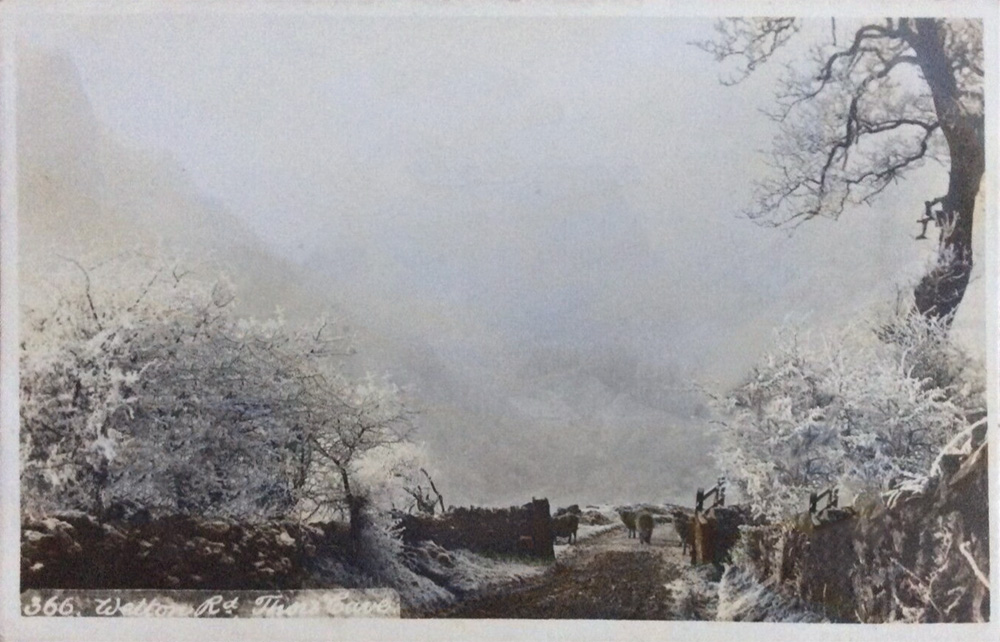
A Wetton trackway in winter.