Deepdale Cave and Gawain?

An interesting snippet from a review of Ordelle G. Hill’s now-unobtainable Looking Westward: Poetry, Landscape, and Politics in Sir Gawain (2009).

Apparently in tracing Gawain’s journey, Hill had Gawain reaching Blackshaw Moor near the North Staffordshire town of Leek. In my own book on the topic Strange Country I also get Gawain to the vicinity of the same Moor, but… then I have him following the ‘Earlsway’. Thus Gawain hooks south along a long ridgeway path and is then headed straight for Alton Castle, which matches the poet’s description very well indeed — and yet curiously no other scholar seems even to have noticed this castle.

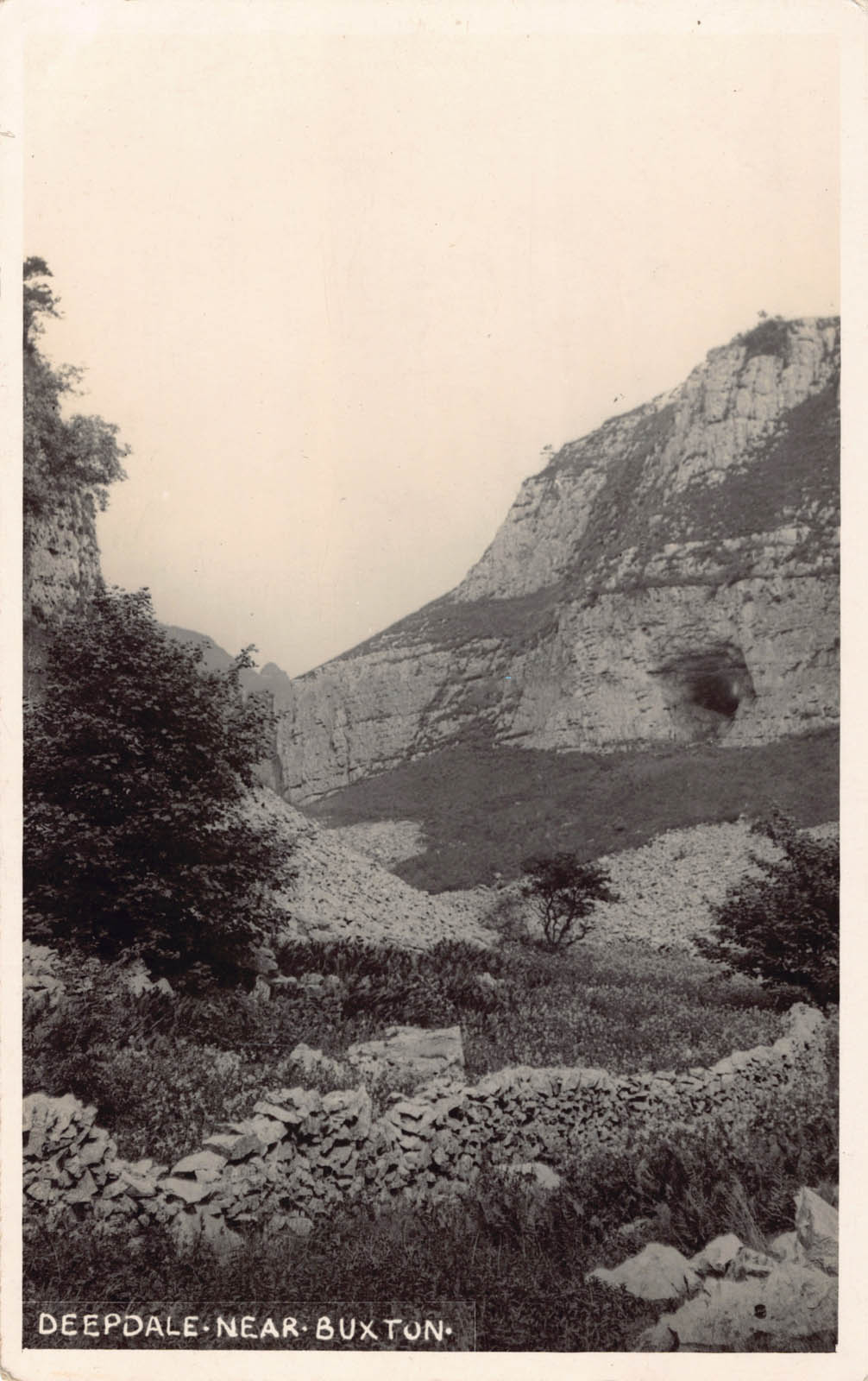
Instead, Hill’s book has Gawain heading north from Blackshaw Moor, toward the town of Buxton and away from the dialect area. Hill then identifies “the Green Chapel with Deepdale Cave near Buxton”, according to the review I read. The cave is also known in the local antiquarian literature as the ‘Thirst Hole’.
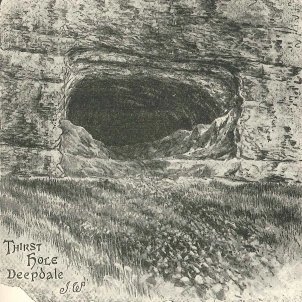
Deepdale Cave looks physically very unlikely to me, though, judging by postcard images of the cave. More like an aircraft-hangar entrance, though I guess it may be been enlarged since the 1370s?
Still, Hill offers a closer suggestion than a recent unsupported claim from another author that Gawain’s journey has him journeying ultimately “into southern Yorkshire”, or the unsupportable notion among dogged Cheshire/Stanley advocates that he must have remained in the Wirral.


Incidentally, there’s another snippet of evidence that Gawain’s likely route had dramatic rock formations…

“Blackshaw Moor, where you are greeted by a dramatic panorama of intimidating rock formations. They rise up suddenly, looking like a row of ancient fortresses.” (Staffordshire Folk Tales, 2011)

Tolkien Gleanings #260

Tolkien Gleanings #260

* A listing for the Tolkien Seminars in Oxford, for Spring 2025…

    – Tolkien the Mythographer
    – Tolkien’s contribution to the specialisation of dwarves in popular fantasy
    – Tolkien’s Forms of Detachment
    – Tolkien and old English prosody
    – Themes in The Lord of the Rings: A Defence and an Exploration
    – Tolkien, Place, and the Past
    – Tolkien’s Invented Languages and Their Use in Adaptations

* FanHistory Project Zoom Sessions, with the holders and curators of science-fiction fandom university collections. This is an online webinar series, set to run from January through April 2025.

* Tolkien fan-fiction hub the Silmarillion Writers’ Guild is having a one-day 20th anniversary event on either 17th or 19th July 2025 (the Web page seems somewhat befuddled about 2024 vs 2025, and 17th vs 19th). The submission deadline is 15th January 2025, and the call is open to scholars as well as fan-fiction writers.

* A few years back the Chinese communist authorities took a sudden and unexpected interest in science-fiction and fantasy fans, writers and communities. What seemed relatively benign at the time now looks different. A new journal paper reveals the “unexpected intensification” of censorship which followed, and how “government censorship caused once-thriving fan-fiction communities to break apart”.

* Signum University SoCal Moot, 15th March 2025 is to be themed around Samwise’s words “‘The Same Tale Still’: The Intersection of Personal Experience With History and Storytelling”. Presentations can be delivered in-person or online. Deadline: 15th February 2025.

* Almost Archaeology blog is on the track of “Tolkien’s archaeological trail”. Meaning, the real ancient places he is known to have visited. The well-illustrated post relates to the new ARTE feature-length TV documentary on Tolkien’s places.

* Recently published, the £100+ academic book Medieval Spaces in Comics: Affect and Ideology (2024). The blurb makes no mention of the titles discussed, but by search one can discover that the author doesn’t appear to have drawn on any large collection of comics on the theme. The titles discussed being: Beowulf: Dragon Slayer (DC, 1975); Northlanders (Vertigo, 2016); Angela: Asguard’s Assassin (Marvel, 2015); Black Road (Image, 2016); and an issue of Monstress (Image, 2018). Also draws, a number of times, on a 2012 indie equivalent of a Classic Illustrated-type compendium, titled The Graphic Canon. Tolkien is not in the Index. Nor is Robert E. Howard or his much adapted character Conan. Though, admittedly, neither LoTR or Conan is strictly ‘medieval’ as such.

* And finally, a pleasing Shire still life, newly painted in delicate watercolour for the German Tolkien Society and now posted online.

Tolkien Gleanings #259

Tolkien Gleanings #259

* The new C.S. Lewis Podcast #189, with Holly Ordway on ‘What did Christmas mean to J.R.R. Tolkien?’ Freely available to download (the link is under the ‘three-dots icon’). A good overview but omits mention of hobbits celebrating Yule (“there was a great deal better cheer that Yule than anyone had hoped for”), and there’s no time for the podcast to also discuss the Father Christmas Letters.

* Signum University short courses for February 2025. Including candidate modules on “Pre-Christian Religions of the North”, and “Turin’s Bones: The Influences of Sigurd, Oedipus, and Kullervo on J.R.R. Tolkien’s Tale of Turin Turambar”.

* Medievalists.net on “Searching for hidden medieval stories from the island of the Sagas”. Old parchment, used for the stiff covers of medieval Latin books from Iceland, is now being inspected for previously hidden texts in Old Norse. So far, the discoveries only amount to… “hymns, prayers, sermons, hagiographies and church music”. But there are many still to be inspected, and who knows… perhaps some snippets of unknown tales, one day?

* The latest online Elvish Lexicon, last updated 18th December 2024.

* A short talk by the Byron Society, “Byron’s Literary and Cultural Legacies in Tolkien’s Middle-earth”. Set for April 2025, with an online option.

* Set to be published at the end of December, the ebook of Theology, Religion, and Dungeons & Dragons: Explorations of the Sacred through Fantasy Worlds (2024). The paper edition is due in February 2025.

* Teen Fandom and Geek Programming (2018), a book for librarians seeking to bring young people’s fannish ‘clubs and collections’ into community and school/college libraries. Probably also useful for museum curators.

* And finally, Reviews from R’lyeh enjoys “A Hobbity Holiday” in a long review of a free pen-and-paper Yule-set RPG adventure set in The Shire. Note that this requires the One Ring Starter Set (2021) core game-book, which frames various Shire adventures… “set between the time Bilbo went on his journey [with the dwarves] and the events in The Lord of the Rings“. Not to be confused with the unrelated board-game with a very similar name. Even non-gamers may be interested to know the 2021 crowdfunded book has… “a full compendium covering the four Farthings of the Shire, all the way from Greenholm and the White Downs in the west to Buckland and the Old Forest in the east”. A review of the boxed 2021 edition states this 52-page Shire-description section has…

“a ton of lore for any RPG setting, let alone for a starter set. While I am a fan of Tolkien’s work, I’m no uber fan and I do have to admit that reading this took me the longest time. It can get quite dry at times and honestly reminded me of reading Tolkien’s books, complete with descriptions of various flower types. Big-time Lord of the Rings fans will probably eat this up.”

Sounds great. I see the boxed edition also has a rather pleasing fold-out colour wall-map in paper.

Tolkien Gleanings #258

Tolkien Gleanings #258

* Thoughts on Tolkien has a long post with “Musings on Christmas Poetry”.

* Tolkien Gateway now has a handy online title-list of Collected Poems : Previously unpublished contents.

* I’m pleased to see that the book Bridal-Quest Epics in Medieval Germany (2012) is now newly available as an affordable £10 paperback, and also that Amazon UK can ship it to a delivery locker. Relevant to Tolkien because it has a “detailed history of the textual scholarship” done in Germany on the Orendel epic (the German cognate of earendel). I’ve ordered a copy and will report on it in due course. After promising “1-2 days”, Amazon now seems to think it may take a few months to arrive.

* There’s now a list of Westmoot 2025 Keynote Speakers and a Westmoot Call for Artwork. No mention of an AI ban for the latter.

* At the newly Tolkien-ified Oxford Centre for Fantasy, a week of “Walking and Writing in the Shires”. 14th – 19th July 2025. Booking now.

* Cannock Chase Council (Labour) is proposing the closure of the Museum of Cannock Chase to save money. Despite the bankable Tolkien connection (90,000 people saw the Museum’s Tolkien exhibition a few years ago), it appears that only “locals” are invited to comment on the proposal.

* And finally, new on Archive.org is a very hi-res scan of the recent Tolkien £2 coin. The idea springs to mind of making a ‘Tolkien Tree’ for Christmas. Tweak the image for brightness, print it, cut out the centre, Pritt-stick onto some generic ‘giant gold chocolate-coins’. Hang on your custom Christmas ‘Tolkien Tree’. Merry Christmas.

Tolkien Gleanings #257

Tolkien Gleanings #257

* A substantial new review has been added to the latest Journal of Tolkien Research, a detailed 40-page critical review of The Collected Poems of J.R.R. Tolkien (2024). Freely available online.

* A new edition of the scholarly Spanish Tolkien journal Aelfwine. Includes the English essay “Middle-earth Without Clovers: Unveiling the Myth of ‘Celticism’ in Tolkien”. Freely available online.

* “Jung, Campbell, Tolkien, and the Christian Moral Vision”. An old essay dug up from 20+ years ago, and now freely republished online.

* A forthcoming conference strand will be on “Hobbits in the 25th century: enjoying Tolkien’s Legendarium into the Future”. Perhaps partly interesting in relation to the likelihood of a specialist AI ingesting and then ’embodying’ all of a writer’s letters, works, and essays. A related topic of discussion at the event is “AI and the future of literary preservation”. Abstracts are due before 1st January 2025.

* A December 2024 call for submissions to Gramarye , the journal of the venerable Chichester Centre for Fairy Tales, Fantasy and Speculative Fiction. Deadline 21st March 2025. No special theme for the issue, but submissions must relate… “to literary and historical approaches to fairy tales, fantasy, Gothic, magic realism, [or] science fiction and speculative fiction”.

* And finally, a page from the Forum Auctions catalogue for 30th November 2023…

Tolkien Gleanings #256

Tolkien Gleanings #256

* From the Bodleian and free on YouTube, “Christopher Tolkien at 100: A celebration”.

* A new issue of Amon Hen from the Tolkien Society ($ paywall). The new December 2024 issue has, among others…

    – An examination of… “why Galadriel arrayed Aragorn as an Elf-lord of the West and seemingly favoured his match with Arwen”.
    – A short review of the new History of Middle-earth four-box box-set, focusing on the physical quality… “the bindings are glued instead of stitched”.
    – Reviews of the books Tolkien’s Faith (2023), Leadership in Middle-earth (2021), and a brief personal review-note on the new Collected Poems.
    – Two pages on Goldberry as a supporting character.

Also an intriguing reprint of some artwork I’d not seen before. Presented small and tagged only as “Ent and Entwife by Arthur Rackham”. Reverse image-search shows it to be from Hawthorne’s Wonderbook (1922 edition), retelling selected Ancient Greek myths for children. The book is only to be found on Archive.org as A wonder book, where the artwork is found inserted just before page 167.

* The latest rolling edition of Journal of Tolkien Research is filling up, with new additions including a review of Cities and Strongholds of Middle-earth (2024). The review is freely available online.

* Slipping out of U.S. copyright in the New Year, Sir Gawain and the Green Knight: A Modern Version of the XIV Century Alliterative Poem in the Original Metre (1929). The book was published as an attractive popular edition by Dent in early spring 1929 — thus it seems very likely that Tolkien would have at least looked through it, perhaps in the summer of 1929. Well-reviewed, and then reprinted in 1931. Not on Archive.org, but Hathi Trust has a 1929 scan due for release on the due date. Not in Tolkien’s Library (2nd Edition).

* Notice of a private Tolkien Lecture for the Old Edwardians KES Boys. March 2025, at the new Ruddock Performing Arts Centre, part of Tolkien’s old school (now relocated into south Birmingham). No topic given.

* Set for 9th August 2025 at the Museum in Tewkesbury in the West Midlands, a talk on “Tolkien and the Cotswolds – The shaping of Middle-earth”. No speaker named.

* And finally, at the Grolier in New York City, “Imaginary Books: Lost, Unfinished, and Fictive Works”. The exhibition runs until 15th February 2025, and there is also an online version.

Tolkien Gleanings #255

Tolkien Gleanings #255

* A review of the recent Arte TV documentary on Tolkien’s places, in Italian. An auto-translation of the review makes the 90-minute film sound rather fair and thoughtful. The review also brings news that the film can be viewed free of charge until early March 2025. There are English subtitles, and I found no region-blocking in place.

* A new open-access article in Classical Receptions Journal, “The Meaning of Mr. Tumnus: classical epic and the making of modern fantasy”. Identifies the use of the faun as part of a masterly “layering of pasts” technique which was developed and used by both Tolkien and Lewis.

* Now online, the schedule for the conference A Flame Imperishable: The Christian Legacy of J.R.R. Tolkien.

* A bare listing for a talk in Oxford on 7th February 2025 at the Divinity School, on “J.R.R. Tolkien’s Forms of Detachment”.

* A new repository record for a forthcoming chapter in a festschrift book titled Florilegium Nordmannicum, on “La presence de la Volundarkviða dans l’oeuvre de J.R.R. Tolkien”. The record has the book as “2024”, but evidence elsewhere suggest it is delayed from 2023 and is now set to appear in 2025. The book’s Tolkien chapter is in French, and the English abstract reveals it examines the…

“omnipresence of the ancient and medieval Germanic world [in Tolkien, and specifically how he] “borrowed elements from the Völundr/Wéland smithy early on to feed his legendarium. Some traces have been erased after numerous rewrites, and others persist, reshaped, or concealed.”

* The European Conservative reviews the recent book Tolkien in the Twenty-First Century (2023). Not to be confused with the similarly-titled book Tolkien in the 21st Century (2022).

* And finally, in The Spectator Christmas special, Matthew Parris on “My mission to save the elm” (probable $ paywall). Elm being the elm trees, towering giants which the English landscape began to lose to the devastating Dutch Elm Disease in the last few years of Tolkien’s life.

Tolkien Gleanings #254

Tolkien Gleanings #254

* The open-access Journal of Tolkien Research is seeking peer reviewers, able to review between nine and twelve articles per year.

* Newly listed on Amazon UK, Proceedings of the Tolkien 2019 Conference, for publication as a 610-page book and ebook at the end of February 2025. The event was a major five-day Tolkien conference in Birmingham. I filleted the PDF programme (now vanished) when it appeared and noted interesting items.

* A “free exhibition of tapestries from the world of Tolkien” at the College des Bernardins, Paris. Fifteen of the Aubusson tapestries will be on display in the College’s mediaeval vaults. Running 21st March to 18th May 2025.

* The Church Times has a profile interview with the creator of the new book The Mythmakers: The Remarkable Fellowship of C.S. Lewis & J.R.R. Tolkien.

* I somehow missed the news of Visualizing Camelot, which was a 350-item university gallery exhibition surveying the uses of King Arthur in popular culture. The show was developed by subject-expert curators who were able to draw on specialist American and British collections of such material. The free exhibition venue appears to have been rather remote (on Lake Ontario, very near the US/Canada border) and is now over. The show was however co-organised with Bangor University in North Wales, so I guess there may be a possibility it might pop up in the UK in summer 2026? In the meanwhile, there’s a substantial website. Also a 134-page hardback catalogue with a detailed survey-essay of the topic, yet even I can’t discover where one might order this online. Possibly the book was only available to buy at the exhibition?

* Copyright Literacy brings a link to a useful new survey of the state-of-play in the UK for galleries, museums and public domain images. This is in the light of the recent UK legal ruling that there can be no copyright in digital images of 2D out-of-copyright visual works. The article’s table shows which museums are still open to legal action, and which are safely following the law. The matter is especially relevant to scholars who require pictures for use in presentations, articles and books.

* Here is another item useful for scholars. Especially those fed up with the grinding slowless of Google Maps, as it loads up all its junk. For simple “where the heck is Little Puddling?” queries, of the sort historians often make, try Google Maps Ultralite with Labels and enjoy blistering load speed and silky-smooth zooming. It does however lack a measurement tool for distances, for those needing to know how many miles might lie between Little Puddling and Greater Puddling.

* New on Archive.org, a scan of the 55-page Mirkwood Tales (1977) by Eric S. Roberts. Being what appears to be a ‘Middle-earth in Mirkwood’ fannish RPG adaptation, to be played with the mid 1970s edition of Dungeons and Dragons.

* Tolkien in Lettere is a new podcast which seems to be about reading aloud all the Tolkien letters in Italian translation.

* And finally, British Fairies has a new post on ‘Away with the fairies’ — faery terms in English speech.

Tolkien Gleanings #253

Tolkien Gleanings #253

* A new podcast interview with the leading Tolkien collector ‘Trotter’…

“Stef and Jude are joined by Tolkien collecting expert and moderator of the Tolkien Collector’s Guide, Andrew ‘Trotter’ Ferguson. Andrew tells us about his experience collecting and sharing the Professor’s material culture.”

* Bombadil as seen through Indian Hindu eyes, in the new scholarly paper from India “Tom Bombadil: A Challenge to Dualism in Tolkien’s Legendarium through the Indian Metaphysical Lens”. Freely available online.

* “Old English Goddesses, Lost and Found” an introductory online study-day on Friday 7th February 2025. There’s a full outline, and it’s obviously not going to be neo-pagan mumbo-jumbo. Booking now.

* Green Book blog has a new blog post on details of Christopher Tolkien’s wartime service, followed by a short list of the author’s current projects. His list includes “Animals during wartime in J.R.R. Tolkien’s work and life”. Springing to mind there are: i) carrier pigeons as battle-front messengers (birds as messengers in The Hobbit and as Saruman’s spies in LoTR); ii) labouring pack-horses (Bill the pony); and iii) likely encounters had by soldiers with ferocious dogs in a battle-torn French countryside (Farmer Maggot’s dogs).

* The Oddest Inkling offers a detailed outline of the Inklings lectures for his forthcoming online course for The Great Courses / The Teaching Company.

* Names and World-building in Fantasy & Science Fictional Universes, a panel to be hosted at the annual meeting of the Linguistic Society of America in January 2025. To include the paper “Tolkien’s vs. Rowling’s Names: Historical vs. Modern Reality; Elvish vs. Humorous Inventions”.

* The latest edition of Midland History journal has “Mercian Charms: From The Lair of the White Worm to Penda’s Fen”. This looks “at the mythopoeic reinvention of Anglo-Saxon Mercia” via Bram Stoker’s imaginative but unsuccessful final novel The Lair of the White Worm (1911) and the ‘earth mysteries’ TV-film Penda’s Fen (1974). Tolkien was of course also fascinated by ancient Mercia, although here the article strains in the opposite political direction to Tolkien. The article is part of a special issue of the journal on ‘The Haunted Midlands’ and publisher Taylor & Francis has it as free-to-access, at least for now.

So far as I can tell, Tolkien did not read The Lair of the White Worm (1911). It was published in early November 1911, and by that time he was busy with his first year at Oxford. He might have been disappointed if he had encountered it later (“utterly ruins a magnificent idea” — Lovecraft). Though, in trying to discover if he read it or not, I found mention that… “some of the fairy tales collected in [Stoker’s] Under the Sunset (1882) also have a sinister edge”. I imagine that a book of original fairy tales by the author of Dracula might have interested the Inklings, had they known of it.

* The Silver Key blog discusses the creative uses of King Arthur, specifically comparing Tolkien’s The Fall of Arthur with a similar use by the British heavy metal band Iron Maiden.

* And finally, the Foreshadowed and Foresung blog has a long and pleasingly-illustrated appreciation of the pioneering Tolkien artists The Brothers Hildebrandt.

Midland History journal: ‘Haunted Midlands’ special

The latest issue of Midland History journal is a ‘Haunted Midlands’ special. Appears to be open-access, for now.

* Towards the Haunted Midlands

* Edgehill, Naseby, and the Ghosts of the Civil Wars

* Recapturing History: Newstead Abbey and Romantic-Gothic Interpretation

* Mercian Charms: From The Lair of the White Worm to Penda’s Fen

* Weird Waterways: Blue Humanities and Eerie Canals in the Midlands

* Queering the Postindustrial Landscape in Joel Lane’s Short Fictions

* Wave Goodbye to the Future: Haunting, Music, and Cultural Stasis in the Regional Novels of Catherine O’Flynn and Joel Lane

* The National Literacy Trust Haunted Birmingham Campaign: How Might ‘Scary stories’ Connect People to Place, Heritage and Literacy?

Tolkien Gleanings #252

Tolkien Gleanings #252

* A review of the recent Christopher Tolkien conference

“Two papers, by Sara Brown and Kristine Larsen, discussed the Athrabeth, a key text in the legendarium [1959, in HoME 10: Morgoth’s Ring, pages 301-366], analyzing all of the layers of writing and the choices involved in editing it, and they and Verlyn Flieger emphasized even [Christopher’s] courage in publishing this thing, which cut down to the bedrock of the fictional universe and touched the author’s own deepest religious beliefs. I got the impression, listening to Sara and Kris speak and reading the chat function, that the mere existence of the Athrabeth was news to a lot of the attendees.”

* There’s a Tolkien chapter in the new McFarland book From Soldier to Storyteller: Essays on World War Veterans Who Became Famous Children’s Authors (2024), titled “J.R.R. Tolkien (1892-1973): War, Fatherhood and Writing for Children”.

* A probable Tolkien article in the latest edition of the Biblical scholarship journal The Expository Times, “Reign of Christ” ($ paywall). There is no abstract, but judging by the title and introduction, it seems likely to relate events in LoTR to six Biblical passages.

* A well-reviewed new book from Oxford University Press, The Victorians and English Dialect: Philology, Fiction, and Folklore (2024). A review in The Critic says the book is accessible to the general reader of British history, and as such it may appeal to readers of Gleanings. Especially since it tells the story of a significant aspect of Tolkien’s scholarly field, as it developed prior to 1905. The “fiction” of the title is of the earthy Thomas Hardy sort, not fantasy.

* On YouTube, a coming-shortly fan reading of “The Death of Saint Brendan” by J.R.R. Tolkien. Though I’m not sure which version, as there are evidently several…

“[1945-46, Tolkien] writes the poem The Death of Saint Brendan (*Imram), producing much initial working, four finished manuscripts, and a typescript. He includes the alliterative verse retelling of the legend of King Sheave, previously associated with The Lost Road, but writes it out as if it were prose. At some later time, he will develop the poem (as Imram) in three further type-scripts.” — from the ‘Companion & Guide: Chronology’.

* This week The European Conservative has a long and timely essay on “Mordor in England”, responding to a first-time reading of LoTR and especially to ‘The Scouring of the Shire’.

* And finally, news that The Hungry Hobbit cafe in Moseley has finally closed. Moseley being a small district that long served as the city of Birmingham’s redoubt for the ‘muesli and Marx’ brigade. But I imagine that some Tolkien tourists may also have sought out the cafe over the years. The local newspaper reports that The Hungry Hobbit, forced to become ‘The Hungry Hob’ after legal threats, has now been replaced by an American-style fried chicken shop. Hopefully this is not named The Lord of the Wings.