Tolkien Gleanings #200.
Welcome to the 200th edition! If you value these ‘gleanings’, please consider becoming my patron on Patreon.
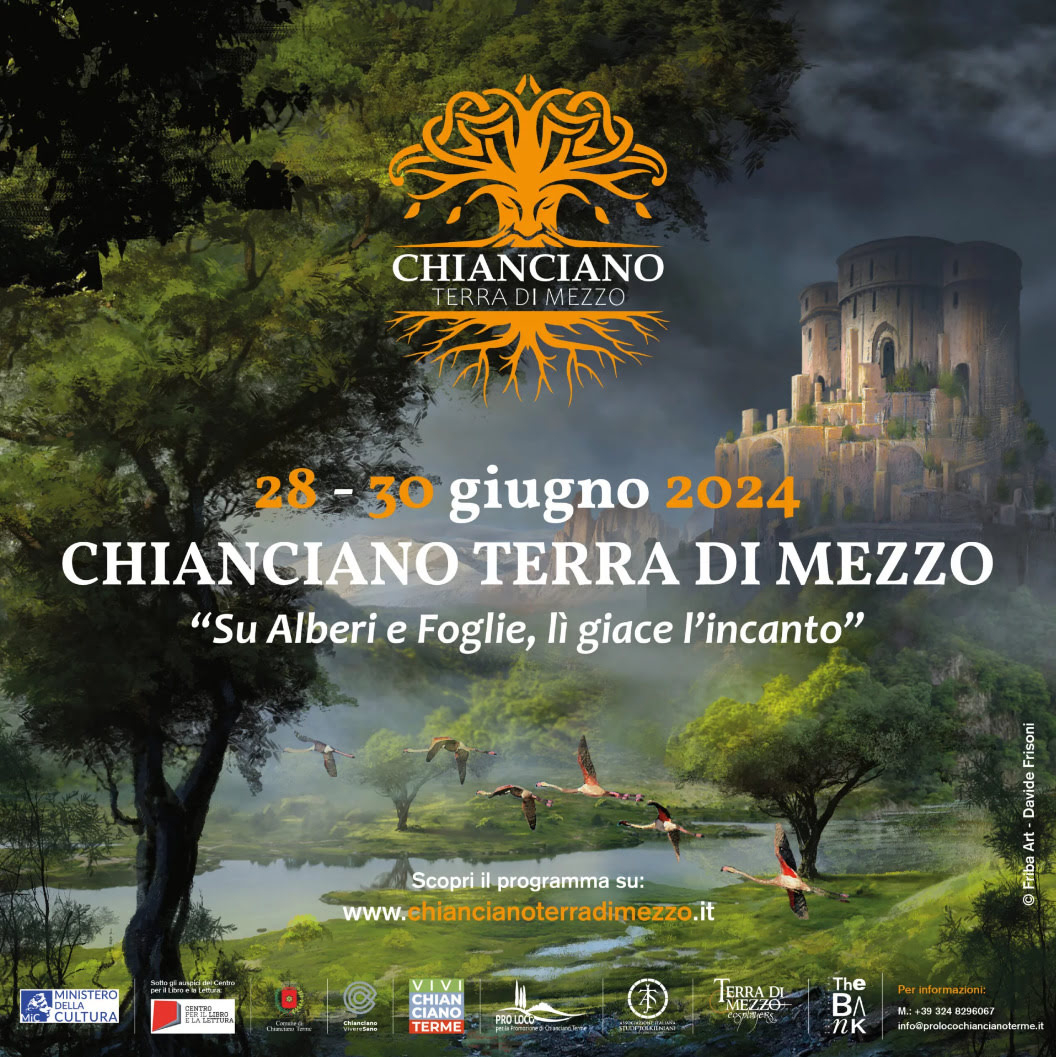
* In Italy, the three-day Chianciano Terra di Mezzo event returns, 28th–30th June 2024…
“an extraordinary event entirely dedicated to the writer J.R.R. Tolkien and his work […] meetings, exhibitions, shows, music, films […] evening concerts, shows […] This year we take our key inspiration from one of Tolkien’s first poems [“Kortirion”] which is a celebration of Warwickshire, envisaging Warwick as the city of the Land of Elms, and as Alalminore of the faerie realm.
… amid this sleeping land
of silver rain, where still year-laden stand
in unforgetful earth the rooted trees (— from Book of Lost Tales 1)
* Newly republished online and freely available, Tolkien’s 1945 letter to The Catholic Herald on ‘the Name of Coventry’, the West Midlands city…
“The settlement and naming of the Midlands lies far back in English history, and in the main preceded the conversion [to Christianity] of the Angles. Indeed, the giving of names often preceded the formulation of the ‘places’, that is of the villages and towns, and so originally denoted isolated swellings, boundary-marks, and local features, near which communities were later formed.”
He roots the name Coventry to the Anglo-Saxon “Cofa’s tree”, and Cofa to “cove”, which he ‘nods through’ as being a word used by later men to recall the shrewd original “farmer-settlers” — those who left behind them only a tamed lowland landscape and their burial mounds on the heights…
The name Cofa appears in other place-names in other parts, Covington, Covenham, and Cobham: but these names are the only records that these long-forgotten “coves,” these farmer-settlers, have left on the pages of history to-day.
Thus he appears to claim the word “cove” as the origin of that which survived into the common speech of the 19th and early 20th century. An “old cove” being a canny and somewhat rascally old man, still sharp and knowledgable but somewhat antiquated and withdrawn from the main stream of life. Possibly also reluctant to give sums of money to his relations (a “stingy old cove”). This would sit somewhat alongside the more accepted meaning for the Anglo-Saxon cofa, a cave-like chamber scooped out under a mounded hillock (the still-current modern sea-shore word “cove”, as a scooped-out inlet between rock walls, is similar). In that, the phrase “old cove” also implies that the old man has ‘one foot in the coffin’. Or the barrow-mound, in the case of the early Angles of Mercia. Tolkien’s earlier mention of “isolated swellings” in the landscape then suggests for Coventry a large pre-Christian Anglian burial mound, from which a large and notable tree grew.
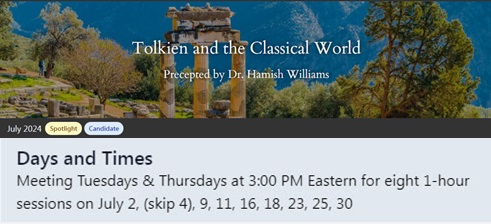
* At Signum University, an eight-class online course on ‘Tolkien and the Classical World’. Forthcoming in July 2024, though only if enough students sign up for it.
* A new YouTube recording of a Signum University Thesis Theater: On The “Notion Club Papers and Tolkien’s Vision of Creative Mysticism”.
* The Tolkien Guide has a new post containing an article on “Tolkien-Inspired Art from the ‘Hobbit Craze’ Years, 1965-1969: Untraced Works”. Freely available online.
* The Tolkien Society Annual Guest Speaker 2024 is announced…
“Dr. Andrew Higgins is the Director of Development at Imperial War Museums [and a Tolkien scholar…]. His talk to the Society, in honour of the publishing of the new extended version of Tolkien’s Letters, will be ‘Epistolary Glossopoeisis: Tolkien’s Letter Writing and Language Invention'”.
* In the latest issue of The Criterion, student journal of the College of the Holy Cross, an article on “Language and The Lord of the Rings: The Expansion of a Universe”. The author aims to show how, with the aid of its many “linguistic markers, […] Tolkien hints at a larger world outside the narrative”. Freely available online.
* From 2018, but new to me, ““Learn Now the Lore of the Living Creatures”: On J.R.R. Tolkien’s Alliterative Poetry”. Freely available online.
* Another worthy blast-from-the-past. The early Tolkien fanzine Niekas #16, now freely available online as a PDF via the Fanac History Project. #16 has the full version of an essay that Amon Hen No. 9 recalled as “the most penetrating commentary on The Lord of the Rings that had yet appeared” by the early 1960s, “Men, Halflings and Hero worship”. Note that this same essay was severely truncated in the later book Tolkien and the Critics (1968), and the truncation was repeated by the same editors in their updated volume Understanding The Lord of the Rings (2004). If you think you’ve read this seminal essay there, you haven’t.
* Note that April 2025 will be the 100th anniversary of the publication of Tolkien and Gordon’s edition of Sir Gawain and the Green Knight. Surprisingly I don’t see the 1925 edition on Archive.org. Superseded in 1967, true, but the 1930 corrected reprint “remained the most widely used text of the poem for forty years” and it appears to have gone through eight reprints. As such the original as-printed edition should really be readily available for study as a historical document. It isn’t, so far as I can tell, except in the dead-tree form now made expensive by book collectors.
* Advance notice of a new lecture-series class from the high-quality Great Courses company, to be titled The Inklings: C.S. Lewis, J.R.R. Tolkien, and Others. Due in 2025.
* Apparently, Tolkien once wrote something about Chelsea, London? Or so claims the UK’s Royal Philharmonic Orchestra in their blurb for a Chelsea-themed concert in June 2024… “hear words written in and about Chelsea from authors including A.A. Milne, Jane Austen, J.R.R. Tolkien…”. The Chronology only has him present at the 1968 Chelsea launch of the song-cycle “The Road Goes Ever On”, so perhaps some late writing arose from that? One likes to imagine him using the opportunity to have a quick potter down the famed Kings Road in 1968, sampling — with raised eyebrows — the swinging dandy fashion and psychedelic rock-music of the time. But perhaps not.
* Severely overcrowded with tourists, partly due to its Tolkien claims, the Swiss village and valley of Lauterbrunnen… “plans to charge visitors to experience ‘Middle-earth'” according to various news reports.
* And finally, Games Beat magazine has a long and well-padded interview with Lee Guinchard the CEO of Embracer Freemode. No surprise revelations, but interesting background if you can slog through it all. Here’s the digest for the rest of us. Guinchard is a highly experienced game producer and sees “big opportunities for further exploration and expansion” in the Middle-earth IP, envisaging something multi-platform and akin to the ‘Marvel Universe’. But based around the “games [i.e. videogames, that] are going to be made to fully explore the new universe being created”, possibly with AI character enhancement and the maturing “new technology for how people immerse themselves in worlds”. This is as part of “a 10-year or 20-year plan” while Tolkien is still in copyright, which will aim to align with other companies (making new movies, TV series, card games etc). Current videogames (such as the dire Gollum, the soon-to-close Heroes of Middle-earth, the imminent and icky Tales of the Shire, and the mediocre Return to Moria) were approved before he arrived on the scene. He sees no “rights issues” for stories set in the Second Age of Middle-earth. The overall aim will be to “reach billions” of buyers and “work with a wide variety of merchandise companies” to generate income. This likely includes reaching the big Chinese audience, and he poses the question “how would it be visualized for them?” Personally I’d be happy with interactive AI-driven audio, where I can imagine my own visuals.
[…] now reached Tolkien Gleanings #200 with my Tolkien news-round-up […]