A small mystery in Hanley…

I can’t believe the headlines that Stoke-On-Trent is the most air polluted place in the UK. Apparently the reading was made in “Parliament Street”, taken “over a two-week period”. It measured PM2.5 particulates in the air.

The first problem is… there is no Parliament Street. I assume they mean Parliament Row in Hanley, since Google Maps knows nothing of any Parliament Street in Hanley or indeed in Staffordshire. I hope we’re not being confused with the busy Parliament Street, in the centre of Nottingham?

The study was by some organisation called GRIDSERVE. No, I’ve never heard of them either. Apparently they want to sell you so-called ‘zero carbon’ solar energy. They’re not exactly official, and I can’t discover if their research-design and methods were peer-reviewed for validity. Looks like a headline grabbing exercise to me, aiming to build up a contacts list for their sales force?

Anyway… our Parliament Row is pedestrianised. It’s where the Stanley Matthew statue is, and Waterstones. A fair distance away from the new bus station, and the roads used by buses hauling themselves up to it. And it’s elevated, on top of a hill. Meaning that most often, it’s as windswept as only Hanley can be, with nothing between it and the Cheshire Plain.

How then can it possibly give the highest road-pollution reading for PM2.5 particles in the UK? If measured in the high summer, were the Hanley druggies perhaps smoking right next to the sensor… and blowing their smoke at it? It’s the only thing I can think of.

Tolkien Gleanings #147

Tolkien Gleanings #147.

* A student’s lengthy November 2023 summary-report of an “Oxford professor’s USC visit” and the lectures given there…

“USC’s Nova Forum for Catholic Thought invited Pezzini for a weeklong speaking series on Tolkien’s literary contributions from a Catholic perspective.”

* Advance notice of an Easter Tolkien talk in the UK, “J.R.R. Tolkien and the Hope of Easter”.

* Now on Archive.org, Colin Wilson’s Tree by Tolkien chapbook (1973), seen here in its 1974 U.S. edition…
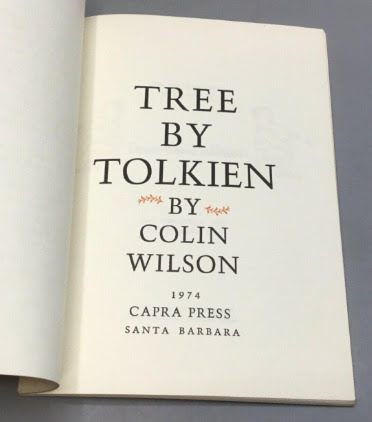
Not to be confused with the notoriously-wrong critic Edmund Wilson. The only commentary on it that I can immediately dig up is in the Tolkien Encyclopedia

“It could be said, fundamentally, that no ‘mainstream critic’ appreciated The Lord of the Rings or indeed was in a position to write criticism on it. […] The best possible exception would be Colin Wilson in his 1974 Capra Press pamphlet Tree by Tolkien, in which he compares Tolkien somewhat oddly (but in the end perhaps perceptively) with Jeffrey Farnol.”

Actually I find the comparison is short, and then a later passing comment suggests Wilson intended it to apply to the initial walking journey from the Shire to Rivendell. But the observation made me look into Farnol. He was one of the many accomplished Edwardian writers of popular adventure-romance novels. He was from Aston in the north of Birmingham, so not far from Tolkien. But at age 30 he married his 18 year-old love and they set off for America. There he became a successful writer, robust but with a strong dash of romance added so as to appeal to women readers. Also a strong taste for the old English rural highways and byways, Regency highwaymen and ‘country characters’ being then very much in demand. Four of his novels are on Archive.org

As I sat of an early summer morning in the shade of a tree, eating fried bacon with a tinker, the thought came to me that I might some day write a book of my own: a book that should treat of the roads and by-roads, of trees, and wind in lonely places, of rapid brooks and lazy streams, of the glory of dawn, the glow of evening, and the purple solitude of night; a book of wayside inns and sequestered taverns; a book of country things and ways and people. And the thought pleased me much.” (Opening of The Broad Highway, 1911).

Update: I heard the first fifteen or so chapters via the LibriVox reading. No great resemblance to Tolkien, so far, other than the love of English landscape.

As for Colin Wilson, there are some perceptive moments. But he reveals that the first read of LoTR was a three-day gallop, and we later learn that he skipped large sections. The second was a read-aloud to his children which meant many “long speeches” skipped and the book’s reading also re-ordered so as to focus on Frodo and Sam. Partly, Wilson’s reading doesn’t appear to have been deep or complete enough. Nor does he have anything much of the biography to grasp, seemingly having to intuit the Catholicism rather than to know about it. Still, as possibly the first worthy criticism after Auden, it’s fairly creditable. Unlike many critics of the time, he had actually (mostly) read the book.

* A short new book from the University of Wales, Introducing the Medieval Fox (2023).

* And finally, advance news of a short summer 2024 exhibition at the Getty in the USA. “The Book of Marvels: Wonder and Fear in the Middle Ages” will run from 11th June – 25th August 2024.
Leaf it out…

Several new research findings, as noted in the latest New Scientist. Most people think that thick wet…

“blankets of fallen leaves can choke plants beneath them, especially shorter species like lawn grass […]. The surprising thing is, this received wisdom has only recently been scientifically scrutinised, with a range of studies all pointing to the exact opposite conclusion.”

So long as the lawn isn’t heavily swamped, meaning less than 20 percent coverage, then…

“the fertility benefits of this light leaf coverage far outweigh the drawbacks – the leaves will quickly break down and help next year’s lawn grow far better than if you had raked them”.

If the grass has 50% leaf-wad coverage and it’s thick, it’s said it’s best wait for a dry spell (easier said than done, in the British Isles), then shred the dry leaves with a good lawnmower. Probably a lightweight hover-mower, I’d guess. Then just leave the shreds for the spring rains/winds and the worms to deal with.

All of which saves time, bin-bags, bin-men hassle (“we’re not taking that…”), smoky bonfires and roasted hedgehogs, the tiring use of hand-rakes or the hire of neighbour-annoyingly leaf-blower machines.

Of course, paths are different. I know from experience there that it’s best to let them get wet and wadded if you can. Then take them off via slicing and lifting with a shovel as if they were peat sods. Then brush and let the rain do the rest.

Tolkien Gleanings #146

Tolkien Gleanings #146.

* New at Word on Fire, Holly Ordway on “Tolkien, “Beloved Bernadette,” and the Immaculate Conception”. It appears to be a new essay, and not an extract from the new book Tolkien’s Faith.

* This week Ad Fontes has a review of Ordway’s Tolkien’s Faith.

* A YouTube interview I’m fairly sure I missed, back last January. The one-hour podcast “Tolkien as Philologist and Oxfordian Catholic” interviewed Dr. Yannick Imbert. Imbert is author of From Imagination to Faerie: Tolkien’s Thomist Fantasy (2022) and Professor of Apologetics at the Faculte Jean Calvin in France.

* The latest European Conservative has a long freely-available peice “Further In and Further Up: 50 Years with J.R.R. Tolkien” by Joseph Pearce. It appeared in the Fall 2023 print edition of the magazine, and has been newly released online.

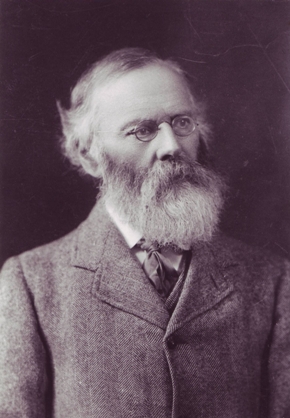
* I see that the Weston Library, Oxford, recently held the event “Henry Bradley (1845-1923): A Celebration of his Life and Scholarship”. The date was 17th November 2023…

“It has been Henry Bradley’s fate to be remembered as ‘only’ the second Editor of the Oxford English Dictionary, always overshadowed by James Murray. This event aims both to celebrate and recontextualize his achievements – not just as a lexicographer, but as a writer, historian, and scholar in a variety of contexts. When he died in 1923, his former OED assistant J.R.R. Tolkien paid tribute to him, in Old English, as a sméaþoncol mon (a ‘man of subtle thought’). One hundred years after his death we offer a long-overdue reappraisal of his life and scholarship in a series of papers.”

Somewhat Gandalf-ian? But I suppose many fellows had such an appearance around the turn of the century.

* ““What a tale we have been in”: Emplotment and the Exemplar Characters in The Lord of the Rings and the Harry Potter Series” is a new journal article coming from the jargon-filled field of educational theory. Freely readable, but not downloadable without paying. Putting the abstract into plain English, as much as possible, gives…

“[The] admiration [of the young reader for characters] involves wonder and distance, and is best evoked by mixed or flawed characters … [Through such admiration a child may come to understand that they themselves may be part of] larger narratives [in the real world]. [For the writers under discussion, the child’s admiration of virtue is aided by the writer’s uses of] moral realism.”

I’d add time-scales as well as “larger narratives” (by which most teachers would probably assume immediate things like family structures, the daily news, etc). The most intelligent child reader will over time learn to draw more deeply from the past, as well as anticipating further ahead into the future. The classics of fantasy and science-fiction literature will ably serve these rare text-readers in forming such habits of mind. The Lord of the Rings especially offers them deep lessons in “The Long Now” — with a number of characters operating and planning over far longer time-scales than the hobbits are aware of.

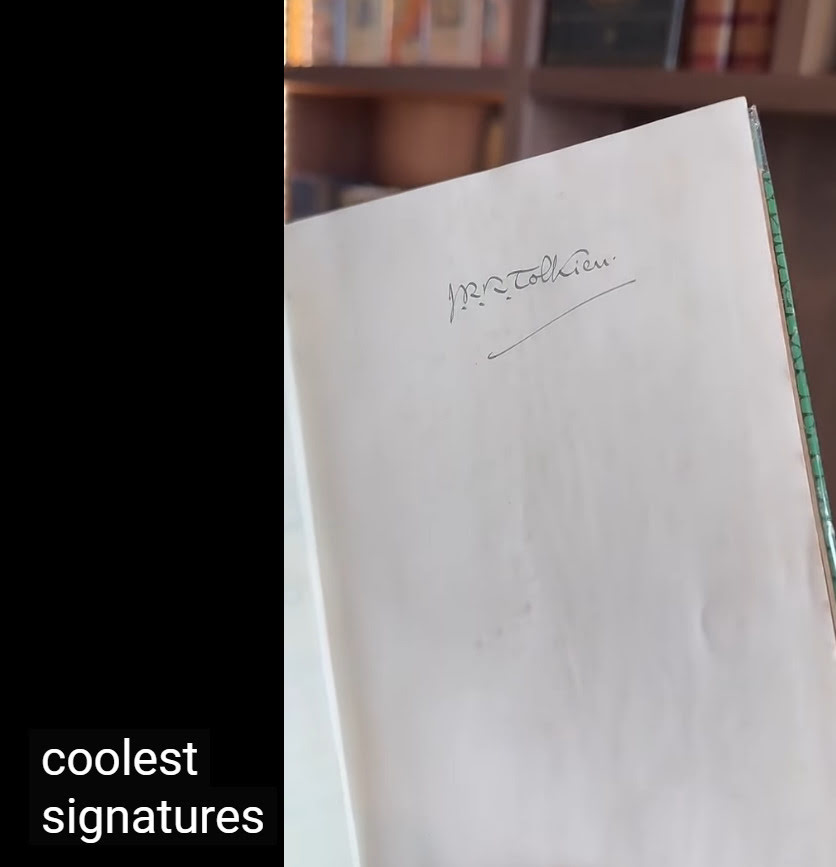
* And finally, a 50 minute video tour of a $4-million dollar home library, including Tolkien treasures…

Tolkien Gleanings #145

Tolkien Gleanings #145.

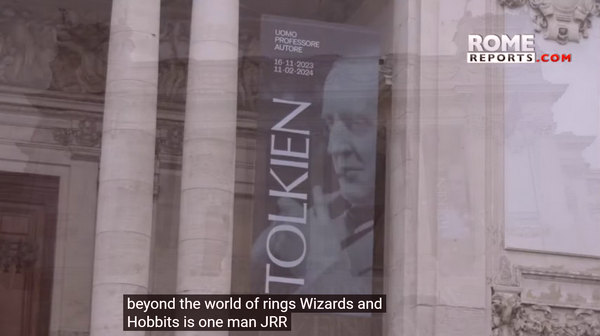
* A Rome Reports two-minute TV-news style video takes cameras inside the Italian National Gallery for a peep at the successful new Tolkien exhibition there, and interviews Oronzo Cilli. Be sure to turn on YouTube’s auto-subtitles.

* The Athrabeth podcast interviews Thomas P. Hillman. His new book is due just before Christmas from Kent State University Press, titled Pity, Power, and Tolkien’s Ring: To Rule the Fate of Many. The publisher’s blurb has…

“Instead of turning his interpretation [of LoTR] to allegory or [Christian] apologetics, Hillman demonstrates how the story works metaphorically, allowing Tolkien to embrace both Catholic views and pagan mythology.”

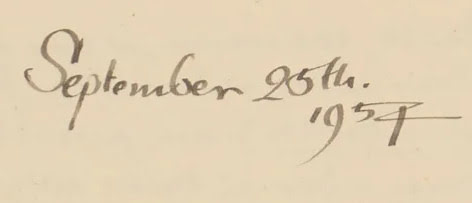
* Seemly newly up for auction, Tolkien’s hand-written 25th September 1954 letter to someone who had given The Lord of the Rings an attentive and positive review on publication of Fellowship. In the New Statesman magazine, of all places. Presumably British armchair leftists had no idea what was coming, given that only the first volume of LoTR had by then appeared, or they might have had a more hostile reviewer lined up. My guess would be that the editor simply nodded it through.

The item up for auction appears to be Letter 154 in the Letters.

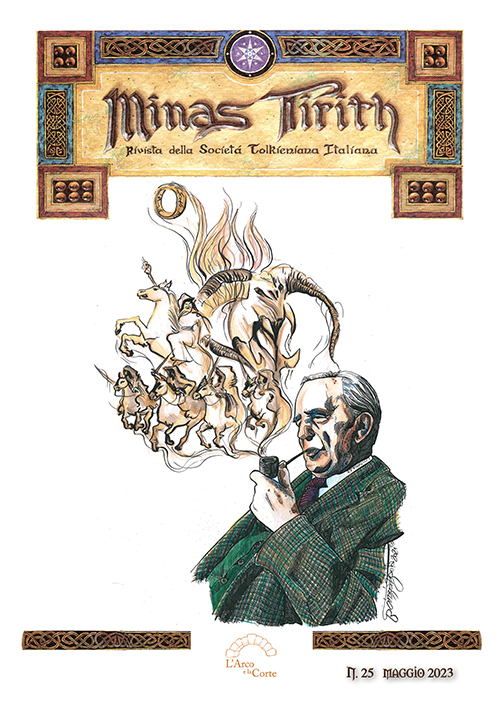
* I found the site of L’Arco e la Corte, an Italian publisher offering Tolkien scholarship including a journal. This gave me the Italian journal’s Minas Tirith #23 (May 2023) contents in Italian, which includes among others…

    – Tolkien the philologist and Armand Berger’s Res germanica.
    – At the Origin of the Elvish Languages: Early Quendian and Proto-Indo-European.
    – Elvish language trees according to various later conceptions of J.R.R. Tolkien.
    – The French ‘Library’ of J.R.R. Tolkien.

A Tolkien page in their catalogue also revealed interesting items (though again, published in Italian). Among which are, here given in English title-translation…

Glimmers of things higher, deeper, or darker than its surface (conference proceedings); Travelling to Isengard: Tolkien and European traditions (multi-author, scholars from widely differing disciplines); J.R.R. Tolkien, philologist and poet between antiquity and the 20th century (a short primer for Italians on Tolkien’s Philology and his wider academic interests); and a two-volume The Languages ​​of the Elves of Middle-earth – History and development of the Elvish languages ​​of Arda.

* And finally, An Unexpected Journal has the new essay “Melchizedek, Bombadil, and the Numinous in The Lord of the Rings”. A new long and Bible-aware essay, which suggests a possible Biblical source / influence for Bombadil. One that’s new to me.

Tolkien Gleanings #144

Tolkien Gleanings #144.


“Together we score one hundred and forty-four.” (Bilbo in LoTR).


* A starter list of errors found in the new book of Tolkien letters

“most of them are OCR errors. Obviously the publishers didn’t have a native digital file for a decades-old book, so they used OCR. … Hundreds of similar typos can be found in [recently published OCR’d] Tolkien books.”

I’d guess that finding and flagging OCR errors is probably a good task for an AI, and I’d hope someone’s already working on that one — if it isn’t already built-in to the better professional OCR engines.

* “J.R.R. Tolkien Offers an Antidote Against New Forms of Paganism”… “This article is an adaptation of a lecture, “Tolkien, Heroic Christianity and the Dangers of Neo-Paganism”, delivered at the Sept. 17-19 EWTN Gotland Forum in Sweden.” The video version was previously noted here, but the heavily accented English of the speaker may mean that the text transcript is welcome.

* The Colorado Catholic Herald has a long and glowing review of Holly Ordway’s new book Tolkien’s Faith.

* The G.K. Chesterton Society has a new podcast interview with Holly Ordway.

* A thoughtful consideration of “Tolkien & [R.E.] Howard: similarities in literature & life”. R.E. Howard being the creator of Conan and progenitor of the commercial sword & sorcery sub-genre. To perhaps save some readers time after reading the article, note that my 2019 Tentaclii examination into the question ‘Did Tolkien read R.E. Howard?’ found…

“it all boils down to what L. Sprague de Camp remembered in 1983 of a snatch of conversation had with Tolkien in a garage in 1967, so it’s pretty slim as evidence goes.”

* A new review of the book Beowulf as Children’s Literature. Paywalled at Project MUSE, but the mention of a chapter on Tolkien is part of the free sample…

“Amber Dunai tackles the monumental and imposing figure of J.R.R. Tolkien and his relationship with Beowulf within the context of his theory of fairy stories, focusing on his use of Beowulfian themes and motifs in the two versions of The Lay of Beowulf, his effort to reconstruct the fairy tale ur-text of Beowulf in Sellic Spell, and his use of the skin-changer Beorn in The Hobbit as an analogue for Beowulf.”

* Call for Papers: Tolkien Society Seminar 2024 on “Tolkien’s Romantic Resonances”. By which they mean not the fluttering hearts and heaving bosoms of the fan-fiction, but the broad historical movement called Romanticism and its aesthetics and histories.

Offa’s Dyke Journal #5

Offa’s Dyke Journal has reached volume 5. This latest is free in PDF, and includes one article of local interest… “Treaties, Frontiers and Borderlands: The Making and Unmaking of Mercian Border Traditions”. In this it’s interesting to learn that Staffordshire pottery appears to have bank-rolled the defence against the Vikings…

Working at pace on multiple fronts, [Queen] Aethelflaed frequently used the Mercian royal tradition of ‘common burdens’ [to raise funds] for military works [which were raised from centres] such as Stafford, known for its ninth-century kilns.

Tolkien Gleanings #143

Tolkien Gleanings #143.

* Erm, about that new and expanded volume of Tolkien letters that recently arrived on your doormat? Perhaps not so complete, after “An Unexpected Discovery”

“whilst checking the bundles of letters ahead of a researcher’s visit […] I came across an unpublished letter from the author J.R.R Tolkien to [the British folklorist] Katharine Briggs. [… The newly uncovered] letters from Katharine Briggs to J.R.R. Tolkien are part of the uncatalogued family archives and not currently available for research.”.

* New on Archive.org to borrow, a scan of the b&w book The Tolkien family album (1992). Early items I’d not seen: a picture of Birmingham’s Samson Gamgee; the frontage of Edith’s house in Warwick; the homes in Leeds at St. Mark’s Terrace and Darnley Road.

* My ideal book, being a scholar of both Tolkien and Lovecraft, but… it’s in Italian and I can’t read Italian. Urg. Tolkien e Lovecraft: Alle origini del fantastico is newly published in what appears to be series titled Historica Edizioni. There’s a listing page at Amazon Italy, which has a 28th November 2023 publication date — though Amazon thinks the book is not currently shipping.

J.R.R. Tolkien and H.P. Lovecraft: the gods of fantastic writing. Co-founders of a genre that is both deeply ancestral and very modern. The conventional view would place them at opposite ends of the fantastic ecosystem: light and shadow, black and white, Tolkien synonymous with airy fantasy and Lovecraft with deep horror. Yet in the epic of Tolkien’s Middle-earth there is no shortage of flashes of darkness and terror, just as in the dark Lovecraftian cosmos, populated by unspeakable entities, fairy-tale horizons of enchantment and wonder are also found. By analysing their masterpieces, and the reading that inspired both men, this book aims to read the two great architects of the imagination from a more flexible perspective, one which attempts to frame and understand them within their authentic complexity.

* A new repository record-page suggests a new book in French, Tolkien et l’Antiquite. Passe et Antiquites en Terre du Milieu (2023). Probably the proceedings of the conference of the same name at the Sorbonne in 2022, on Tolkien and antiquity. Though at present Amazon France knows nothing about the book… perhaps expect it in 2024?

* Thoughts on “Hedgerows, coppices, and the economy of the Shire”.

* And finally, news that the National Gallery exhibition in Rome, “Tolkien. Man, professor, author”, has proved popular enough to spur a national tour…

“Rome will be the first stop on a journey that will continue in 2024 in other Italian cities. Conceived and promoted by the Ministry of Culture with the collaboration of the University of Oxford, under the curatorship of Tolkien scholar Oronzo Cilli and the co-curatorship and organization of Alessandro Nicosia.”

The National Gallery is said to have seen “numbers never seen before, and many young people” for the show. Even with a hefty entrance-fee. Collectors might also note that… “The catalog that accompanies the exhibition” is also said to be partly “composed of unpublished [Tolkien] materials”.