Tolkien Gleanings #146.
* New at Word on Fire, Holly Ordway on “Tolkien, “Beloved Bernadette,” and the Immaculate Conception”. It appears to be a new essay, and not an extract from the new book Tolkien’s Faith.
* This week Ad Fontes has a review of Ordway’s Tolkien’s Faith.
* A YouTube interview I’m fairly sure I missed, back last January. The one-hour podcast “Tolkien as Philologist and Oxfordian Catholic” interviewed Dr. Yannick Imbert. Imbert is author of From Imagination to Faerie: Tolkien’s Thomist Fantasy (2022) and Professor of Apologetics at the Faculte Jean Calvin in France.
* The latest European Conservative has a long freely-available peice “Further In and Further Up: 50 Years with J.R.R. Tolkien” by Joseph Pearce. It appeared in the Fall 2023 print edition of the magazine, and has been newly released online.
* I see that the Weston Library, Oxford, recently held the event “Henry Bradley (1845-1923): A Celebration of his Life and Scholarship”. The date was 17th November 2023…
“It has been Henry Bradley’s fate to be remembered as ‘only’ the second Editor of the Oxford English Dictionary, always overshadowed by James Murray. This event aims both to celebrate and recontextualize his achievements – not just as a lexicographer, but as a writer, historian, and scholar in a variety of contexts. When he died in 1923, his former OED assistant J.R.R. Tolkien paid tribute to him, in Old English, as a sméaþoncol mon (a ‘man of subtle thought’). One hundred years after his death we offer a long-overdue reappraisal of his life and scholarship in a series of papers.”
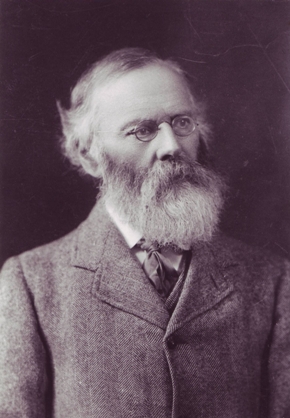
Somewhat Gandalf-ian? But I suppose many fellows had such an appearance around the turn of the century.
* ““What a tale we have been in”: Emplotment and the Exemplar Characters in The Lord of the Rings and the Harry Potter Series” is a new journal article coming from the jargon-filled field of educational theory. Freely readable, but not downloadable without paying. Putting the abstract into plain English, as much as possible, gives…
“[The] admiration [of the young reader for characters] involves wonder and distance, and is best evoked by mixed or flawed characters … [Through such admiration a child may come to understand that they themselves may be part of] larger narratives [in the real world]. [For the writers under discussion, the child’s admiration of virtue is aided by the writer’s uses of] moral realism.”
I’d add time-scales as well as “larger narratives” (by which most teachers would probably assume immediate things like family structures, the daily news, etc). The most intelligent child reader will over time learn to draw more deeply from the past, as well as anticipating further ahead into the future. The classics of fantasy and science-fiction literature will ably serve these rare text-readers in forming such habits of mind. The Lord of the Rings especially offers them deep lessons in “The Long Now” — with a number of characters operating and planning over far longer time-scales than the hobbits are aware of.
* And finally, a 50 minute video tour of a $4-million dollar home library, including Tolkien treasures…