Tolkien Gleanings #134.
* A new official website for Tom Shippey. The site made me aware of his interesting-sounding book Hard Reading: Learning from Science Fiction (2016).
* Here are transcriptions of two of the questions and answers which followed the recent Tom Shippey talk titled “Sixty Years of J.R.R. Tolkien”…
Q: What question would he have liked to discuss personally with Tolkien?
A: I’d have liked to talk to him about the nature of dialect studies. I think we now know a lot more about dialect than Tolkien did. [Based on the evidence then available, he would have thought] that Sir Gawain and the Green Knight came essentially from the county of Chester. I would have liked to say to him, ‘Excuse me Professor but I think that’s wrong. Actually it’s not Chester at all, is it?’. Chester was a very funny and strange county with special privileges in the middle-ages, and that meant its neighbours didn’t like it at all. Indeed they fought a battle over it. No, actually surely the author of Sir Gawain and the Green Knight came from the neighbouring county of Staffordshire. And I think Tolkien would have been pleased to have heard this argument, partly because Staffordshire was one of his ‘home counties’. There are three counties which meet in Birmingham — Worcestershire, Warwickshire and Staffordshire — and those I think were the counties that Tolkien thought were his counties. And [as such] he would have been very pleased to have me argue that the great works of medieval literature in English all came from the West Midlands… and especially from those three counties.
Q: What gaps still need work, in Tolkien studies?
A: Well, I think that there are perhaps two great gaps. One is that we know that Tolkien spent a great deal of time and thought on producing a work called “The Lost Road”, but of course he never got round to doing it [i.e. to completion]. We do know quite a lot about what he intended, but it would be good to have a better theory of what he meant to do. And I think there are some hints and indications. But of course the only answer can be speculative… and academics don’t really like speculation. […] I made a start on it by writing a piece in the [2022] memorial volume for Christopher Tolkien [The Great Tales Never End: Essays in Memory of Christopher Tolkien], in which I discuss a poem by Tolkien which I think he intended to work up as part of “The Lost Road”. The other [gap] is that we now have a great mass of early material edited by Christopher Tolkien, and I think Tolkien critics have rather fought shy of studying this. Because there’s so much of it, and it’s so difficult and it’s so tangled. But I think it would be interesting once again to try to [use this material to] get back to the original sources… no, not to the original sources… to Tolkien’s original intentions.
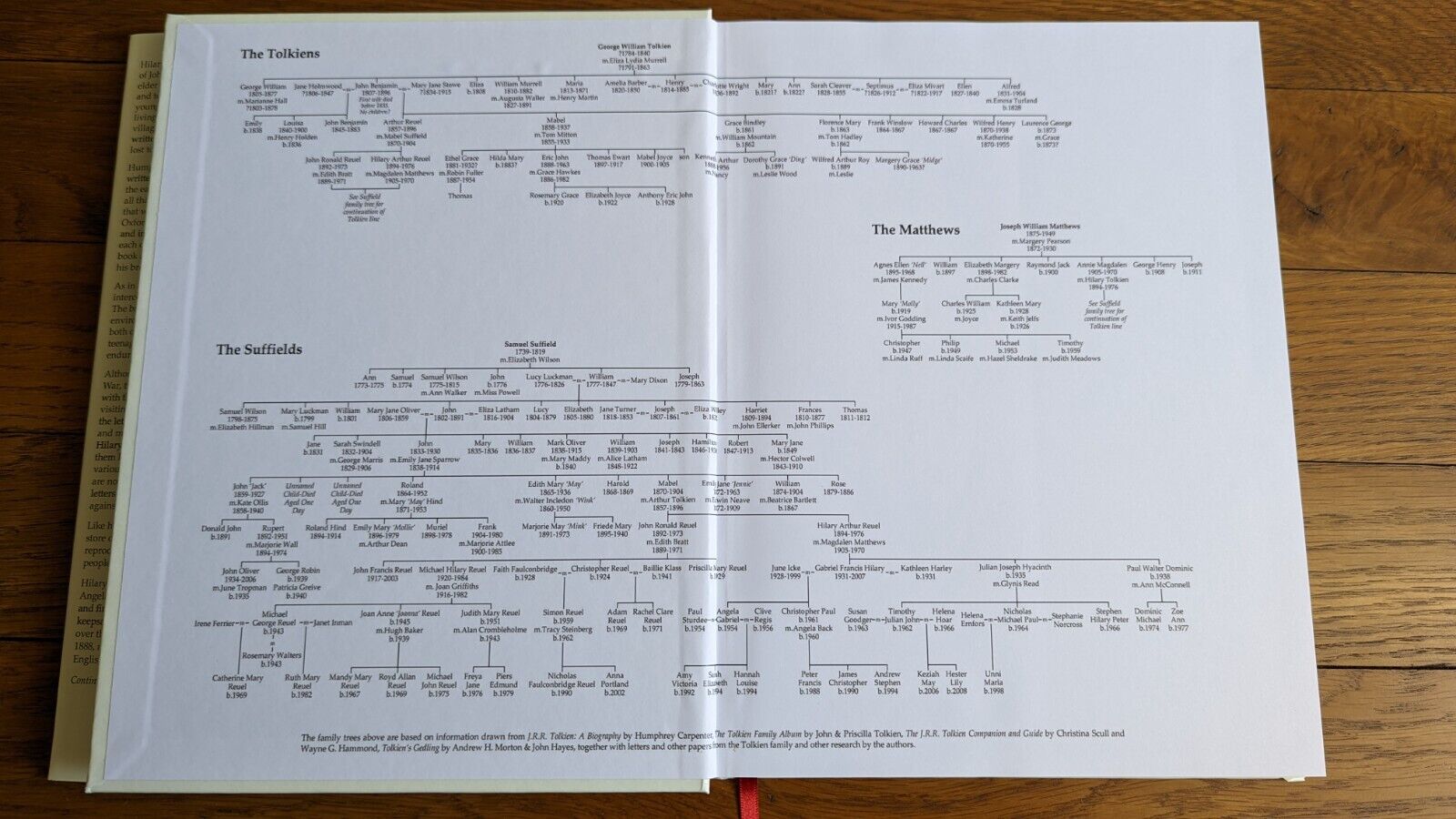
* Currently on eBay, another copy of the very rare book Wheelbarrows at Dawn: Memories of Hilary Tolkien, with a number of sample images.
* In Italy on 14th October 2023, a scholarly Workshop: ‘Tolkien and the Arthurian Myths: in honor of the 50th anniversary of Tolkien’s death’… “This workshop is open to all Tolkien enthusiasts, literature students, budding writers and anyone who wishes to deepen their knowledge of Tolkien’s works and the Arthurian myths. Places are limited to a maximum of fifteen participants.”
* New to me, a book of Italian essays on Tolkien titled Albero di Tolkien. Topic titles, in approximate English translation, include among others…
– The name of Snorri.
– Walking through Oxford.
– The use of traditional symbols in J.R.R. Tolkien.
– Tolkien’s polytheistic sentiment.
– Tolkien, life, death and immortality.
– The figure of the hero in Tolkien.
– Music and Middle-earth.
– Tolkien and the figurative arts.
* On YouTube, the October 2023 Update for the Digital Tolkien Project.
* Tolkien’s Philology: General Works (1923-1925). Being a new Archive.org PDF compilation of his authoritative “The Year’s Work in English Studies” surveys for 1924, 1925 and 1926. These are also on Archive.org in their original format and context.
* And finally, the latest edition of the UK’s The Critic magazine reviews The Globe, a new book offering an entertaining brisk tour of the history of the ‘flat Earth’ fallacy. This book also touches on the use by Tolkien…
The book ends as rapidly as it began, with an account of the flat literary worlds created by the medievalists-turned-fantasy authors C.S. Lewis and J.R.R. Tolkien. [But] Hannam’s narrative is at its most illuminating when discussing the wide acceptance of the spherical earth theory in the European Middle Ages. Far from [being] drooling, dogma-blinded pantomime bigots […] mediaeval thinkers were keen cosmologists who by and large had read their Aristotle. Some, such as Bede in the 7th century, arrived at similar conclusions on their own.